-
-
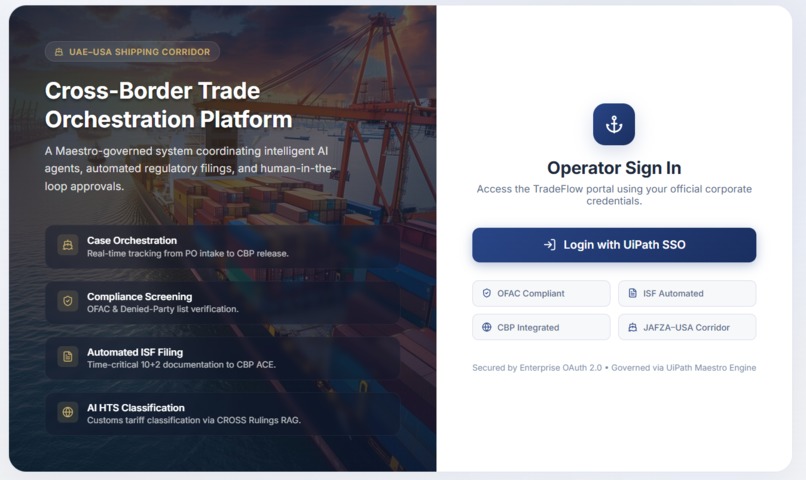
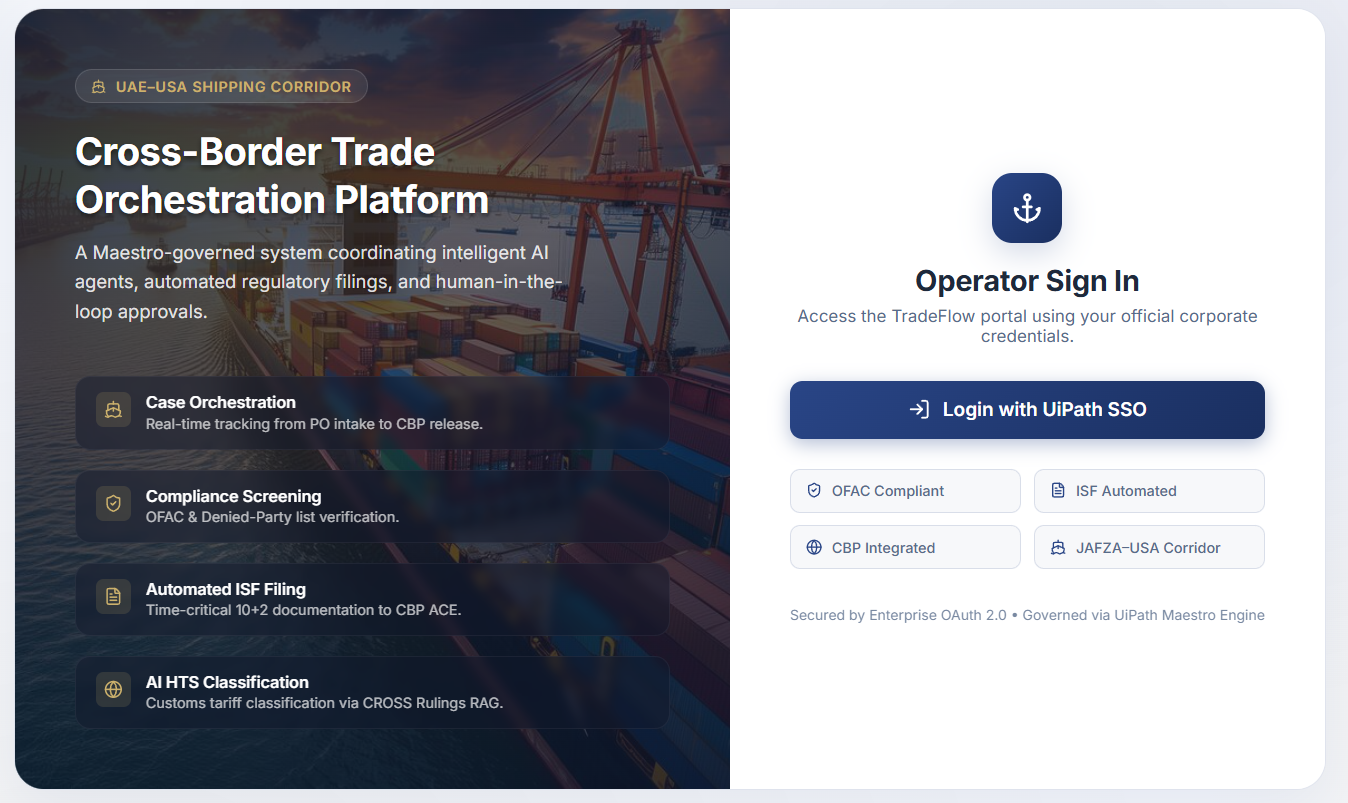
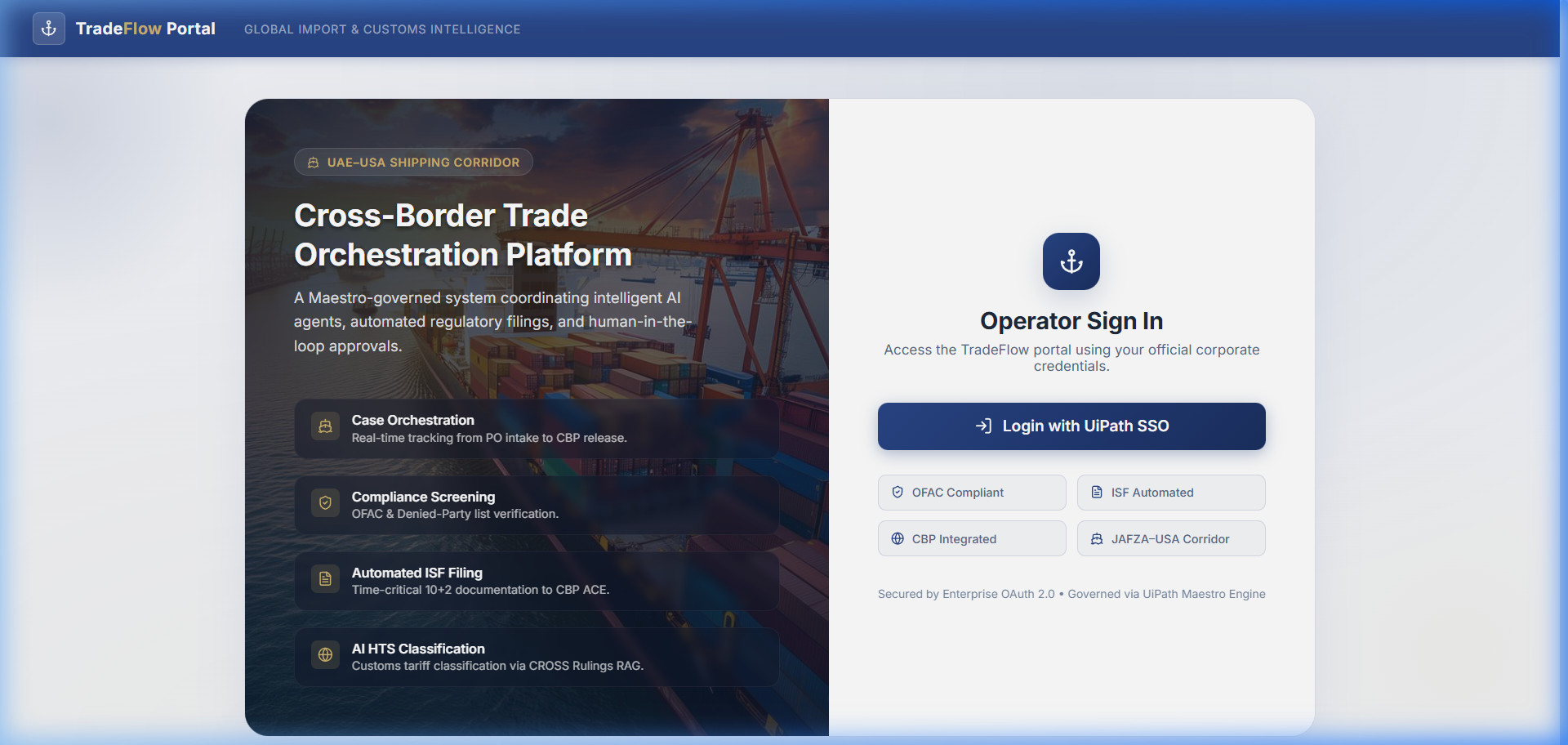
Login Using UiPath SSO
-
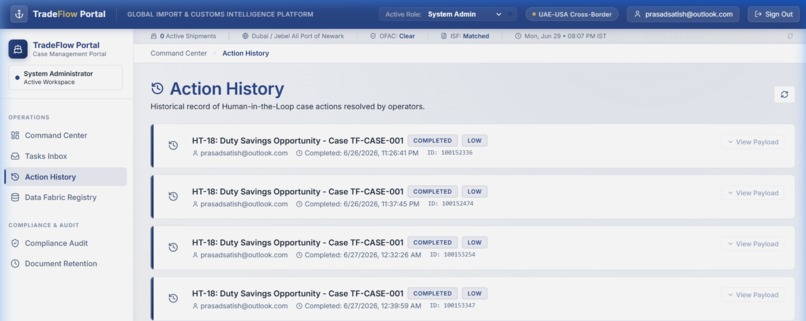
Human In Loop in Control Panel
-
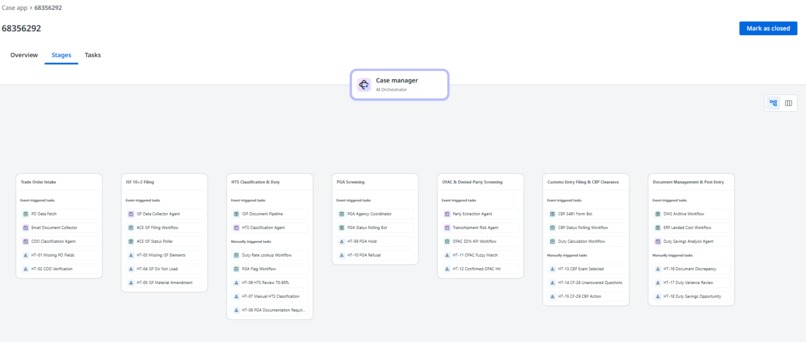
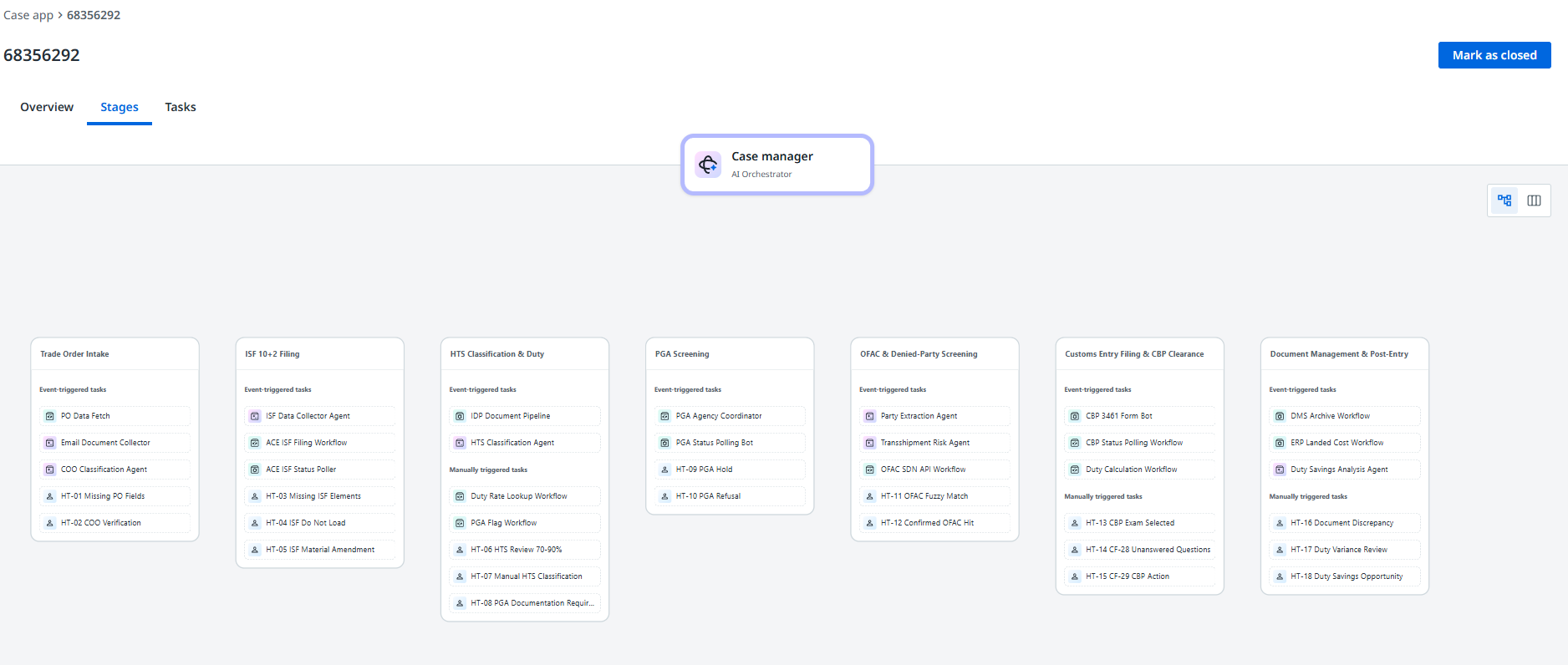
Stage in Maestro Apps
-

Supports Global UAE to USA Imports Shipments

Here is the full cleaned-up submission with every section tightened:
🚢 TradeFlowX: Agentic Import Operations Platform
Automating UAE (Dubai/JAFZA) → USA Customs Clearance & Compliance



Inspiration
Global trade between the UAE and the USA moves billions of dollars of goods every year — yet the import clearance process still runs on fragmented email chains, manual tracking, and disconnected compliance checks. A single missed ISF deadline costs $5,000 per day in CBP penalties. A misclassified HTS code can trigger Section 301 tariffs or hold cargo at port for weeks.
We asked: what if an AI could act as a fully-trained Import Operations Manager — one that never sleeps, never misses a deadline, and coordinates every stakeholder automatically?
That question became TradeFlowX.
What It Does
TradeFlowX autonomously manages every stage of UAE → USA customs clearance inside a single governed UiPath Maestro case — from the moment a purchase order arrives through CBP release and post-entry reconciliation.
| Stage | Name | Summary |
|---|---|---|
| 1 | Trade Order Intake | Captures PO data; validates shipment fields; flags JAFZA transshipment risk; assigns broker |
| 2 | ISF 10+2 Filing | Assembles all 10+2 data elements; files via CBP ACE within the 24-hour deadline; monitors and amends |
| 3 | HTS Classification | AI agent queries USITC tariff schedule; confidence-score gate routes to auto-approve, broker review, or specialist queue |
| 4 (conditional) | PGA Agency Screening | Triggered by PGA-flagged HTS codes; submits message sets to ACE; monitors May Proceed / May Hold / Refuse per agency |
| 5 | OFAC & Denied-Party Screening | Screens all trade parties against OFAC SDN, BIS Entity List, and SAM.gov; fuzzy-match routes to human review or hard-blocks |
| 6 | Customs Entry Filing | Calculates MFN duty + MPF + HMF + Section 301; files CBP Form 3461; handles CF-28 / CF-29 exam queries |
| 7 | Post-Entry Reconciliation | Cross-validates trade documents; archives to DMS; reconciles landed costs to ERP; flags duty drawback opportunities |
The platform manages 18 human-in-the-loop task types (HT-01 through HT-18) with role-based routing to brokers, compliance officers, legal counsel, and finance — each backed by Maestro SLA timers.
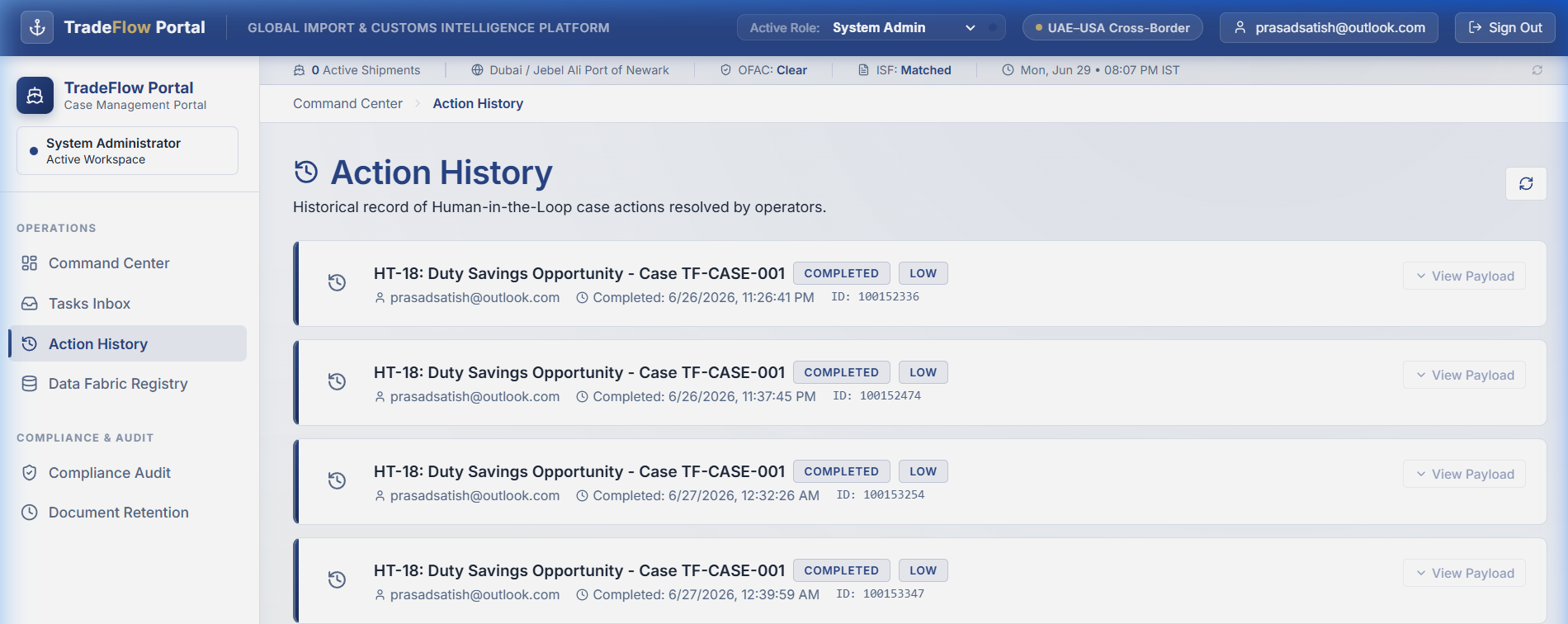
TradeX Portal Dashboard
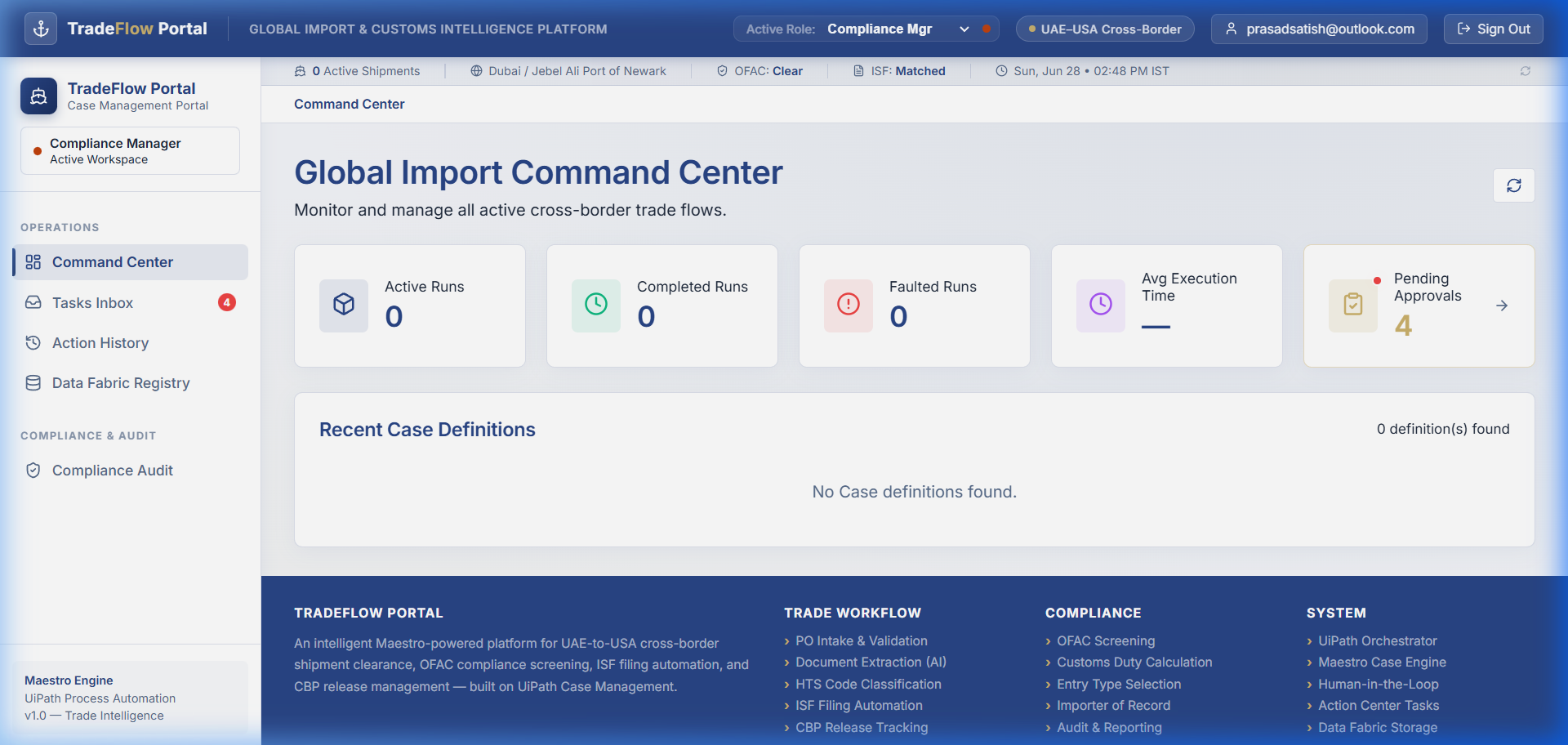
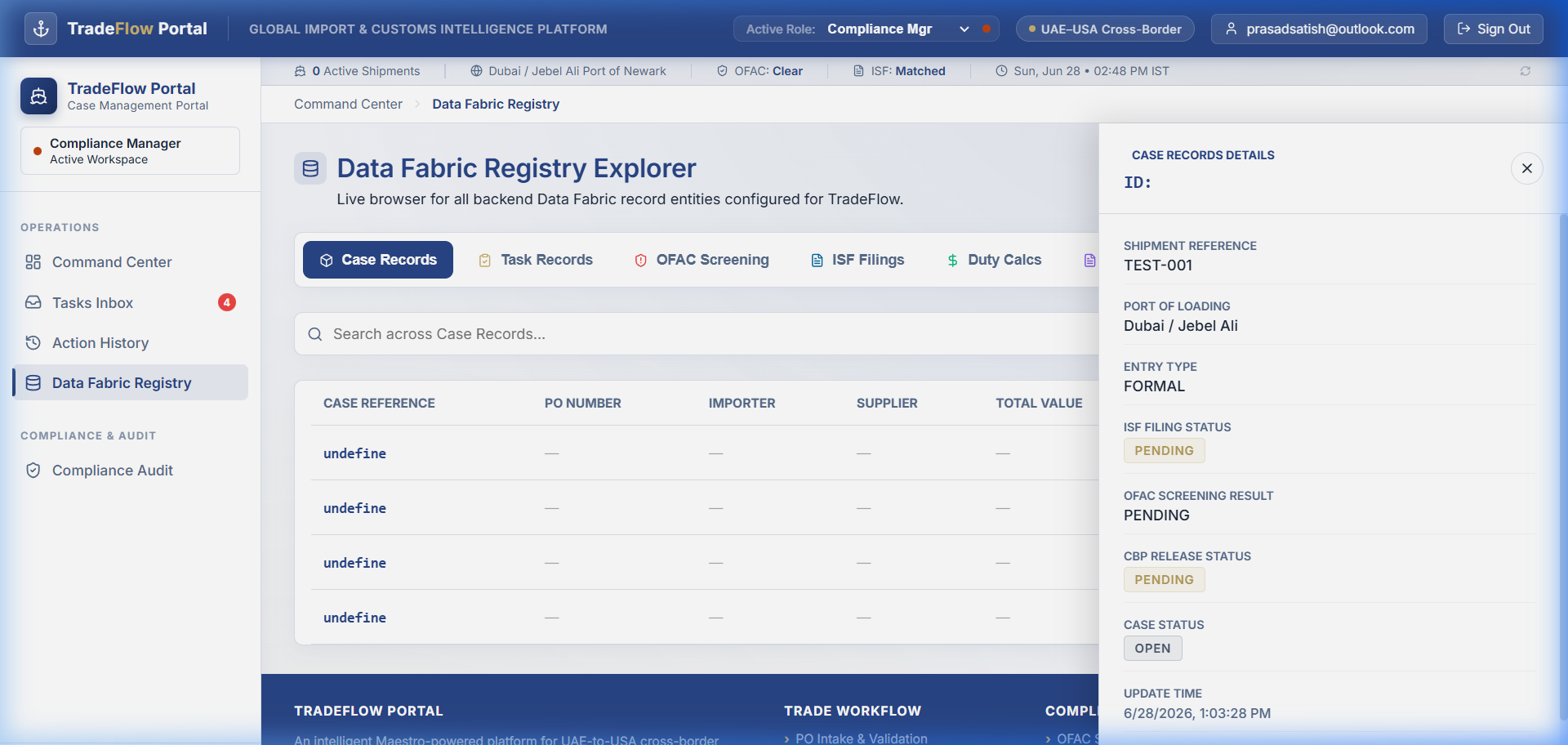
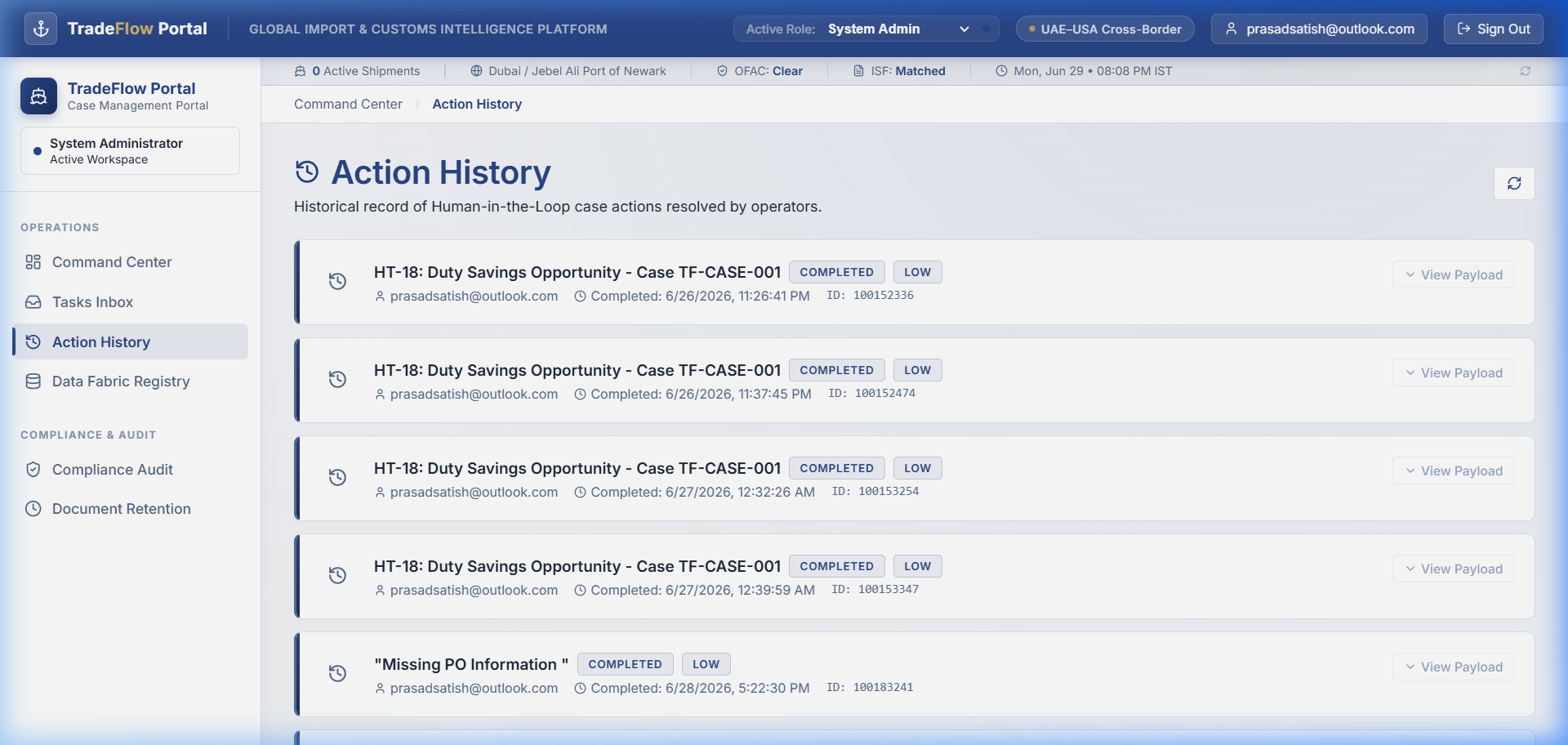
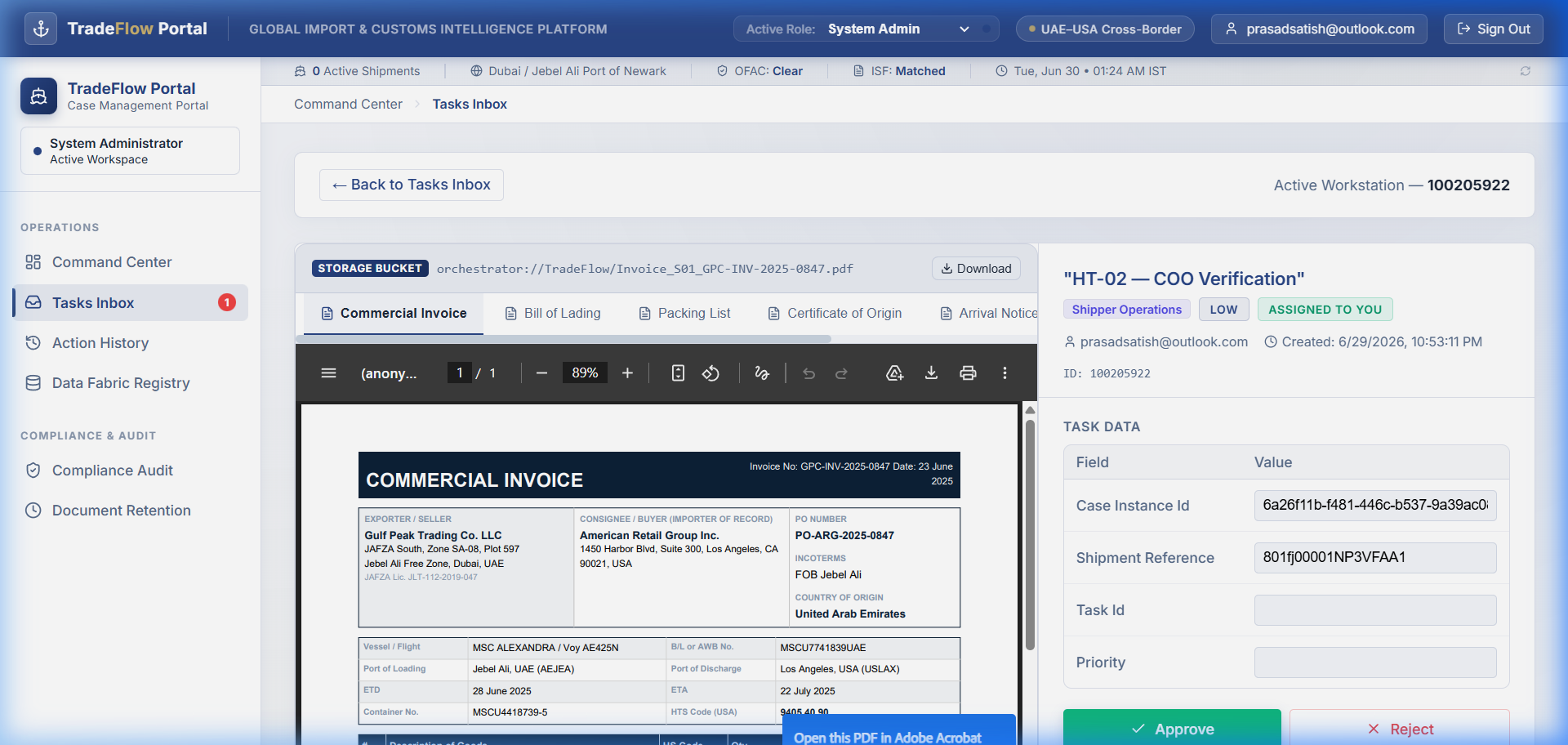
The TradeX Portal is a Vite + React + TypeScript web application serving as the central control room — live case dashboard, Data Fabric records, Task Inbox for approvals, and a full Action History trail.
| Operator Login | Main Dashboard |
|---|---|
 |
 |
| Data Fabric Case Details | Action History |
|---|---|
 |
 |
| Task Workstation & Approval Inbox |
|---|
 |
Coded Agents
✅ This project uses UiPath coded agents — eligible for judging bonus points.
TradeFlowX deploys five coded agents across two frameworks:
- HTS Classification Agent (LangGraph) — RAG-based tariff schedule queries with confidence-scored HTS output
- Transshipment Risk Agent (LangGraph) — stateful graph that suspends at human checkpoints and resumes on broker approval
- Duty Savings Agent (LangGraph) — post-entry analysis for First-Sale Valuation and Duty Drawback opportunities
- COO Classifier Agent (UiPath low-code) — evaluates 13 shipment variables to determine UAE origin and transshipment risk
- OFAC Screening Agent (UiPath low-code) — fuzzy-matches all trade parties against OFAC SDN, BIS Entity List, and SAM.gov
How We Built It
The platform combines UiPath-native tooling with LangGraph for stateful agent orchestration.
Orchestration: The import lifecycle runs as a Maestro case with seven stage groups, 18 human task definitions, SLA timers, and merge-gate logic. Stages 2, 3, and 5 run in parallel; Stage 4 is a conditional branch; Stage 6 is the gate that requires all three to complete before customs entry proceeds.
Frontend: A single React TypeScript Coded Web App houses all 18 human-task forms in a HT_FORM_MAP registry. Decisions flow directly to Maestro via the UiPath TypeScript SDK — no backend, no proxy, no separate Action App deployments.
Integrations: CBP ACE · OFAC SDN API · BIS/SAM.gov · USITC tariff API · CBP CROSS database · Commerce ADD/CVD database · ERP REST · DMS (SharePoint) · Customs broker TMS
Document intelligence: UiPath Document Understanding extracts and cross-validates commercial invoices, packing lists, bills of lading, and certificates of origin — flagging discrepancies in value, quantity, weight, and COO.
How AI Helped Us Build Faster
Claude was our primary coding partner. Running Claude Code with UiPath-specific skills, it authored the entire Maestro case plan, wired all automation and human tasks, scaffolded coded RPA processes in C#, and managed every deployment cycle from the terminal. The UiPath Maestro Case skill understood the schema deeply enough to diagnose structural defects and fix them — turning what would have been days of documentation-reading into hours of iteration. The UiPath TypeScript SDK integration for the human-task portal was also Claude-authored end to end.
Gemini handled trade compliance research — mapping HTS chapters to PGA agencies, compiling ISF 10+2 filing requirements, and drafting CBP query response language for the human review forms. It gave us accurate regulatory content fast, without manually reading through CFR chapters.
The split was clean: Gemini for domain knowledge, Claude for building. Together they let a small team deliver a seven-stage, production-grade import compliance platform in hackathon time.
Challenges We Ran Into
Transshipment complexity. Whether JAFZA-origin goods qualify as UAE-origin depends on whether substantial transformation occurred — too many variables to encode as a rule. It had to be an agent decision with confidence scoring.
Parallel stages with a single merge gate. Stages 2, 3, and 5 run simultaneously; Stage 6 cannot open until all three are complete. Structuring gate logic without race conditions — especially when human tasks extend one stage beyond another — required careful case plan design.
ISF timing. The ISF deadline is 24 hours before vessel loading at Jebel Ali, not US arrival. SLA timers had to anchor to freight forwarder departure notifications, not port ETA.
18 HT forms in one app. All 18 form components had to share a single registry, route correctly by task type, and complete via the UiPath TypeScript SDK — with no backend and no separate Action App deployments.
Accomplishments We're Proud Of
- End-to-end coverage — seven stages, 18 human tasks, full SLA enforcement, and documented integration points for every external system
- True parallel orchestration — ISF filing, HTS classification, and OFAC screening run simultaneously, saving 12–24 hours on a typical clearance timeline
- COO Classifier Agent — a fully wired
agent.jsonwith 29 content token blocks and 13 runtime-injected variables handling one of the hardest compliance judgments in US import law - Single-app HT architecture — all 18 human-task forms in one Coded Web App, proving Maestro HITL does not require a proliferation of separate deployments
- Full compliance depth — Section 301, ADD/CVD, MPF/HMF, ISF 10+2, OFAC SDN, BIS Entity List, PGA message sets, CF-28/CF-29, CBP 7501, duty drawback, first-sale valuation — every requirement is modeled as a task or decision gate
What We Learned
- Maestro case plans map almost perfectly to how customs clearance actually works — parallel tracks, merge gates, role-based human intervention
- LangGraph's
interrupt()/ resume pattern is exactly the right handshake for human-in-the-loop AI in enterprise workflows - Country-of-origin determination must be an agent decision, not a rule — the JAFZA scenario has too many variables for any lookup table
- Architecture decisions for Coded Apps must be made before writing component code — the single-app constraint shapes every downstream design choice
What's Next
- Live ACE API integration — real CBP ACE calls for ISF and entry status in a test environment
- Carrier tracking — AIS vessel data to anchor ISF SLA timers to live Jebel Ali departure events
- Predictive exam detection — flag high-exam-risk shipments before filing based on HTS code, COO, and value patterns
- Trade Regulation Knowledge Graph — structured graph of HTS codes, PGA triggers, ADD/CVD orders, and OFAC programs for real-time agent queries
- Multi-country expansion — India → USA, China → USA, and EU → USA corridors with corridor-specific compliance rule sets
- Autonomous supplier communication — agent that drafts and sends document-request emails directly from a Maestro human task, with response parsing and auto case update on reply

Log in or sign up for Devpost to join the conversation.