Inspiration
What it does
How we built it
Challenges we ran into
Accomplishments that we're proud of
What we learned
What's next for ImpactLint
Inspiration
The dangerous part of a warehouse schema change is rarely the SQL itself. It is the invisible graph of dashboards, transformations, ML features, owners, governance tags, and quality contracts behind that SQL. Most pull-request checks cannot see that graph, so teams discover the real blast radius after deployment.
What it does
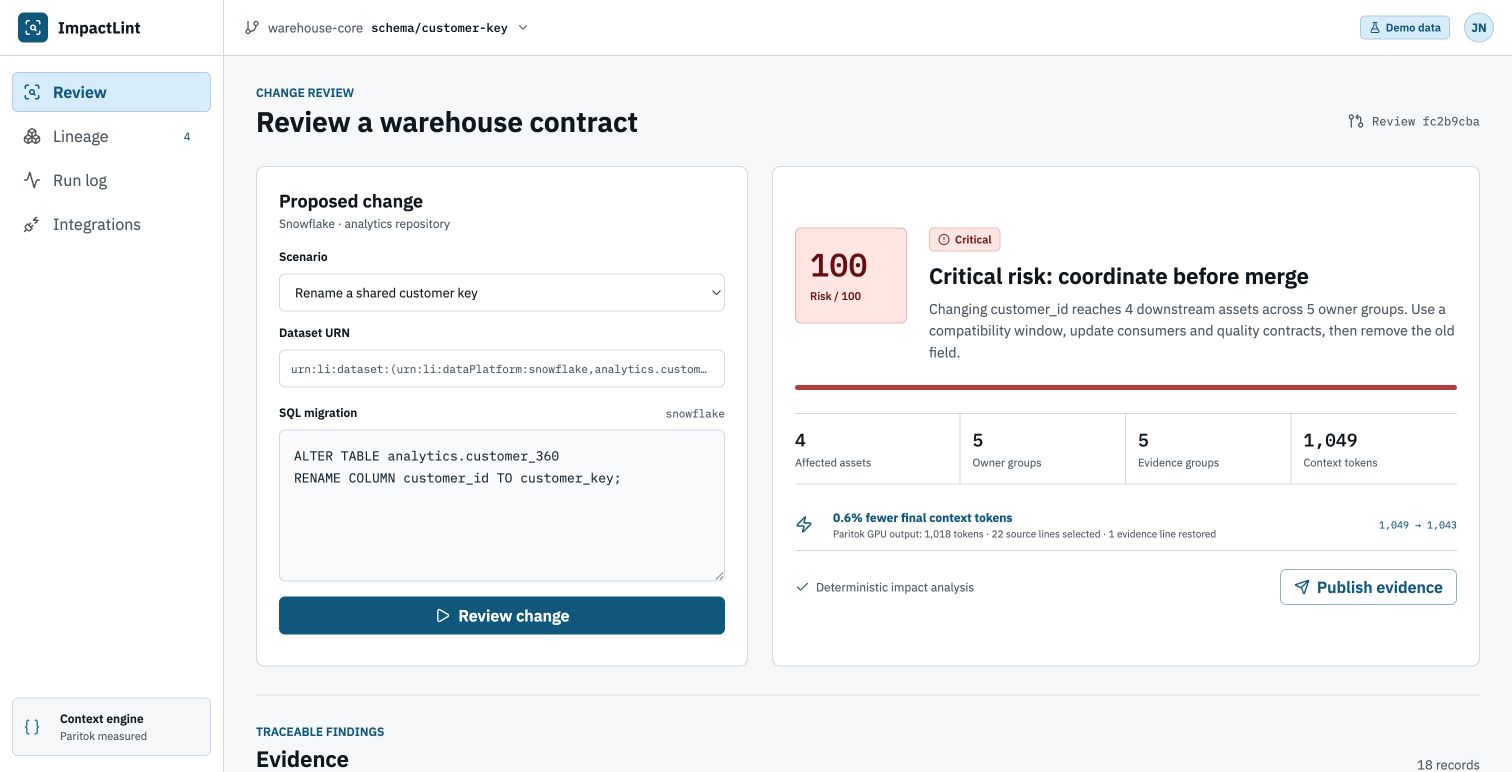
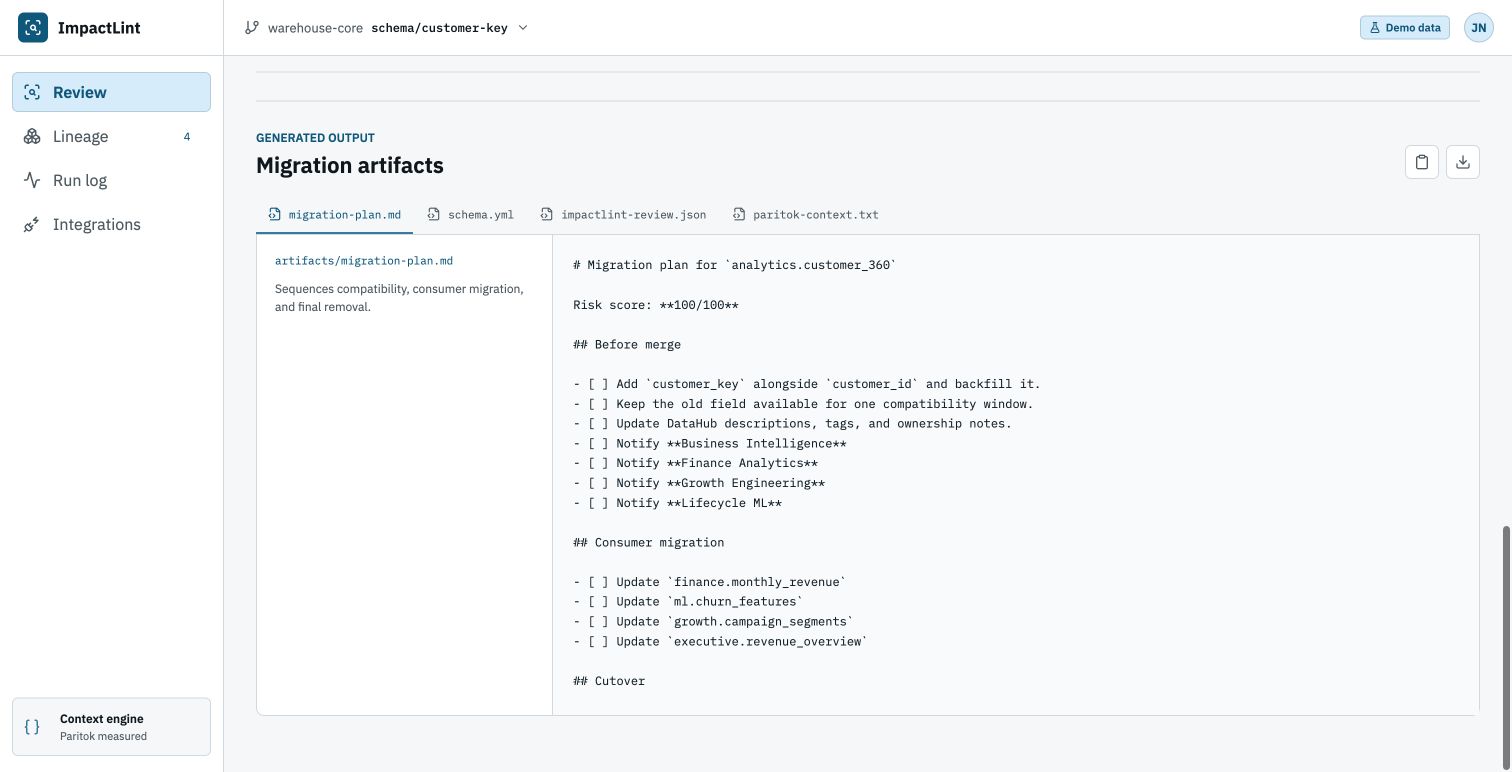
ImpactLint is a metadata-aware change-review agent. A developer submits a proposed warehouse migration. ImpactLint parses the SQL, reads DataHub context through the official MCP server, traces field-aware downstream impact, and produces a deterministic risk decision with inspectable evidence. It generates a coordinated migration plan, dbt tests, and a JSON review manifest that can live in a pull request.
The workflow also writes knowledge back. Publishing a live review calls DataHub MCP save_document with the analysis and related assets, then add_tags to mark the source dataset as reviewed. The next engineer or agent inherits the decision instead of repeating the investigation.
Meaningful use of DataHub
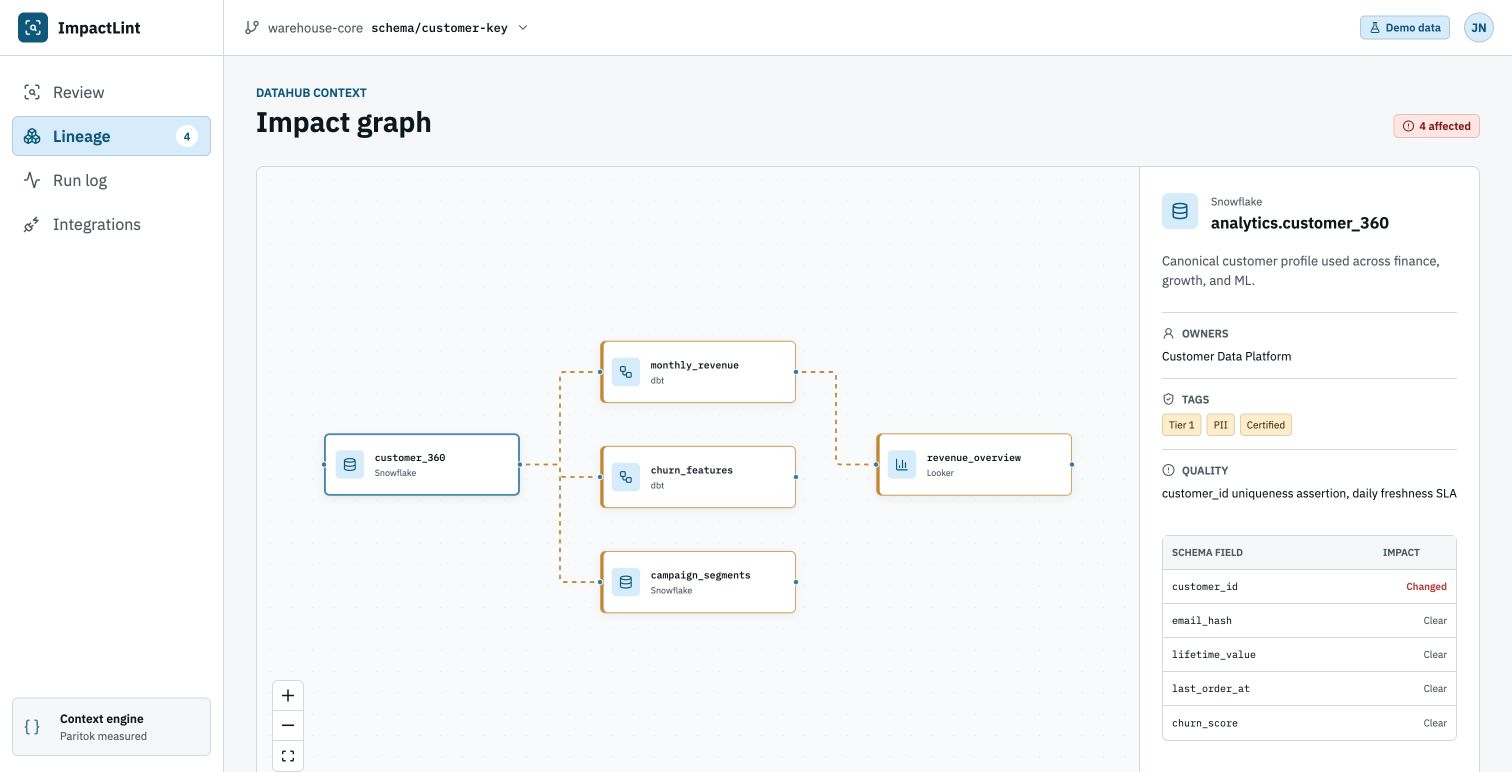
get_lineagetraces up to three downstream hops from the changed dataset.get_entitiesretrieves schemas, ownership, tags, descriptions, and quality metadata for every asset in scope.- Additional upstream lineage calls reconstruct exact direct edges for deeper graph nodes.
- The risk engine cites DataHub evidence rather than asking an LLM to invent a score.
save_documentandadd_tagspublish the completed review back into the metadata graph.
The live quickstart scenario includes four datasets, a Looker dashboard, multi-hop lineage, five owner groups, governance tags, and quality signals. Renaming customer_id correctly produces a critical 100/100 decision, identifies four affected assets, and generates an executable compatibility plan.
Technical execution
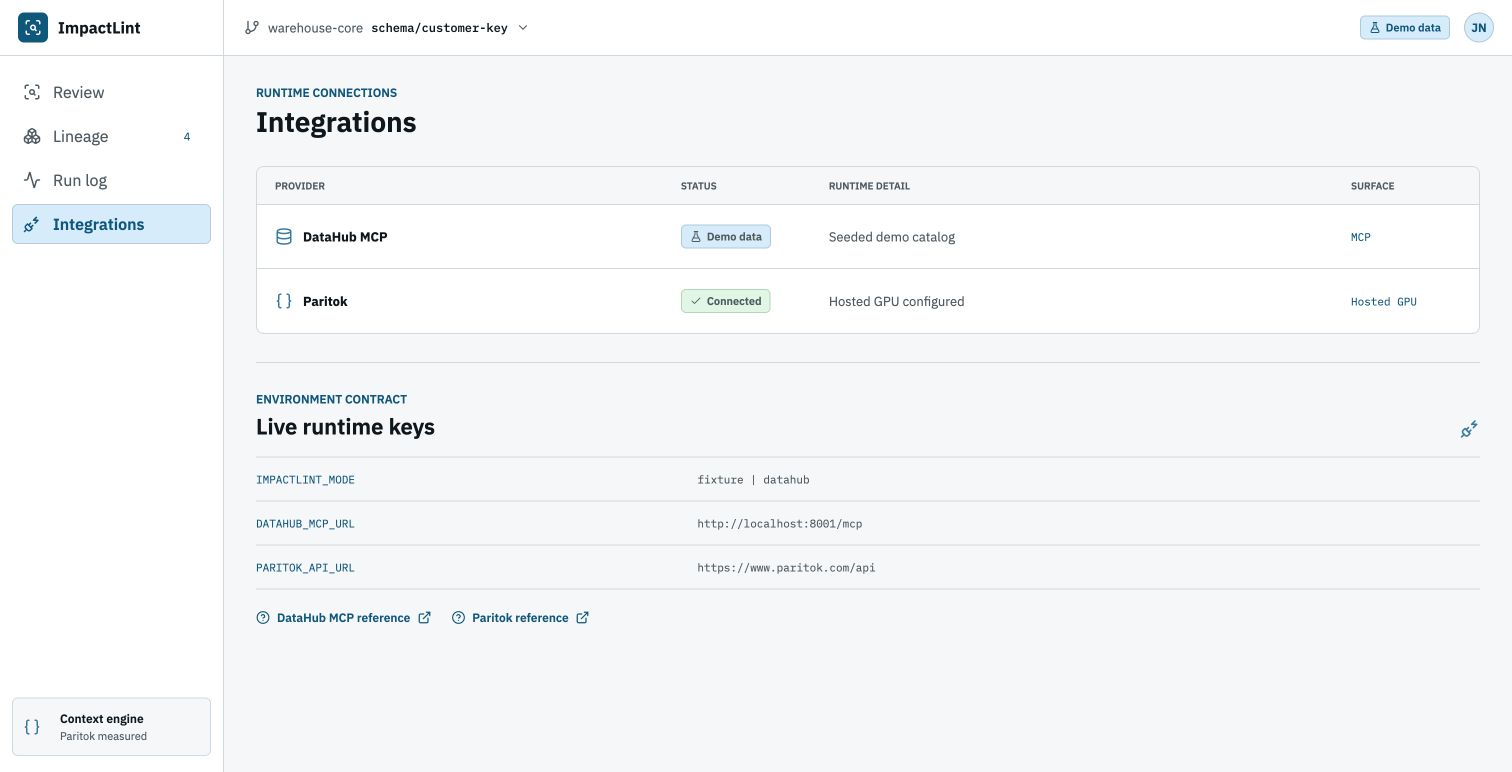
The backend is FastAPI and Python 3.12. sqlglot parses migrations into structured operations. A typed DataHub provider normalizes official MCP payloads without coupling the risk engine to response formatting. React and XYFlow provide the review, lineage, execution trace, and integration views. Paritok compresses large raw DataHub responses before downstream reasoning, with an extractive guard that rejects unsupported evidence.
The repository contains 12 backend tests and one primary frontend-flow test, reproducible fixture mode, live DataHub seeding scripts, measured integration output, generated examples, and a public Vercel deployment.
What is next
ImpactLint can become a GitHub check that comments on migration pull requests, requests acknowledgements from DataHub owners, and blocks merge only when governed downstream assets lack a compatibility plan.
Built With
- datahub
- fastapi
- mcp
- paritok
- react
- sqlglot
- typescript
- vercel
- xyflow

Log in or sign up for Devpost to join the conversation.