Inspiration
What it does
How we built it
Challenges we ran into
Accomplishments that we're proud of
What we learned
What's next for ImpactLint
Inspiration
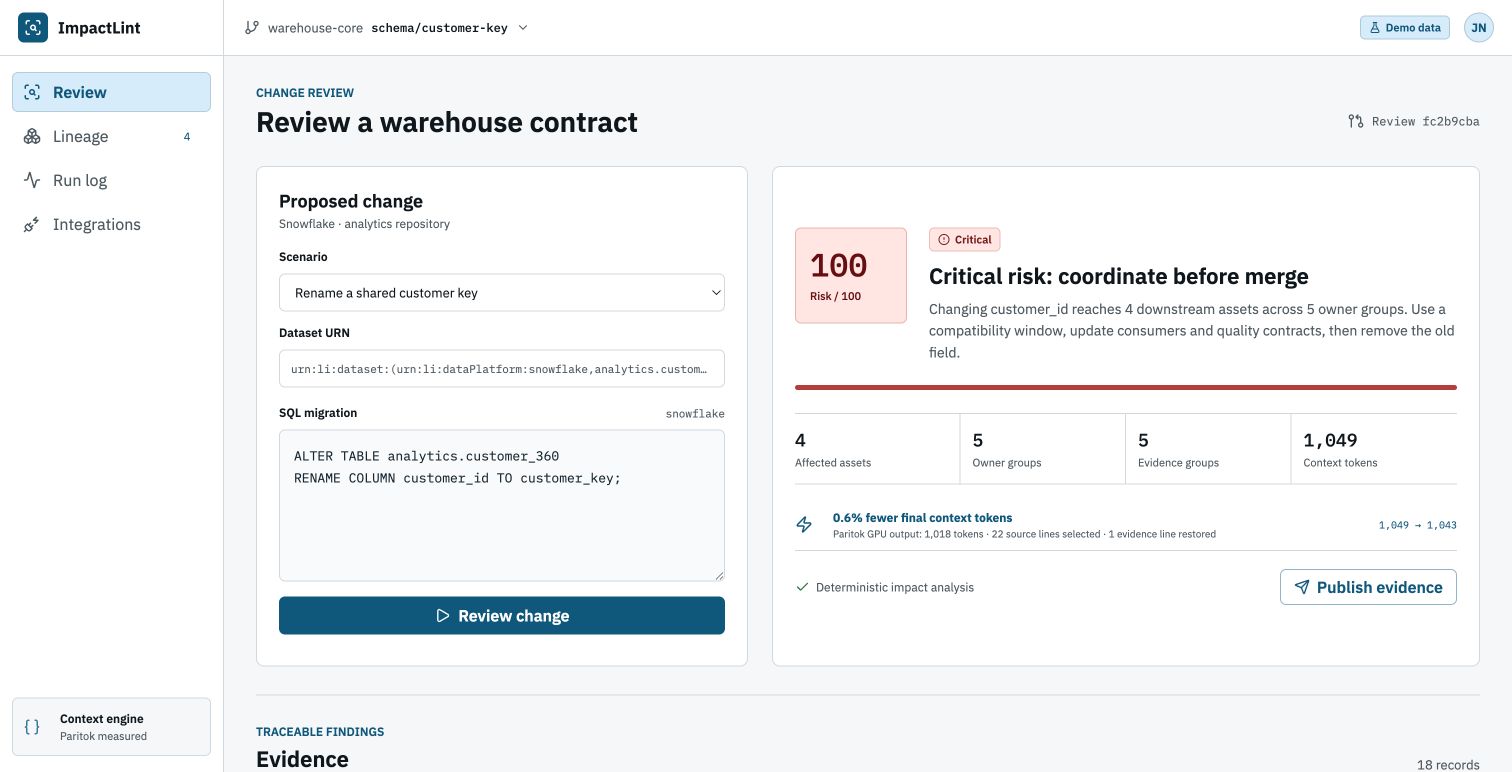
A warehouse migration can look like a one-line SQL edit while silently breaking finance models, executive dashboards, quality assertions, and ML features. The metadata needed to review that change exists in a catalog, but sending a full catalog response to every reasoning step is slow and expensive. ImpactLint makes that review both context-aware and token-efficient.
What it does
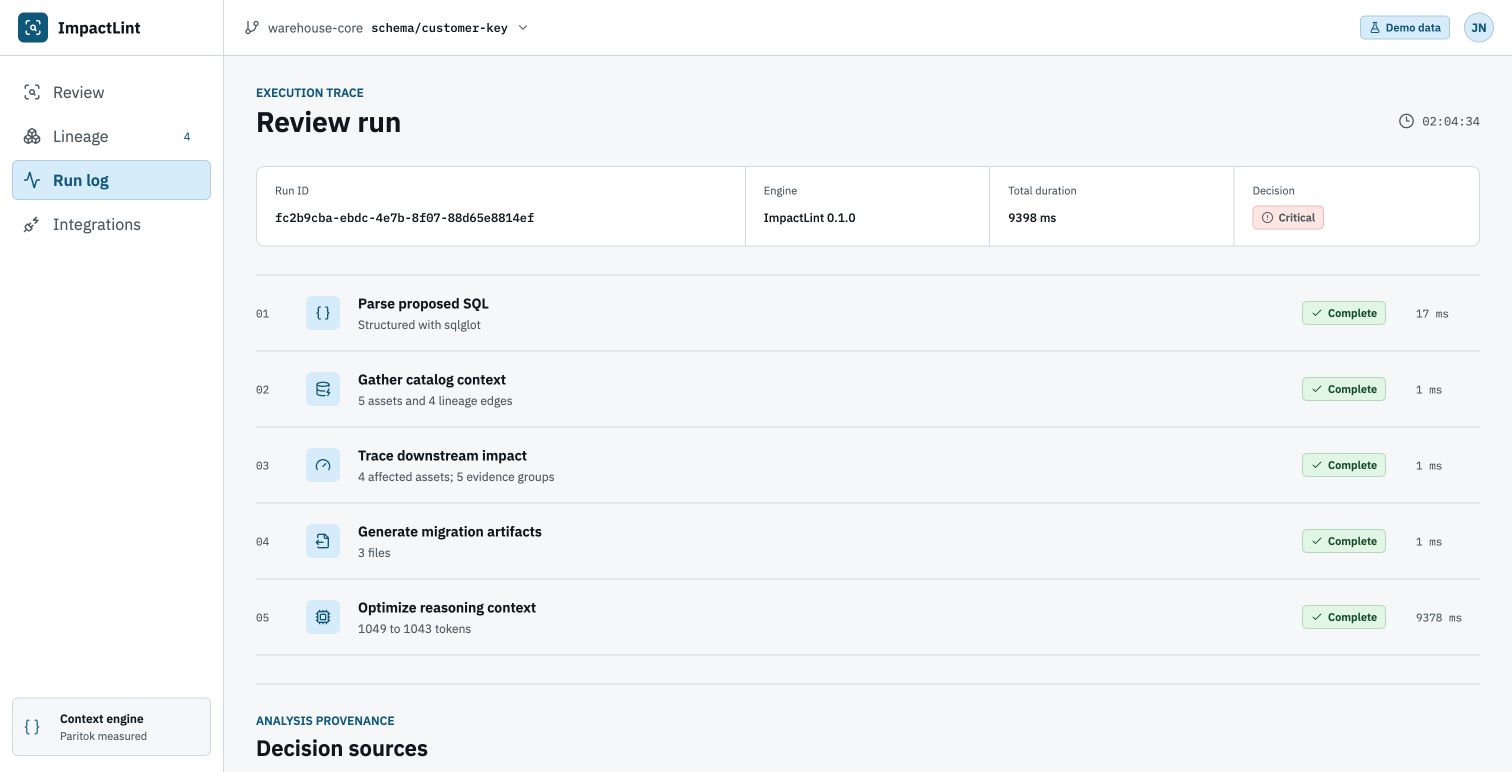
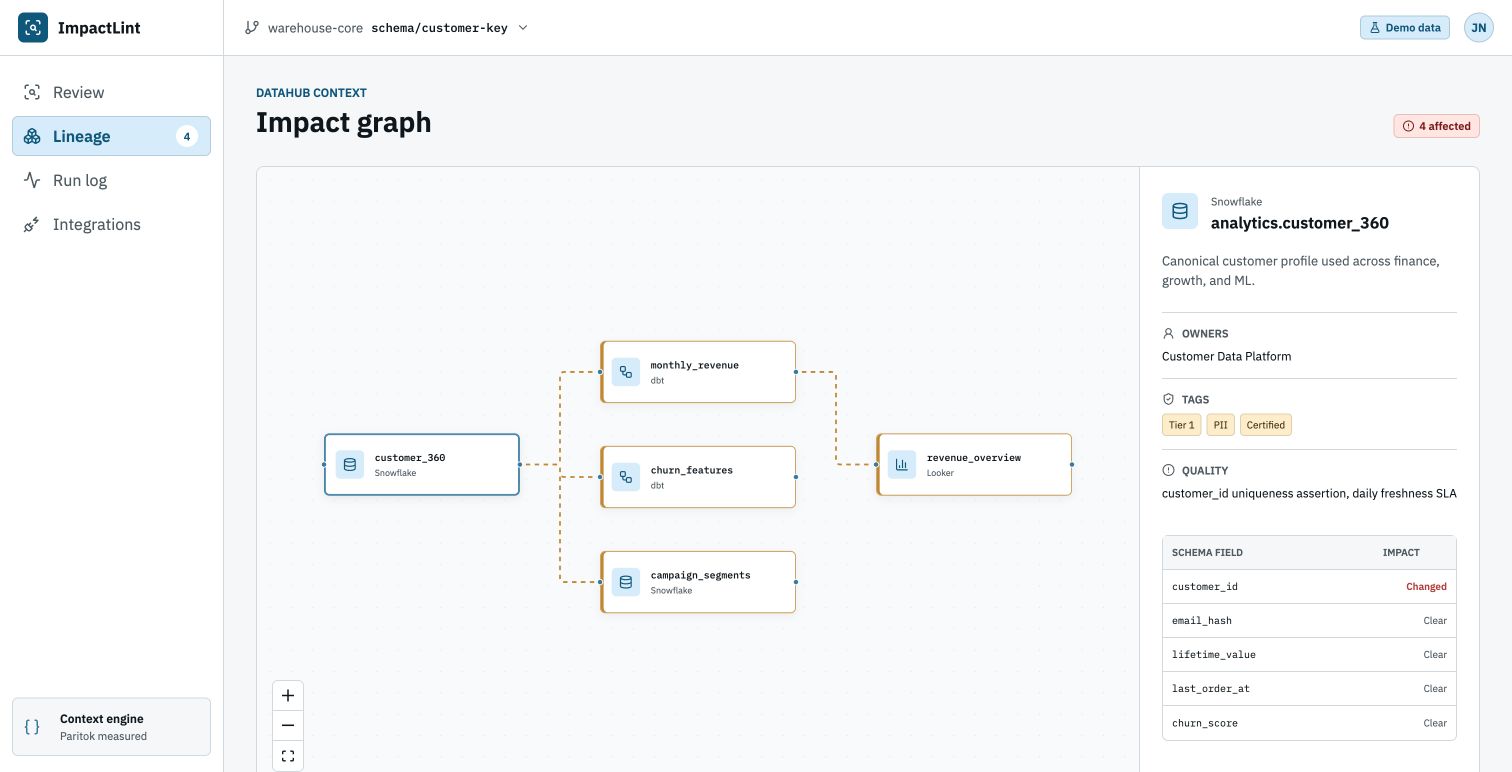
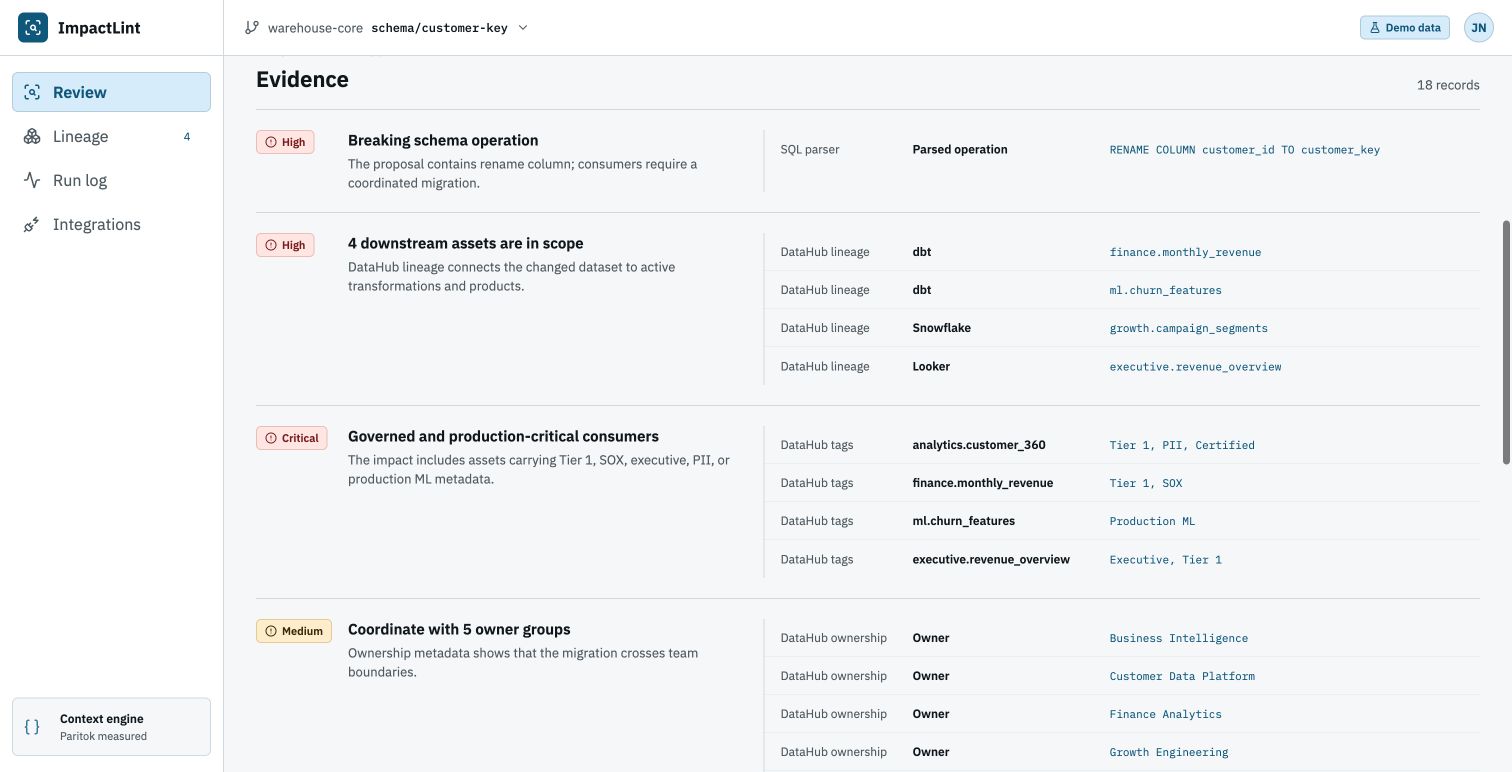
ImpactLint accepts a proposed schema change, parses the SQL into structured operations, reads downstream lineage and governance metadata, and produces a deterministic risk score backed by inspectable evidence. It identifies affected assets and owners, visualizes the impact graph, and generates a migration plan, dbt tests, and a machine-readable review manifest. In live DataHub mode it can publish the completed analysis back as a DataHub document and tag the source asset.
How Paritok is used
The raw DataHub entity and lineage responses are normalized into line-oriented evidence, divided into bounded segments, and sent concurrently to Paritok's hosted GPU through /api/compress. The returned context is then checked by an extractive evidence guard: only complete source lines are accepted, invented rewrites are discarded, and required change, asset, lineage, and identifier evidence is restored before the final token count is reported.
On the checked-in live run, the DataHub review context contained 7,635 tokens. Paritok returned 2,476 tokens and the guarded final context contained 2,475 tokens, a measured 67.6% reduction. Eighteen required evidence lines and 25 protected identifiers were checked; one line and zero identifiers needed restoration. The public fixture demo intentionally has a much smaller input and reports its lower reduction honestly.
What I am proud of
- Paritok is part of a genuine data-engineering workflow, not a decorative API call.
- Original, raw model-output, and guarded-final token counts remain separate.
- Compression failure never blocks a deterministic impact review or creates fake savings.
- Every result links back to concrete SQL, DataHub metadata, lineage, ownership, tags, and quality signals.
- Sample artifacts and a non-secret measured run are committed for independent inspection.
Challenges and lessons
Compression quality cannot be judged by token reduction alone. During development, a compressed response rewrote a required evidence line and an earlier exploratory response introduced an unsupported tier. That led to the source-line and identifier guards now built into ImpactLint. The result is a practical pattern for using lossy context compression in audit-sensitive agent workflows.
What is next
The next step is a CI integration that reviews migration pull requests automatically, publishes findings to DataHub, and reruns only the affected dbt contracts after owners approve the plan.
Built With
- datahub
- fastapi
- mcp
- paritok
- react
- sqlglot
- typescript
- vercel
- xyflow

Log in or sign up for Devpost to join the conversation.