Abstract—
Modern Web 2.0 technology is enabling new strategies for exploiting the semantic web. One such strategy is known as cloud computing and entails renting out computer hardware and software to users through the internet. The predicted future pattern of figuring is generally agreed to be this cloud registering because it offers a wealth of benefits including no capital expenditure, rapid usage arrangement, quicker time to market, lower activity expense, and simpler support for the occupants. This article examines how the process of developing high-quality programming products will be impacted by distributed computing, which is built on the foundation of Web 2.0. How difficult will the relationship with the cloud provider be given that they are an external material or outsider? Detailed guidance on how to separate the jobs of SW engineers and cloud suppliers? SW development should include structuring exercises to make thoughtful, methodical use of all the benefits of cloud computing. In order to promote cloud adoption, this study expands the conventional dexterous process display known as Outrageous Programming (XP) and coordinates contact with the cloud provider.
Introduction I.
During the Semantic Web or Web 2.0 era, the development of a few web advances are enabling creative web usage. In Web 2.0, computers are able to read and manipulate XML (extensible markup language)-based metadata that describes web content. Other XML-based web conventions, such as administration arranged design (SOA), basic item access convention (Cleanser), web benefit portrayal dialect (WSDL), and widespread portrayal, disclosure, and incorporation (UDDI) of web, are prepared for integrating applications made with a variety of processing platforms, operating systems, and programming languages. New strategies for distributing and delivering apps via the web have been conceptualised in light of this capacity for information inclusion and information trading amongst heterogeneous applications. Applications can be made available online and accessed by geographically dispersed users via the internet. Web Services are a class of interoperable applications that are made available on the internet for usage by many users remotely. They can even be accessed instantly without any prior knowledge of their existence. Due to the fact that different clients will be considered for identical administrations, they may even be remade in accordance with customer preferences. To provide this versatility, there will be two distinct layers: application engineering and conveyance design. Applications that combine data and capabilities from multiple outside sources made possible by web administrations, such as Hadoop and Mashup are generating a considerable amount of fresh data and creating new web administrations. Mashup with Hadoop can support high-performance processing, including distributed document frameworks with petabytes of data. In a different course of action, the web might be used to provide clients with access to the application improvement foundation, which includes processors, storage, memory, working frameworks, and application improvement devices and programmes. This is what is meant by distributed computing, in which numerous clients share a sizable pool of physical resources made available online as needed. Distributed computing may become the main processing stage in the future due to its many benefits, including its lack of capital consumption, speed of use organisation, shorter time to market, lower cost of activity, and ease of asset support for consumers. This study analyses through essay writing services describes how Web 2.0 and the cloud figuring stage affect programming design to provide high-quality programming (SW). All developed countries' economies rely on high-quality software, and SW costs more than hardware (HW) costs. The vast majority of SW projects fail due to lack of communication and coordination between all of the involved parties, in addition to the fact that SW development is by nature a complicated process involving many different groups. The main thesis of this research is that in order to make the product venture successful, the dominating SW process models should incorporate the cloud provider in each venture of fundamental leadership in programming development life cycle. The foundational writing on distributed computing and constructing programmes is examined in Section II. It is taken into consideration how the product designer is adjusting to the altering pattern of usage development with Web 2.0 conventions and application arrangement over the web. Section III breaks down the challenges of using the cloud registration step for programming design. In Segments IV and V, a quick technique that establishes a connection with a cloud provider is suggested and examined.
Second, a literature survey
Cloud computing, first
The pattern of registration in the future is distributed computing . With distributed computing, you rent servers, storage, organisation, software developments, hardware, and applications to use or manage through the internet as needed, rather than purchasing them outright. There are four different types of distributed computing, depending on what resources are pooled and delivered to the clients. When computing hardware, such as processors, storage, and systems, is communicated as an administration, it is referred to as "framework as an administration" in distributed computing terminology (IaaS). Amazon's Elastic Cloud (EC2) and Simple Storage Administration are examples of IaaS. (S3). It is referred to as "stage as an administration" when programming frameworks and tools like Java, Python,.Net, MySQL, and APIs are provided as a benefit (PaaS). Software as a service refers to the delivery of applications as an administrative service (SaaS).
Platform for Cloud Computing
There are three different types of cloud depending on how much self-management or control the resident has over their resources: inside or private cloud, outside or open cloud, and half breed cloud. In a private cloud, a business maintains all of its assets locally and makes them available to other apps. In open cloud, the project will rent the resources from an off-site cloud provider, and these resources will be divided among many occupiers. A hybrid cloud forms in the middle when a business leases some assets from an outside party while claiming some other assets. The administrative situated engineering (SOA) of Web 2.0, the virtualization of hardware as well as programming resources, and distributed computing are all necessary Physical assets can be gradually connected to multiple programmes running on various operating systems thanks to the virtualization technology.
Infrastructure virtualized
On-demand versatility can be strengthened through distributed computing. Instead of renting each asset from the earliest starting point fully anticipating future need, a monthly interest application for higher assets will pay for the higher assets just the time they are used. The clients will find this fine-grained (hourly) pay-by-utilize approach of distributed computing to be particularly appealing. Distributed computing offers a wide range of benefits. Numerous conventions can be supported by cloud foundation, and apps can modify their course of action more swiftly. As the cloud infrastructure is a vast pool of resources like servers, storage, and organise and offers flexibility of development to the end users, it can also handle increased execution requirements like management scaling, reaction time, and accessibility of the programme. Leading IT companies like Microsoft, Google, IBM, SalesForce, HP, and Amazon are distributing mists with this strategy of feeding many clients with pooled resources. On these mists, web administrations and applications like Hadoop and Mashup can continue to function. This distributed computing architecture may end up being the widespread registering model of the future because of all its emphasis points. In the sections that follow, we first explore ways for developing high-quality programming products under normal circumstances, excluding web administrations and distributed computing platforms. Then, we dissect the issues with the current strategy for use advancement and arrangement, which includes web 2.0 and cloud registration. Finally, we offer solutions to produce high-caliber SW that will progress the distributed computing stage.
A. Computer Science
Over the past 50 years, the rapid advancement of equipment technology, including PCs, memory, storage, communication systems, cell phones, and integrated frameworks, has increased the demand for larger and more unexpected programming. Programming enhancement involves many different groups, including clients, end users, and programmers, in addition to many other technological advancements. SW improvement is an inherently difficult process because of this. Programming engineers have needed to adopt the building disciplines since 1968 in order to produce high-quality programming products. These disciplines include deliberate, constrained, and quantified approaches to problem solving. A SW project's success or nature is determined by its effectiveness, usability, consistency, and viability as well as by whether it was developed on schedule and within budget . An express method demonstration with a set of exercises that are synchronised in a defined way serves as the foundation for programming development. This process show illustrates or supports step-by-step instructions for creating programming with common visible work items (reports) and the final completed item, such as a working SW. The term "product advancement life cycle" refers to the full process of developing SW, from its inception through task and retirement (SDLC). The SDLC goes through a few structure exercises, such as gathering requirements, planning, coding, testing, organisation, and retirement. These exercises are timed to the process show adopted for a particular improvement in programming. Depending on the size of the assignment, the need for delivery time, and the nature of the project, there are a variety of process models to consider, including the water fall show, fast application improvement (RAD) model, and winding display. A different process demonstration will be given for the improvement of a flight-inserted framework in comparison to the advancement of a web application.
3. How is the SW development sector surviving in the era of cloud computing?
This topic examines how the SW improvement sector is attempting to survive during the Web 2.0 era with the help of web administrations and distributed computing. They provide structural activities for creating applications based on the discovery of semantic web benefits using programming designing approaches in reference. They suggest developing a self-loading semantic representation of usages that abuse the current techniques and tools for web creation. This increases plan productivity and reduces human labour required for making semantic comments on the new application created from web gains from distinct endeavours. Salesforce.com has discovered that agile processes that use distributed computing perform better. In the past, distributed computing had a negative impact on the idea of nimble advancement because it took a lot of effort to deliver the SW to the client and more time to obtain feedback from them. Although new SW arrivals can now be quickly transmitted to the server and used by clients. In this essay, the authors primarily highlight the benefits of programming as a web-based administration tool and how it supports quick registration. The challenges of distributed computing in developing new business programmes have not been considered.
Third: Analysis
SW development would be quite challenging in the rapidly shifting registration environment with web services and cloud platform. The procedure of improving SW will involve multiple stages, applicable online benefits, and diverse initiatives that are topographically dispersed all over the world. Existing models of the programming process and structural exercises won't be sufficient unless cloud supplier communication is included. Clients, clients, and programming engineers were all involved in the initial step of gathering necessities. Currently, it needs to include cloud providers as well because they will provide the registering framework and maintain them. Due to the fact that the cloud providers will only be aware of the foundation's size, design details, virtualization strategy, and asset utilisation percentage, the cloud providers must also be taken into account throughout the planning and configuration phases of SW development.
These questions on
1) How many engineers are needed, 2) Component Reuse, 3) Cost estimation, 4) Schedule estimation, 5) Risk management, 6) Configuration management, 7) Change management, and 8) Quality Assurance can be noted with the aid of the cloud suppliers.
Cloud Computing Platform IV:
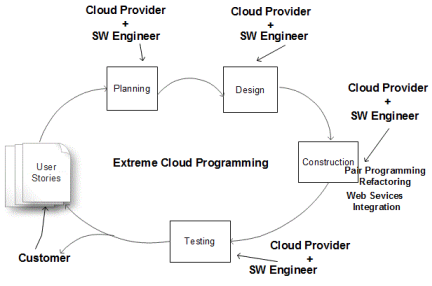
##Economics vs. Software Development Complexity SWPROCESSMODEL It takes creative programming design to make the most of distributed computing's benefits and purposefully address its challenges in order to advance this technology. Here, we suggest an extensive modification of Extreme Programming (XP), a clever method exhibit for distributed computing stage, and call it Outrageous Cloud Programming. Each stage, including planning, structuring, developing, testing, and sending, requires cooperation from the representatives of the cloud provider. Isolates and lists the tasks or exercises performed by SW engineers and cloud service providers Myarticles. The cloud provider will handle asset bookkeeping on the cloud stage during the necessary social affair stage. A collaborative effort with the cloud provider is required for programming engineering, mapping of programming design to equipment engineering, interface structure, information type configuration, cost calculation, and project timeline estimation. If web administrations are planned throughout the application development phase and a variety of projects are involved, errors should be fixed with the help of the cloud provider. A maintenance agreement with a cloud provider will include a Quality of Service clause.
V. OUTCOMES AND DISCUSSIONS
In this section, we experiment with several approaches using the standard estimations of a, b, c, and d for the Cloud Computing class of SW extends in relation to various classes. Table 2 lists the normal estimates of the coefficients a, b, c, and d for several classes of SW initiatives. Expecting increased complex collaboration with cloud vendors, the coefficient is increased to 4 for the cloud processing stage. The distributed computing coefficients a and b are determined so that the exertion bend is more intense than the other three classes but straight identical to the following three classes. Additionally, the coefficients c and d for distributed computing are chosen so that the advancement time bend is comparable to the next three classes while being less dramatic than the previous three classes. We adjusted the cloud processing coefficients a, b, c, and d to new estimates of 4, 1.2, 2.5, and.3, respectively. Segment reuse will fundamentally reduce KLOC (kilo lines of code) in SW innovation with cloud processing. We calculate new KLOC as new KLOC = i*C + (KLOC)*C, where I is the coefficient modification for new interface structure exertion and C is the percentage of component reuse.
Estimated SW effort using Extended COCOMO
Extended COCOMO for SW Development. Time
The estimated SW effort for tasks with measures ranging from 10 to 50 KLOC for each of the 4 task categories. In the case of distributed computing, we anticipated a 30% part reuse. If more than a percentage of segments can be reused, it will alleviate the larger degree of multidimensional cooperation in coefficient A and be helpful for the distributed computing stage. For each of the 4 types of SW initiatives, the corresponding SW improvement time estimation is plotted. SW improvement in the distributed computing stage will take the shortest amount of time with a 30% segment reuse likelihood.
Conclusion VI
A shift in viewpoint from the traditional method of writing and sending programmes is represented by distributed computing. As a result, programming designers will have a harder time communicating with the "cloud supplier," an external party. The amount of effort needed to create programming will decrease, but there will also be a requirement for communication and coordination with the cloud provider, which increases the complexity of the project. This paper's main argument is that the traditional SW process models should incorporate this new component of supplier collaboration as well as the distinct roles of SW specialists and cloud providers. Another coordinated process example is suggested in this paper that takes into account the anticipated connection requirement with the cloud provider. This demonstration will help to alleviate all of the challenges associated with programming development on the distributed computing platform and increase its profitability.
Built With
- html<css

Log in or sign up for Devpost to join the conversation.