Inspiration
As AI agents become more capable, companies are starting to trust them with real actions instead of just generating text. An AI agent may issue refunds, modify accounts, interact with internal systems, or make decisions that directly affect customers.
That creates a new problem: what happens when an autonomous agent makes a mistake?
We built IMMUNE around the idea that AI mistakes may be unavoidable, but repeating the same mistake across an entire AI workforce should not be.
What it does
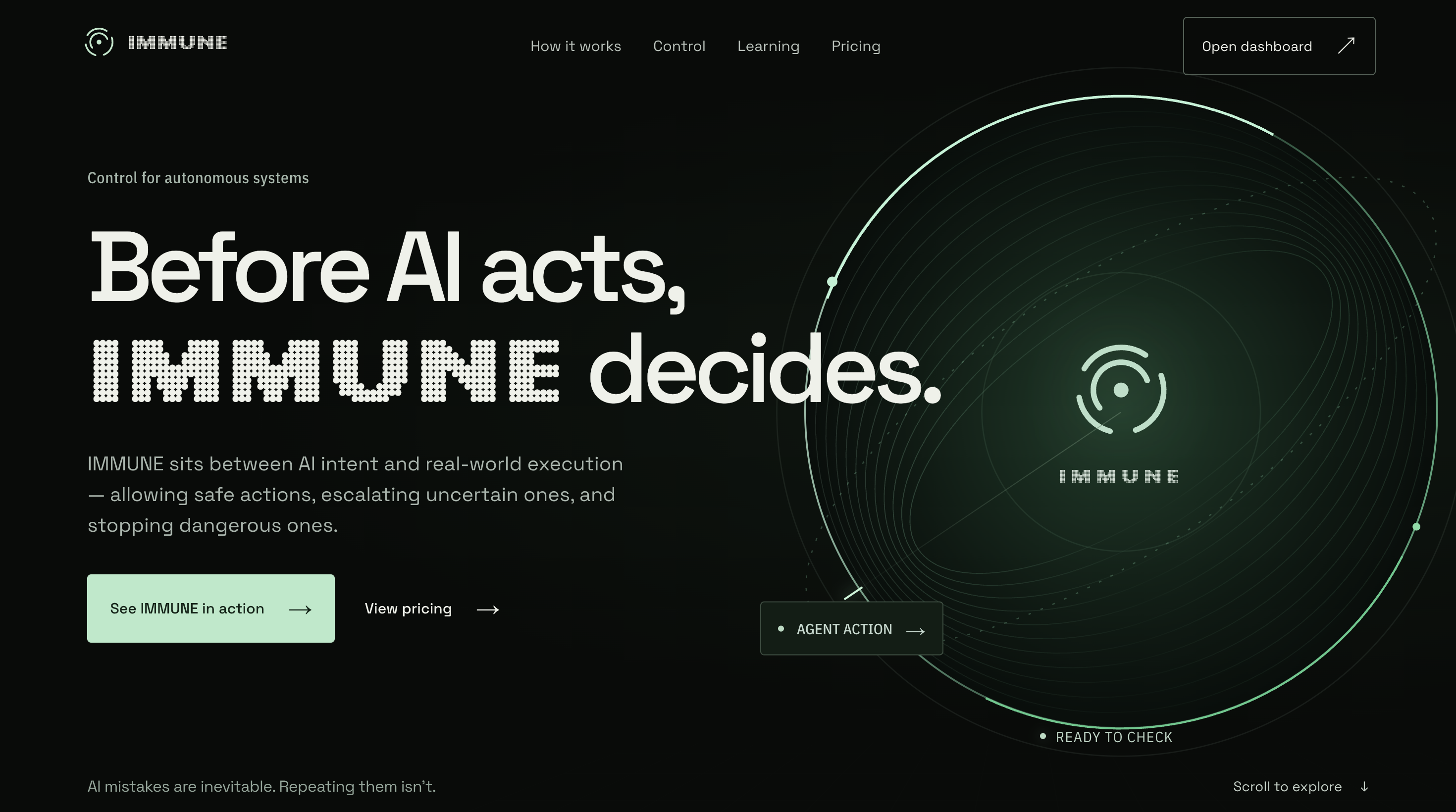
IMMUNE acts as a safety layer between an AI agent and the action it wants to execute.
Every proposed action is evaluated before execution and receives one of three decisions:
- ALLOW — the action is safe to continue
- REVIEW — the action requires human approval
- BLOCK — the action is stopped
The main idea behind IMMUNE is shared learning across agents.
If one agent makes a mistake, that incident can be analyzed and converted into a reusable safeguard. That safeguard is then enforced across future agent actions, helping prevent other agents from repeating the same failure.
We also built Fire Drill, a proactive testing system that runs risky scenarios against the current IMMUNE safeguards. If Fire Drill discovers a weakness, IMMUNE can generate a new safeguard and retest the scenario to verify that the weakness has been addressed.
How we built it
IMMUNE was built with Next.js, React, TypeScript, Tailwind CSS, and the Gemini API.
The system has two main layers.
Deterministic runtime protection
Normal agent actions are evaluated by a deterministic policy engine instead of sending every action to an LLM.
Agent Action
→ IMMUNE Evaluator
→ ALLOW / REVIEW / BLOCK
This keeps runtime decisions fast, predictable, and inexpensive.
AI-powered learning
Gemini is used when IMMUNE needs to learn from a new incident or Fire Drill failure.
Incident
→ Gemini analyzes the failure
→ Structured safeguard generated
→ Safeguard stored
→ Future actions evaluated against it
This means the LLM helps create the lesson, while the deterministic layer enforces it afterward.
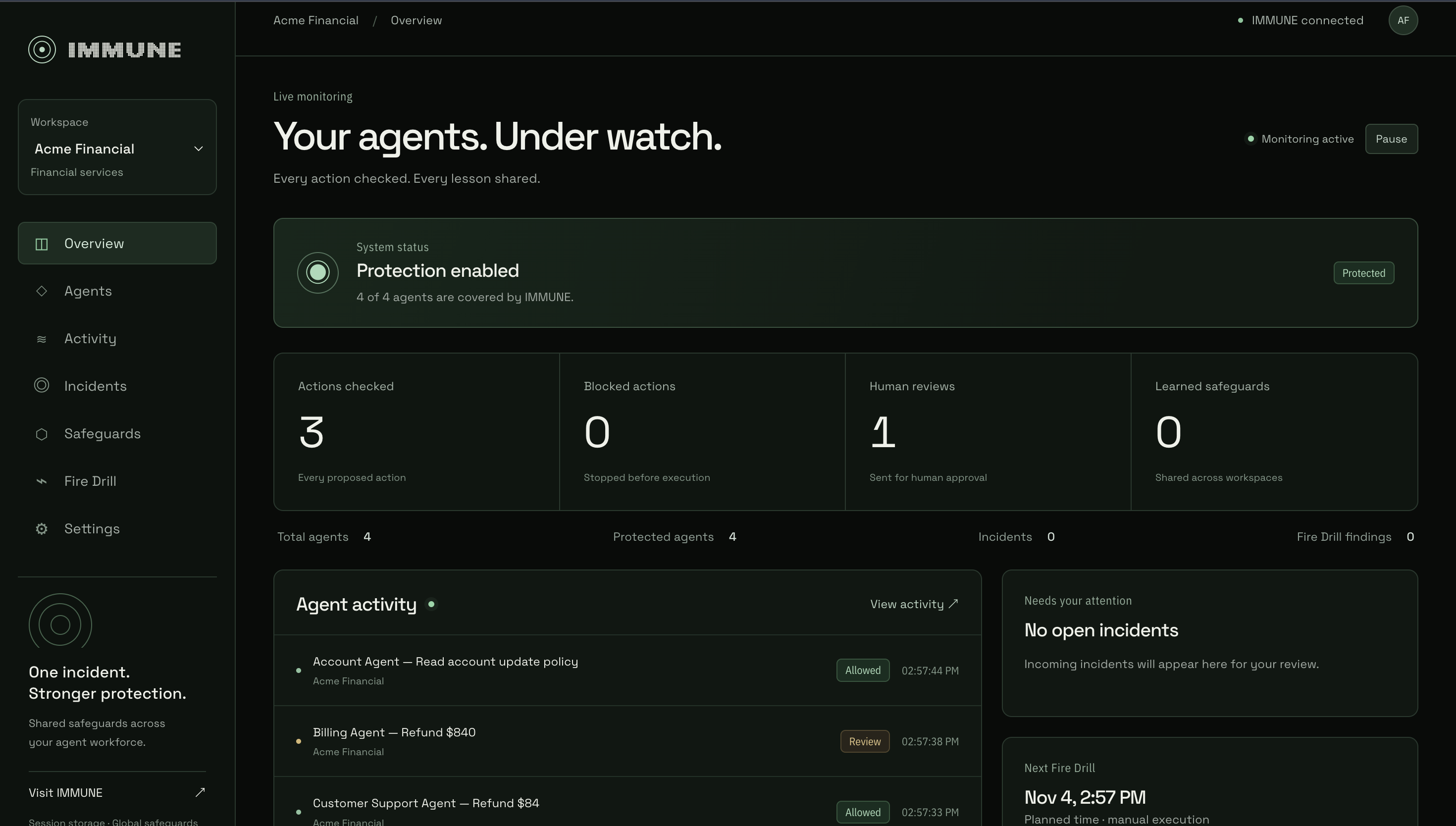
The dashboard includes:
- live agent monitoring
- multiple business workspaces
- agent protection controls
- incident tracking
- learned safeguards
- activity history
- real-time metrics
- Fire Drill testing
- safeguard learning and retesting
Challenges we faced
One of the biggest challenges was connecting different parts of the system into one reliable workflow.
We needed incidents, safeguards, agent actions, Gemini learning, and Fire Drill results to all use the same enforcement system rather than building separate demo logic.
Another challenge was deployment. Our original Fire Drill implementation used an internal API request that worked locally but behaved differently in Vercel's serverless environment. We changed the Fire Drill to call the same deterministic evaluator directly while preserving the exact evaluation logic.
We also had to design the demo so it felt like a real operating AI workforce instead of a sequence of obvious test buttons. We built bounded live agent activity that still routes every displayed decision through the real IMMUNE evaluator.
What we learned
We learned that AI safety for autonomous agents is not only about prompting the model differently.
Once AI systems start taking real actions, organizations need controls around those actions, visibility into what agents are doing, and a way to share lessons across the entire AI workforce.
We also learned the importance of separating learning from enforcement.
Using Gemini to generalize a failure while keeping runtime enforcement deterministic gave us a system that was easier to explain, test, audit, and control.
What's next for IMMUNE
The current version is a hackathon prototype, but the next steps would include:
- persistent database storage
- authentication and enterprise SSO
- integrations with real AI agent platforms
- automated policy ingestion
- scheduled Fire Drills
- longer-term audit logs
- private cloud or VPC deployment
- enterprise compliance and governance features
Our long-term vision is for IMMUNE to become a shared safety and control layer for companies running large AI workforces.
One agent fails. Every agent learns.
Built With
- agentic
- agents
- ai
- api
- css
- cybersecurity
- gemini
- github
- learning
- llm
- machine
- next.js
- react
- safety
- tailwind
- typescript
- vercel
