Inspiration
We were frustrated that wearables collect mountains of health data but do almost nothing useful with it. Your Apple Watch knows your HRV dropped 20% this week — but it won't tell you why, won't suggest what to change, and definitely won't help you run a self-experiment to figure it out. We wanted to build the "operating system" for personal longevity: something that actually closes the loop between data collection, pattern detection, and actionable behavior change — all grounded in peer-reviewed science, not vibes.
What it does
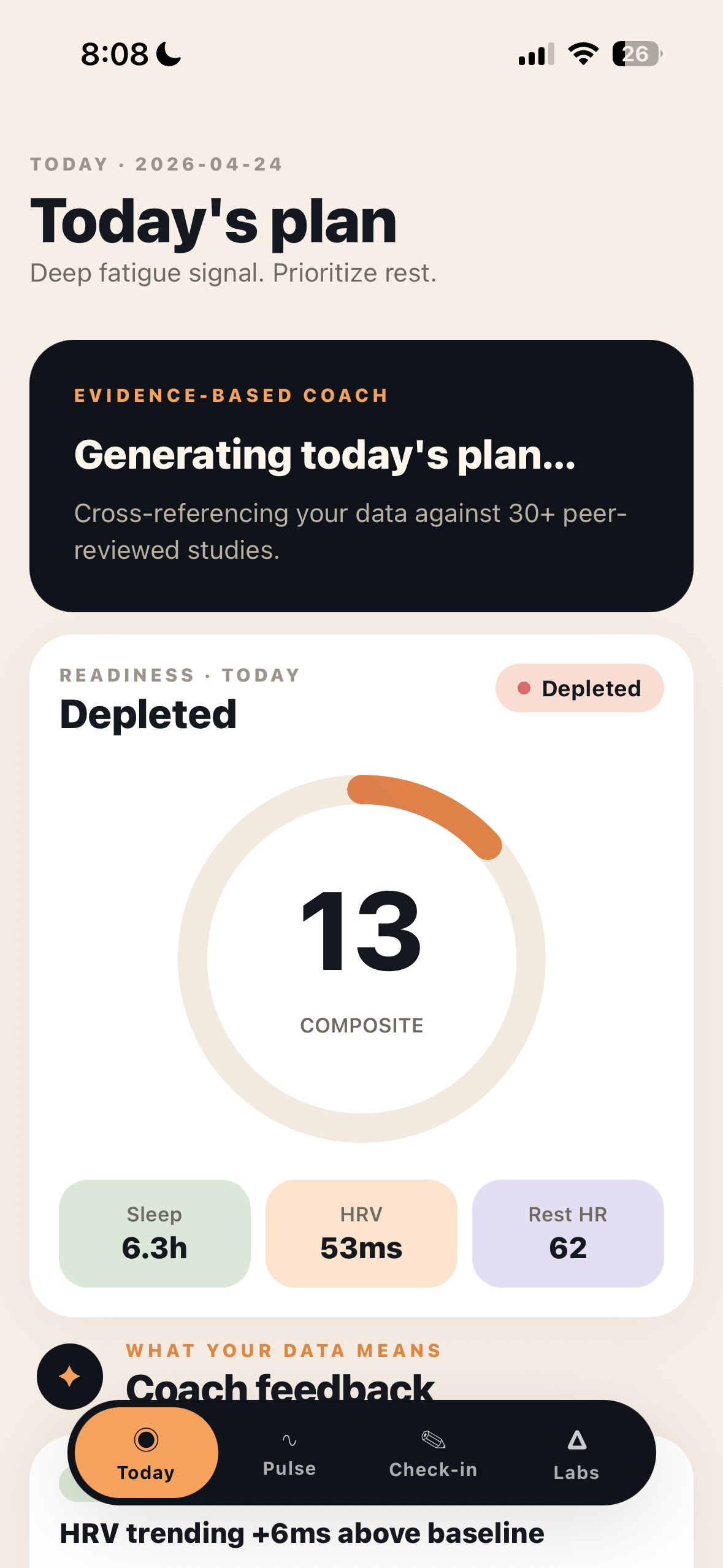
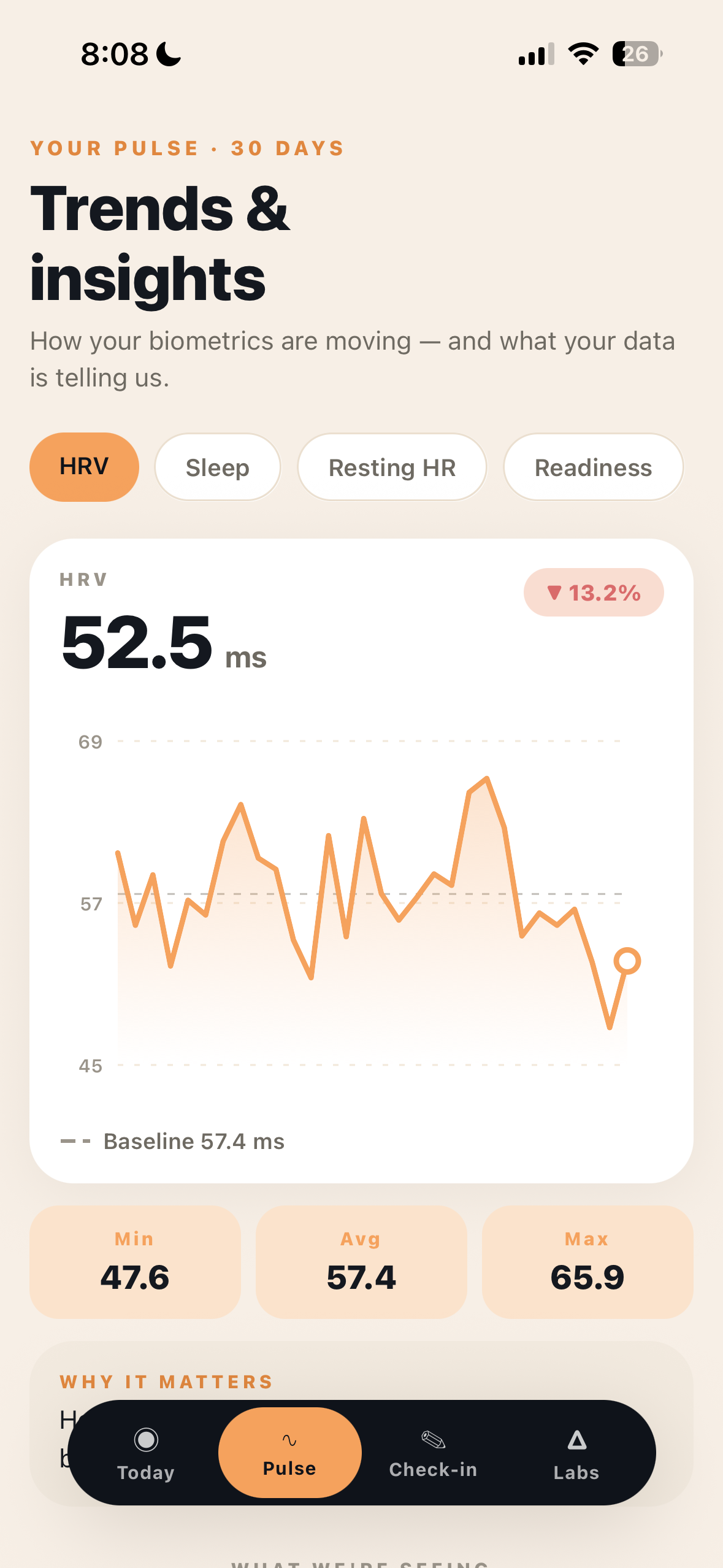
Immortal is a closed-loop personal health intelligence system. It syncs wearable data from Apple HealthKit (HRV, sleep, resting heart rate, steps, workouts), learns your individual baselines over 7/30/90-day windows, and detects anomalies using z-score analysis. When it spots something — like a sustained HRV dip or creeping resting heart rate — it generates evidence-based recommendations ranked by confidence, with citations to the underlying research.
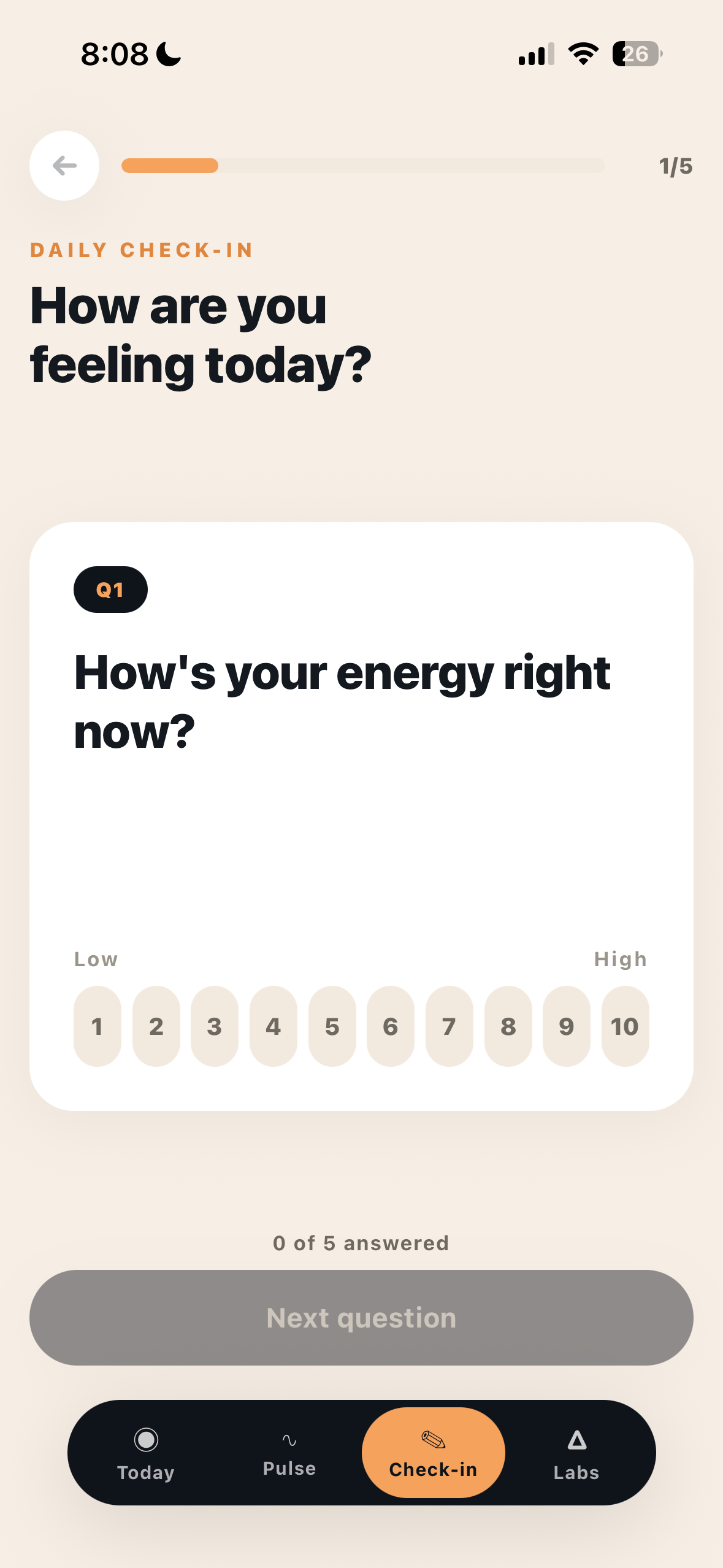
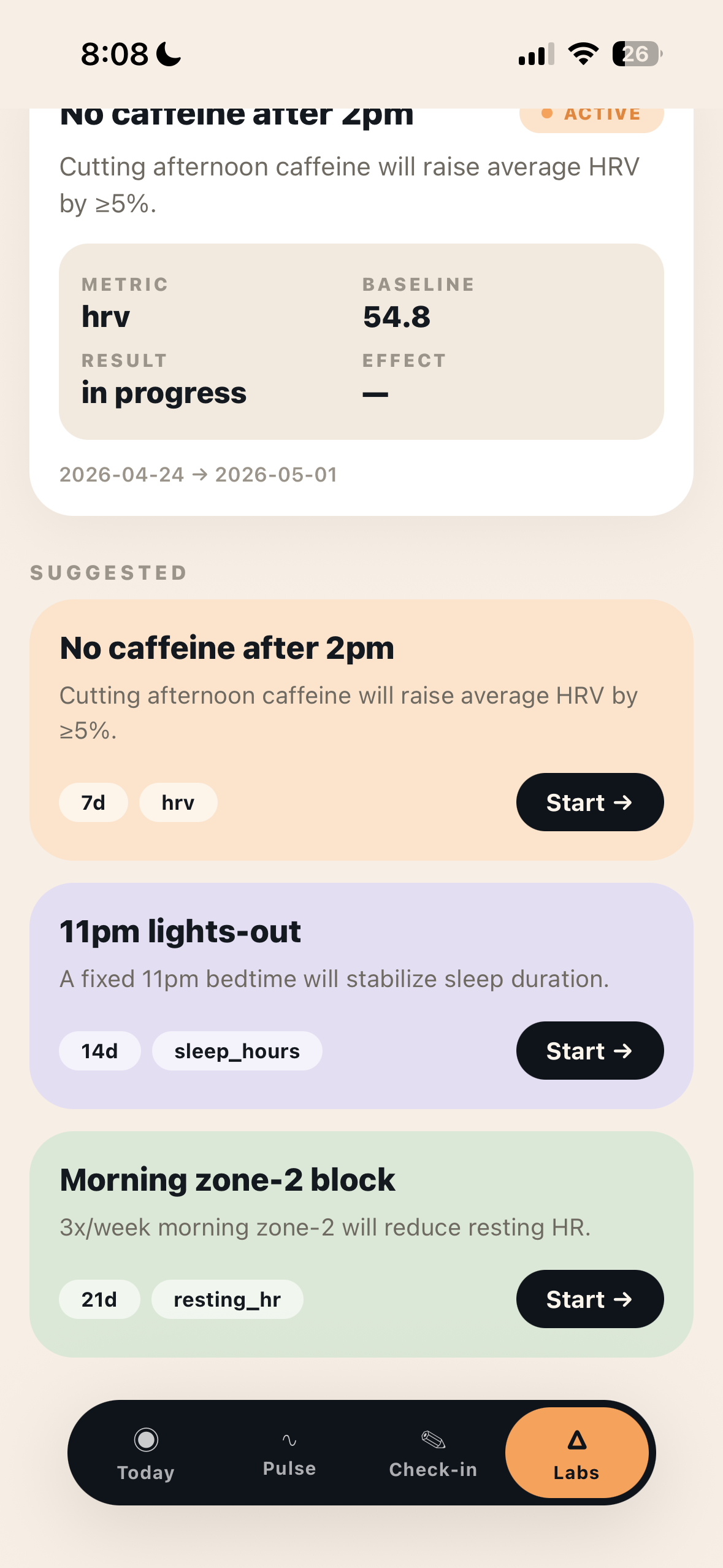
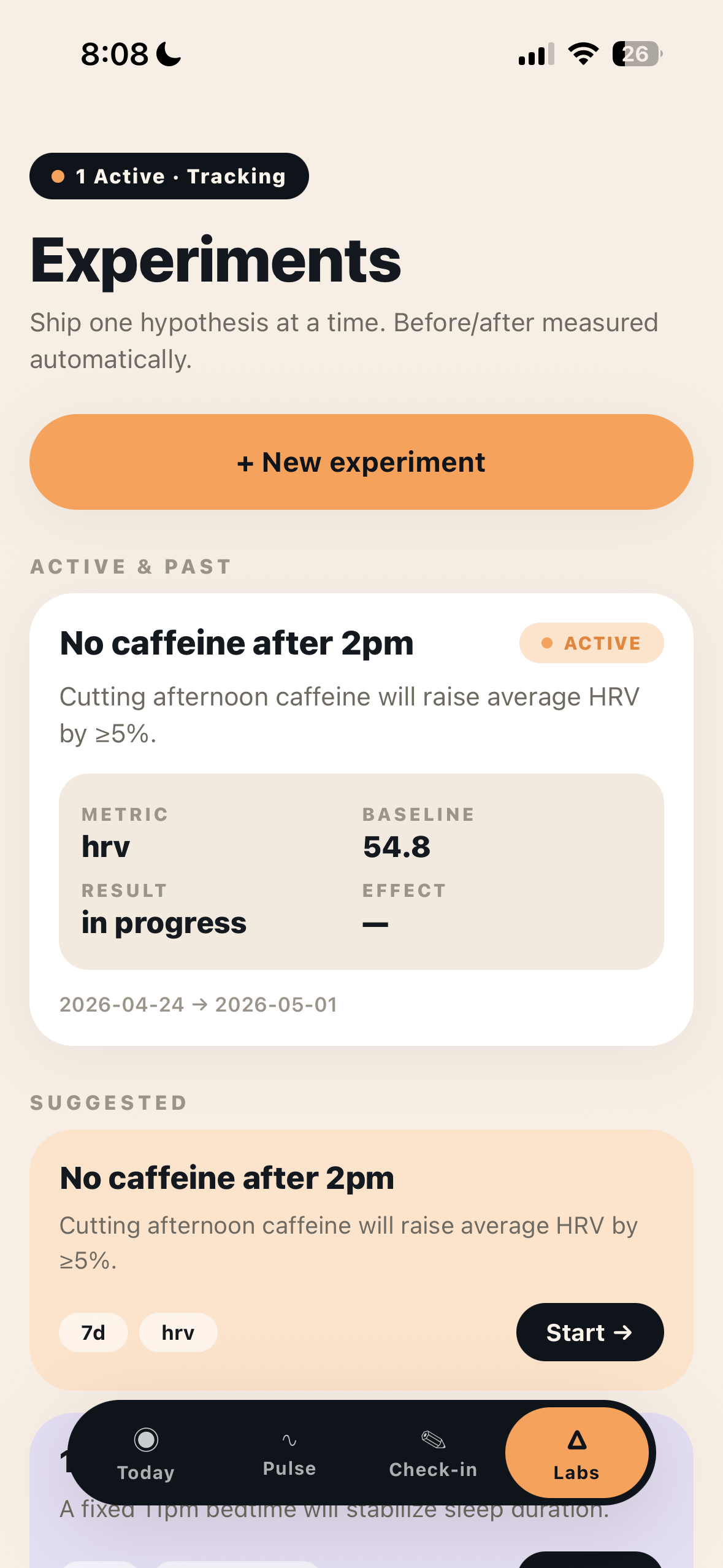
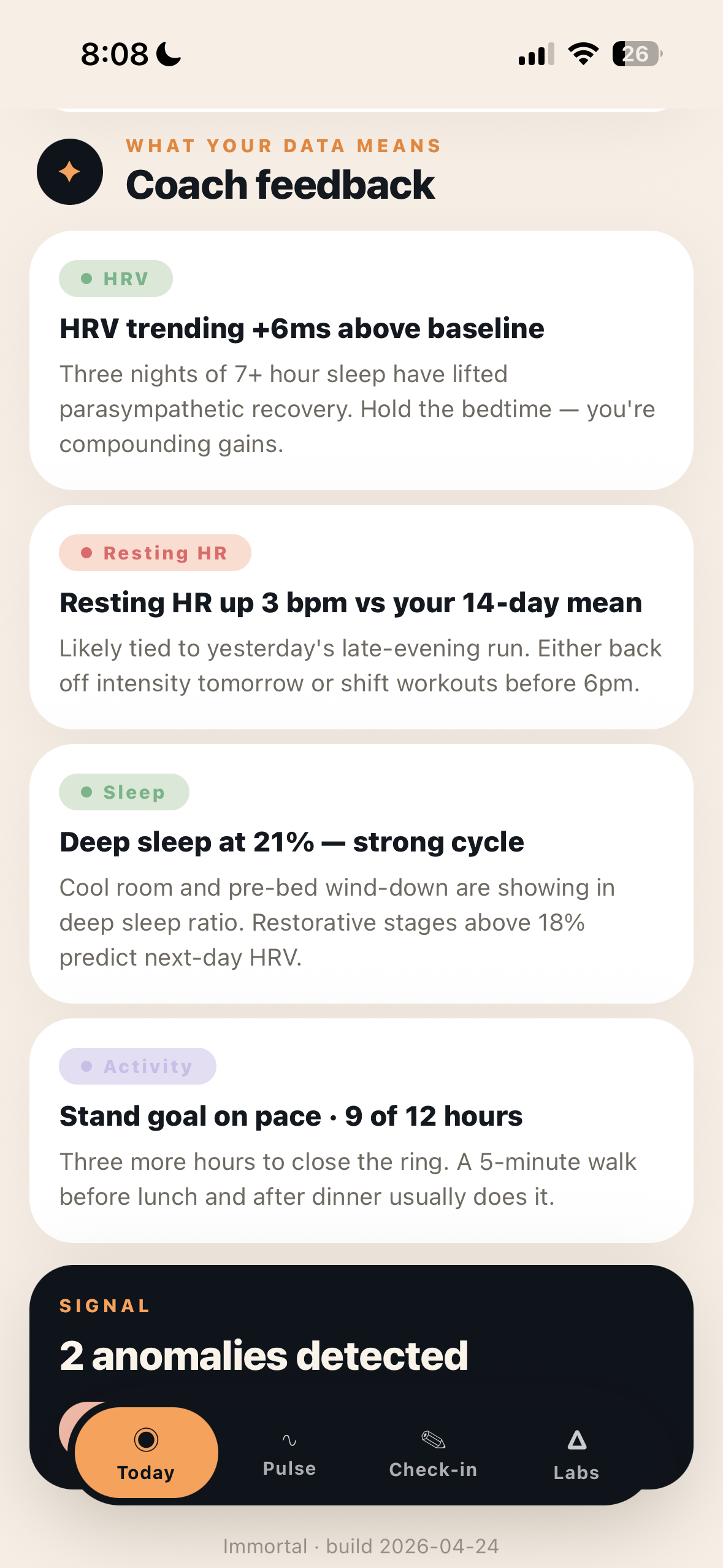
The standout feature is self-experiments: you can propose hypotheses (e.g., "does cutting caffeine after 2pm improve my HRV?"), and the system automatically tracks pre/post metrics, computes effect sizes, and evaluates whether the intervention actually worked. An adaptive check-in system asks different questions based on what anomalies are detected — no generic surveys. An LLM-powered coach (Gemini 2.5 Flash) synthesizes all of this into personalized, conversational guidance.
How we built it
Backend: FastAPI + SQLAlchemy with a modular intelligence engine — seven distinct modules handling baselines, daily state aggregation, pattern detection, recommendations, adaptive check-ins, experiments, and insights. Every clinical threshold is documented with peer-reviewed citations in our EVIDENCE.md file.
Mobile: Expo 54 + React Native with TypeScript, using React Query for server state, Zustand for local state, and a custom HealthKit integration via @kingstinct/react-native-healthkit for native iOS data access with anchored incremental sync.
AI Layer: Hybrid approach — deterministic rule engines handle pattern detection and anomaly scoring, while an LLM coach provides nuanced contextual guidance. The rules ensure reliability; the LLM adds personalization.
Data: SQLite for dev with a Postgres/TimescaleDB-ready schema (single env var flip). Time-series hypertable support built in for production scale.
Challenges we ran into
HealthKit rate limits and complexity. Apple's HealthKit API is powerful but unforgiving — anchored queries, background delivery permissions, and entitlement signing all had to work perfectly on a real device. Simulator testing only gets you so far; we had to set up EAS Build for actual iOS testing.
Balancing rules vs. LLM. We wanted recommendations to be scientifically grounded, not hallucinated. Getting the hybrid architecture right — where deterministic engines provide the facts and the LLM just synthesizes them — took several iterations. We switched from Claude to Gemini 2.5 Flash mid-project for the coach layer after evaluating latency and cost tradeoffs.
Baseline cold-start. The system needs historical data to compute meaningful baselines. We built a 30-day synthetic seed script to demo the full pipeline, but designing graceful degradation for new users with sparse data was tricky.
Accomplishments that we're proud of
- Evidence-first engineering. Every threshold in the system maps to a cited paper. We wrote EVIDENCE.md as a living document with quarterly review cadence — this isn't a "trust me bro" health app.
- Self-experiments actually work. Users can propose, run, and auto-evaluate personal health experiments with real effect-size computation. We haven't seen this in consumer health apps.
- The adaptive check-in system. Questions change based on detected patterns — if you're showing signs of overreaching, it asks about training load and recovery, not generic mood questions.
- Clean modular engine. Seven independent intelligence modules that compose through a single assembler. Each one is testable and replaceable in isolation.
What we learned
- Health data is deeply personal and noisy. Population norms are nearly useless — individual baselines are everything.
- Hybrid AI architectures (rules + LLM) are underrated. Rules give you reliability and auditability; LLMs give you natural language and personalization. You need both.
- Building for iOS wearable data is a whole different beast from web development. Entitlements, provisioning profiles, background delivery — the platform complexity is real.
- Evidence-based software engineering is worth the upfront cost. Documenting why every threshold exists made debugging and iteration dramatically faster.
What's next for Immortal
- Multi-source integration: Fitbit and Oura Ring OAuth support to reach beyond the Apple ecosystem.
- Per-user correlation learning: Move beyond population-level rules to discover individual-specific patterns (e.g., "for you, alcohol correlates with a 15% HRV drop").
- Causal inference on experiments: Upgrade from simple pre/post comparison to proper causal methods that account for confounders.
- Predictive trajectories: Forecast readiness scores 3-7 days out based on current trends and planned activities.
- Push notifications: Proactive alerts when the system detects emerging patterns, not just passive dashboard updates.
- Auto-experiment proposals: System suggests experiments based on detected patterns, closing the loop entirely.
Built With
- applewatch
- expo.io
- reactnative


Log in or sign up for Devpost to join the conversation.