🚀 Immigration Command Center
## Inspiration
Working at a personal injury law platform like AlphaLaw, I’ve seen firsthand how highly skilled legal professionals spend an unreasonable amount of time on repetitive, low-leverage tasks — navigating clunky government portals, re-entering the same data, and waiting on slow workflows.
That observation sparked a simple question:
What if legal operations could run like autonomous systems instead of manual processes?
Immigration law stood out as the perfect domain. Unlike personal injury, it involves highly structured, rule-based workflows across government systems like USCIS and USPS — ideal for automation but still heavily manual today.
The idea behind Immigration Command Center was born:
👉 Turn immigration workflows into one-click autonomous actions, powered by AI agents.
## What it does
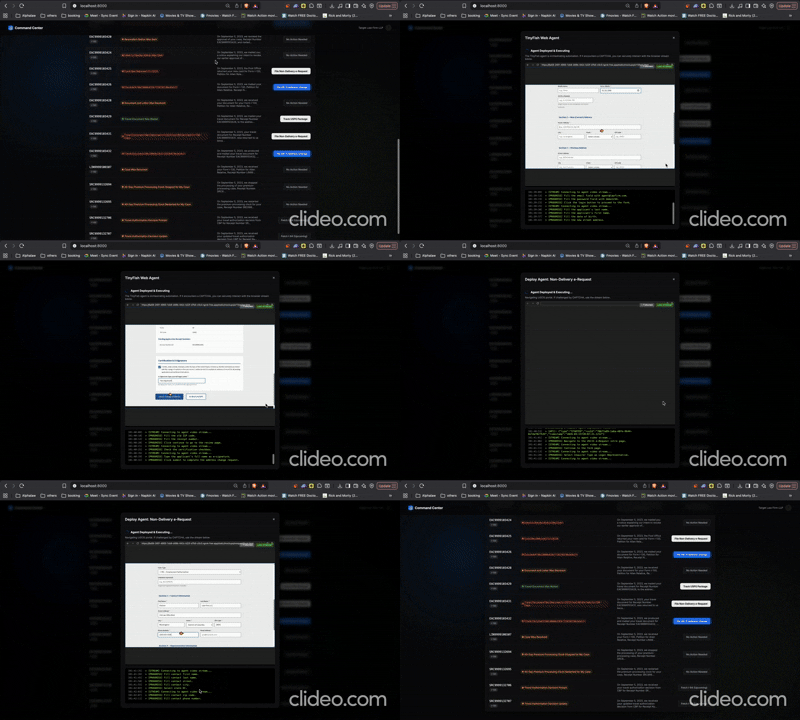
Immigration Command Center is an AI-powered operations dashboard that:
- Connects to USCIS case data
- Understands case status
- Automatically determines the next required action
- Deploys autonomous agents to execute workflows
Instead of:
- Logging into 3 portals
- Filling multiple forms
- Clicking through dynamic UIs
Lawyers now:
👉 Click one button
👉 Watch an agent complete the task in ~90 seconds
## How we built it
The system is designed as a 3-layer agentic architecture:
1. Real-Time Case Intelligence
- Integrated with USCIS Case Status API (OAuth 2.0)
- Each case is analyzed and mapped to actions
Examples:
- “Document Was Mailed But Not Received” → AR-11 Address Change
- “Card Destroyed” → e-Request Filing
This converts raw legal data into structured decisions.
2. Autonomous Web Agents (TinyFish)
Using TinyFish, we deploy agents that:
- Navigate real websites
- Fill forms using CSS selectors
- Handle multi-step workflows
- Capture screenshots
- Stream execution live
Each agent behaves like a junior legal ops assistant — but faster and error-free.
3. Real-Time Execution UI
- Server-Sent Events (SSE) for live updates
- Embedded video stream of agent execution
- Terminal-style logs for transparency
The lawyer doesn’t lose control — they observe, verify, and trust the system.
## Key Workflows Automated
🧾 AR-11 Address Change
- Multi-page USCIS form automation
- Login → fill → certify → submit
📩 e-Request (Non-Delivery)
- Legal representative workflow
- Returns confirmation instantly
📦 USPS Tracking
- Extracts delivery status, timestamps, and proof
## Impact
$$ \text{Time Reduction} = \frac{20 - 1.5}{20} \approx 92.5\% $$
- ⏱️ 15–20 minutes → ~90 seconds
- 📉 ~90% reduction in time
- 💰 25+ hours saved per month per firm
- 💵 ~$2,500–$5,000 recovered in billable value
## Challenges we faced
1. Dynamic Government Portals
- Heavy JavaScript rendering
- Anti-bot mechanisms
Solution:
- Cloud browser agents
- Explicit selector-driven execution
2. Reliable Agent Control
- Agents needed to be deterministic, not “chatty AI”
Solution:
- Structured prompts
- Step-by-step execution plans
- Strict input/output control
3. Local-to-Cloud Communication
- TinyFish agents run in the cloud
- Mock services were local
Solution:
- Used ngrok to expose local endpoints
- Enabled seamless interaction
4. Real-Time Feedback Loop
- Needed visibility into agent execution
Solution:
- SSE streaming
- Live iframe video feed
## What I learned
This project fundamentally changed how I think about AI systems:
- AI is not just about answers, it's about actions
- Deterministic workflows + AI agents = real-world value
- Observability (logs, video, state) is critical for trust
- Legal tech is massively underserved in automation
The future of software is not dashboards — it’s autonomous operators
## Closing Thought
At AlphaLaw, we’ve already seen how AI can transform legal workflows.
With Immigration Command Center, I wanted to push that idea further:
👉 Not just assisting lawyers
👉 But acting on their behalf
From personal injury to immigration — the pattern is clear:
Wherever there is structured process, there is an opportunity for autonomous execution.
Built With
- fastapi
- httpx
- javascript
- jinja
- ngrok
- python
- tinyfish
- uscis

Log in or sign up for Devpost to join the conversation.