Inspiration
Immigration rules and policies are constantly changing — and in recent years, that pace of change has accelerated dramatically. For people navigating immigration, staying informed isn’t just difficult; it’s emotionally and cognitively exhausting.
When people look for information today, they often end up on forums like Reddit or social media threads, where they encounter racism, hate speech, misinformation, fear-mongering, and increasingly AI-generated content that confidently misinterprets policies. Official government sources exist, but they are fragmented, hard to monitor, and not designed for real-time understanding.
Immigration is also a highly underserved population: international students, workers, families, and asylum seekers are making life-altering decisions based on information that is often outdated or unclear.
We wanted to explore a different approach — one that treats immigration policy not as static documents, but as a living, evolving stream of events, and uses AI responsibly to interpret changes without amplifying noise or fear.
What it does
Immichange is a real-time immigration policy change tracker.
For this MVP, Immichange focuses intentionally on USCIS updates in the United States.
When USCIS publishes a new update:
Immichange automatically detects it
Streams it through Confluent Kafka as a real-time event
Uses Google Vertex AI to interpret what changed and who it affects
Stores the enriched update as part of a growing historical record
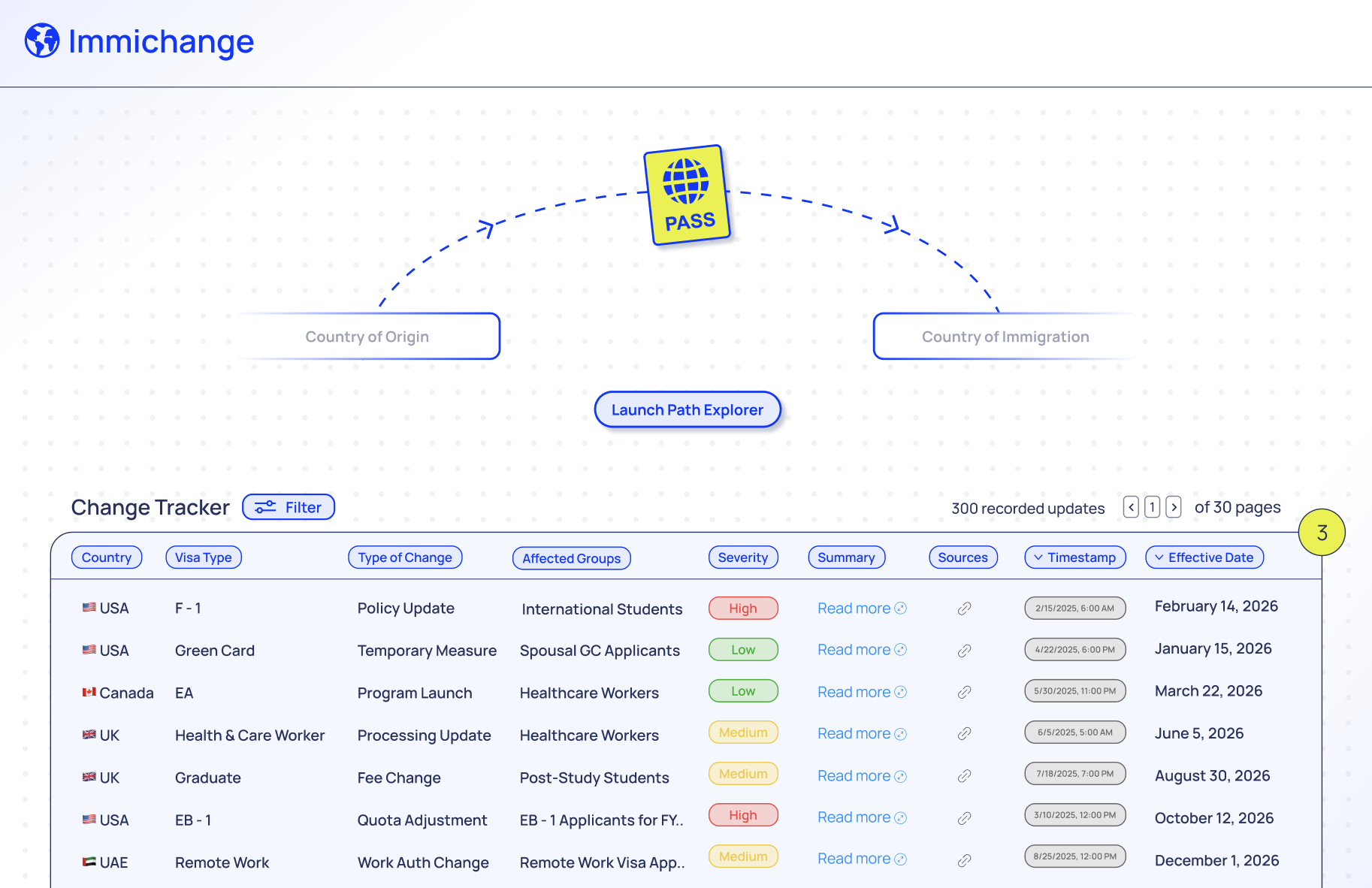
Displays it live in a clean, human-readable dashboard
The dashboard shows:
Country Visa type Type of change Affected groups Severity AI-generated summary Source link Timestamp
Immichange continues polling in the background, so judges (and future users) will see new USCIS updates appear automatically over time.
This is an MVP by design, with a clear path to expand to additional countries, agencies, and migration pathways.
How we built it
Immichange is built as an event-driven AI system:
Data ingestion Official USCIS RSS feeds are polled at a regular interval to detect new updates.
Streaming backbone (Confluent) Each update is published as an event to Confluent Kafka, allowing the system to treat policy changes as data in motion rather than static pages.
AI interpretation (Google Vertex AI) As events flow through Kafka, Vertex AI (Gemini) analyzes each update and extracts structured insights such as visa type, severity, affected groups, and a concise summary.
Persistent history (BigQuery) Enriched updates are stored in BigQuery, creating a reliable historical record that supports replay, auditing, and long-term analysis.
Web application A live web dashboard consumes this data and displays the most recent ~50 USCIS updates in a clear, accessible format. The UI was designed in Figma and implemented as a real, connected frontend.
By combining streaming infrastructure with AI reasoning, Immichange demonstrates how policy intelligence can be built as a continuously updating system rather than a static reference site.
Challenges we ran into
One of the biggest challenges was thinking in streams rather than batches. It required re-framing the problem from “fetch and summarize documents” to “react to events as they happen.”
Handling duplicates and safely replaying historical events without breaking the pipeline was another challenge — especially while keeping the system simple and understandable for an MVP.
Finally, balancing AI usefulness with responsibility was important. Immigration is a sensitive domain, so we focused on interpretation and clarity, not prediction or legal advice.
Accomplishments that we’re proud of
- Building a real, end-to-end streaming pipeline with live government data
- Using Confluent Kafka in a way that is central — not decorative — to the product -Applying Vertex AI to interpret real policy changes, not just generate text
- Creating a clean, functional UI that reflects real data in motion
- Designing the system so it continues updating even after the hackathon ends
Most importantly, we’re proud that Immichange feels like a real product we could build on.
What we learned
- Event-driven architecture is a powerful way to think about public policy and governance data
- Streaming + AI enables a fundamentally different class of applications than batch processing
- Good system boundaries (raw data → enrichment → presentation) make complexity manageable
- Responsible AI design matters even more in high-impact domains like immigration -We also learned that starting with a focused scope makes it much easier to build something solid and extensible.
What’s next for Immichange
This MVP focuses on USCIS and the United States, but the architecture is designed to scale.
Next steps include:
- Adding more countries and immigration agencies
- Expanding coverage to additional visa and migration pathways
- Introducing user-specific views (country of origin → destination)
- Building alerting and notification features for high-severity changes
- Providing longitudinal insights into how immigration policy volatility changes over time
Immichange is just the beginning of a larger idea: treating immigration policy as real-time, interpretable data — and making it accessible without fear or misinformation.
Built With
- confluent
- kiro
- vertex

Log in or sign up for Devpost to join the conversation.