What Inspired This Project This project was inspired by the gap between how road safety is taught in schools and how traffic is actually experienced in real life. While children are taught traffic rules through textbooks, posters, and videos, real-world roads are dynamic, unpredictable, and interconnected.
We observed that many students can recite road safety rules but struggle with situational awareness, judgment, and decision-making when faced with real traffic scenarios. The inability to safely experience consequences—such as unsafe crossings, signal violations, or congestion—limits deep understanding.
This motivated us to explore how immersive technology and AI could make road safety education more experiential, intuitive, and meaningful for children.
(1) Gemini 3 Pro will think deeper and provide live traffic simulation results based on movement of vehicles, people on streets.
(2) Gemini 3 Pro will create image of city landscape meant for students to learn road traffic simulation. The image will be created by Gemini 3 Pro to replicate city landscape of 4 junctions with traffic lights in live operations.
(3) Gemini 3 Pro will provide AI Chatbot to students to answer on any traffic related simulation and various scenarios.
What We Learned Through this project, we learned that:
- Experiential learning is far more effective than rule memorization for safety education
- Visualizing cause-and-effect relationships helps children understand why rules exist
- AI-driven natural language interaction encourages curiosity and deeper thinking
- Browser-based technologies like WebXR can deliver immersive experiences without expensive hardware
- Educational simulations must balance realism with simplicity to suit different age groups
Most importantly, we learned that when students are allowed to explore, question, and predict outcomes, learning becomes active rather than passive.
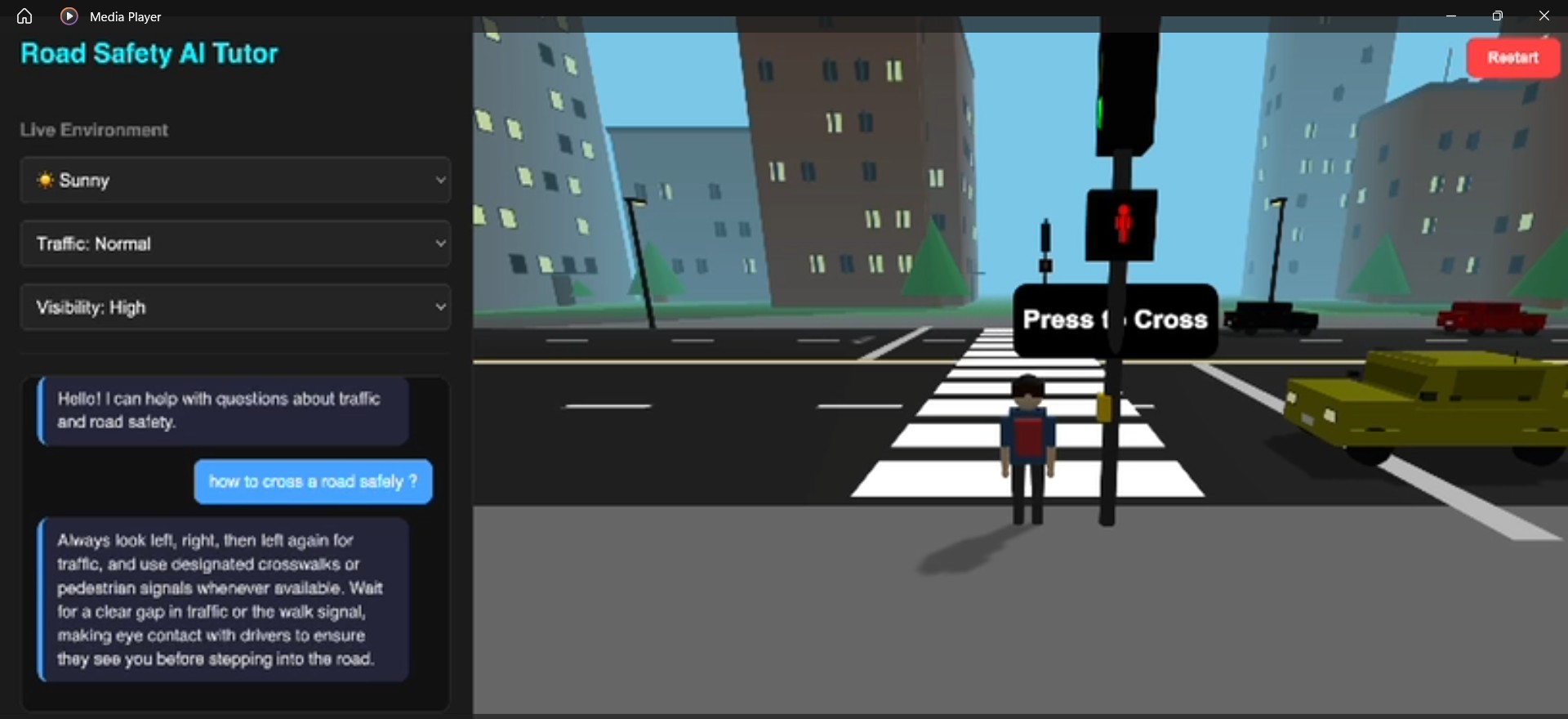
How We Built the Project The project was built as a browser-based 3D road traffic simulation using WebXR, ensuring accessibility across school devices without requiring app installation.
Key components include:
- A virtual city environment with roads, signals, pedestrian crossings, and traffic flow
- Multiple perspectives such as street-level, bird’s-eye, and control-room views
- Simulated traffic scenarios demonstrating safe and unsafe behaviors
An AI-assisted Road Safety Tutor that allows students to ask questions like:
- “Why is traffic slowing here?”
- “What happens if pedestrians cross on red?”
The AI explains scenarios in student-friendly language, highlighting cause-and-effect relationships and visualizing outcomes. The platform is designed to scale from simple simulations for younger students to more complex scenarios for advanced learners.
Challenges We Faced Some of the key challenges included:
- Designing traffic simulations that are realistic yet not overwhelming for children
- Translating complex traffic dynamics into simple, age-appropriate explanations
- Ensuring smooth performance across different browsers and devices
- Balancing immersion with safety, avoiding overstimulation
- Aligning the experience with educational goals rather than pure gaming
Addressing these challenges required continuous iteration, testing, and refinement to keep the learning experience both engaging and educational.
Conclusion This project demonstrates how AI and immersive web technologies can transform road safety education from passive instruction into active, judgment-based learning. By allowing children to safely experience traffic situations and understand consequences, the platform aims to build long-term awareness, responsibility, and safer behavior on real roads.

Log in or sign up for Devpost to join the conversation.