-
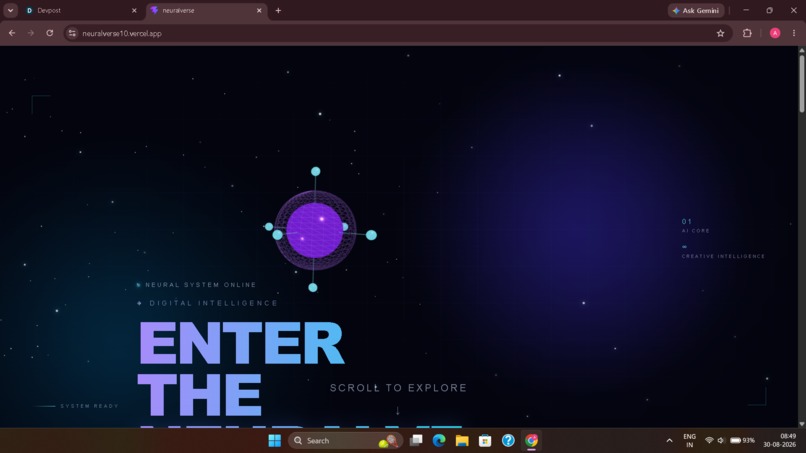
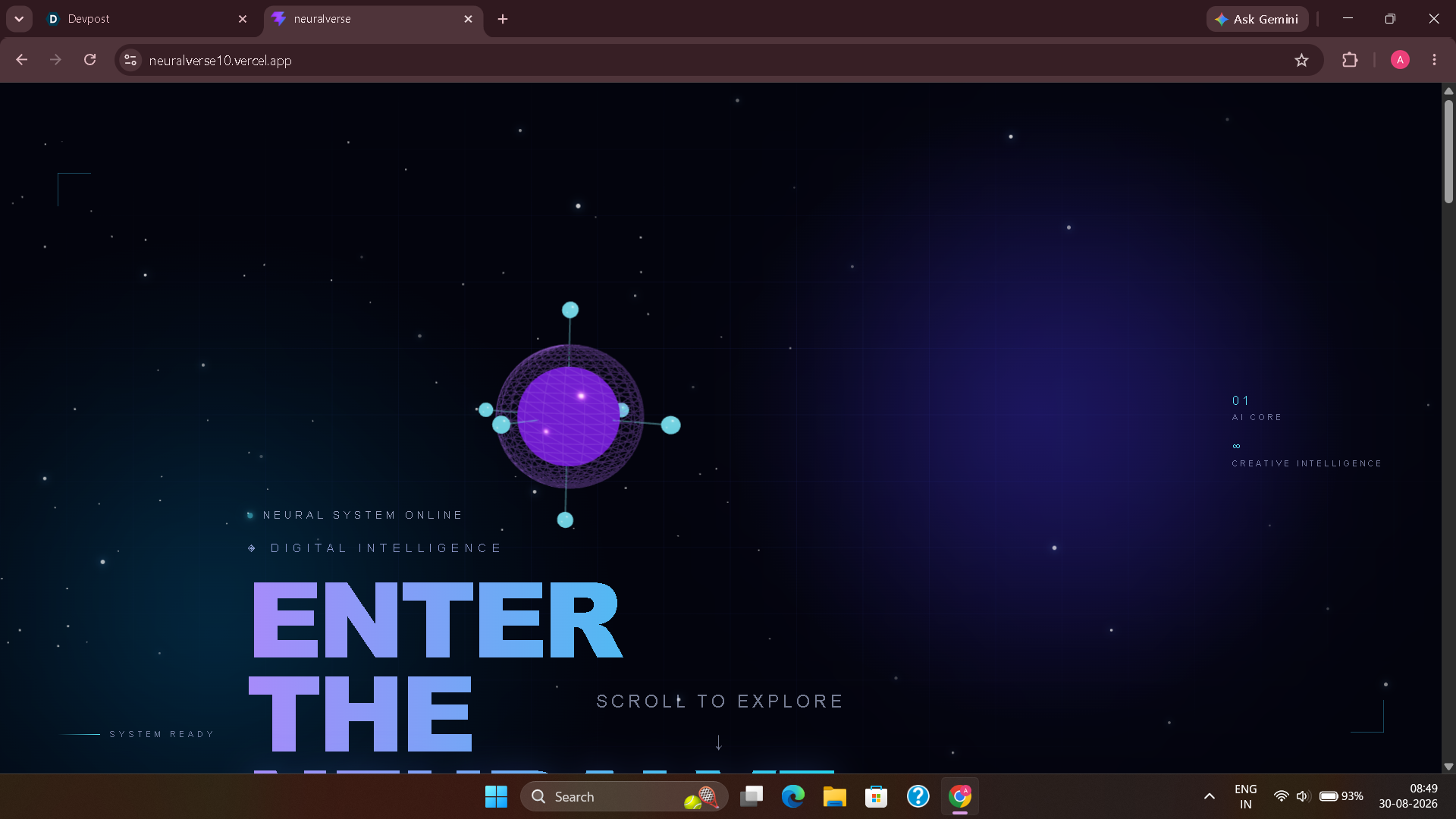
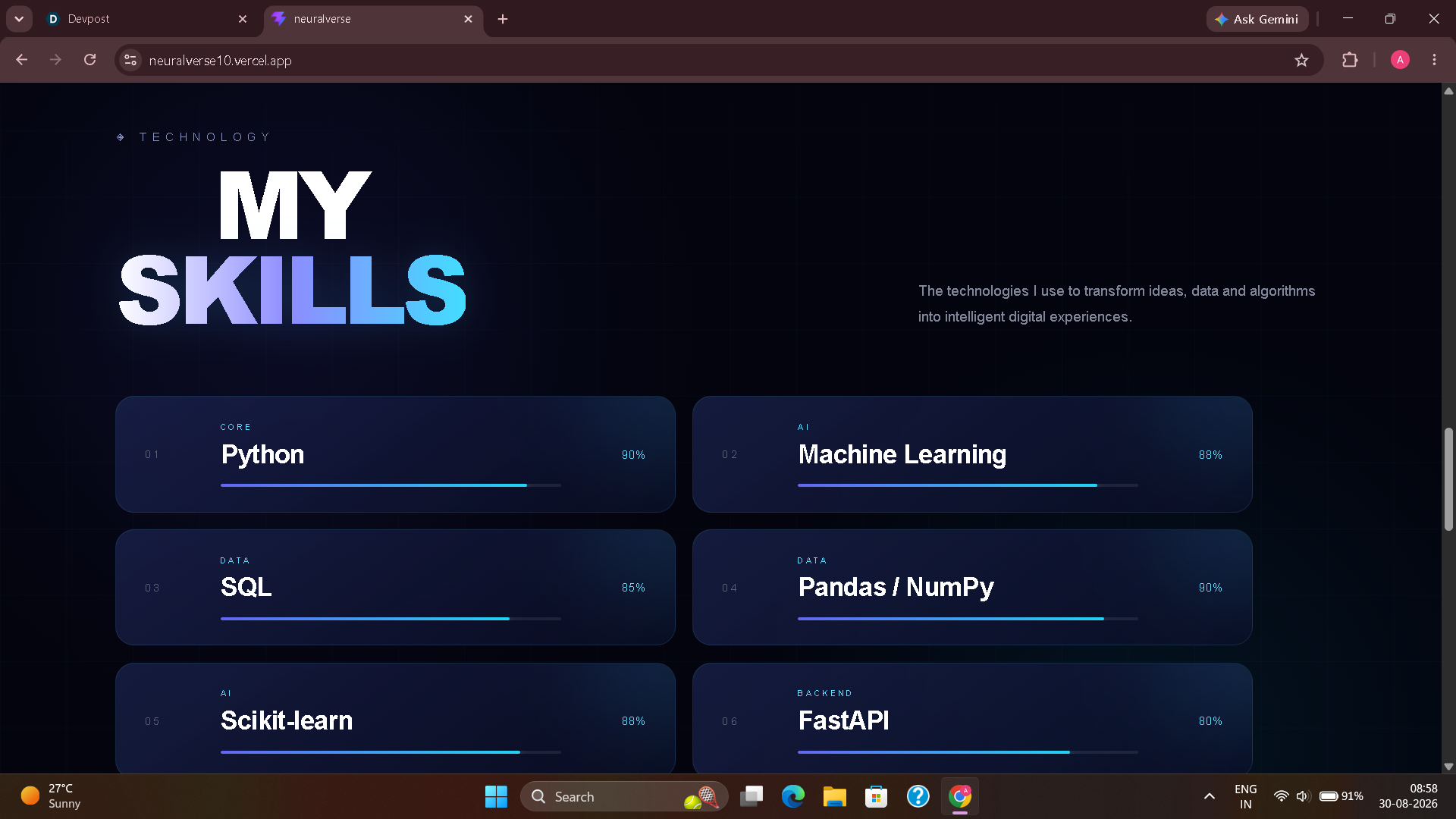
Futuristic NeuralVerse landing page introducing an immersive AI-powered portfolio experience.
-
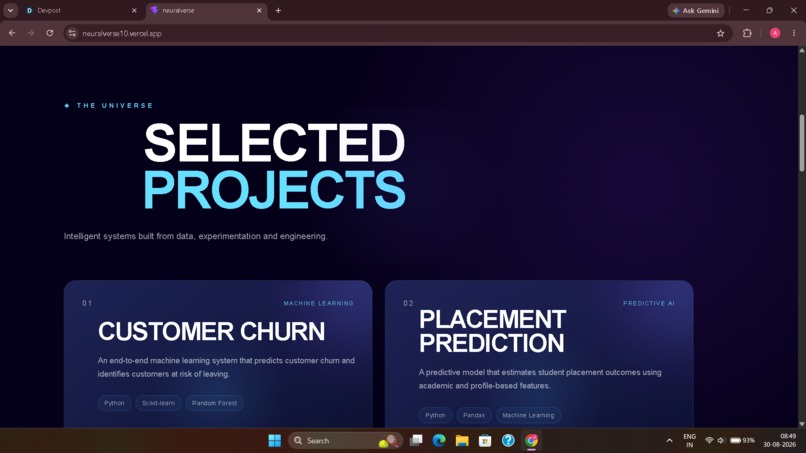
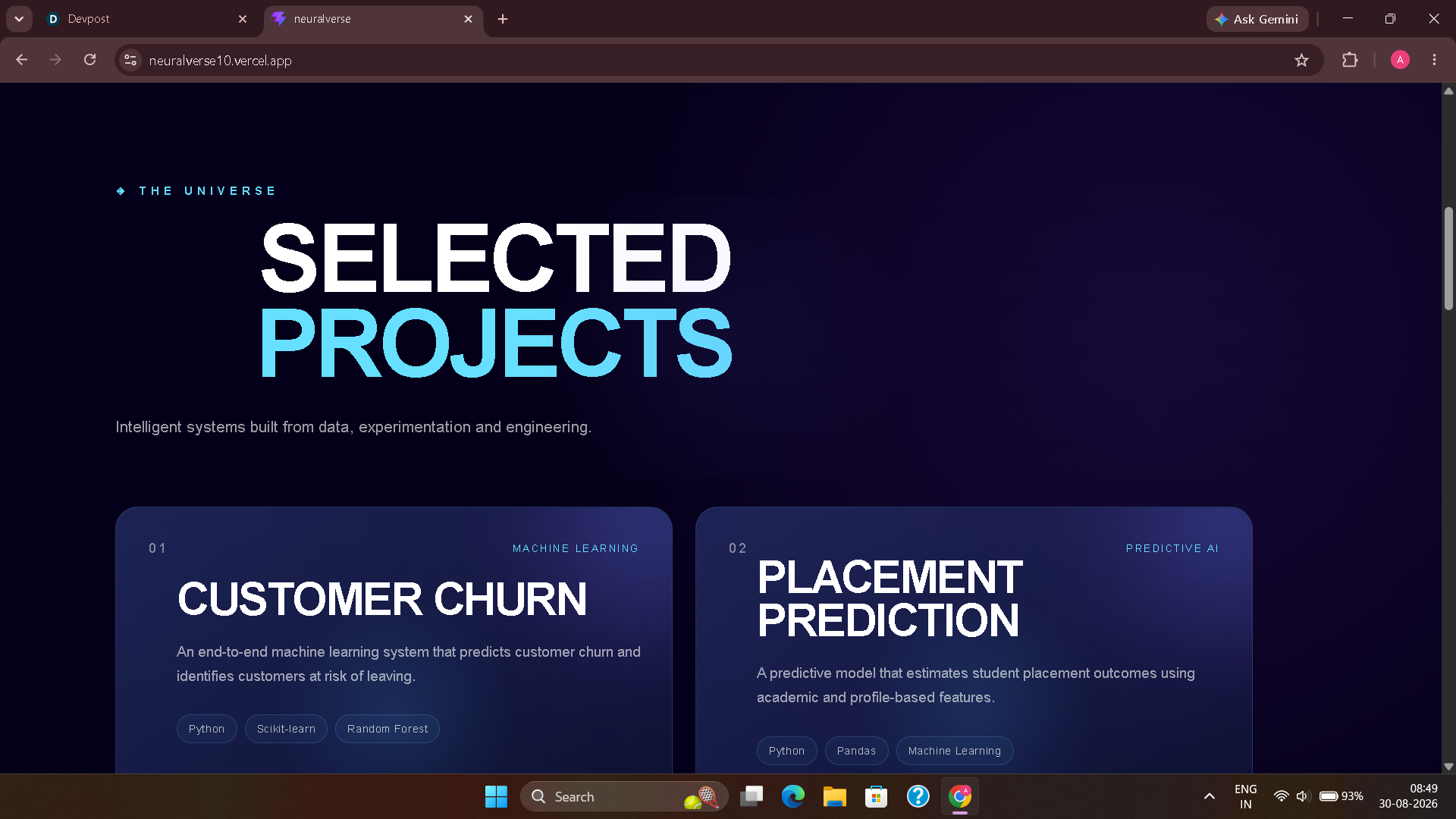
Selected projects highlighting Customer Churn and Placement Prediction built with machine learning.
-
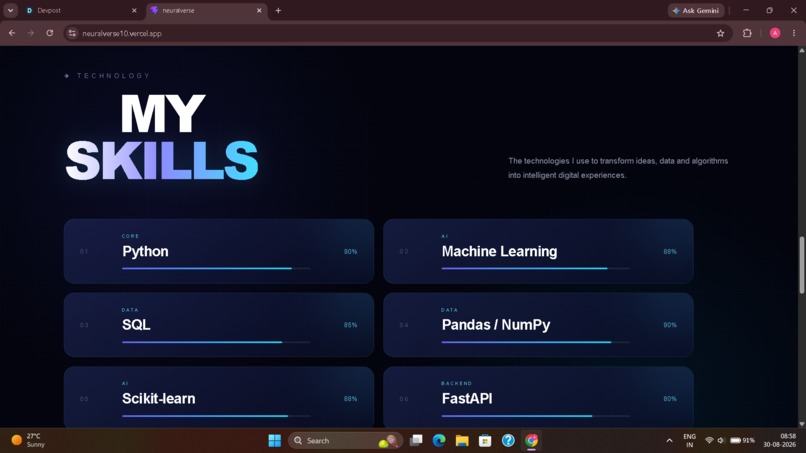
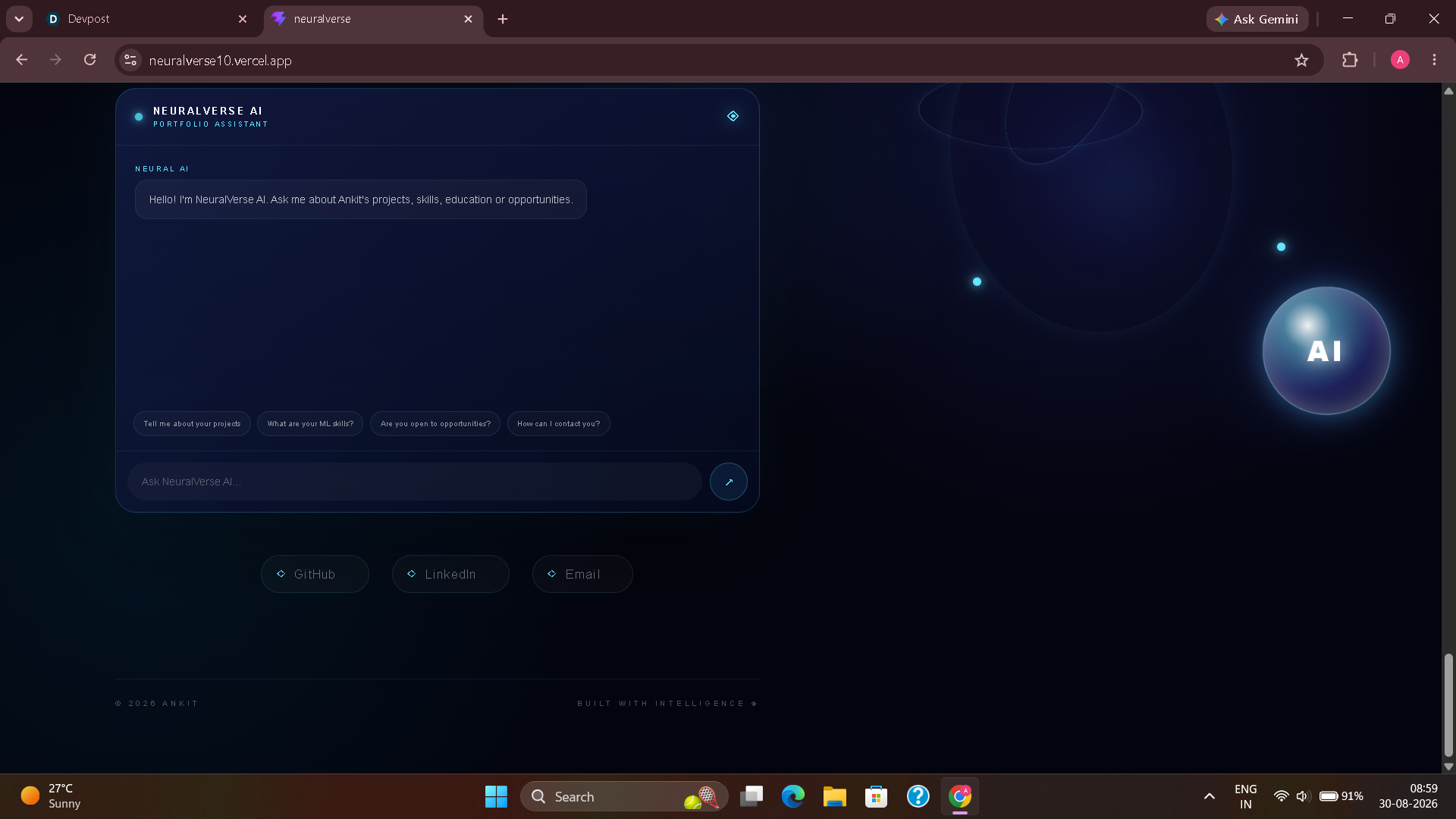
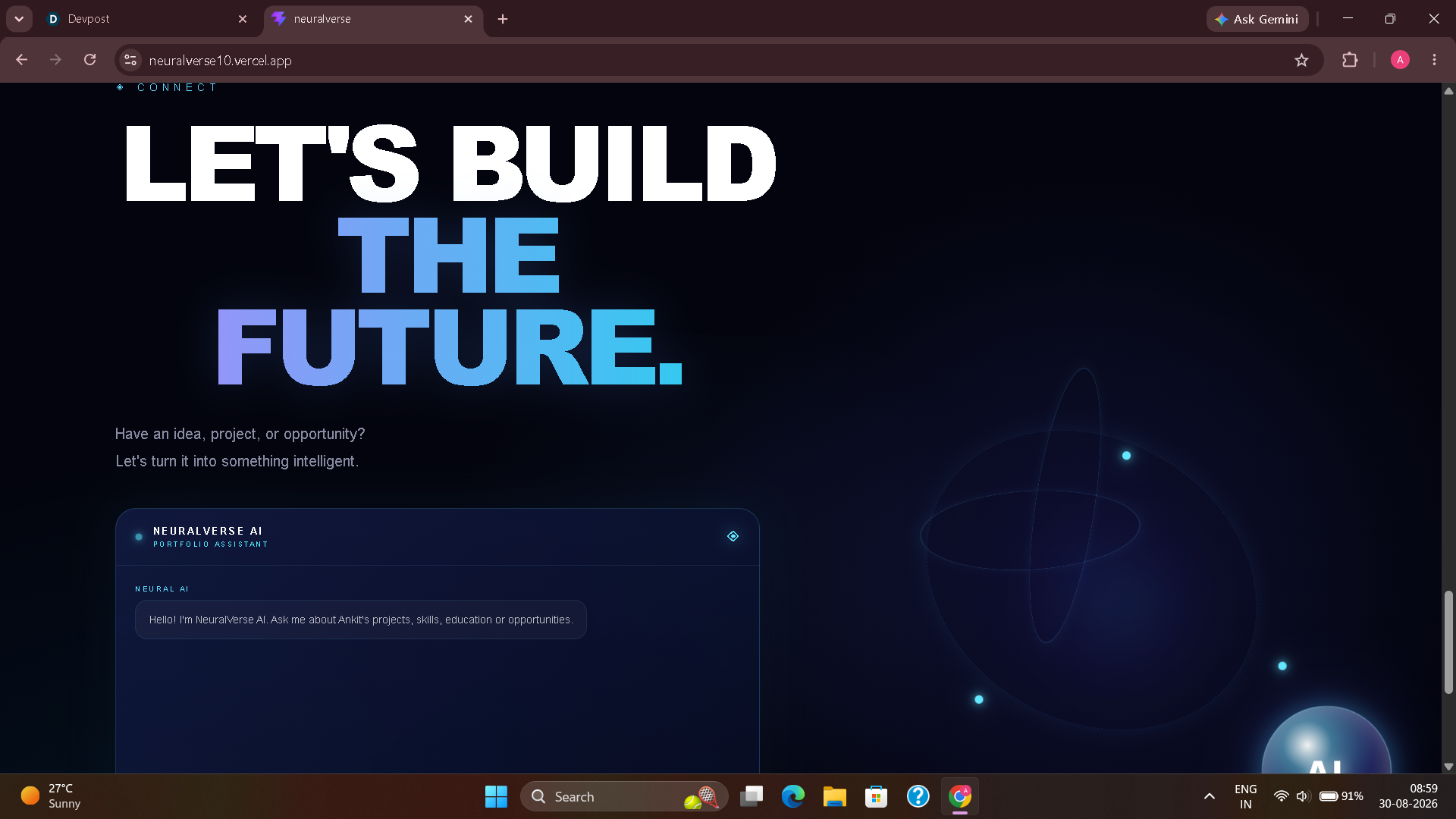
Interactive AI portfolio assistant helping visitors explore projects, skills, education, and opportunities.
-
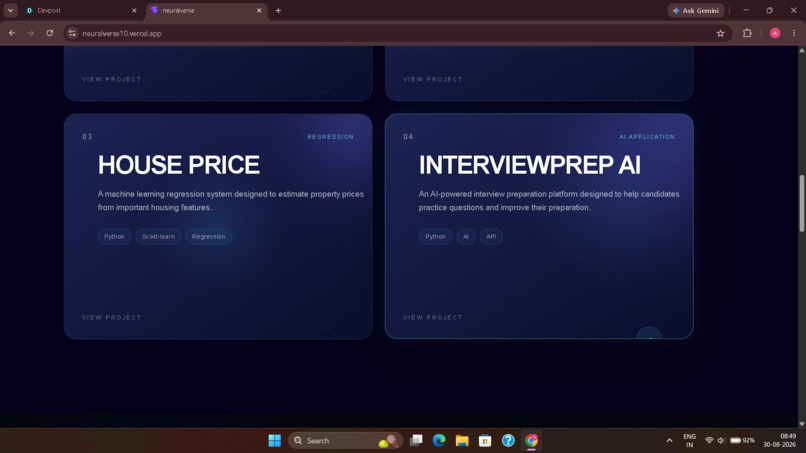
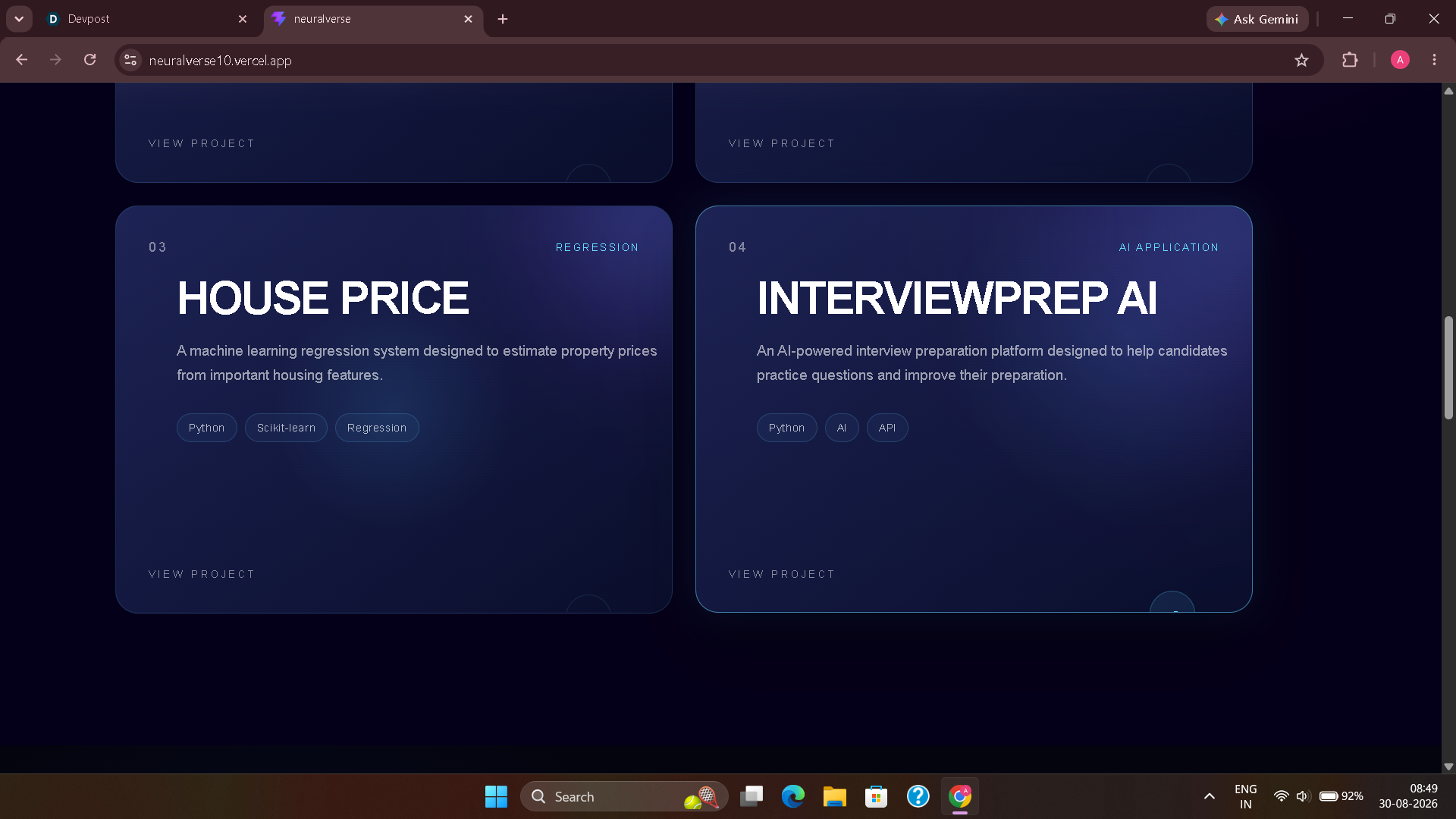
Project showcase featuring House Price Prediction and InterviewPrep AI, highlighting practical AI solutions.
-
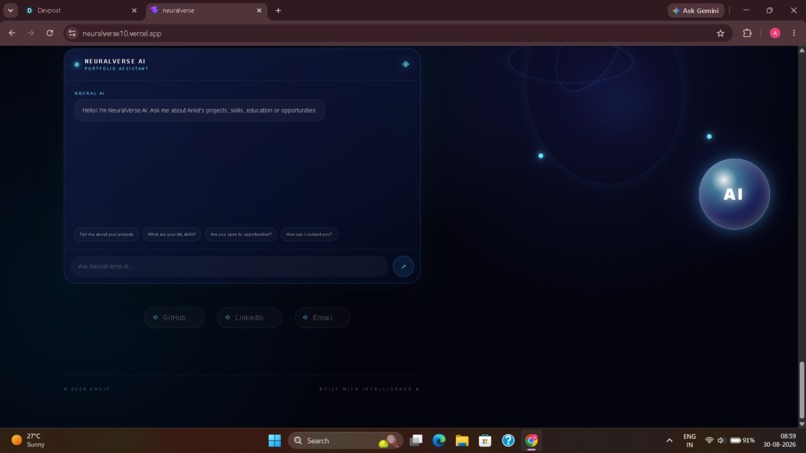
NeuralVerse AI interface connecting visitors with projects, professional profiles, and contact opportunities.
-
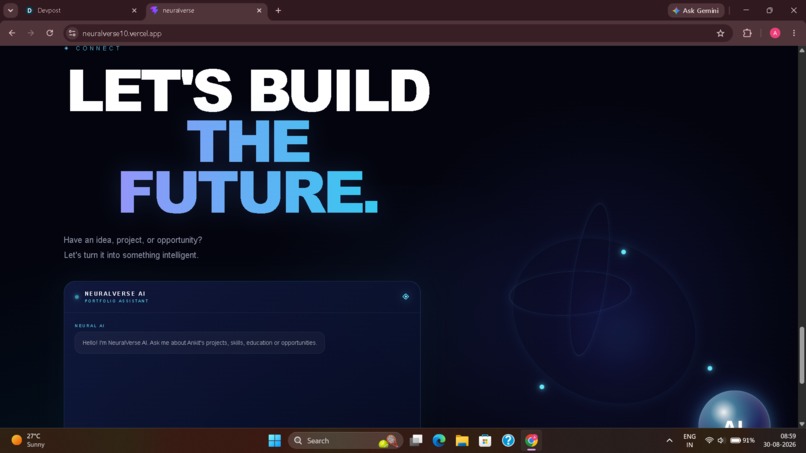
Interactive AI portfolio assistant helping visitors explore projects, skills, education, and opportunities.
Inspiration
Traditional portfolios often feel like static resumes on a webpage. We wanted to create something more immersive — an experience where visitors could explore a developer's work rather than simply scroll through a list of information.
The idea behind Immersi Verse was to combine modern web development, 3D visualization, animation, and an AI-inspired design language to create a digital universe around technology and creativity.
The neural-core concept represents interconnected ideas, technologies, and projects, while the surrounding space represents the continuously expanding possibilities of AI and software development.
What it does
Immersi Verse is an interactive 3D portfolio experience that presents projects, technical skills, and contact information through a futuristic digital interface.
Key features include:
🧠 Interactive 3D neural core 🌌 Animated star-field environment ✨ Particle and glow effects 🖱️ Mouse-responsive 3D interactions 🎬 Smooth UI animations 📂 Interactive project cards 🛠️ Skills showcase with progress indicators 🔗 GitHub and LinkedIn integration 📩 Direct email contact 📱 Responsive interface 🚀 Production deployment using Vercel
The project section showcases machine-learning and AI projects such as Customer Churn Prediction, Placement Prediction, House Price Prediction, and InterviewPrep AI.
How we built it
We built Immersi Verse using a modern React-based frontend architecture.
Tech Stack React Vite JavaScript CSS Three.js React Three Fiber React Three Drei Framer Motion Git & GitHub Vercel
The website was divided into reusable React components such as:
Navbar Hero 3D Scene Projects Skills Contact
For the hero section, we created a custom 3D neural core using React Three Fiber and Three.js. The core contains a central sphere, surrounding energy shell, neural nodes, and connections.
Framer Motion was used to create entrance animations and interactive project-card effects, while CSS was used for the overall visual system, responsive layout, glowing effects, and animations.
After development and testing locally, the project was pushed to GitHub and deployed to Vercel.
Challenges we ran into
One of our biggest challenges was combining a 3D environment with a normal responsive website.
The 3D neural core initially had positioning problems and did not align correctly with the hero content. We had to adjust the camera, object position, scale, and CSS layout to make the scene work properly across the screen.
Another challenge was preventing large typography and animated elements from overflowing the viewport.
We also had to carefully manage multiple animation systems — CSS animations, Framer Motion, and Three.js animations — without making the interface feel chaotic or affecting usability.
Finally, moving from a local development environment to a production deployment required us to verify the project structure, dependencies, build process, and GitHub integration.
Accomplishments that we're proud of
We're proud that we transformed a simple portfolio concept into a complete interactive experience.
Some accomplishments we're particularly proud of:
🧠 Created a custom 3D neural-core visualization 🌌 Built an immersive digital-universe environment ⚡ Added interactive mouse-based 3D movement 🎨 Developed a consistent futuristic visual identity 📂 Integrated real AI/ML projects into the experience 🧩 Structured the website using reusable React components 📱 Made the interface responsive 🔗 Connected the portfolio with GitHub and LinkedIn 🚀 Successfully deployed the final project to Vercel
Most importantly, we didn't want the website to feel like a standard template. We wanted the interface itself to demonstrate our creativity and technical ability.
What we learned
Building Immersi Verse taught us that creating a good web experience requires more than knowing individual technologies.
We learned how to combine:
React component architecture 3D graphics with Three.js React Three Fiber Framer Motion Advanced CSS Responsive design Git/GitHub workflow Production deployment
We also learned the importance of debugging visually. Sometimes the code can work correctly while the final composition still looks wrong. Positioning, spacing, responsiveness, and user interaction all have to work together.
The biggest lesson was that technology and design should support each other. A technically impressive feature is only valuable when it improves the user's experience.
What's next for Immersi Verse
Immersi Verse is designed to evolve beyond a portfolio.
Our next goal is to make it more intelligent and interactive by introducing an AI-powered personal assistant that can communicate with visitors and answer questions about projects, skills, and experience.
Future improvements could include:
🤖 AI portfolio assistant 💬 Interactive project conversations 📊 Live ML model demonstrations 📈 Real-time data visualizations 🎙️ Voice interaction 🌐 Dynamic GitHub activity 🕶️ WebXR/VR exploration ⚡ More advanced WebGL interactions
The long-term vision is to transform Immersi Verse from an interactive portfolio into an AI-powered personal digital universe.
Built With
- css
- framemotion
- javascript
- react
- techstack
- three.js
- vite

