-
-
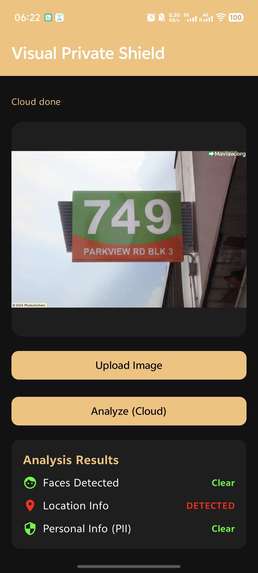
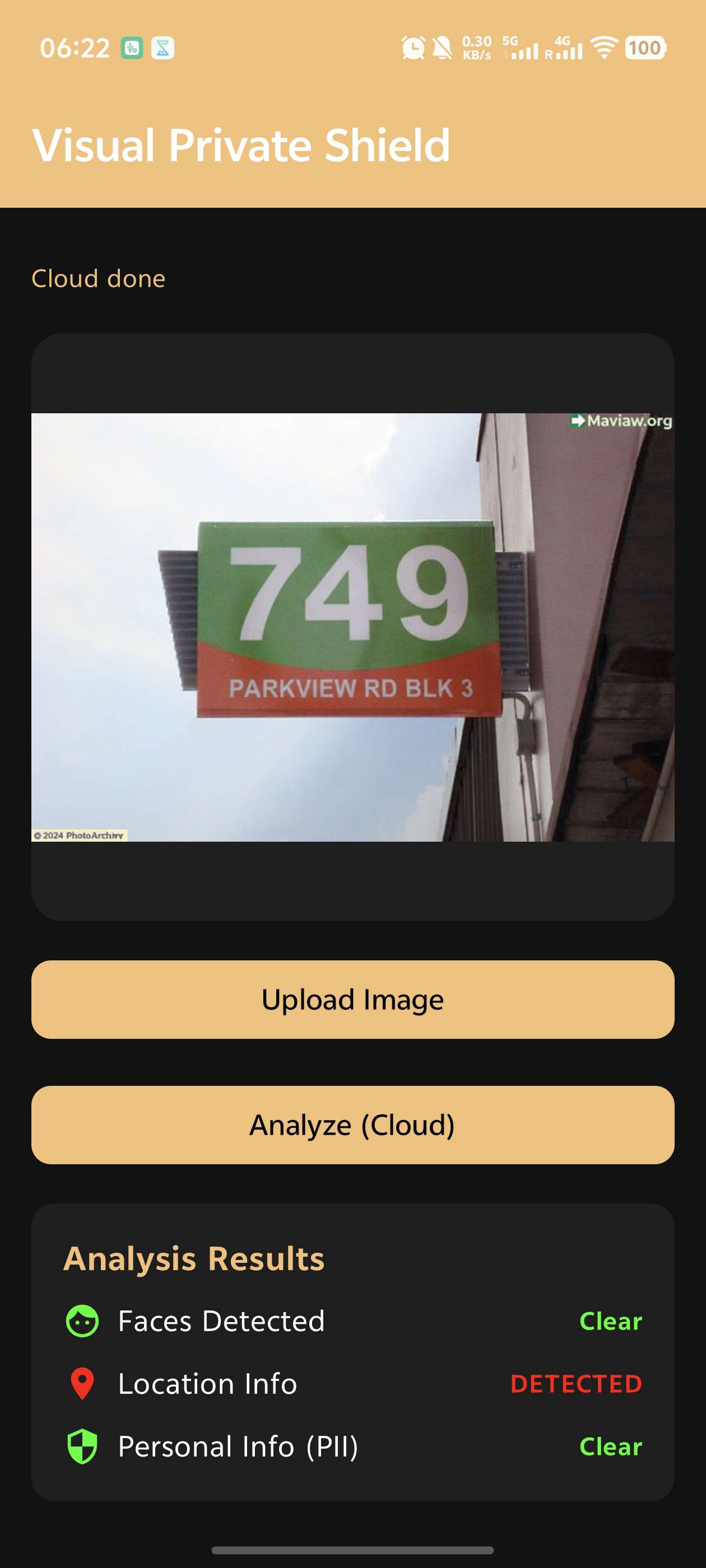
Display of altered location information
-
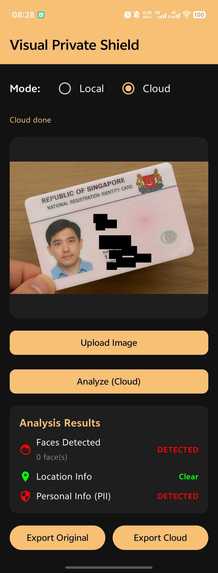
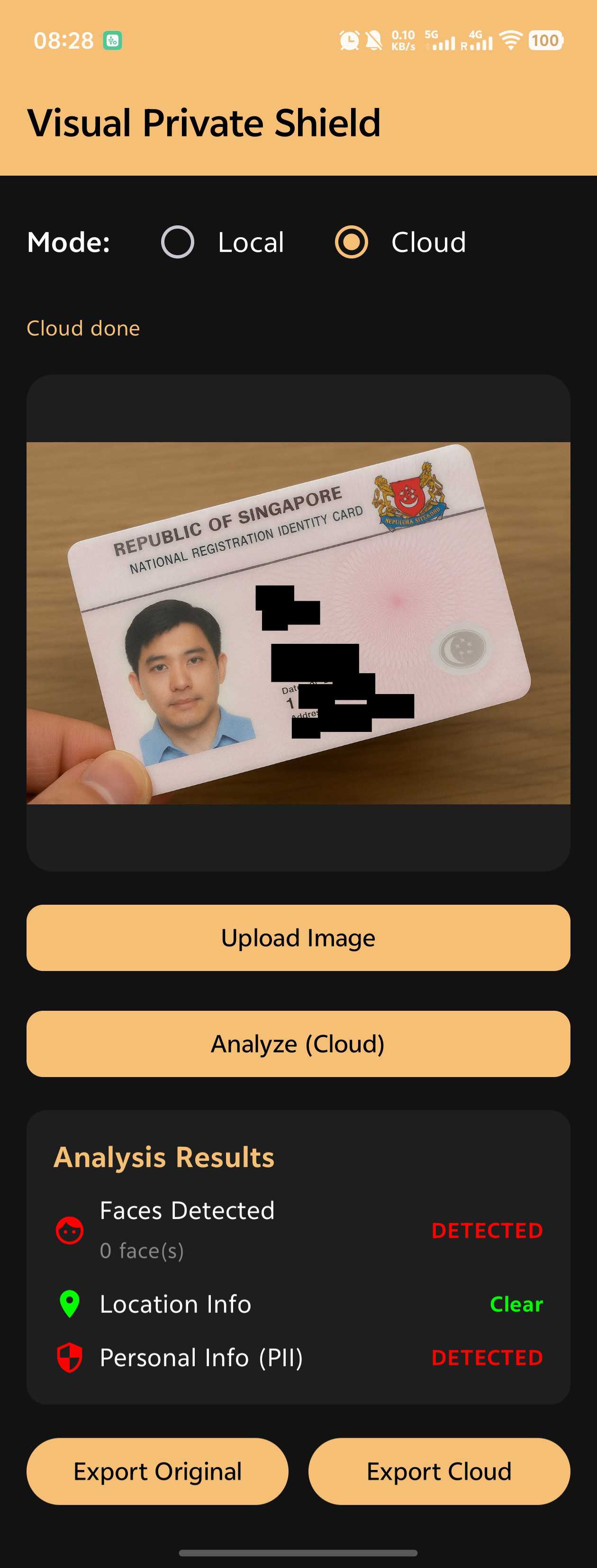
Display of censored PII information
-
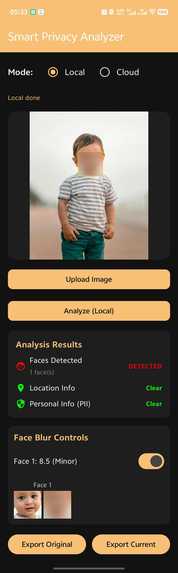
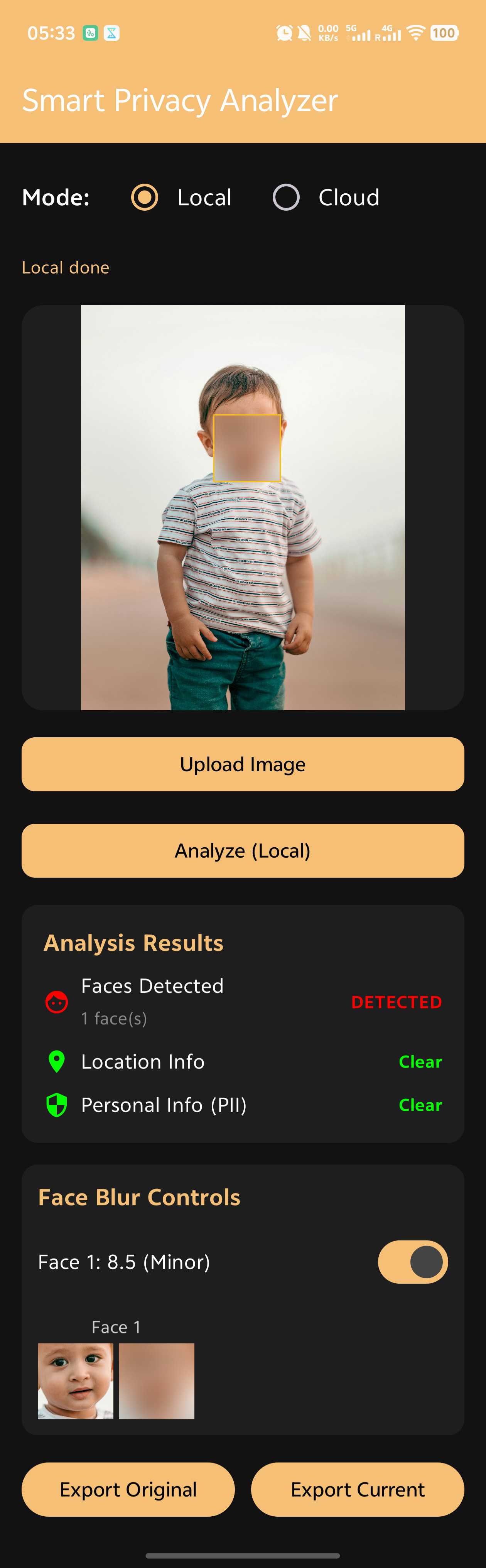
Display of blurred child face
Inspiration
The idea for Visual Privacy Shield was born from the rising privacy risks faced by everyday content creators, enterprises, and social media users. Every day, millions of photos and videos are uploaded that unintentionally expose sensitive details, faces of minors, residential addresses, license plates, or personal documents in the background.
Traditional solutions fall short: manual review is impossible to scale, simple blurring ruins visual authenticity, and human moderation raises its own privacy risks. We saw the need for a smarter, context-aware system, one that safeguards privacy while keeping the media authentic and usable. Visual Privacy Shield is our answer to that challenge.
What it does
Visual Privacy Shield is an intelligent privacy-protection system designed to keep sensitive information safe without degrading user experience.
The system runs locally on mobile devices whenever possible, ensuring data never leaves the phone unnecessarily. For complex tasks, it seamlessly offloads analysis to our distributed cloud environment, where advanced models provide deeper contextual understanding. This hybrid edge + cloud design delivers both privacy by default and scalability on demand.
Once an image is analyzed, the system generates precise, pixel-level coordinates and augmentation instructions, enabling privacy protection that is both accurate and aesthetically natural. Instead of crude blur boxes, we intelligently modify content to look realistic and preserve context.
Key capabilities include:
- Face detection with minor prioritization → Automatically masks under-18 faces while leaving adults untouched unless full masking is required.
- PII recognition in text → Detects names, phone numbers, emails, and other identifiers with options to redact, blur, or replace seamlessly.
- Location-sensitive content protection → Identifies geographic cues such as street signs, landmarks, or license plates and applies content augmentation. For example: a sign saying “Hillview Rd” might be replaced with “Parkline Ave”, maintaining the look and feel without exposing the real location.
- Edge-first, cloud-smart architecture → Ensures privacy stays on-device by default, with microservice-based cloud models available for more advanced inference and large-scale integration.
Note: For the demo we showed a simple toggle, but in production Gemma 3n runs locally to assess risk and confidence, then automatically decides whether to stay on-device or offload to cloud for advanced inference.
The result is a privacy shield that feels invisible: it protects sensitive details while keeping images natural, useful, and shareable.
How we built it
Visual Privacy Shield was designed as a hybrid edge-cloud AI system. The architecture prioritizes keeping sensitive data on the user’s device whenever possible. Lightweight computer vision (YOLOv8n, BlazeFace) and vision language models (Gemma 3n) can run efficiently at the edge, ensuring that initial detection of sensitive elements, like faces or text regions, never leaves the device. Only when deeper contextual reasoning is required, such as assessing whether text constitutes PII or evaluating geographic risk, does the system offload anonymized metadata or cropped feature sets to the cloud for advanced LLM or multimodal processing. This adaptive offloading reduces latency, minimizes data exposure, and strikes a balance between privacy preservation and detection accuracy.
To achieve flexible deployment, we containerized all components using Docker and orchestrated them with Docker Compose. Each AI capability, computer vision, PII analysis, location intelligence, and the API gateway, exists as an independent micro-service. This design brings several benefits:
- Scalability: Each service can scale independently depending on workload, such as spinning up additional vision services for high-volume image streams.
- Fault isolation: If one model or service fails (e.g., OCR downtime), others remain functional with graceful degradation.
- Portability: The same container images can run on cloud instances, local servers, or even be stripped down for deployment on edge devices.
- Rapid iteration: New models can be introduced or updated by redeploying only the affected container, without disrupting the full system.
This modular microservices approach, paired with edge-first inference and intelligent cloud fallback, allows Visual Privacy Shield to adapt across deployment environments, from mobile phones to large-scale social media platforms.
Accomplishments that we're proud of
We successfully proved the concept of edge-cloud privacy orchestration, where sensitive inference tasks (like face and text detection) remain local to the device, while advanced reasoning (like LLM-based contextual PII classification) is selectively offloaded to the cloud. This hybrid strategy ensures privacy-by-design without sacrificing the sophistication of multimodal AI.
Another key accomplishment is our containerized microservice deployment. By isolating each AI model in its own service, we gained the ability to upgrade, scale, and monitor individual components without affecting the whole system. This architecture also enables flexible deployment models, such as running lightweight containers on-device while connecting to cloud-hosted services for heavier tasks. It positions the system for diverse environments, from consumer smartphones to enterprise-scale moderation pipelines.
What we learned
We learned the value of designing AI systems with deployment flexibility as a core principle. Privacy protection workflows cannot rely solely on cloud computing, as transmitting sensitive images introduces risks. At the same time, edge-only approaches lack the computational power for advanced multimodal analysis. The key is intelligent orchestration between edge and cloud, with data minimization guiding every design choice.
We also discovered the power of containerized microservices for AI model integration. Traditional monolithic architectures make it hard to update or replace individual models. In contrast, our service decomposition allowed us to plug in different detection or classification models, test alternative versions in isolation, and scale resources based on workload. This level of modularity significantly reduced integration friction across vision, language, and multimodal domains.
What's next for Visual Privacy Shield
We plan to further enhance the edge AI capabilities, making more components, including OCR and basic PII classification, available for local execution on mobile and IoT devices. This would reduce dependency on the cloud while ensuring sensitive media never leaves user devices. At the same time, we aim to refine the cloud-offloading logic so that only minimal, privacy-preserving features (such as embeddings or anonymized bounding boxes) are transmitted for advanced contextual analysis.
On the systems side, we will continue strengthening our containerized deployment pipeline. Future iterations will adopt Kubernetes orchestration for enterprise use cases, supporting automatic scaling, rolling updates, and multi-cloud resilience. For consumer devices, we will explore lightweight container runtimes and model quantization techniques to shrink model footprints for mobile and edge deployment.
Ultimately, the goal is to provide a privacy-preserving AI framework that runs anywhere: secure and lightweight at the edge, powerful and context-aware in the cloud, and seamlessly integrated through modular containerized micro-services.
Built With
- ai-edge-lite-rt
- amazon-web-services
- android-studio
- docker
- flask-restx
- gemini
- gemma-3n
- github
- huggingface
- jetpack-compose
- kotlin
- mediapipe
- mlkit
- on-prem-server
- openai
- postman
- python
- swagger
- yolo


Log in or sign up for Devpost to join the conversation.