Inspiration
Images are increasingly difficult to evaluate.
AI assistants can explain images, but they often don't have direct access to the forensic evidence behind an analysis.
I wanted to explore a different approach: what if an image forensics application could expose its own analysis directly to an AI agent?
This led to ImageLens — a forensic analysis tool designed to work with AI agents through WebMCP.
What it does
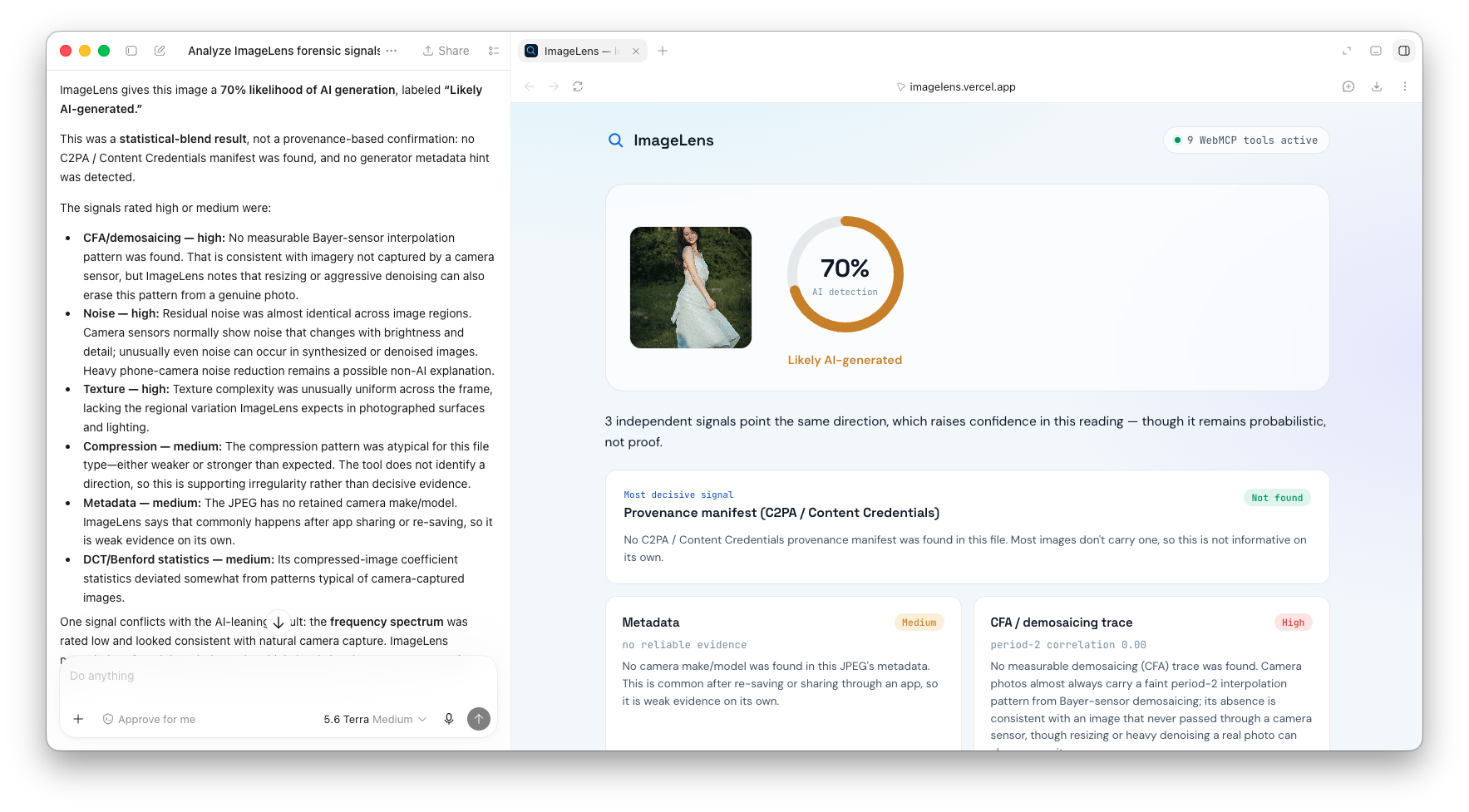
ImageLens analyzes images using its own statistical and forensic detection engine.
It examines multiple signals and produces structured results such as:
- Detection scores
- Forensic signals
- Image metadata
- Noise characteristics
- Frequency-domain analysis
- A combined forensic report
Through WebMCP, an AI agent can access these results directly from the application.
The agent can then investigate the evidence and explain the findings in natural language.
The important distinction is that the AI does not perform the underlying forensic analysis. ImageLens does.
How we built it
ImageLens is a web application with a client-side forensic analysis engine and a WebMCP integration.
The application's analysis engine produces structured results that are exposed through WebMCP tools.
The agent can query capabilities such as:
analyze_imageget_detection_scoreget_forensic_signalsget_metadataget_frequency_analysisget_report
These tools provide the agent with the same information available inside the application, without requiring the user to manually copy and paste results into an AI assistant.
The application and its WebMCP tools share the same underlying analysis logic, keeping the agent's information synchronized with the actual application state.
Challenges we ran into
One of the main challenges was deciding where the responsibility between the application and the AI should stop.
We deliberately did not make the AI the detector.
The forensic engine is responsible for analyzing the image and producing evidence. The AI is responsible for querying that evidence, connecting the different signals, and explaining them.
Another challenge was turning complex forensic information into structured WebMCP tools that an agent can understand and use effectively.
Accomplishments that we're proud of
We are proud that ImageLens is more than an image analyzer with an AI chatbot attached to it.
The WebMCP integration allows an agent to directly access the application's real forensic data.
An agent can independently retrieve different types of evidence, combine them, and produce an investigation-style explanation.
This creates a clear division of responsibilities:
ImageLens analyzes. The agent investigates. The human makes the final judgment.
We also designed the application to avoid making absolute claims about image authenticity. Forensic signals can indicate suspicious characteristics, but they cannot provide mathematical proof that an image was generated by AI.
What we learned
We learned that WebMCP can be particularly powerful for specialized applications.
Instead of trying to make the AI reproduce the application's domain-specific logic, the application can expose its expertise through structured tools.
This allows an AI agent to become an interface to specialized software without replacing the software itself.
We also learned that good WebMCP tools should expose meaningful domain-level capabilities rather than simply reproduce UI interactions.
What's next for ImageLens
The next step would be to expand the forensic toolkit with additional analysis methods and comparison capabilities.
Possible future features include comparing multiple images, detecting inconsistencies between image regions, generating more detailed forensic reports, and allowing agents to conduct multi-step investigations across several images.
The long-term goal is to make ImageLens a specialized forensic engine that AI agents can use as part of larger investigation workflows.
ImageLens doesn't just detect. It gives agents evidence they can investigate and explain.
Built With
- ai-agents
- artificial-intelligence
- image-forensics
- lucide
- openai
- react
- tailwind
- vite
- web-development
- webmcp


Log in or sign up for Devpost to join the conversation.