-
-
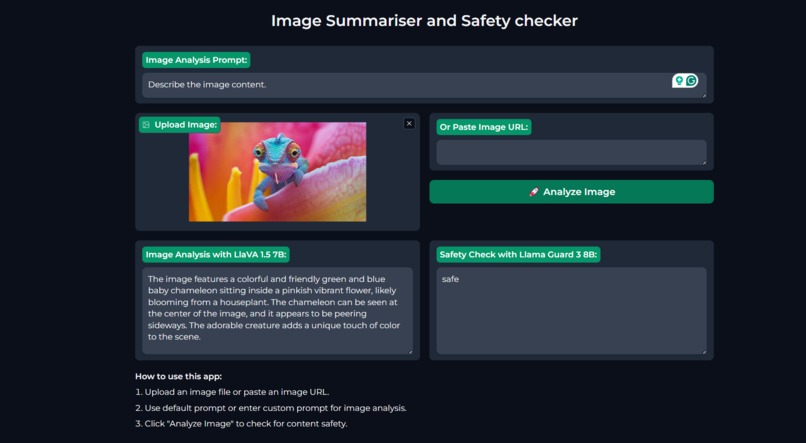
working representation of the project
Inspiration
The rapid growth of user-generated content and the increasing need for moderation inspired us to create a tool that not only summarizes images but also ensures their safety. From social media platforms to content review sites, the demand for quick and efficient tools that can automatically generate image descriptions and assess their appropriateness is on the rise. With NVIDIA AI Workbench, we knew we could leverage cutting-edge technology to develop a solution that provides speed, accuracy, and reliability, all within a short time frame. And the best part? The entire project was completed in just 10 hours!
What it does
The Image Summarization and Safety Checker Tool is a dual-function application that:
- Summarizes images: Provides concise natural language descriptions of images, making it easy to understand the content at a glance.
- Checks image safety: Detects and flags inappropriate or harmful content, helping to ensure compliance with safety standards and content guidelines.
How we built it
We built this project using NVIDIA AI Workbench for GPU acceleration, ensuring that both the summarization and safety check processes run efficiently and in real-time. Here's a breakdown of the tools and technologies used:
- CLIP/BLIP models for accurate image summarization.
- ResNet/EfficientNet models for detecting unsafe or inappropriate content.
- Flask for building the user interface, allowing users to upload images, view summaries, and check the safety status.
- Docker for containerizing the application to ensure portability and ease of deployment.
- Everything, from writing code to creating the README.md, was done within a 10-hour sprint to complete the project from start to finish.
Challenges we ran into
Time was the biggest challenge! Completing the entire project in just 10 hours required focus and efficiency. Here are a few hurdles we faced along the way:
- Model Integration: Ensuring the image summarizer and safety checker models worked smoothly in tandem.
- Performance Optimization: We had to ensure that both functionalities run at GPU speeds, especially when processing larger images.
- UI Simplicity: Building an intuitive and easy-to-use interface in a short time was crucial to allow seamless interaction for users.
Accomplishments that we're proud of
We’re proud to have developed a fully functional tool in such a short amount of time. Key accomplishments include:
- Real-time summarization and safety checking: Achieved both functionalities with high accuracy and speed.
- Efficient GPU Utilization: Optimized the project to leverage NVIDIA GPUs for faster inference and real-time performance.
- 10-hour completion: Despite the tight deadline, we managed to build, test, and document everything in under 10 hours, including writing a comprehensive README and setting up the project for deployment.
What we learned
In this project, we learned how to efficiently integrate AI models for different tasks—summarization and safety detection—into a single workflow. We also gained hands-on experience with NVIDIA AI Workbench, learning how to deploy and optimize AI models for GPU systems. The 10-hour sprint taught us the importance of time management, task prioritization, and rapid problem-solving.
What's next for Image Summarization and Safety Checker
The potential for this tool is enormous. Some exciting possibilities for the future include:
- Multilingual Support: Expanding image summarization to support multiple languages.
- Expanded Safety Categories: Adding more categories for safety checks, such as violence detection or privacy risks like identifying personal data in images.
- Customizable Summarization: Allowing users to choose the level of detail in the image summary (e.g., brief vs. detailed).
- API Integration: Building an API so that the tool can be easily integrated into platforms that deal with large volumes of user-generated content.


Log in or sign up for Devpost to join the conversation.