-
-
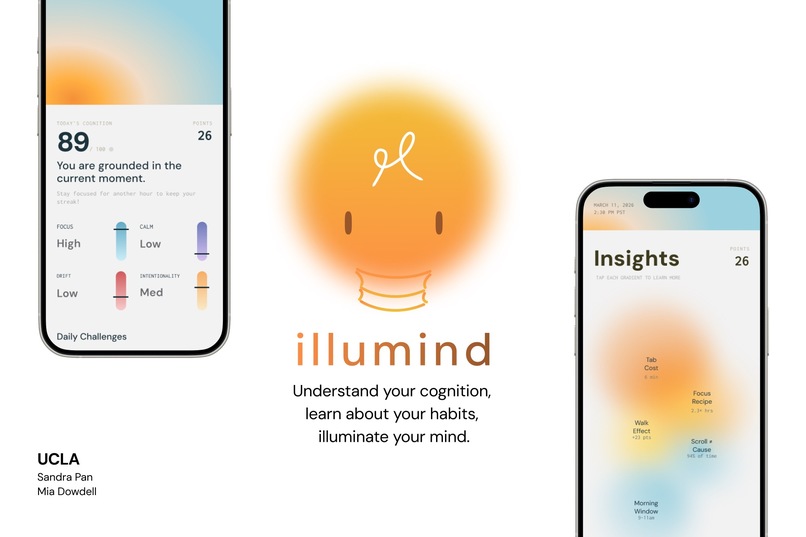
Understand your cognition, learn about your habits, illuminate your mind.
Inspiration
The rise of short-form video and endless social media feeds, as well as the term "doom-scrolling" incited a question: why can't we see what this is doing to our brains? There are numerous app blocking devices with interventions but none show the effects of cognitive health, especially as it's influenced by our digital habits. We were inspired by the gap between how much time people spend consuming digital content and how little awareness they have of the cognitive cost. The idea that metacognition, the ability to perceive the quality of your own thinking, could become a measurable, actionable sense drove the entire project.
What it does
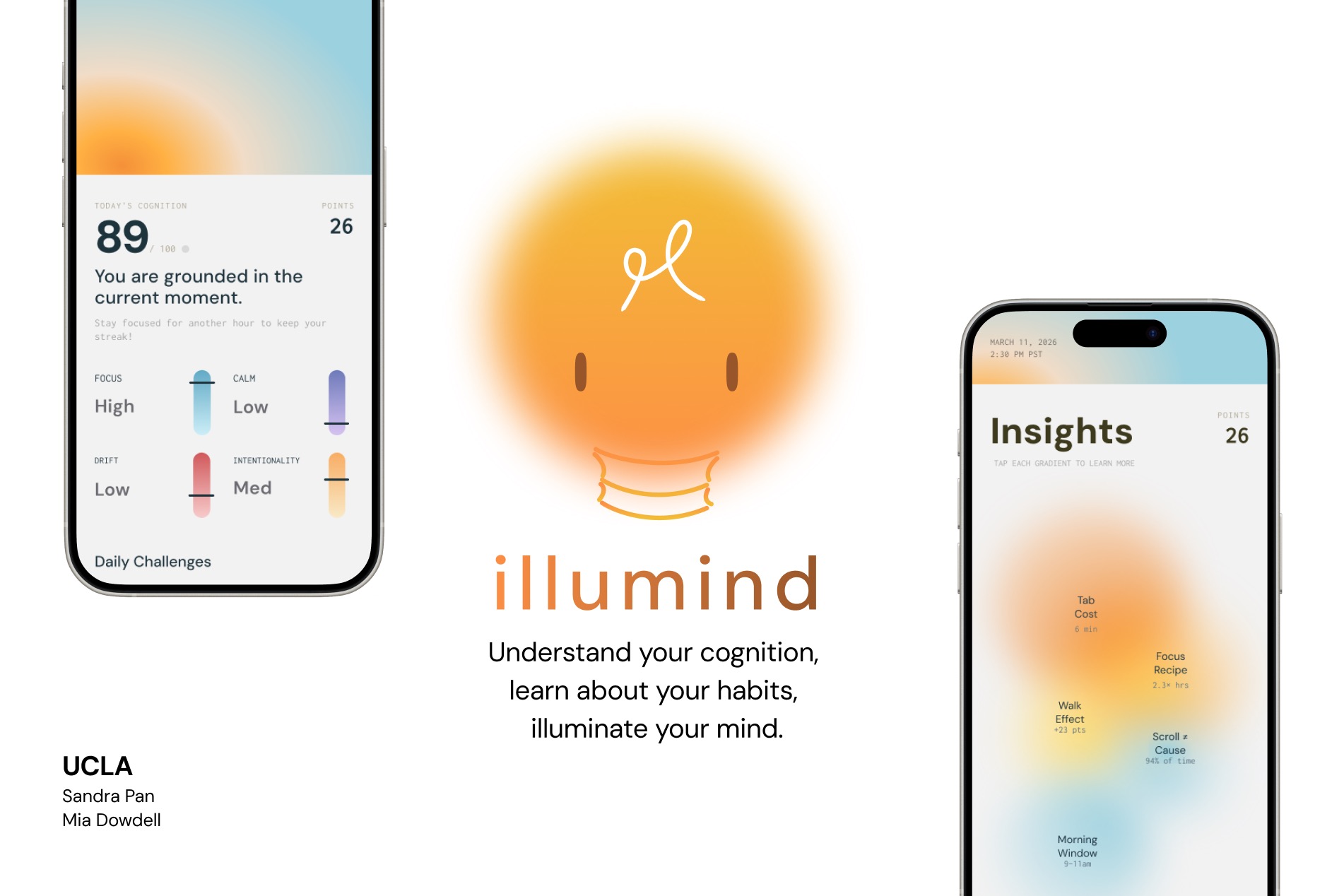
Illumind is a mobile app paired with a wearable device that measures and visualizes your cognitive state in real time. It transforms invisible mental patterns into clear insights that help users improve their digital habits and cognitive health. By combining brainwave frequency analysis from the wearable with behavioral signals already present on your device, that being scroll speed, typing rhythm, and app-switching frequency, Illumind distinguishes between passive and active content absorption. Users receive visualized reports showing which apps, content types, and times of day most affect their cognitive state, along with streaks and points to motivate healthier habits.
How we built it
We designed Illumind around two data layers: the wearable (brainwave/EEG frequency monitoring) and on-device behavioral signals (scroll speed, typing cadence, tab-switching rate). These signals are processed together to calculate a composite cognition score. The mobile app displays this data through graphs, and summary visualizations, broken down by app, content/activity type, and time of day.
Challenges we ran into
The biggest challenge was defining what cognition looks like in behavioral data. Brainwave readings alone don't tell the whole story, and neither does scroll speed alone; the insight comes from combining them meaningfully and extracting correlations from that. We also wrestled with privacy architecture: tracking device activity is inherently sensitive, so we had to design granular consent controls (per-app data sharing toggles, wearable-optional mode). Thinking about how to show a lot of data in a consumable way that didn't overwhelm users was difficult throughout the design process.
Accomplishments that we're proud of
We're proud of reframing cognition as a trackable wellness dimension on par with sleep or fitness. Most wellness tools stop at physical or emotional health; Illumind makes mental acuity legible in a new way. We're also proud of designing for a wide age range (12–65), creating use cases that feel genuinely relevant whether you're a college student doomscrolling, a working professional trying to optimize focus windows, or an older adult wanting to maintain better cognition function.
What we learned
We learned that invisible experiences are hard to design for precisely because we didn't know how to demonstrate a user with low focus. How would the data show that through the EEG data as well as device tracking? This drove us to investigate data visualization to showing users their patterns over time in a digestible way. We also learned that safety measures around sensitive data and edge cases are important because they're a core part of the user experience when the product is tracking something as personal as your cognition.
What's next for Illumind
We are curious and want to explore group insights for settings like classrooms or workplaces, where aggregate (anonymized) cognition trends could help educators and managers make better decisions about screen time and meeting scheduling. Long-term, we see Illumind as the foundation for a new category of cognitive wellness that sits alongside, and informs, physical and emotional health tracking.
Built With
- claude
- figma


Log in or sign up for Devpost to join the conversation.