-
-
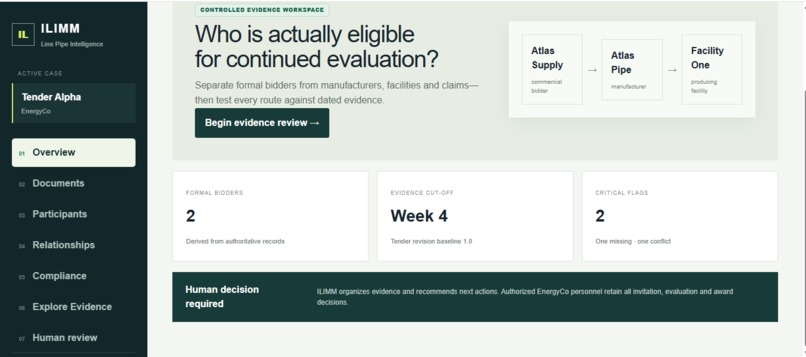
01.Overview
-
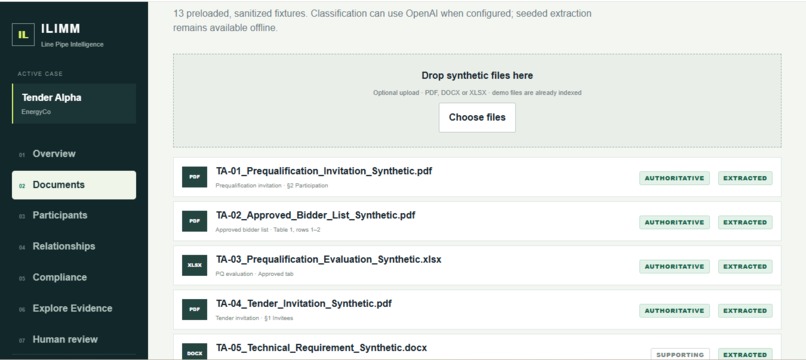
02.Documents
-
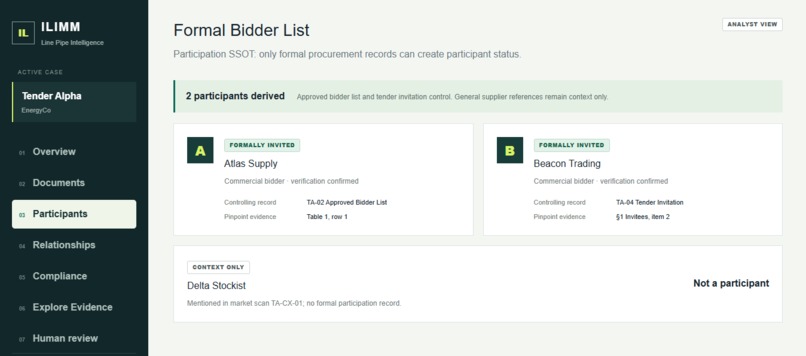
03.Participants
-
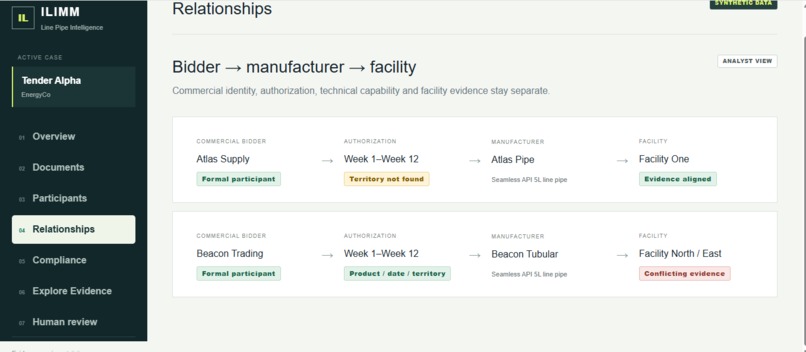
04.Relationship
-
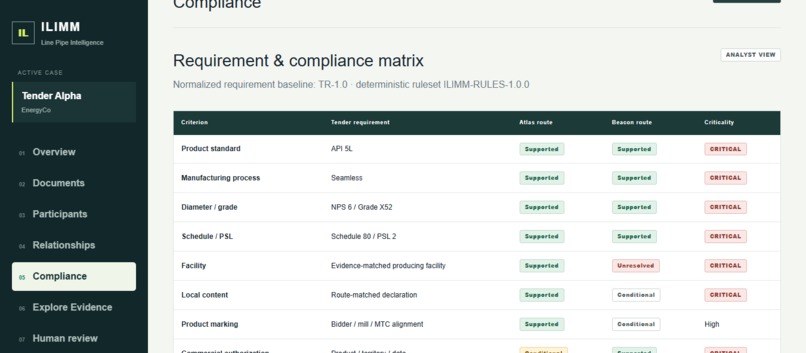
05.Compliance
-
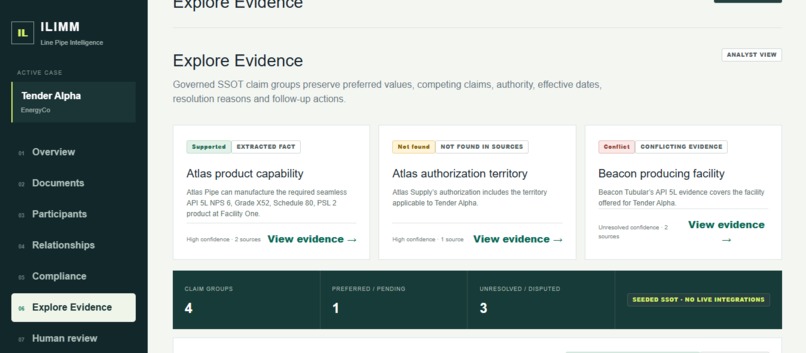
06.Explore Evidence
-
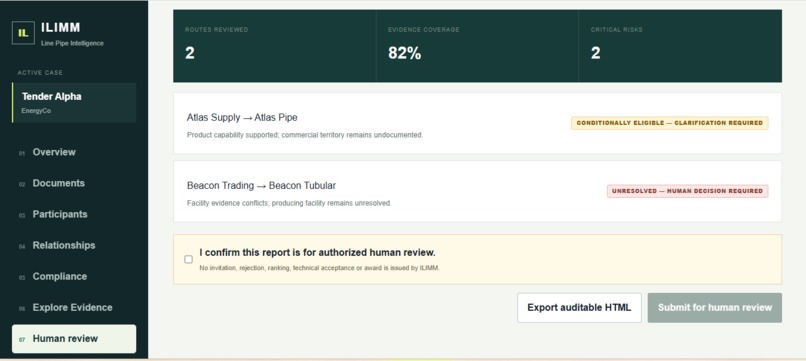
07.Human Review
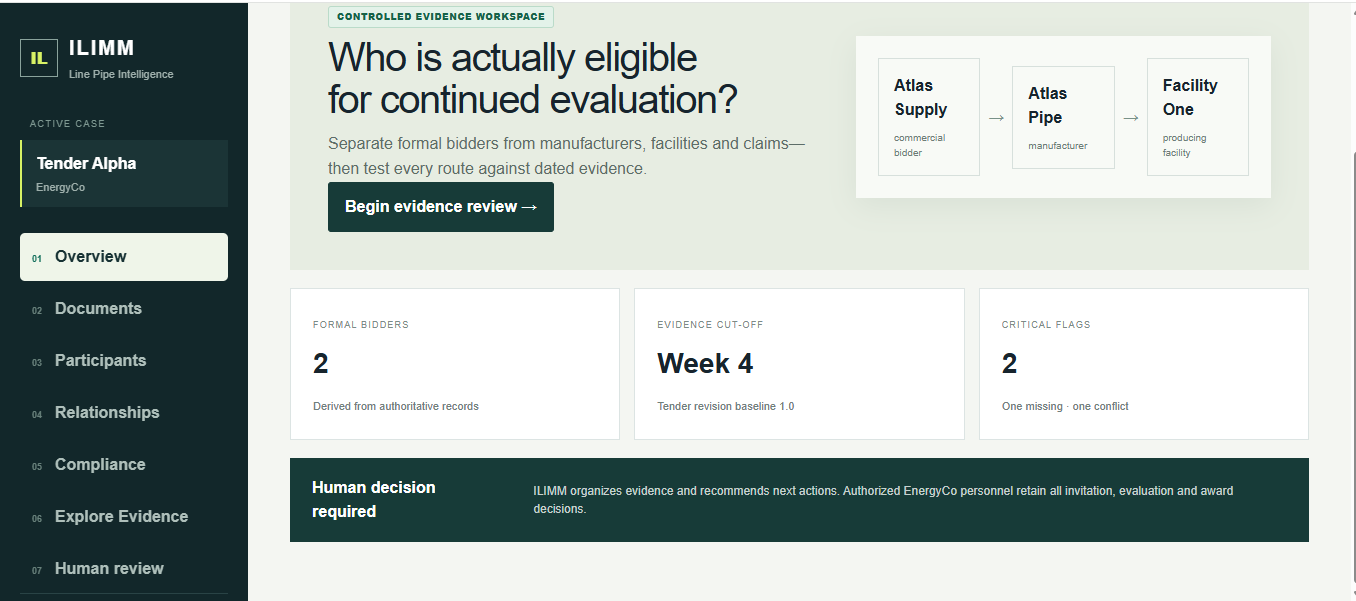
Inspiration
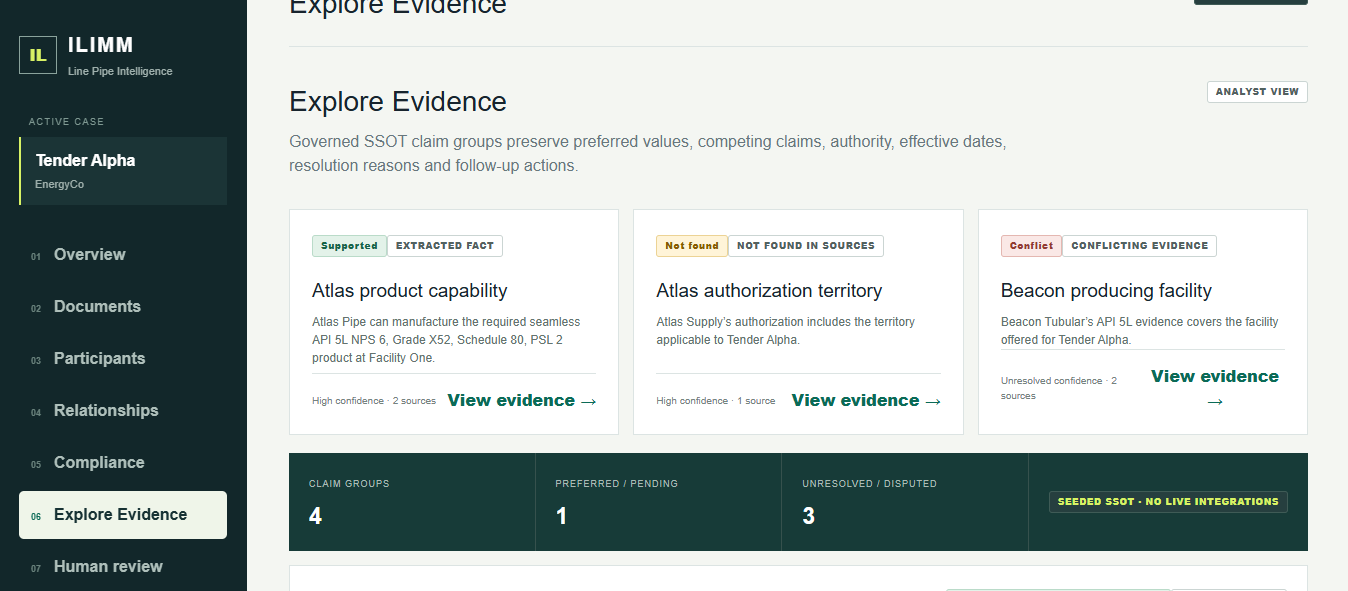
Indonesia’s line-pipe industry depends on fragmented evidence spread across procurement rules, supplier submissions, API 5L records, TKDN and local-content certificates, CIVD data, manufacturer claims, facility information, and project requirements.
Procurement teams must determine who is actually a manufacturer, processor, agent, distributor, or formal tender participant, and whether the supporting evidence is current, authorized, technically relevant, and consistent.
We built ILIMM to turn that fragmented evidence into one governed market landscape.
What it does
ILIMM is an AI-powered operating layer for Indonesia’s line-pipe industry.
It helps users:
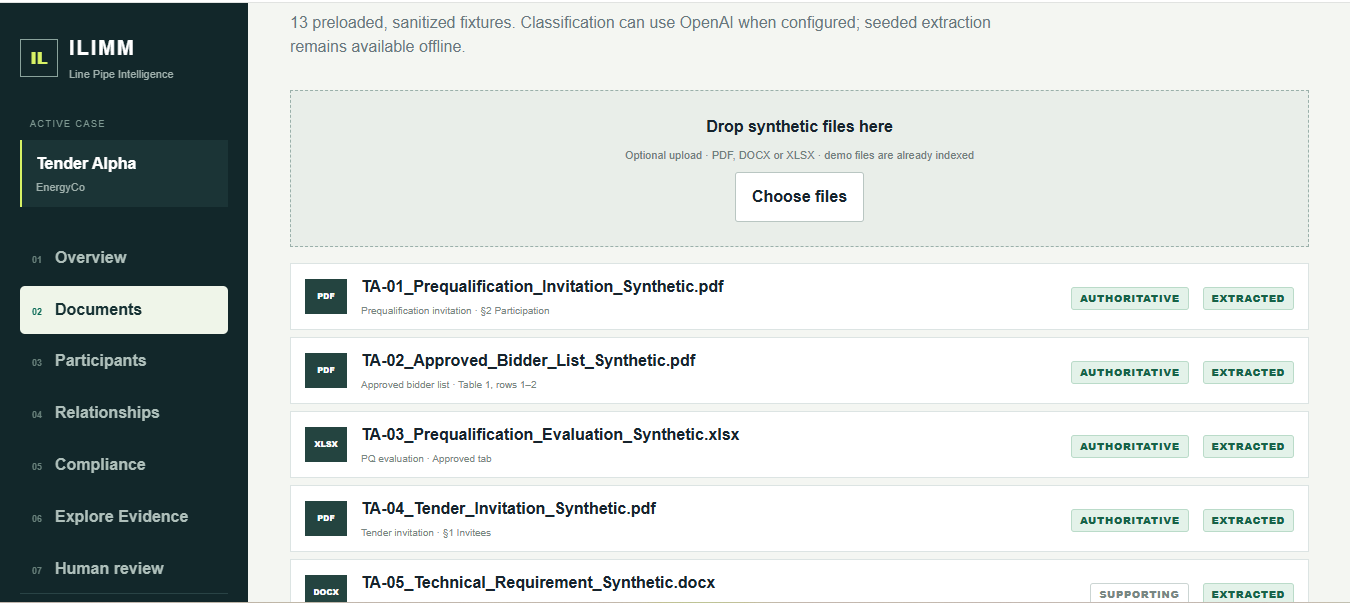
- establish the governing Single Source of Truth;
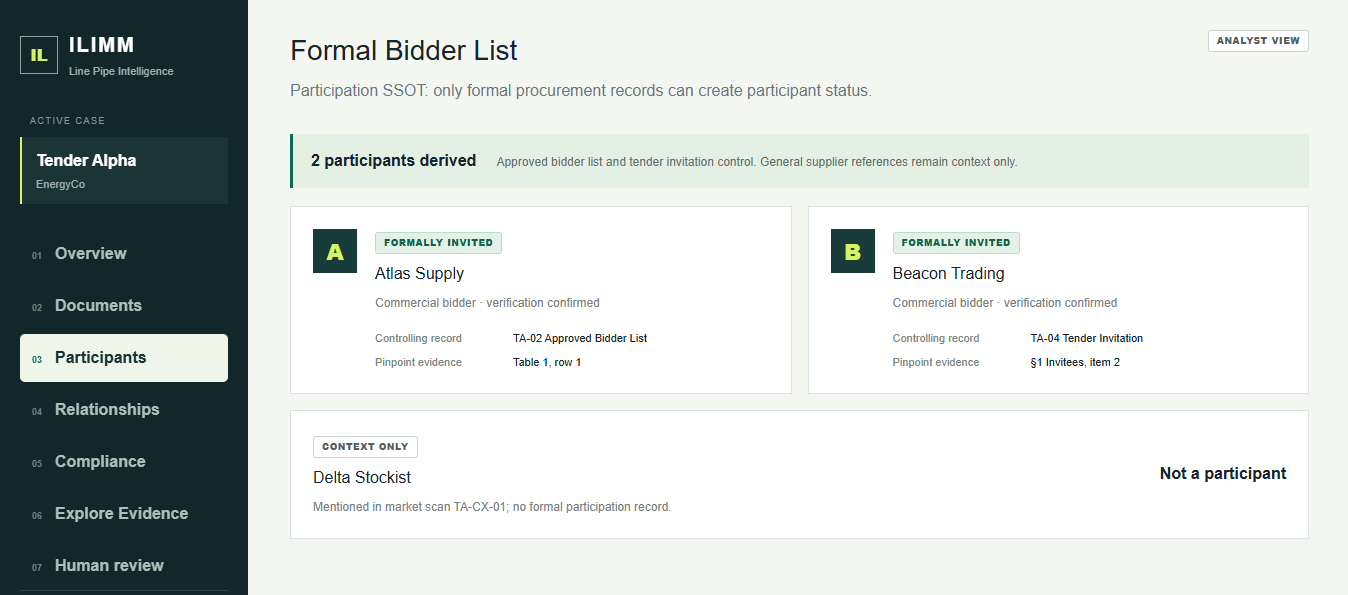
- identify formal tender participants;
- distinguish bidders, agents, distributors, processors, manufacturers, and producing facilities;
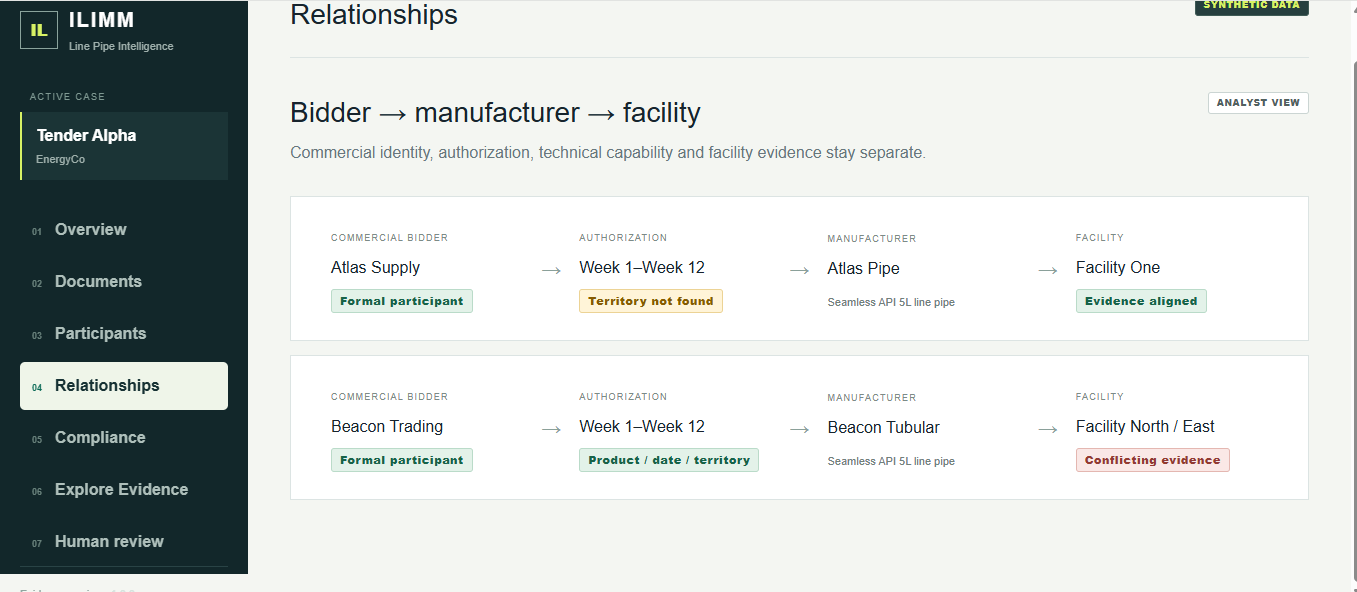
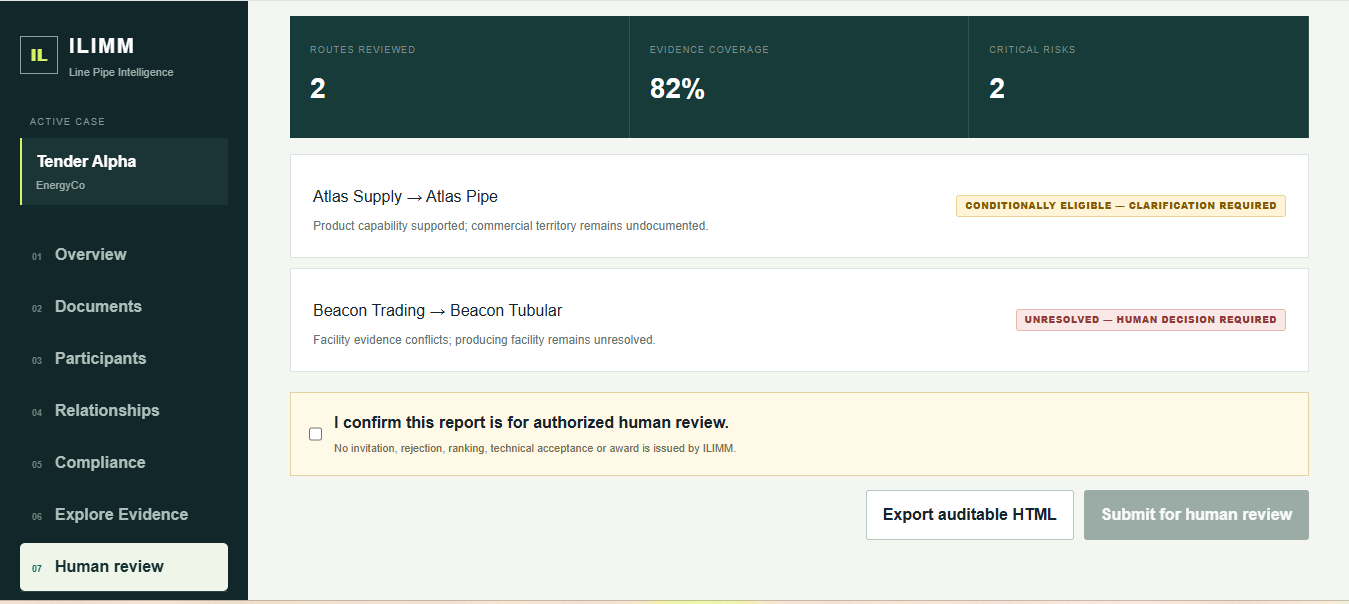
- map bidder-to-manufacturer authorization chains;
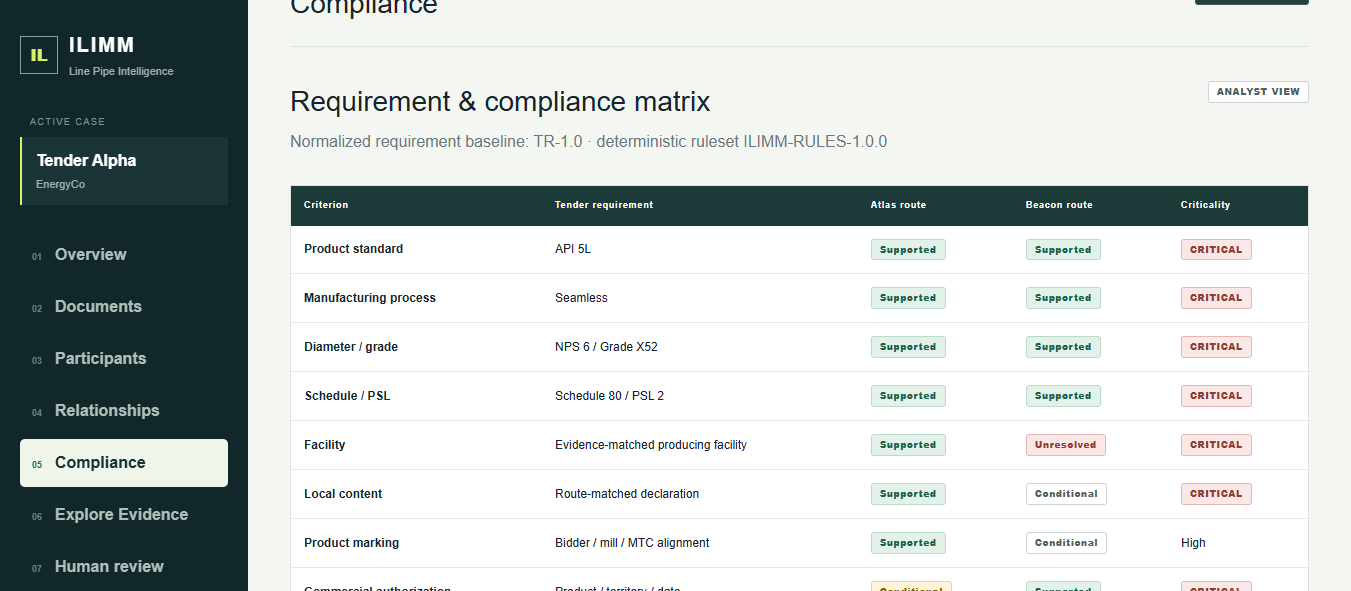
- evaluate evidence against PTK-007, API 5L, TKDN and local-content requirements, and tender requirements;
- detect missing, conflicting, expired, or unauthorized evidence;
- generate clarification and verification actions;
- preserve human approval for final procurement decisions.
The same governed workflow can be reused for other strategic procurement and supply-chain categories.
How we built it
The MVP was built with Codex as the primary development environment and GPT-5.6 as the intelligence and orchestration layer.
The application includes:
- a Next.js interface;
- a SQLite-backed data model;
- a governed SSOT and evidence architecture;
- versioned claims and historical evidence;
- predicate-specific source-authority rules;
- deterministic procurement guardrails;
- conflict and expiry detection;
- joint-verification task generation;
- human-review controls;
- anonymized synthetic tender data.
GPT-5.6 supports evidence extraction, normalization, reconciliation, regulatory reasoning, contradiction detection, clarification drafting, and evidence-backed explanation.
Deterministic rules control hard procurement gates. Authorized humans retain the final decision.
Challenges we ran into
The main challenge was not document search. It was deciding what evidence should control a procurement conclusion when several sources disagree.
We therefore designed ILIMM so that it does not silently overwrite conflicting information. It preserves competing claims, ranks source authority by subject, checks effective dates and scope, and escalates material conflicts for clarification or joint verification.
A second challenge was responsible scope. Live CIVD, APDN and TKDN, API, PSC inventory, manufacturer-capacity, and regulator integrations require authorization, institutional agreements, access controls, and production-grade security. The MVP does not falsely claim that those integrations are already operational.
Accomplishments that we're proud of
- Preserved the original working MVP while adding a governed SSOT and evidence architecture.
- Implemented versioned claims, source-authority rules, conflict detection, expiry handling, and joint-verification tasks.
- Kept deterministic procurement controls and human-review gates intact.
- Passed production build, lint, database migration, disclosure scan, and 27 out of 27 automated tests.
- Built the platform without exposing confidential employer, vendor, tender, pricing, or project information.
- Created a reusable procurement and SCM workflow that can be applied beyond line pipe.
What we learned
A procurement AI system should not act as an autonomous decision-maker.
The strongest design pattern is:
Define the authoritative SSOT → ingest submitted evidence → reconcile claims → identify gaps and conflicts → generate verification actions → preserve human accountability.
This pattern is applicable beyond line pipe to supplier prequalification, contract compliance, vendor management, local-content verification, certificate monitoring, inventory qualification, logistics assessment, and other SCM workflows.
What's next for ILIMM — Indonesia Line Pipe Intelligence & Market Map
ILIMM can scale into a shared interface among:
- Production Sharing Contractors;
- pipeline vendors;
- manufacturers and processors;
- agents and distributors;
- SKK Migas;
- relevant government and local-content authorities;
- inspection bodies;
- investors.
Future modules include:
- Procurement Strategy Copilot;
- DeepFind evidence search;
- Indonesian manufacturer and logistics market map;
- PSC demand and inventory integration;
- manufacturer capacity and production-slot integration;
- regulatory-update monitoring;
- supplier-risk intelligence;
- investment and supply-demand analysis.
The platform can ultimately connect demand, supply, compliance, capacity, inventory, logistics, and market intelligence through one governed SSOT.
Why line pipe matters
Molecules cannot be transmitted wirelessly.
Oil, gas, water, hydrogen, and captured CO₂ require physical transport infrastructure. AI may transform how pipelines are planned, procured, inspected, and operated, but it will not eliminate the need to transport molecules.
ILIMM applies AI to make that enduring physical supply chain more transparent, auditable, efficient, and investable.
Built With
- 5l
- ai
- analytics
- and
- api
- business
- chain
- codex
- data
- evidence
- gas
- governance
- gpt-5.6
- next.js
- node.js
- oil
- openai
- procurement
- ptk-007
- react
- sqlite
- ssot
- supply
- tkdn
- typescript

Log in or sign up for Devpost to join the conversation.