-
-
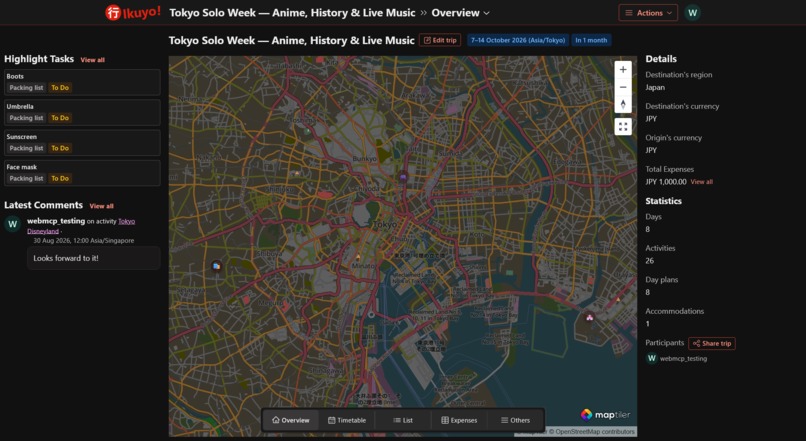
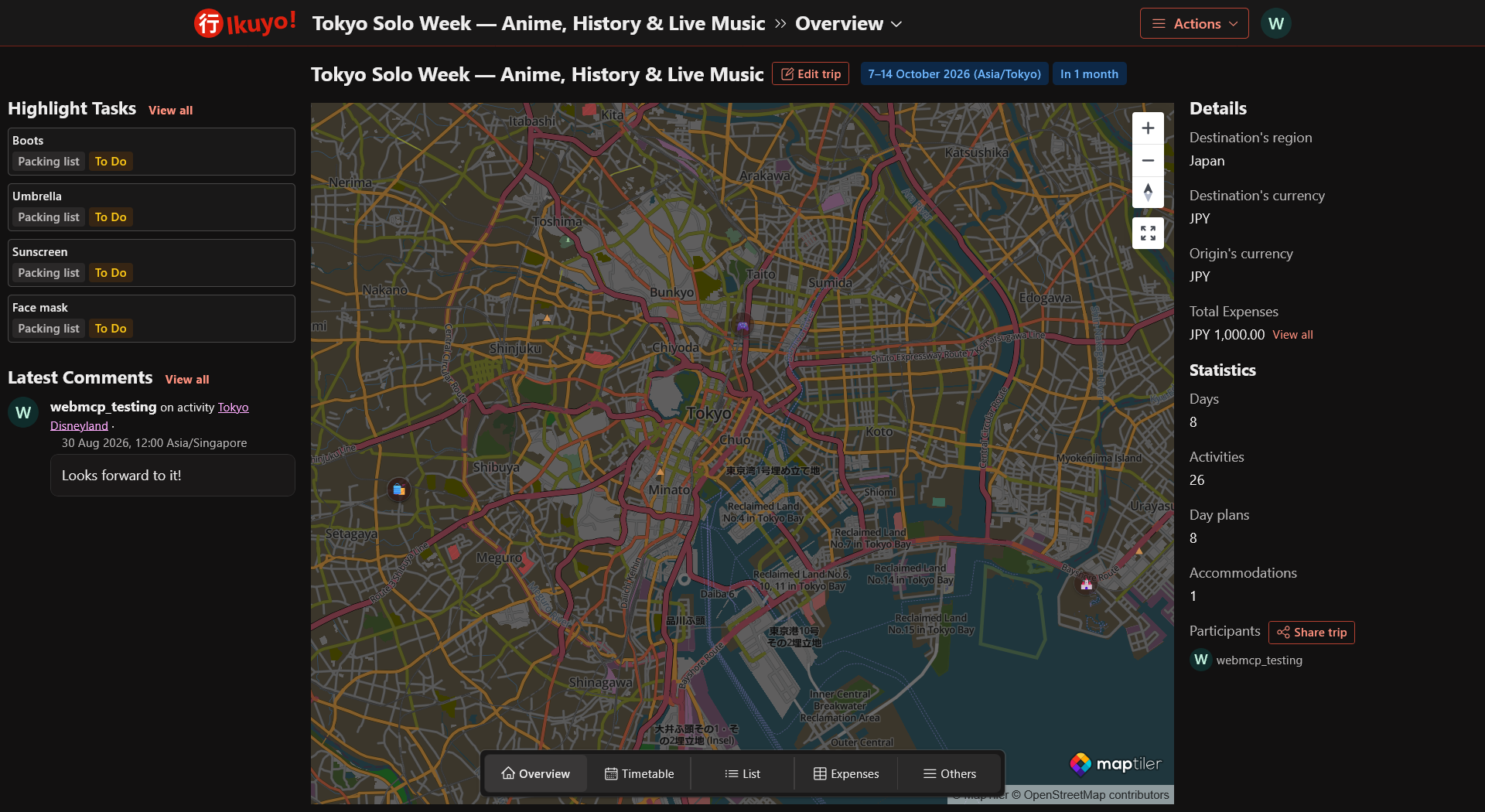
Ikuyo trip home
-
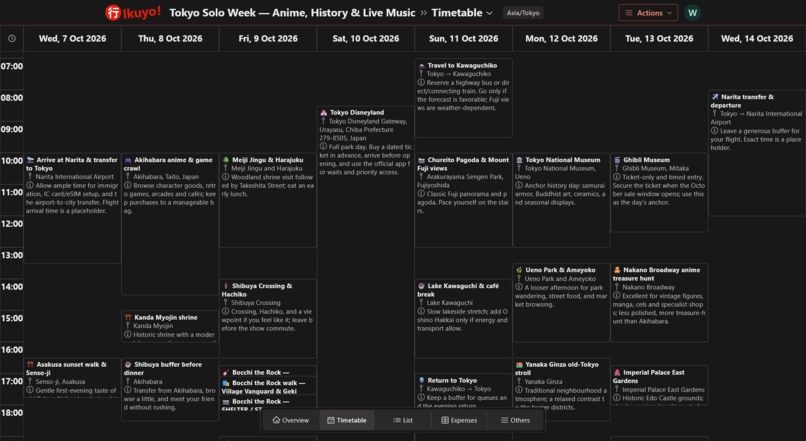
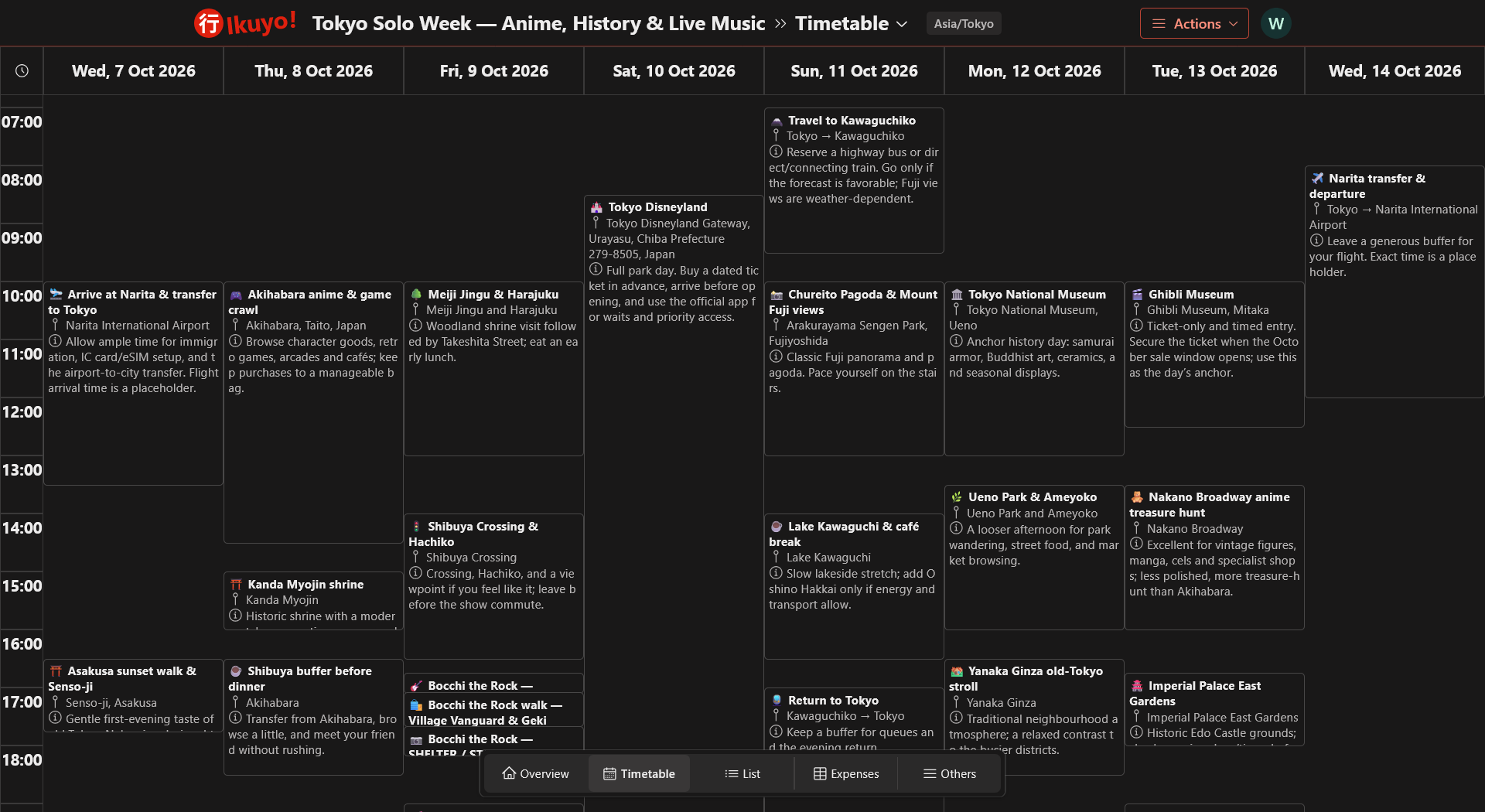
Ikuyo trip timetable
-
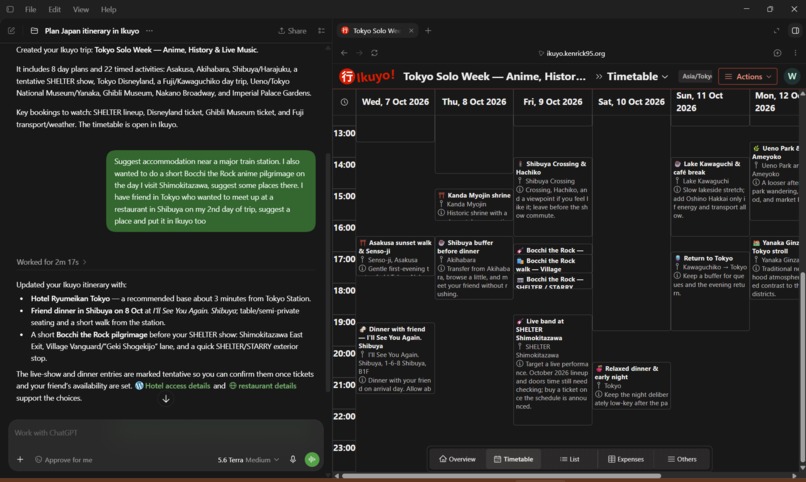
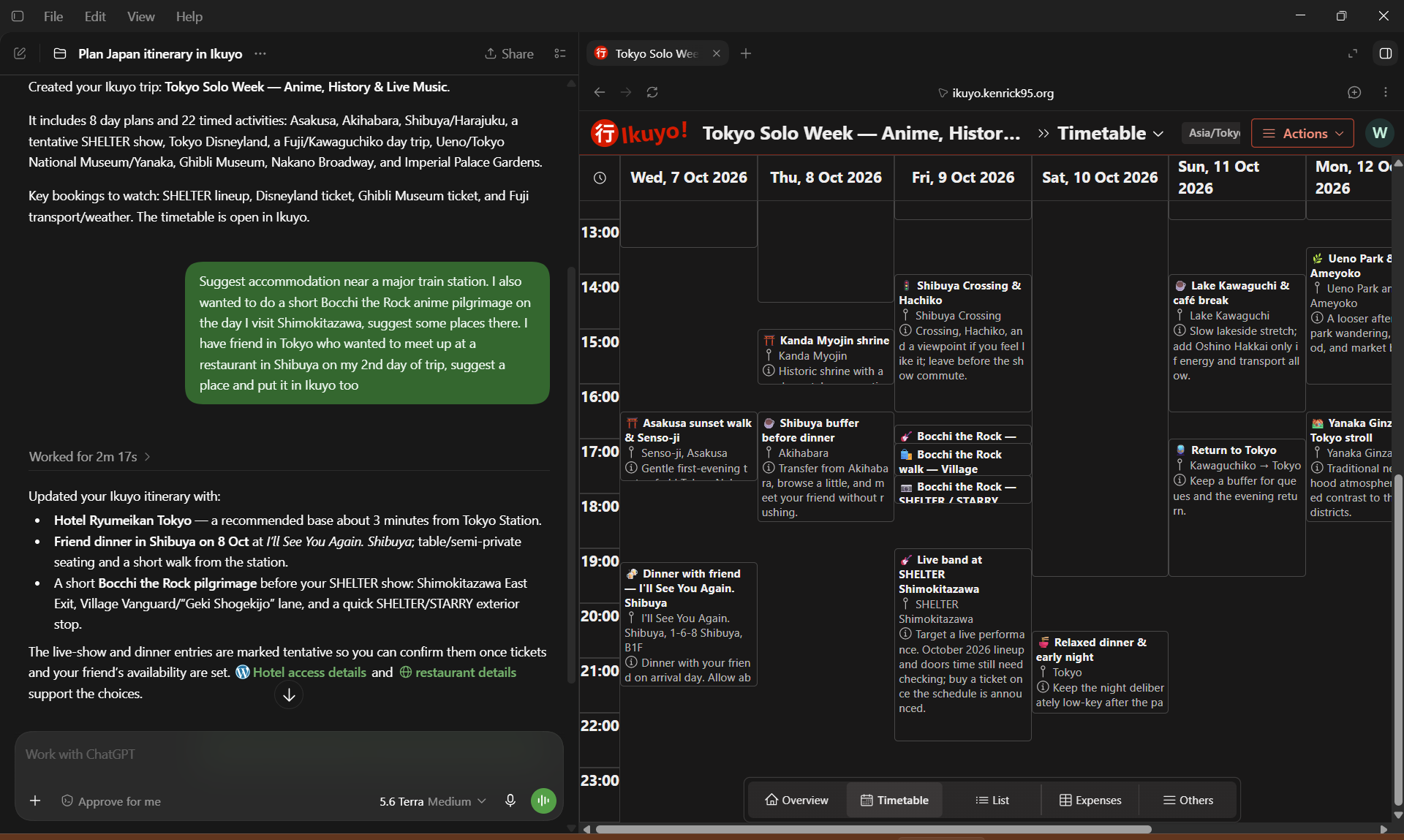
ChatGPT and Ikuyo
-

Ikuyo task list
-
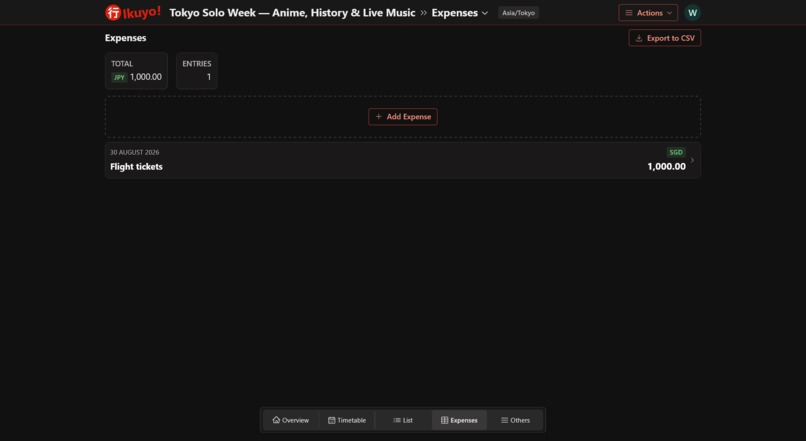
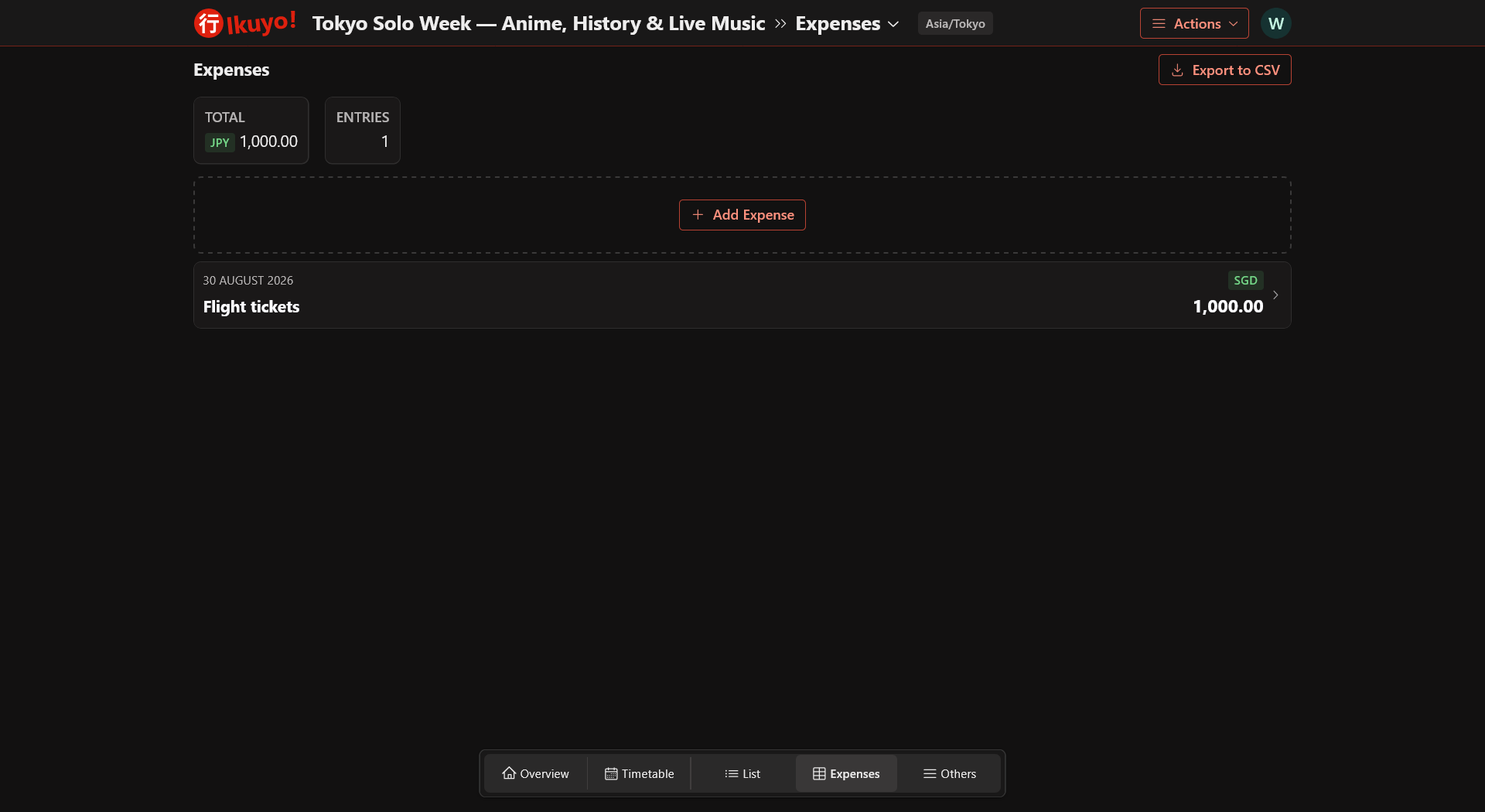
Ikuyo expense list

[Disclosure: the following is written with help AI correcting grammar and sentence structure; the idea and draft is originally human-written]
Inspiration
Travel planning is a living conversation of ideas, changes, and constraints. A useful itinerary must preserve all of that context. I want to empower people with agents, not replace them in the planning process.
What it does
Ikuyo is a collaborative itinerary workspace for travellers and their agents. Through WebMCP, agents can read a trip and create or update activities, accommodations, day plans, tasks, expenses, and comments. The result is not a one-off itinerary, but a shared plan that remains editable, visible, and understandable to the people travelling.
The problem
Planning a trip with an agent is a back-and-forth process of tuning and refining, not one-shot prompting. People need to feel in control of their plans while staying flexible when they change. Chat apps do not feel flexible enough, while spreadsheets are too rigid.
What collaboration looks like
The user asks the agent to draft a realistic travel plan around the fixed bookings, with a few itinerary suggestions. The agent creates it using Ikuyo's WebMCP tools. The user then studies and revises the plan, asking the agent for more suggestions. The agent sees the latest changes through WebMCP and uses them to give further suggestions. This goes back and forth until both parties are happy with the final itinerary.
Why Ikuyo does not have an in-app agent
In today's landscape, LLMs evolve very quickly, and everyone's preferred agent changes often. Committing to a specific agent provider requires significant ongoing maintenance for Ikuyo. It also conflicts with my goal of keeping users in control. Instead of providing an agent for users, I expect them to bring their own agent to help with travel planning.
Why WebMCP is essential
Because I expect users to bring their own agents, they would otherwise need to copy and paste information between Ikuyo and an agent's chat interface. This is inefficient. Another option is for the agent to control Ikuyo through browser automation. That is not ideal either: Ikuyo is built for people, so an agent must read and guess at HTML elements before performing actions. This makes each operation slow and unreliable. WebMCP solves this by exposing Ikuyo's product actions as tools with typed input and output schemas.
The agent can discover the current trip, create and update itinerary objects, and read comments and costs from the live source of truth. Tool availability follows the user's role: viewers can read, editors can plan, and owners manage sharing. Destructive operations remain deliberate, human-confirmed UI actions.
How we built it
This project started in 2024, when I had the idea of making a Google Calendar-like web application for travel planning. The application uses React and Radix Themes for the frontend, MapTiler for maps, and PHP/Laravel/MySQL for the backend. It originally used InstantDB, but I migrated away from it in late August after its shutdown announcement. The calendar grid uses CSS Grid, and all frontend time and date calculations use Temporal.
During this hackathon, I extended the application to support WebMCP, with the help of LLM agents (GPT-5.6). I imported Modern Web Guidance's WebMCP skill and used it while building. Afterward, I tested a range of prompts to fine-tune the tool descriptions so future agents can fill them in correctly.
Challenges we ran into
The main challenge was treating WebMCP as more than another function for calling backend APIs. I had to consider it from the user's point of view and align the UI capabilities with the WebMCP tools, so they could call the existing backend APIs more efficiently. I also adjusted some backend API fields to make them more intuitive for agents to use.
The application initially focused on people, so I naturally built it around adding or editing one object at a time. However, when agents performed operations one by one, they were still slow to reach the desired outcome even when the plan was already synthesised in the context. I then added batch versions of the WebMCP tools so agents could create and edit itinerary activities more efficiently.
Accomplishments that we're proud of
I'm proud that this travel-planning application now integrates deeply with agentic capabilities. People can bring their preferred agents to interact with the site while remaining in control of their own travel plans.
What we learned
I learned that building for agents is different from building for people. People receive hints through the visual UI, while agents can access only the tool descriptions. I therefore need to fine-tune the capabilities so agents can operate correctly and efficiently. I also learned that agents work faster than people, so they need ways to batch-create and batch-edit activities.
What's next for Ikuyo
I have used Ikuyo to plan my own travels, and other people have shared that they completed trips using it. However, it still lacks some human-to-human collaboration capabilities, such as expense splitting and combining. It also needs better support for travel plans that span multiple regions and time zones. Those are the areas I plan to tackle next.


Log in or sign up for Devpost to join the conversation.