-
-
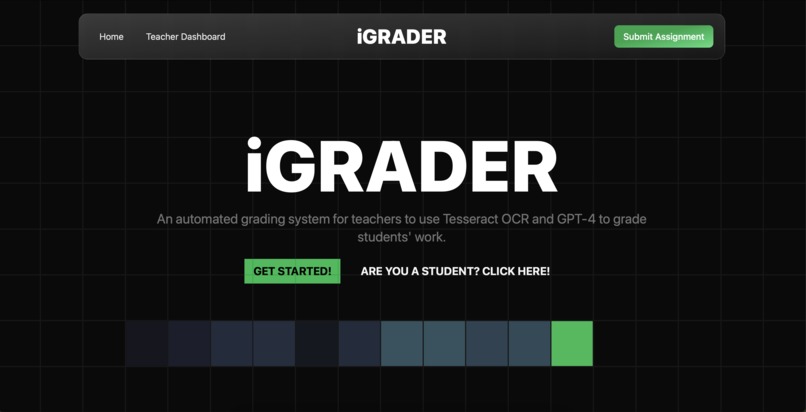
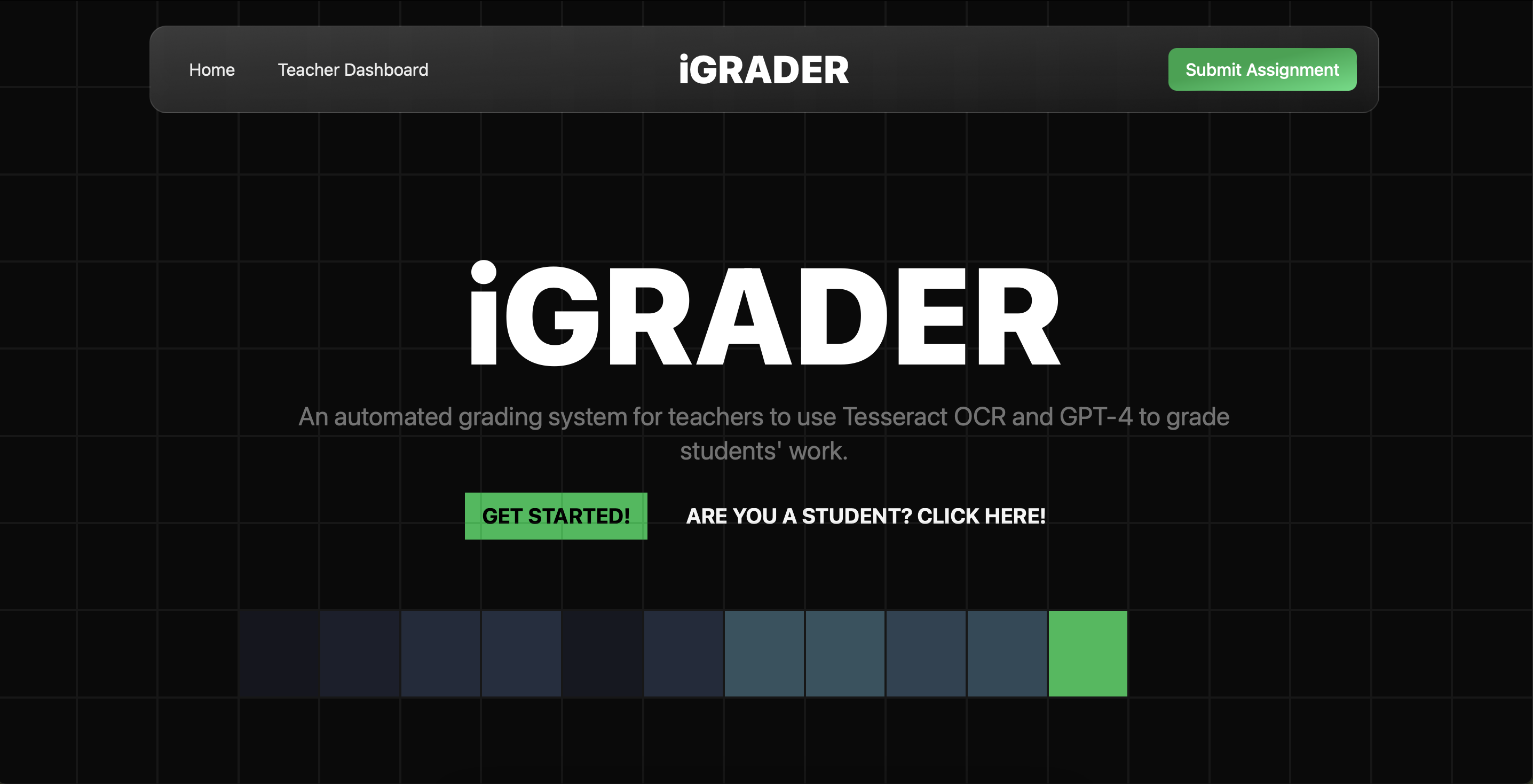
Homepage for iGrader
Inspiration
Our professors work very hard to help students achieve success. So, we decided to help them. Professors often have a ton of workload, and a lot of it is grading assignments. An AI based auto-grader would save the professor's time and increase consistency across grading assignments.
What it does
iGrader increases consistency, decreases time consumption and also provides feedback on the paper. Since the rubric used to grade all students is the same, it has the ability to provide an accurate grading result.
How we built it
We built it using Next.js in the frontend, JavaScript for backend, Tailwind & CSS for styling and framer motion library for animations. We used Tesseract OCR for image to text conversion and GPT4 for grading the assignments.
Challenges we ran into
We originally used Nougat OCR, but it took a really long time to respond. So, we decided to use Tesseract OCR which decreases the conversion time by a factor of 20.
Accomplishments that we're proud of
iGrader has achieved a pretty accurate grading points, and our team is really proud of that. We have used Tesseract OCR, and managed to get the APIs interacting with one another and an overall good achievement of what we were aiming for.
What we learned
We learnt a lot about collaboration, teamwork, leadership skills, and technical skills. We were exposed to a new type of challenge, and we managed to solve the issue we were targeting.
What's next for iGrader
We want to add some functionalities which allows the professor to talk with the model. In case that the professor is unhappy with the rubric, he would be able to talk with the model and the model would be able to re-grade all the assignments accordingly. It would also be giving the questions which the student can think about and learn from, to get stronger in the topics they got wrong.
Built With
- css
- javascript
- next.js
- typescript

Log in or sign up for Devpost to join the conversation.