-
-
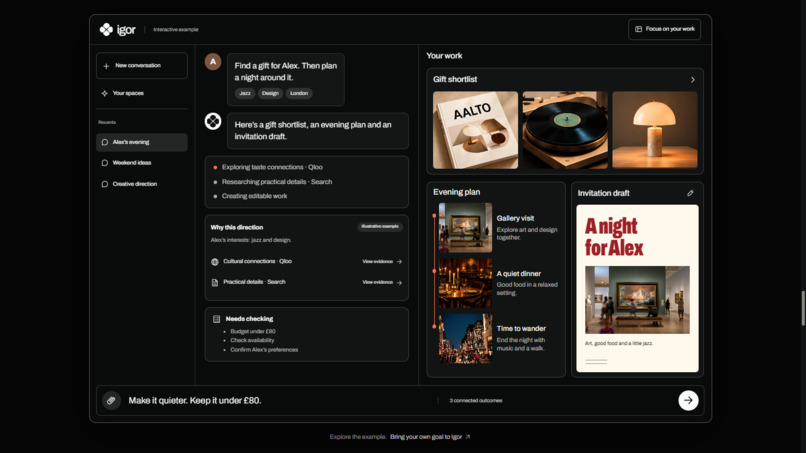
Home
-
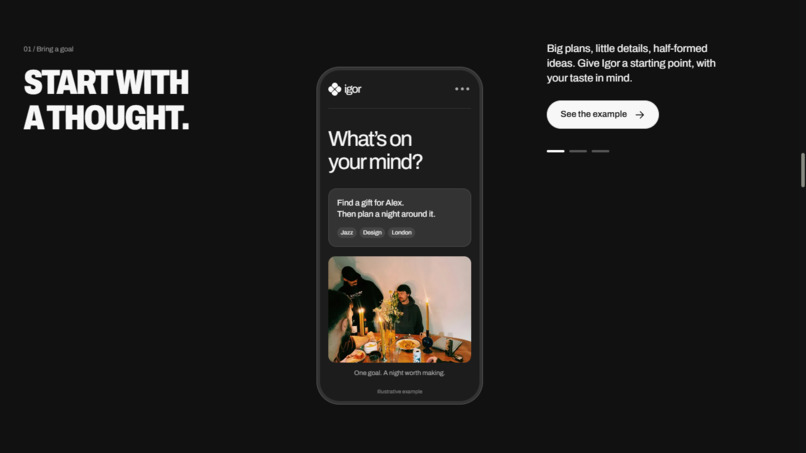
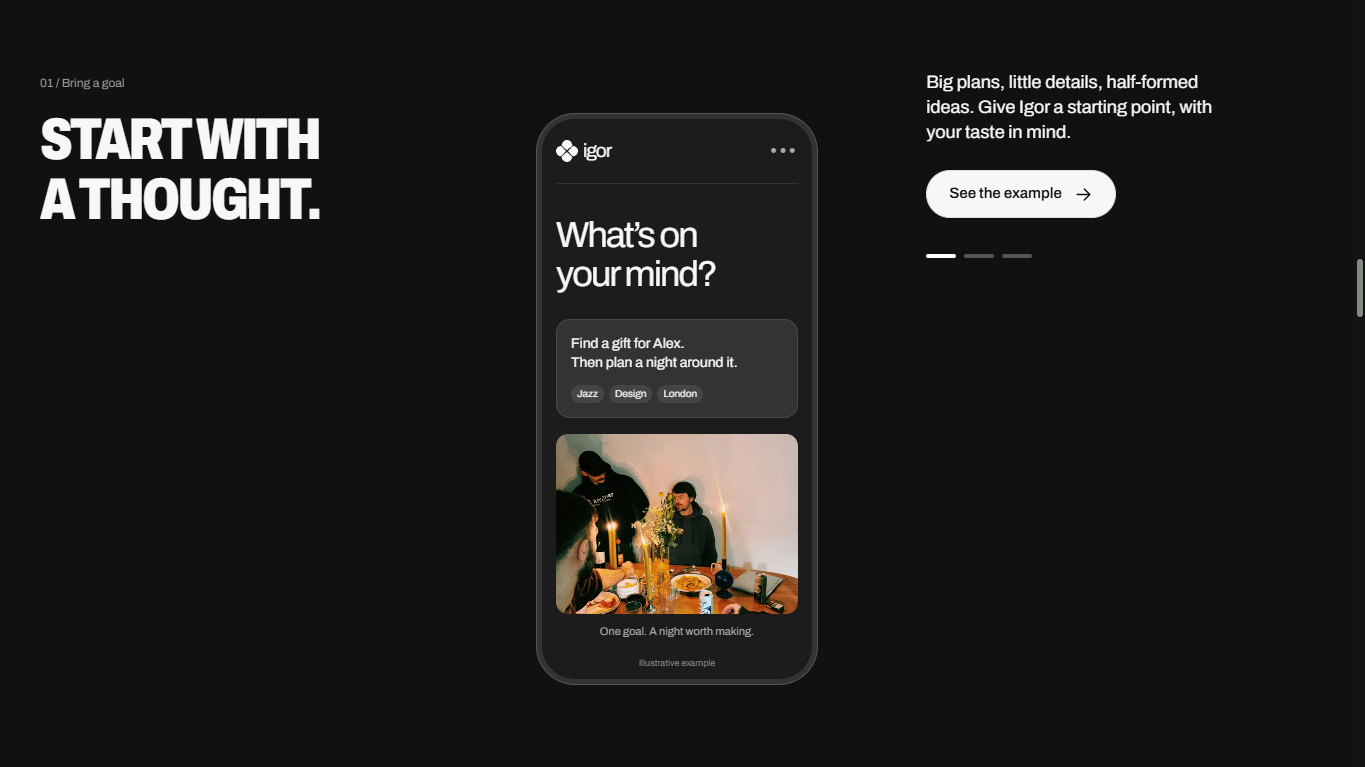
Start with a thought
-
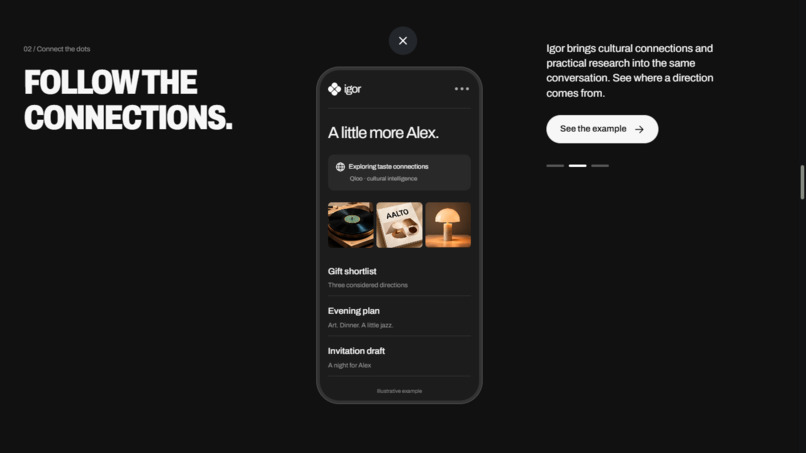
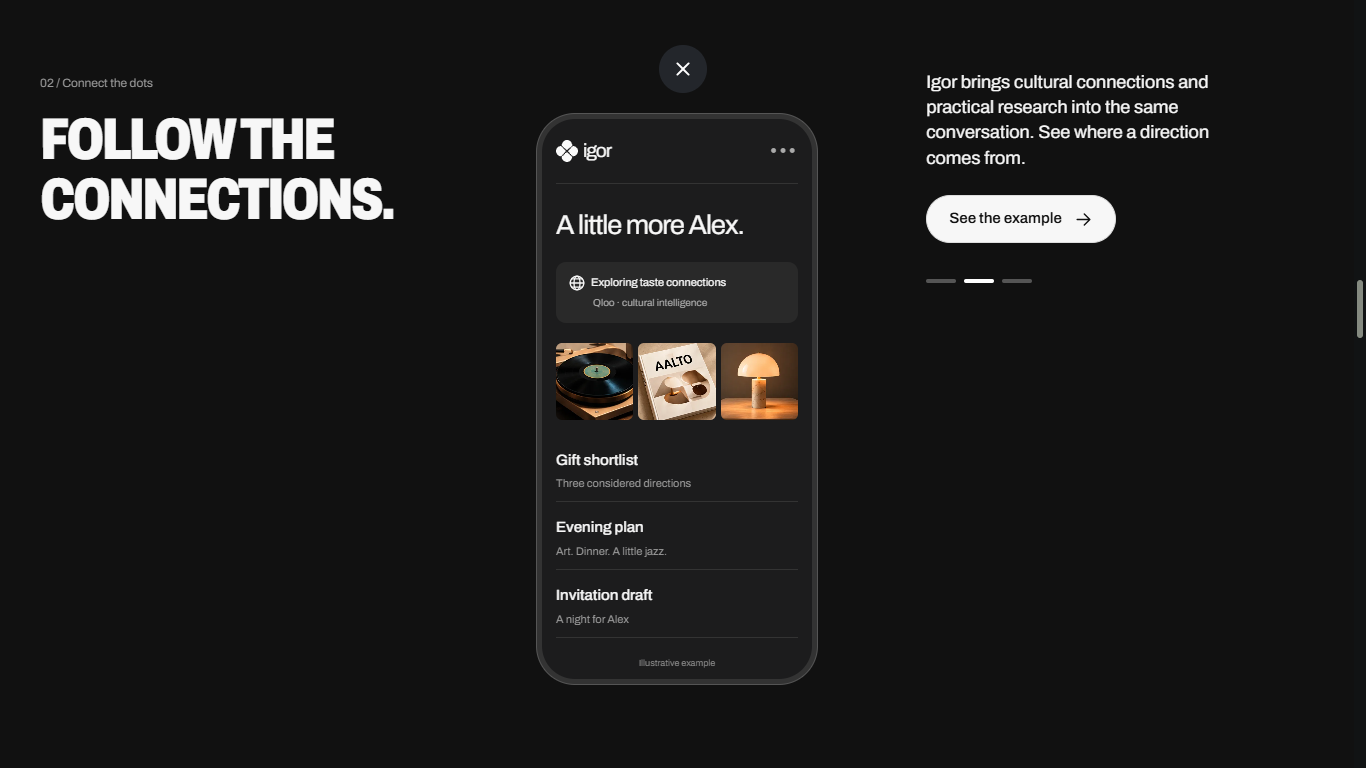
Follow the connections
-
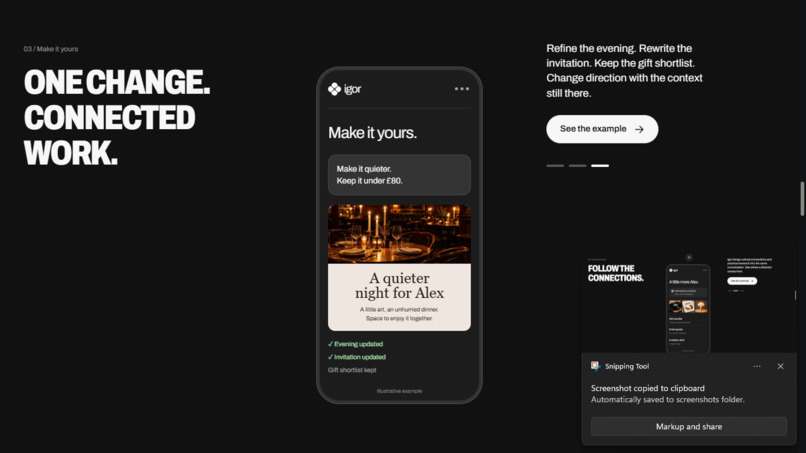
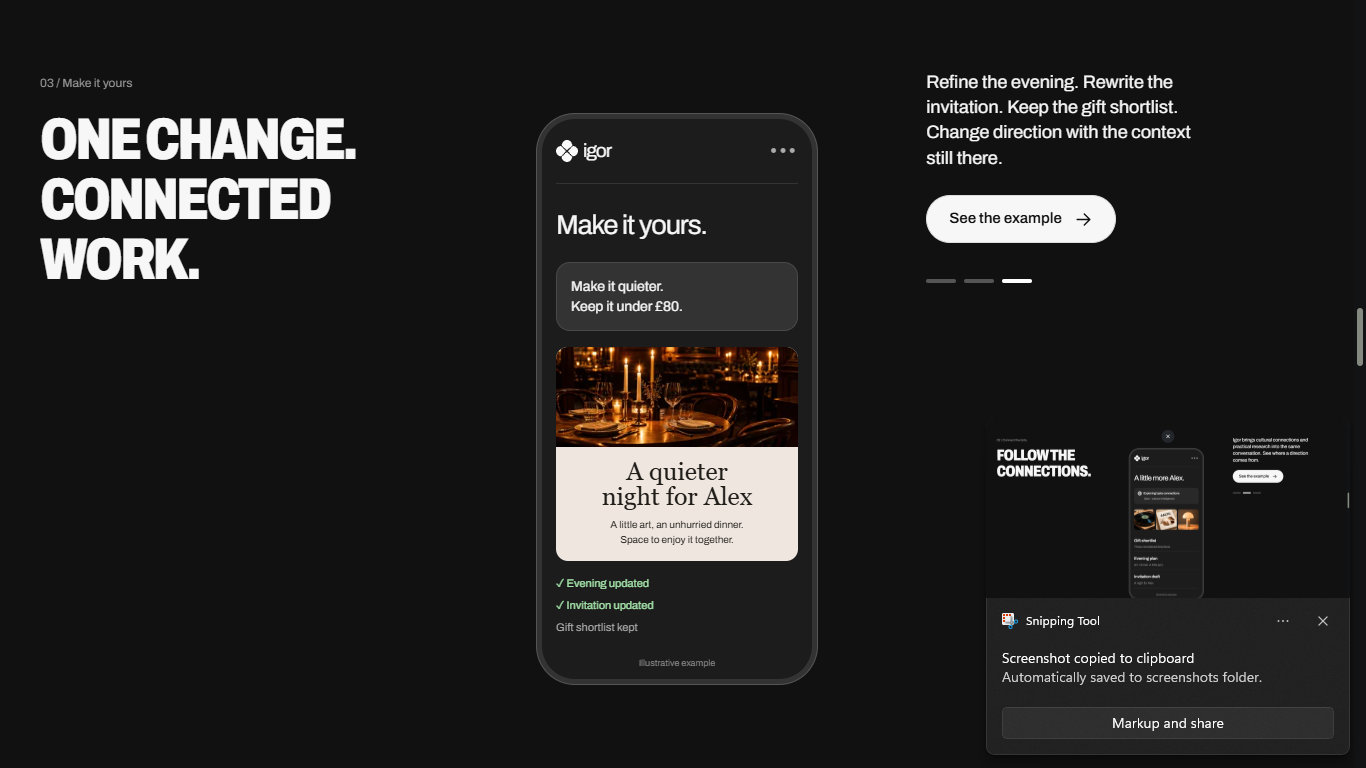
One change, connected work
🕶️ Igor.
Your agent with taste. Powered by Qloo.
AI agents are learning how to do almost anything. But how do they know what's right for you?
Knowing how to do something isn't the same as understanding what fits.
Your taste. Your interests. Your people. Your constraints.
That's the missing piece we wanted to explore.
💡 Meet Igor
What if your AI agent had taste?
Not just the ability to recommend a film or find a restaurant, but the cultural understanding to connect your interests, navigate different preferences, and help turn ideas into something real.
Meet Igor, a conversational AI agent powered by Qloo's Taste Graph.
It brings cultural intelligence into the way an agent discovers, evaluates, creates, and makes decisions.
And it doesn't forget everything when you change your mind.
Because the best recommendation means little if you can't do anything with it.
🍿 Inspiration: Six Friends. Six Opinions. One Plan.
Picture this.
You're planning an evening with six friends. Someone loves indie films. Someone's obsessed with jazz. Two people can't agree on dinner. There's a budget, a time limit, and a group chat full of opinions.
You ask AI for help.
It gives you ten recommendations.
Great. Now you have ten more things to argue about.
The recommendations were easy. Making them work together was the hard part.
That's where Igor comes in.
Instead of leaving you with another list, Igor helps connect the discoveries, weigh the trade-offs, build a plan, and keep working on it as things change.
One conversation. From the first idea to something you can actually use.
✨ Four Capabilities. Endless Possibilities.
Igor isn't four different assistants pretending to be one. It's one agent with four capabilities that work together.
🔎 Discover: Find unexpected connections between films, music, places, and the things you already love. Qloo's Taste Graph helps Igor explore beyond obvious recommendations.
⚖️ Evaluate: Something can be a great cultural match and still be a terrible plan. Igor considers preferences, budgets, available information, and practical constraints before making decisions.
🤝 Collaborate: Your friends don't all have the same taste. Igor compares their stated interests, reveals overlaps, and makes trade-offs easier to understand.
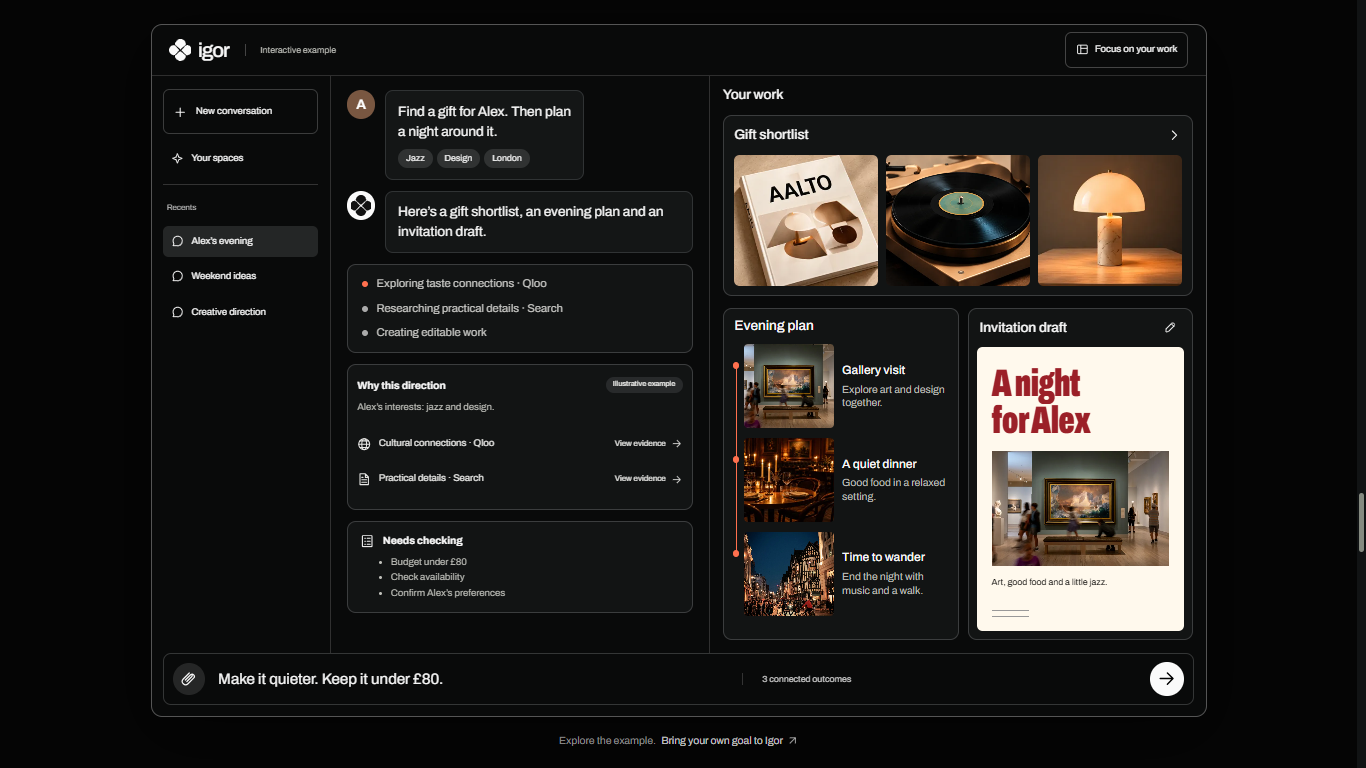
🎨 Compose: Discovery should lead somewhere. Igor turns selected ideas into editable plans, invitations, itineraries, research, and creative briefs.
And when something changes?
Igor remembers what still matters.
🌍 Three Signature Experiences
🗺️ 01. Taste Atlas
Because discovery shouldn't end at a list.
Imagine exploring a city through culture rather than just searching for what's nearby.
Igor brings cultural references, place discoveries, and supporting evidence into a spatial workspace.
With a Google Maps 3D integration and a fallback interface, the experience connects the things you're interested in with the places where they might happen.
It's a different way to explore. Start with what you love, follow the connections, and see where they take you.
🤝 02. Taste Negotiator
Good taste is personal. Group decisions are complicated.
Six people might have six completely different ideas of a perfect evening.
Instead of blending everyone into one imaginary taste profile, Igor keeps individual preferences separate and compares what each person actually expressed.
It uses cultural signals to explore possible matches, while making disagreements and unknowns visible.
No magical 97% compatibility score.
Just a clearer picture of what could work and why.
🕹️ 03. Experience Operator
The interesting part starts after the recommendation.
You found a film. Picked some music. Narrowed down your options.
Now what?
Igor helps turn those decisions into something useful: an evening programme, an invitation, a travel itinerary, or a creative direction.
And the work doesn't disappear after the first response.
Change the budget. Swap an artist. Rewrite the invitation.
Igor can revisit the affected decisions while keeping unrelated work intact.
Less starting over. More getting somewhere.
🛠️ How We Built It
We wanted Igor to feel like one continuous experience, not a collection of disconnected AI tools.
So we built a shared agent engine that connects conversation, cultural intelligence, decision-making, and persistent work.
⚙️ Here's What Happens Under the Hood
🗣️ 1. You describe a goal.
Something as simple as planning an evening with friends or creating a music-inspired event.
🧠 2. Igor understands the context.
The agent interprets your request using the conversation, existing preferences, constraints, and decisions.
🔎 3. Qloo brings the cultural intelligence.
Igor retrieves relevant cultural connections across supported domains, including films, artists, and places.
⚖️ 4. The agent evaluates the options.
Cultural relevance is considered alongside your requirements. Known facts, assumptions, and missing information stay distinguishable.
🎨 5. Igor creates something useful.
A plan, comparison, invitation, itinerary, or another editable outcome.
🔄 6. You change your mind. Igor adapts.
Instead of blindly regenerating everything, Igor identifies which parts depend on the change and updates those decisions.
🧰 The Tech Behind Igor
| Layer | What we used |
|---|---|
| Frontend | Next.js, React, TypeScript |
| Agent intelligence | Model-driven orchestration |
| Cultural intelligence | Qloo Taste Graph |
| State and persistence | Node.js, SQLite |
| Validation | Zod and typed capability contracts |
| Testing | Vitest, Playwright |
One of our biggest engineering decisions was separating the agent's reasoning and state management from how the interface displays results.
This lets the same underlying capabilities support different goals without rebuilding the logic for every experience.
Conversations, preferences, evidence, and editable outcomes are stored as versioned work, so Igor can keep track of what happened and what changed.
🧠 The Hard Parts Were Surprisingly Interesting
🎭 01. Taste Isn't a Crystal Ball
One of the first things we learned while experimenting with Qloo was that cultural affinity isn't the same as certainty.
Just because two artists are culturally connected doesn't mean everyone who likes one will love the other.
And a restaurant being culturally relevant doesn't tell us whether it's open, affordable, or available.
We built evidence tracking and separate practical constraint checks so Igor can distinguish what Qloo suggests from what is actually known.
That distinction became a big part of how we designed the agent.
🔄 02. "Actually, Change the Budget."
Four innocent words.
A surprisingly complicated engineering problem.
Imagine spending time working on an invitation, agreeing on a film, and then realizing the budget needs to change.
A typical AI workflow might generate everything again.
We didn't want that.
So we built dependency-aware revisions that track which decisions are affected by a change.
A budget adjustment can trigger a feasibility update without unnecessarily repeating cultural discovery. An invitation wording change doesn't need to restart the entire planning process.
The goal was simple: changing one thing shouldn't break everything else.
🧩 03. Making It Work Beyond One Demo
Building a movie recommender would have been easier.
But we wanted to explore something bigger.
Could the same agent handle a group gathering, a travel itinerary, a listening programme, and a creative research brief?
That meant designing reusable capabilities, typed contracts, shared evaluation rules, and a consistent way to preserve context.
Instead of writing a separate script for every scenario, we built an engine that can combine capabilities depending on the task.
That was one of the most challenging and rewarding parts of the project.
🏆 The Bits We're Proud Of
🧠 Qloo is part of the thinking. Cultural intelligence influences Igor's discovery and evaluation workflow rather than sitting inside a standalone recommendation widget.
🔗 Recommendations have receipts. Cultural references retain their supporting evidence, sources, and limitations.
🤝 Group preferences stay personal. Igor compares individually stated interests rather than pretending everyone shares the same taste.
🔄 Changes don't mean starting over. Dependency-aware revisions help preserve work that doesn't need to change.
💬 Conversations actually have continuity. Messages, decisions, and outcomes stay connected across the workspace.
🎨 Ideas become editable work. Igor can turn cultural discoveries into documents and plans that users can continue shaping.
🧪 We tested more than the happy path. Our testing covers persistence, revisions, provider boundaries, and failure handling, alongside the interface.
Our favourite accomplishment? Building an agent that can keep working with you after its first answer.
📚 What We Learned
We started with a question about giving AI agents taste.
We ended up thinking a lot more deeply about memory, trust, uncertainty, and how people actually make decisions.
Qloo showed us how much cultural context can add to discovery. Building the agent taught us that discovery is only one part of the experience.
People change their minds.
Friends disagree.
Budgets change.
Ideas evolve.
And an AI agent should be able to handle that without losing the plot.
The first answer is only the beginning. What happens next is what makes an agent useful.
🔮 Where We're Taking Igor Next
🗺️ More immersive discovery: Richer spatial experiences, smoother 3D exploration, and more ways to navigate cultural connections.
📬 From plans to actions: Moving beyond preparing invitations and plans toward coordinating people and services through permission-based integrations.
🤝 Better shared decisions: More collaborative reviews, feedback, approvals, and ways for groups to make decisions together.
📊 Measuring the difference Qloo makes: Comparing outcomes with and without cultural intelligence to understand how much it improves the actual experience.
🌍 More possibilities: Extending the same agent capabilities into more creative, cultural, and everyday workflows.
💻 Take Igor for a Spin
🌐 Live app: https://igor-taste.vercel.app/app 💻 Public repository: https://igor-taste.vercel.app/
⚙️ Run It Locally
You'll need Node.js 24 or newer.
1. Clone the repository
git clone https://github.com/Davemafy/ighor.git
cd ighor
2. Install dependencies
npm ci
3. Configure your environment
Add your Qloo API key and a supported model provider key to your server-side environment.
For example:
QLOO_API_KEY=your_qloo_api_key
GEMINI_API_KEY=your_gemini_api_key
4. Start Igor
npm run dev
Open http://localhost:3000/app in your browser.
5. Run the tests
npm test
For the full development setup, architecture, and verification commands, see the documentation in the public repository.
❤️ A Special Thanks to Qloo
Huge thanks to the Qloo team for organizing this hackathon and giving us the opportunity to build with the Taste Graph.
What started as a question about how AI agents could understand people's tastes became a much bigger exploration of cultural intelligence, decision-making, and what agents could actually do with that understanding.
Building Igor challenged us to think beyond recommendations and experiment with new ways people could discover, create, and make decisions with AI.
It's been an incredible experience.
Thank you, Qloo, for making this possible! ❤️
🕶️ Igor. Your agent with taste.
Built with ❤️ for the Qloo Agentic Hackathon.
Because knowing what to recommend is one thing. Knowing what to do with it is another.
Built With
- ai-sdk
- gemini
- github-actions
- google-maps
- next.js
- node.js
- playwright
- qloo
- railway
- react
- sqlite
- typescript
- vitest
- zod

Log in or sign up for Devpost to join the conversation.