Inspiration
The inspiration behind IFA Ω came from a fundamental question: What if we could build an intelligent system from the ground up, rather than simply adapting an existing pretrained AI model?
Most modern AI development depends heavily on massive pretrained models, expensive infrastructure, and external services. I wanted to explore a different direction: creating an independent, adaptive intelligence architecture that can learn, evolve, and improve through its own training processes.
IFA Ω is a long-term research and engineering project driven by the ambition to make AI development more independent, accessible, adaptive, and efficient, with a particular focus on Arabic and multilingual intelligence.
What it does
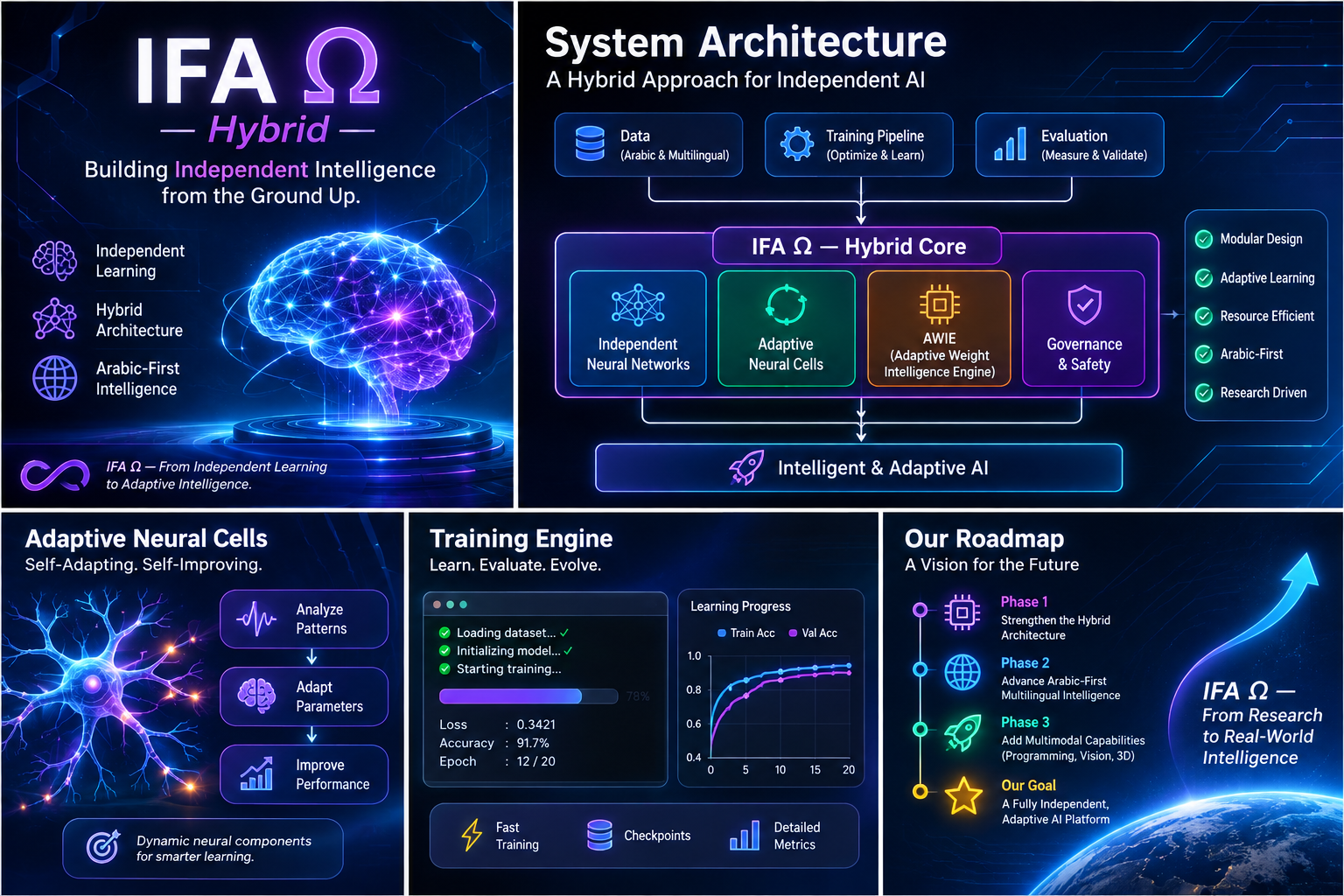
IFA Ω — Hybrid is an experimental AI architecture designed to explore independent neural learning, adaptive computation, and controlled model development.
Its core objectives include:
- Independent Learning: Building neural network components with independently initialized weights instead of relying on pretrained model weights.
- Hybrid Architecture: Exploring combinations of neural learning mechanisms and adaptive computational components.
- Adaptive Neural Cells: Developing mechanisms that allow neural components to adapt during training.
- Adaptive Weight Intelligence Engine (AWIE): Experimenting with controlled weight initialization and optimization strategies.
- Training and Evaluation: Implementing training loops, checkpoint management, reproducible experiments, and evaluation metrics.
- Arabic-First Intelligence: Establishing a foundation for Arabic language processing, including Modern Standard Arabic and Egyptian Arabic.
- Governed AI Development: Applying explicit policies for network access, code execution, data handling, and model promotion.
The current implementation is an experimental foundation, not a finished general-purpose AI assistant. Its purpose is to validate the underlying architecture and learning mechanisms step by step.
How we built it
We developed IFA Ω using a modular, research-driven engineering approach, prioritizing independence, reproducibility, and compatibility with limited computing resources.
The core development stack includes Python and NumPy, with a lightweight, CPU-first design.
We organized the architecture around several engineering components:
- Neural Architecture: A foundation for independently initialized neural networks and adaptive neural components.
- Hybrid Initialization: Experiments involving controlled initialization and learning strategies.
- Training Engine: A training pipeline with optimization, evaluation, and checkpoint support.
- Adaptive Learning: Research into mechanisms that improve learning efficiency without depending on external pretrained models.
- Experiment Management: Controlled experiments, baseline comparisons, reproducibility, and performance tracking.
- Governance Layer: Policies designed to protect project integrity, control external access, and require approval for sensitive operations.
We also explored Kiro as an AI-powered engineering environment to support development, architectural analysis, documentation, and implementation workflows.
Rather than treating AI coding assistance as a replacement for engineering decisions, we use it as a development partner while maintaining human control over architecture, validation, and project direction.
Challenges we ran into
Building an independent AI architecture introduces challenges that are fundamentally different from integrating an existing pretrained model.
Our biggest challenges included:
- Limited Hardware: Designing experiments that can run within restricted CPU and memory resources without requiring GPUs or expensive infrastructure.
- Learning from Scratch: Developing an independent learning foundation without relying on pretrained weights or external model-generated training outputs.
- Training Stability: Exploring initialization and optimization strategies that support stable learning and meaningful experimentation.
- Adaptive Computation: Investigating how neural components can adapt without introducing uncontrolled complexity or computational overhead.
- Evaluation: Establishing reliable metrics and experimental controls to distinguish genuine improvements from misleading results.
- Project Integrity: Ensuring that development, experiments, datasets, and checkpoints do not compromise existing project files or research independence.
One of the most important lessons was that creating an architecture is only the beginning. Demonstrating that it actually learns requires rigorous experiments, reproducible results, and honest evaluation.
Accomplishments that we're proud of
We are particularly proud of establishing a structured foundation for an independent AI research project.
Key accomplishments include:
- Establishing a modular architecture for independent neural network development.
- Implementing a functional training pipeline with checkpointing and evaluation capabilities.
- Developing the foundations of Adaptive Neural Cells and the AWIE research direction.
- Establishing reproducible experiment workflows and baseline comparison strategies.
- Implementing project governance principles to protect data, code, and model independence.
- Successfully validating checkpoint round-trip functionality and basic training execution.
- Designing the project around resource-efficient CPU execution rather than assuming access to expensive GPU infrastructure.
Most importantly, we have created a development foundation that allows us to investigate new learning mechanisms instead of simply building another application around an existing AI model.
What we learned
This project taught us that independent AI development requires much more than neural network design.
We learned the importance of:
- Separating architectural innovation from experimentally proven performance.
- Building reliable baselines before claiming improvements.
- Treating reproducibility and evaluation as essential parts of AI research.
- Designing around hardware limitations rather than ignoring them.
- Using AI development tools such as Kiro to accelerate engineering while retaining human oversight.
- Building security, governance, and data integrity into the architecture from the beginning.
We also learned that ambitious AI research becomes more achievable when divided into measurable engineering objectives.
What's next for IFA Ω — Hybrid
IFA Ω is intended to evolve into a fully independent, adaptive, Arabic-first multilingual intelligence platform.
Our next development goals include:
- Strengthening the Hybrid Architecture: Further developing adaptive neural components and evaluating their contribution to learning.
- Advancing AWIE: Testing new weight initialization and optimization strategies against established baselines.
- Arabic Language Learning: Developing a structured Arabic-first learning system covering character, morphological, and word-level representations.
- Improving Training Efficiency: Reducing computational costs while improving learning stability and convergence.
- Independent Evaluation: Expanding controlled experiments, multi-seed testing, and benchmark evaluation.
- Multimodal Capabilities: Researching future extensions for programming, cybersecurity, image understanding, video understanding, and 3D applications.
- Intelligent Agent Ecosystem: Eventually integrating independent agents, tools, and controlled research capabilities.
Our ultimate vision is to build an intelligent system that does not simply depend on existing AI models, but develops its own capabilities through independently designed learning mechanisms.
IFA Ω — From Independent Learning to Adaptive Intelligence.
Built With
- adaptive-learning
- ai
- ai-research
- arabic-nlp
- artificial-intelligence
- computer-science
- cpu-optimization
- deep-learning
- experimental-ai
- generative-ai
- hybrid-ai
- independent-ai
- intelligent-systems
- kiro
- machine-learning
- model-training
- multilingual-ai
- natural-language-processing
- neural-architecture
- neural-networks
- neurotechnology
- numpy
- open-innovation
- optimization-algorithms
- python
