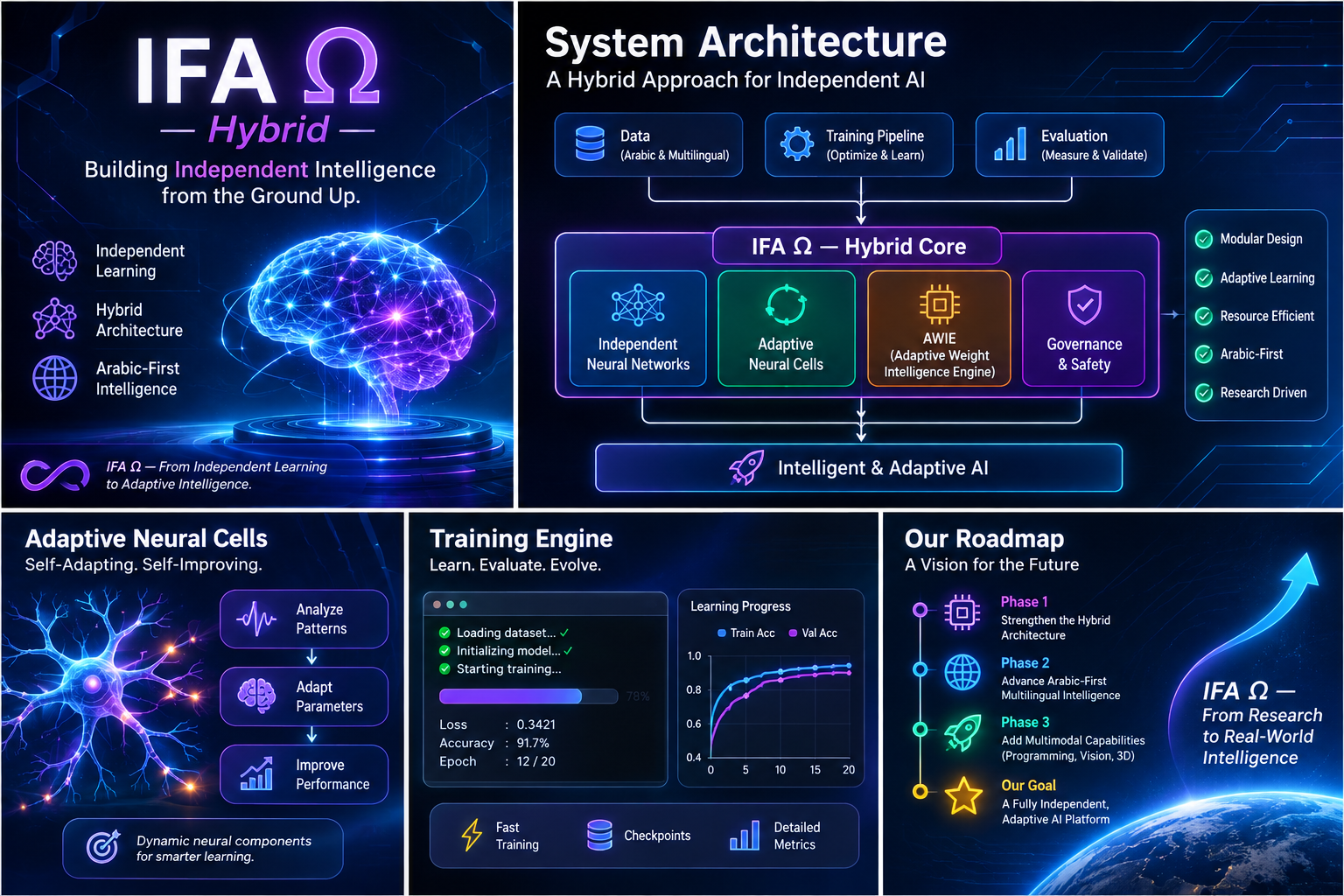
IFA Ω — Adaptive Cognitive Intelligence
Inspiration
IFA Ω was inspired by a fundamental question: Can we build an intelligent system that develops its own capabilities through learning and adaptation, rather than simply relying on knowledge inherited from pre-trained models?
The project began with a vision of creating an independent, adaptive intelligence from scratch, with a particular focus on Arabic language understanding, efficient learning, cognitive development, and continuous improvement.
Our goal is to explore a different approach to AI: one where the architecture, learning mechanisms, memory, and reasoning capabilities are designed to evolve together.
What it does
IFA Ω is an experimental AI research and development project focused on building an independent, adaptive cognitive intelligence.
Its core objectives include:
- Independent Learning: Developing neural architectures with independently initialized weights, without relying on pre-trained model weights or external AI-generated training outputs.
- Adaptive Neural Architecture: Exploring mechanisms that allow neural components to adapt to changing learning requirements.
- Arabic-First Intelligence: Building a foundation for Arabic language processing, including Modern Standard Arabic, Egyptian Arabic, and multilingual capabilities.
- Efficient Training: Investigating new learning strategies, optimization methods, and adaptive computation to improve training efficiency.
- Cognitive Memory: Designing mechanisms for structured knowledge retention and retrieval.
- Modular Intelligence: Establishing a foundation for future reasoning, programming, research, cybersecurity, and multimodal capabilities.
IFA Ω is being developed incrementally, with measurable experiments and evaluation benchmarks guiding its progress.
How we built it
We designed IFA Ω around a modular, research-driven architecture, prioritizing independence, transparency, and computational efficiency.
The development approach includes:
- Building foundational neural network components from scratch.
- Using Python and NumPy to implement and experiment with core computational mechanisms.
- Developing custom training loops, evaluation procedures, and checkpoint management.
- Exploring adaptive neural cells and controlled learning mechanisms through the Adaptive Weight Initialization Engine (AWIE).
- Implementing experimental governance policies to control network access, code execution, data handling, and model promotion.
- Establishing reproducible experiments with baseline comparisons, multiple random seeds, and quantitative evaluation.
The initial development environment is intentionally resource-constrained. This forces the architecture to prioritize memory efficiency, computational optimization, and lightweight execution.
Challenges we ran into
Building an independent intelligence from scratch introduces challenges that are often hidden by conventional AI development workflows.
Some of our biggest challenges include:
- Limited Computing Resources: Developing and testing neural architectures on hardware with limited RAM, CPU performance, and no CUDA support.
- Learning Efficiency: Exploring how to achieve meaningful learning without depending on pre-trained models or external teachers.
- Arabic Language Complexity: Designing an effective representation for Arabic morphology, vocabulary, and linguistic structures.
- Adaptive Architecture: Investigating how neural components can change and adapt without destabilizing previously learned capabilities.
- Scientific Validation: Distinguishing genuine improvements from random variation through controlled experiments and measurable benchmarks.
- Project Independence: Maintaining strict separation from external model weights, third-party AI-generated outputs, and unauthorized data sources.
- Engineering Complexity: Building reliable training, checkpointing, evaluation, and governance systems before expanding the model's capabilities.
Accomplishments that we're proud of
We are proud of establishing the engineering and research foundations for an independent AI system.
Key accomplishments include:
- Establishing the IFA Ω architectural and research vision.
- Implementing an initial training pipeline and evaluation framework.
- Developing checkpoint saving and restoration mechanisms.
- Establishing adaptive neural cell research and AWIE integration.
- Introducing controlled learning experiments and reproducibility requirements.
- Implementing governance mechanisms to protect project independence.
- Successfully validating checkpoint round-trip functionality and initial training-loop execution.
- Creating a development roadmap that prioritizes scientific validation over premature claims of intelligence.
Most importantly, we have established a foundation that allows us to investigate new approaches to learning rather than simply assembling existing AI components.
What we learned
This project taught us that building intelligence is not simply a matter of increasing parameter counts or computational power.
We learned that:
- Architecture design and learning algorithms are equally important.
- Efficient learning requires careful experimentation and measurement.
- Adaptation must be controlled to prevent catastrophic forgetting and unstable training.
- Independent initialization does not guarantee independent intelligence; the learning process must demonstrate measurable capabilities.
- Arabic-first development requires deliberate linguistic and representational design.
- Reproducibility, data governance, and scientific validation must be fundamental parts of AI research.
We also learned that meaningful progress requires patience: every new mechanism must prove its value through experiments rather than assumptions.
What's next for IFA Ω — Adaptive Cognitive Intelligence
Our long-term vision is to evolve IFA Ω into a fully independent, adaptive, multilingual cognitive intelligence.
The next development priorities are:
- Strengthen the Core Architecture: Improve the foundational neural architecture, training stability, and computational efficiency.
- Advance Adaptive Learning: Validate AWIE and adaptive neural cell mechanisms through controlled experiments.
- Develop Arabic Intelligence: Build progressively stronger Arabic linguistic representations and learning capabilities.
- Introduce Cognitive Memory: Develop persistent, structured memory and knowledge retrieval mechanisms.
- Explore Reasoning and Problem Solving: Investigate independent reasoning, planning, and problem-solving capabilities.
- Expand Programming and Research Capabilities: Develop specialized abilities for software engineering, cybersecurity research, and information analysis.
- Explore Multimodal Intelligence: Research image, video, and eventually 3D understanding and generation.
- Build an Integrated Agent Ecosystem: Connect validated cognitive capabilities with governed tools and specialized agents.
Our ultimate objective is not merely to create another AI assistant. It is to investigate a new path toward independent intelligence: an architecture capable of learning, adapting, developing, and expanding its capabilities through its own carefully designed learning mechanisms.
IFA Ω — Intelligence should not only process knowledge. It should develop the ability to learn.
Built With
- adaptive
- ai
- arabic
- architecture
- artificial
- cognitive
- custom
- deep
- independent
- intelligence
- language
- learning
- machine
- models
- multilingual
- natural
- natural-language-processing
- network
- networks
- neural
- numpy
- processing
- python
- research
- training
