-
-
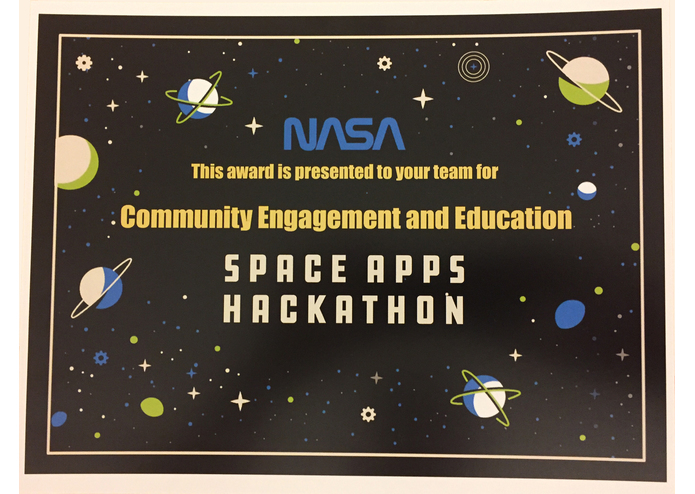
Recipient of the Community Engagement and Education Awa
-
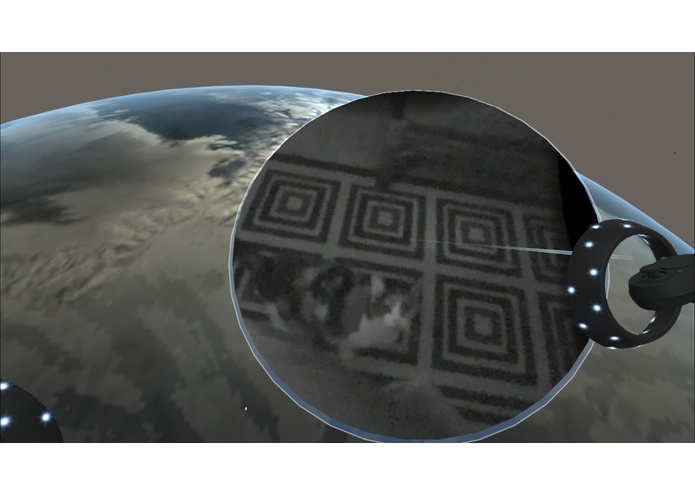
View through Hololense
-
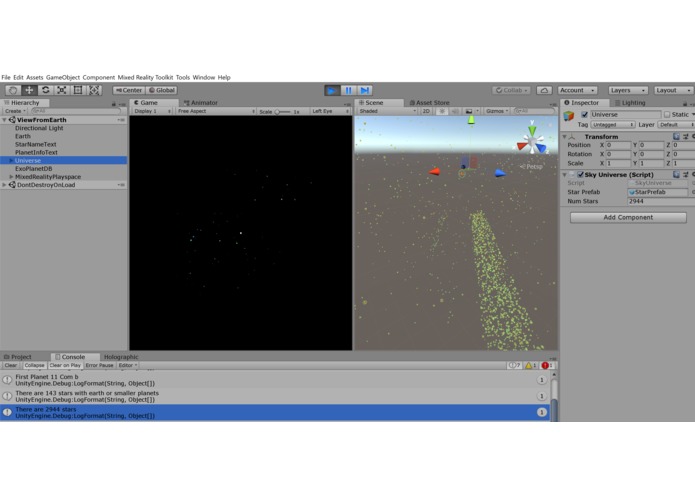
Early view in Unity, visual on Kepler data assured we were on the right track
-
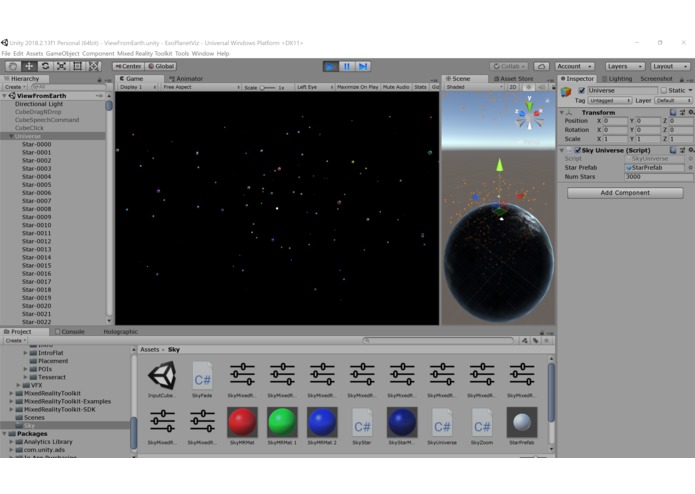
View into the game view
-
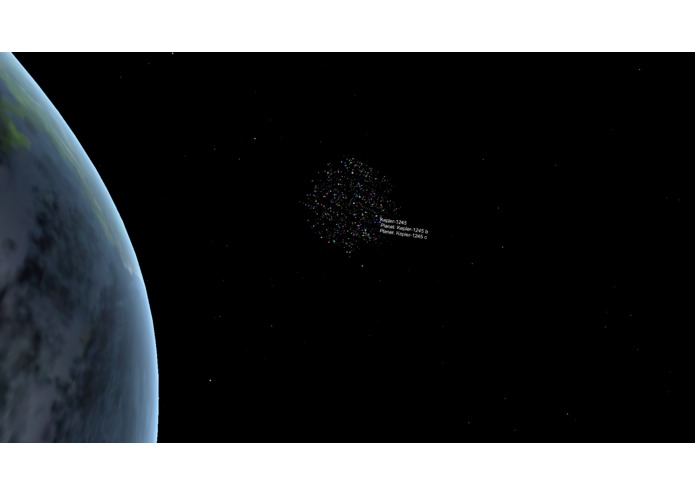
Final view with all exoplanet and star system data pulled in
-
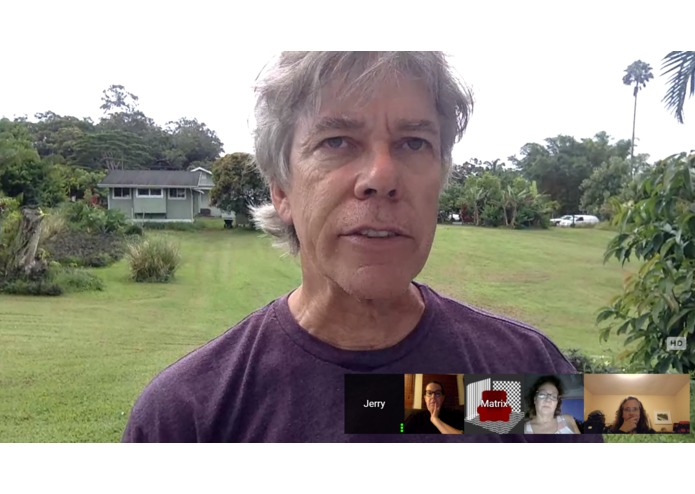
Remote team call across 2 timezones and 6 hours


Created by Team ET Goes Home Recipient of the Community Engagement and Education Award 2018 NASA International Space Apps Challenge (Pasadena, CA)
Inspiration
Describing exoplanets as worlds suggest that these are objects that can be not only perceived but also experienced. With enough information, one can imagine being on the surface of one of these worlds.– Lisa Messeri, Placing Outer Space, p. 113
iET was inspired by the work of Lisa Messeri – an anthropologist at Yale University – who believes that the key to truly understanding all the newly discovered exoplanets is creating a sense of presence. Mixed reality/VR creates presence like no other technology. We chose this medium because it provides huge potential in giving scientists a way to literally be with the data of these unknown worlds – by literally bringing them into the presence of these planets. iET is meant to help scientists visualize what these new worlds might be like outside of scatterplots and data points – to make distant exoplanets “more like intimate, recognizable worlds” (Messeri).
What it does
iET is a mixed reality immersive experience of known exoplanets with smart filtering for locating Earth-like exoplanets. This app would provide context + presence of the exoplanets + star systems, giving an alternate way for scientists to look at the data – from scatterplots to immersive presence with the planets.
One of the main goals of iET is to help visually identify data leading to habitable planets. Throughout iET development, we’ve prioritized showing data that expressed the potential of habitability for each exoplanet - such as a planet’s distance from the sun, it’s place in the habitable zone and what elements have been discovered.
Challenges I ran into
COMPLEXITY OF DATA + UNDERSTANDING THE SCIENCE + MATH
MIXED REALITY TOOLKIT - After much discussion, we chose to use the new Mixed Reality Toolkit for the app build. This would allow us to create one build that can be experienced across various mixed reality + VR devices – a revolutionary potential in immersive technology. We received early access to this new tool before it’s official release, along with direct support from Microsoft to use it for this project. We were excited by the Mixed Reality Toolkit as it would allow our team – who were from 3 different cities with different devices in each location – to test the evolving app across multiple devices. Plus, we believed an app built with this technology would be more accessible to scientists globally who may all have access to various different headsets. In theory, by building it with the Mixed Reality toolkit, any scientist could experience the app on any headset – Hololens, Oculus Rift, Vive, etc. Unfortunately, the learning curve for integrating this toolkit – along with working out the bugs with Microsoft - was steep + the challenges working with this new technology slowed us down on Saturday as our team spent a lot of time in discussion with Microsoft. Unfortunately, this ate into our dev time resulting in not getting as far as we were hoping to by today’s end of the challenge.
MULTIPLE LOCATIONS + TIME ZONES - Another challenge we were faced with was that our team was scattered across 3 locations – Los Angeles, Canada + Hawaii. The advantage of this was that – due to differing time zones - the project going 24/7. The disadvantage of this was that our team could not take advantage of sharing in moment-by-moment collaboration + inspiration as problems and solutions emerged.
Accomplishments that I'm proud of
There was a big hurdle in going from concept to execution with almost no knowledge of planetary science. A great deal of time was spent upfront devouring the data into a digestible format that could be understood and implemented in Unity. We also wanted to be sure we understood it well enough to talk about the details and implement with accuracy.
What I learned
Not to burn-out the week leading up to a hackathon. Too many lates night prior to the hackathon learning about the data, made for a very challenging weekend.
What's next for iET, Immersive Exoplanet Telescope
BUILDING OUT THE STAR SYSTEMS INCLUDING OUR OWN WITH ACCURATE ORBITAL MECHANICS – We have currently been able to realize all the exoplanet’s stars and the next step would be to realize all the star systems w/ exoplanets.
REFINE INTERFACE + UX WITH INPUT FROM SCIENTISTS – We would like to work with scientists to explore the interactivity + data to build a tool that will be most impactful for the community.
CREATE EXOPLANET CATEGORIZATION + REFINE VISUALS WITH SCIENTISTS - With input from scientists, we’d like to determine the best exoplanet categorization and to more closely visually match the data/science we have for each individual planet + star. For example, we’d like to utilize what we know about geometric albedos to inform how each exoplanet may actually look (Madden & Kaltenegger, 2018).
SHARED VIEWING EXPERIENCES FOR COLLABORATION – Ultimately, this app would have a view sharing component allowing scientists to collaborate with other scientists around the world.
Acknowledgements
We gratefully acknowledge the assets we used came from Galaxy Explorer and some scripts and components from the pre-release of the Mixed Reality Toolkit vNEXT. QuickSheet was used to read XLS spreadsheets into Unity as collections of Scriptable Objects.
This project has made use of the NASA Exoplanet Archive, which is operated by the California Institute of Technology, under contract with the National Aeronautics and Space Administration under the Exoplanet Exploration Program. Additional data was obtained from the Extrasolar Planets Encyclopaedia.
Built With
- mixed-reality-toolkit-quicksheet
- unity


Log in or sign up for Devpost to join the conversation.