Inspiration
IEP advocacy is not a one-time task. Parents often have to remember years of IEP documents, goals, services, accommodations, meetings, progress updates, and decisions while trying to determine whether what was agreed upon is actually being delivered.
The problem becomes especially difficult when information is fragmented across documents, conversations, emails, progress reports, and meeting notes. A conventional chatbot may answer a question about one document, but it does not necessarily remember the commitment made months earlier or connect that commitment to new evidence.
We built IEP Continuity Partner to address this continuity gap.
What We Built
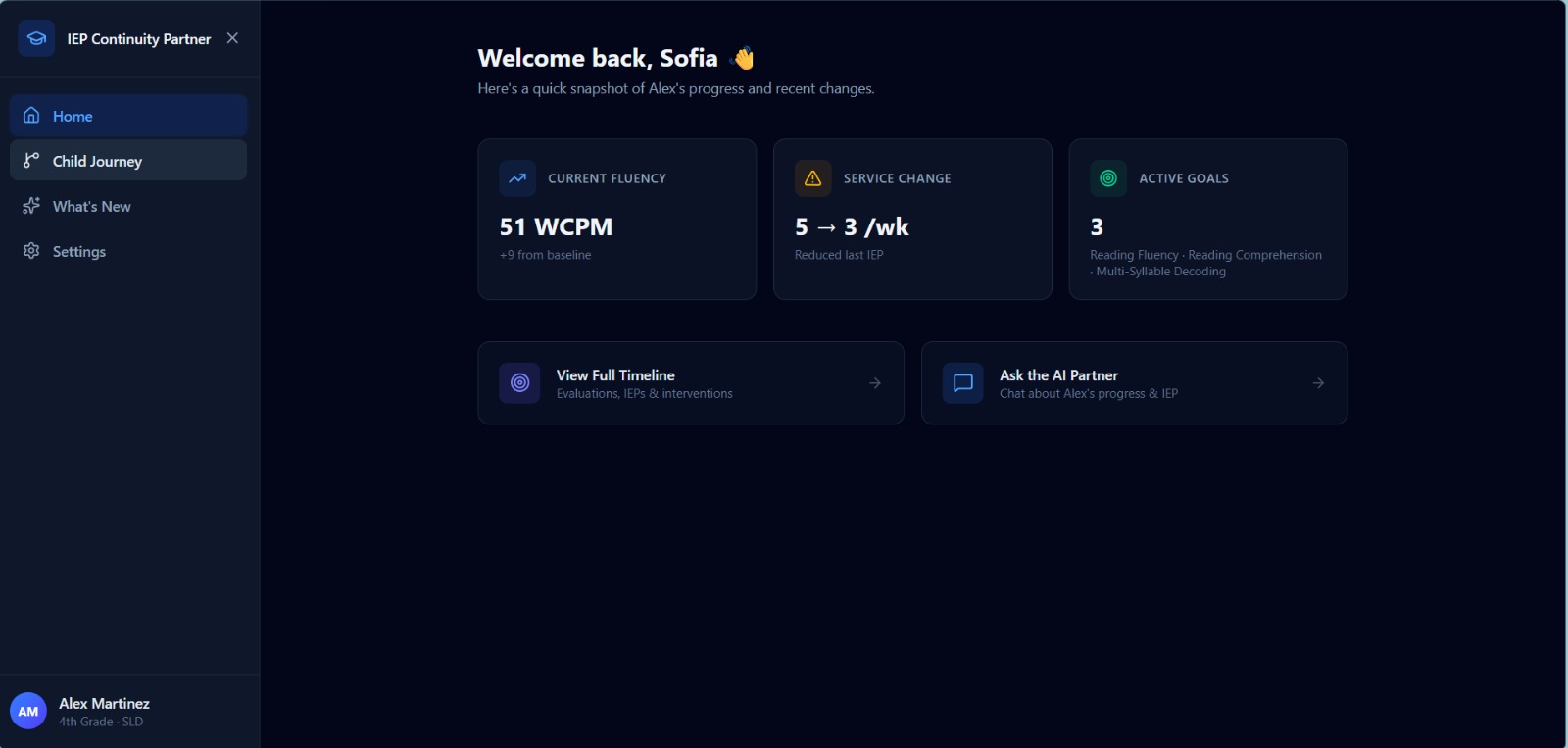
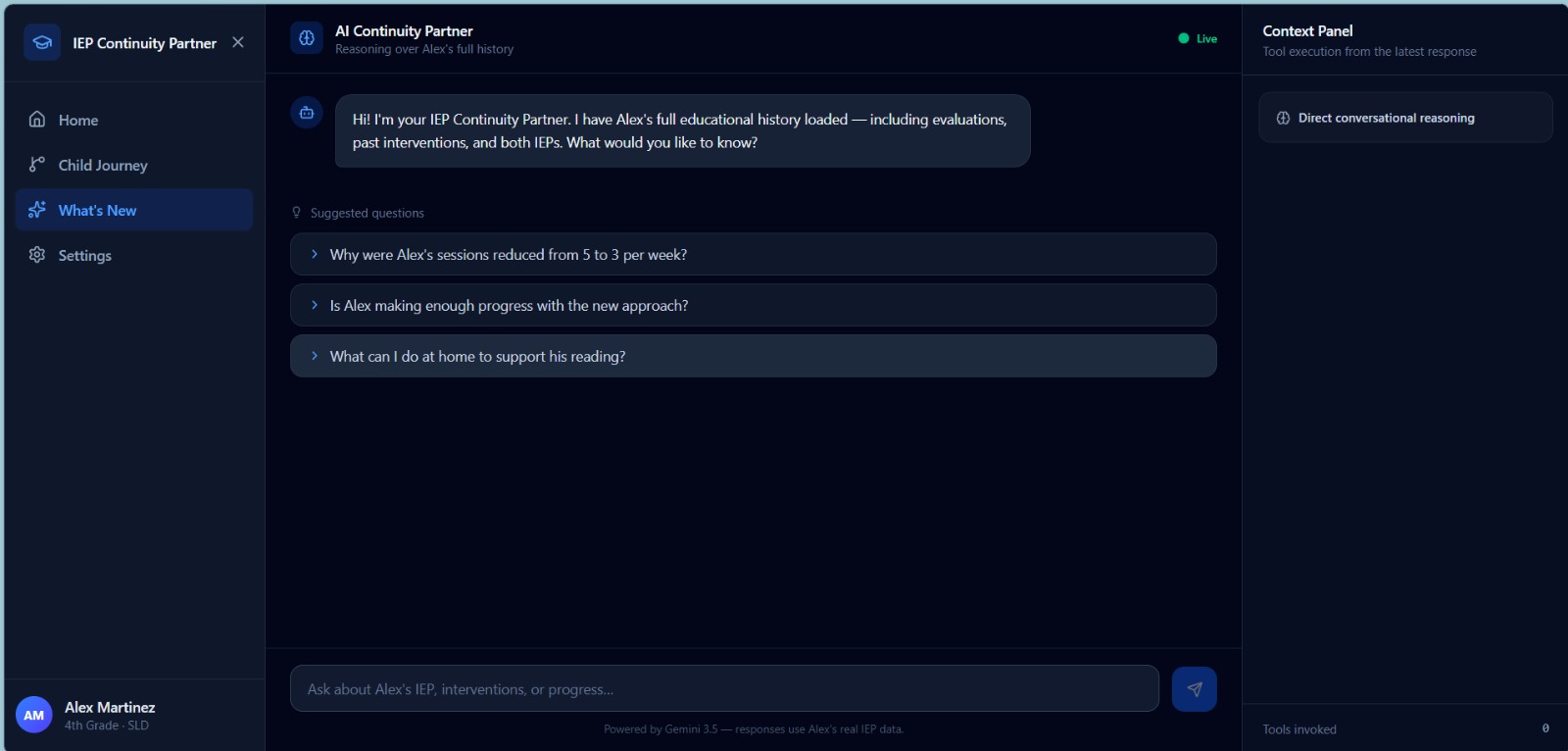
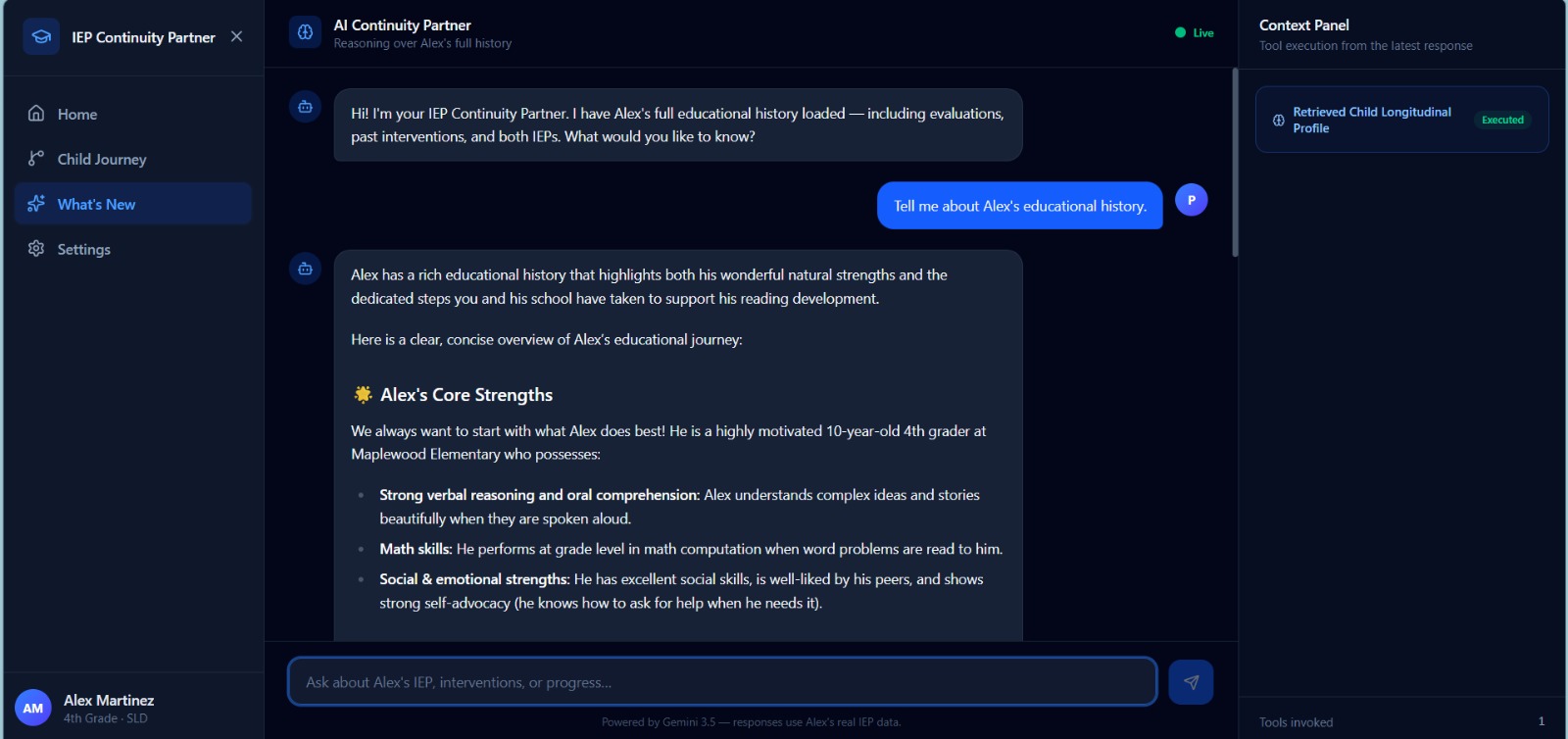
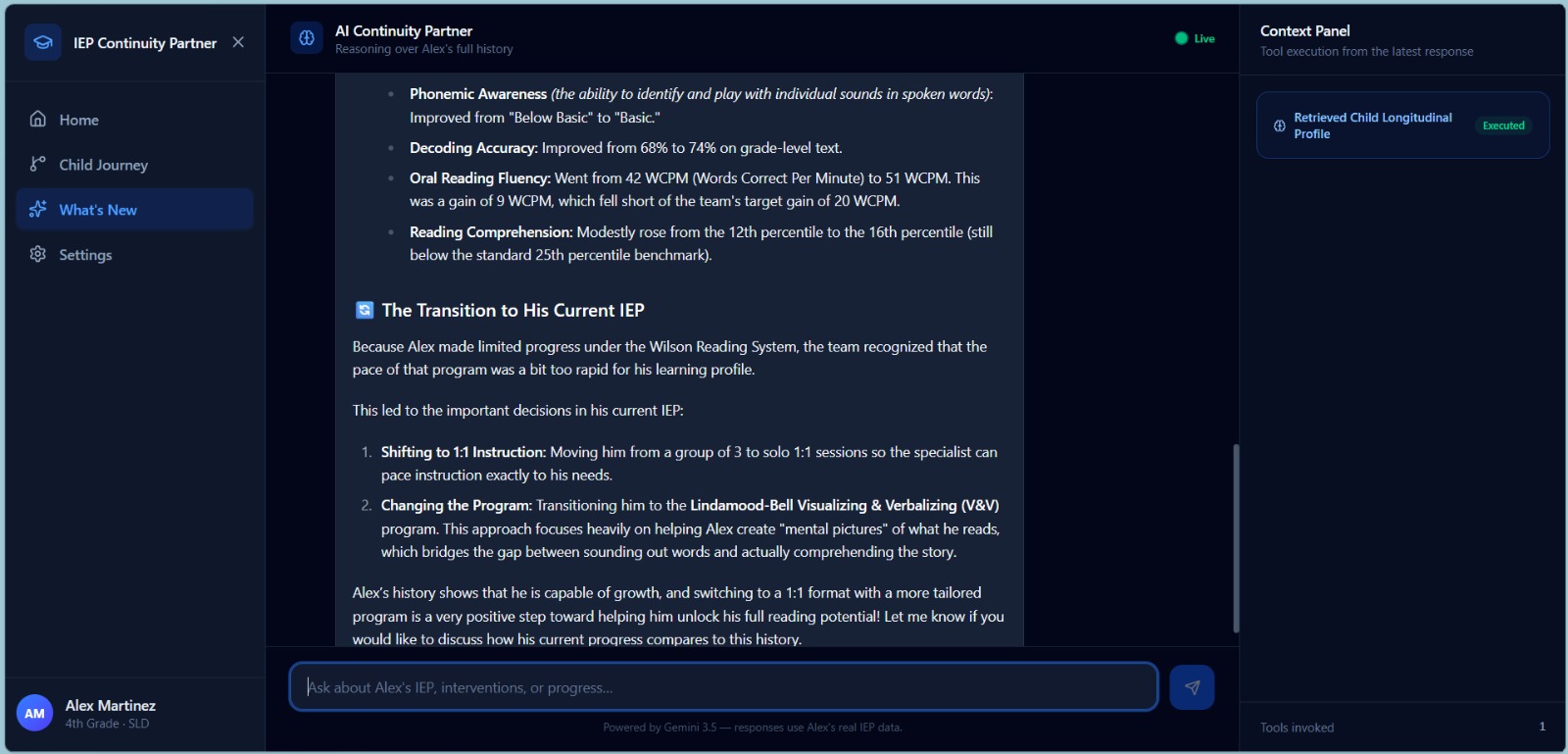
IEP Continuity Partner is a persistent AI Collaborative Partner for parents navigating a child's Individualized Education Program (IEP).
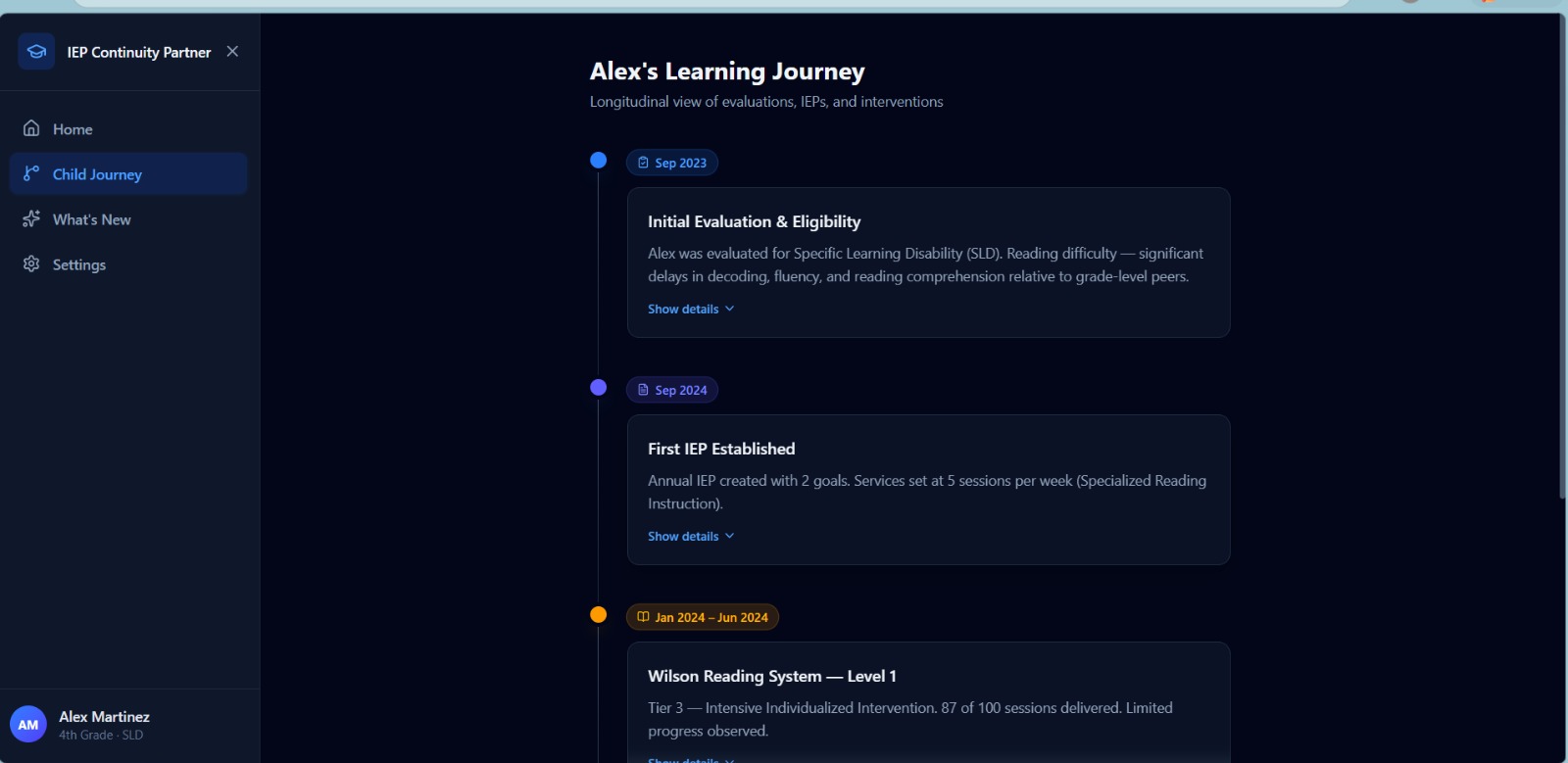
Instead of treating every conversation as a separate interaction, the system maintains longitudinal context about the child's educational journey. It can work with historical IEP information, compare previous and current IEPs, help identify important changes, capture post-meeting commitments, connect later progress evidence to those commitments, and surface potential implementation drift.
The core lifecycle is:
Past → Present → Evidence → Accountability → Future continuity
Core Innovation: Closed-Loop Commitment Drift Detection
The most important part of the system is its closed-loop commitment tracking.
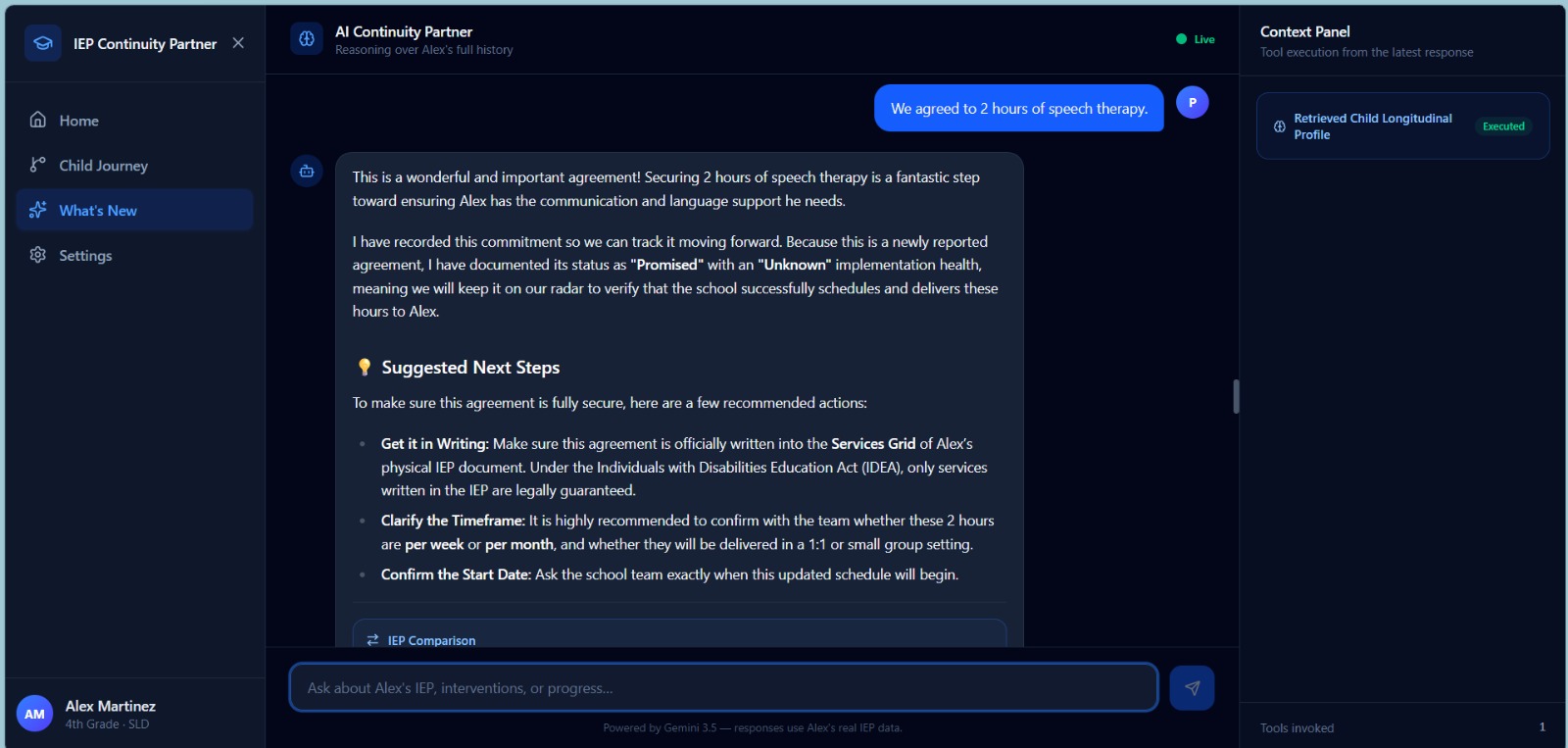
When a parent reports a commitment after an IEP meeting, the AI extracts the relevant commitments and presents them for parent confirmation. A proposed commitment is not automatically written into the permanent record.
Once confirmed, the commitment is stored in Firestore with its implementation health.
Later, when the parent provides progress evidence, Gemini interprets the evidence and extracts relevant observations and supporting quotes. The backend then matches that observation to the authoritative commitment.
The actual comparison is deterministic.
For example, if a commitment expects 2 hours of support but subsequent evidence reports only 1 hour, the backend can calculate the shortfall and delivery percentage.
The system then presents the evidence and proposes an implementation-health transition to the parent.
The parent must explicitly approve that transition before the permanent longitudinal state is changed.
This creates a clear boundary:
Gemini interprets the evidence. FastAPI performs deterministic validation and comparison. The parent makes the final state-changing decision. Firestore preserves the verified result and audit trail.
Human-in-the-Loop
Because educational commitments can have significant consequences, the AI does not independently modify the authoritative commitment state.
Human approval is required when:
- A new commitment is proposed and saved.
- A commitment's implementation health is proposed to change.
The system records the evidence quote, observed value, previous health, new health, timestamp metadata, and parent-approved rationale in an append-only audit trail.
This makes the AI's reasoning reviewable instead of allowing probabilistic model output to silently modify important longitudinal records.
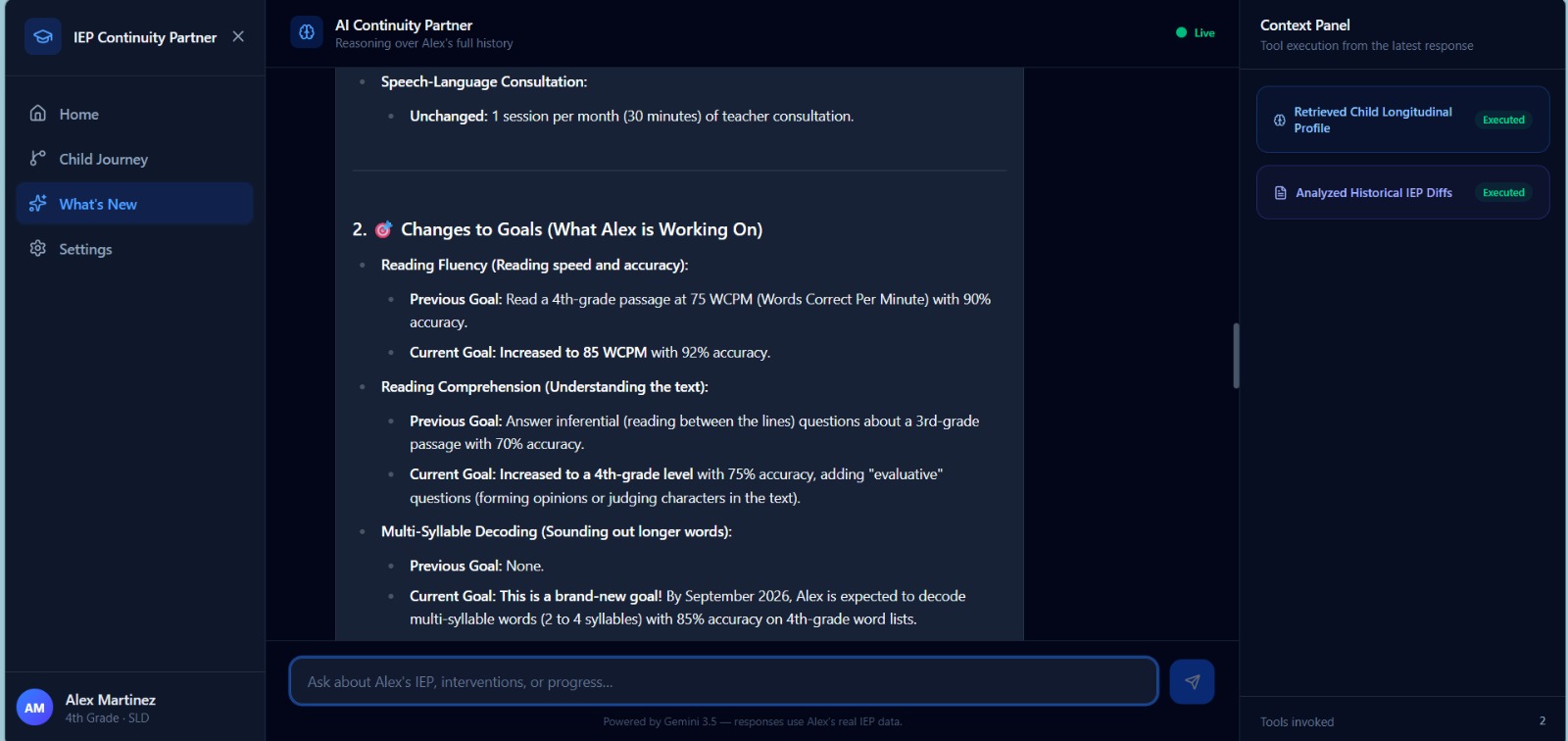
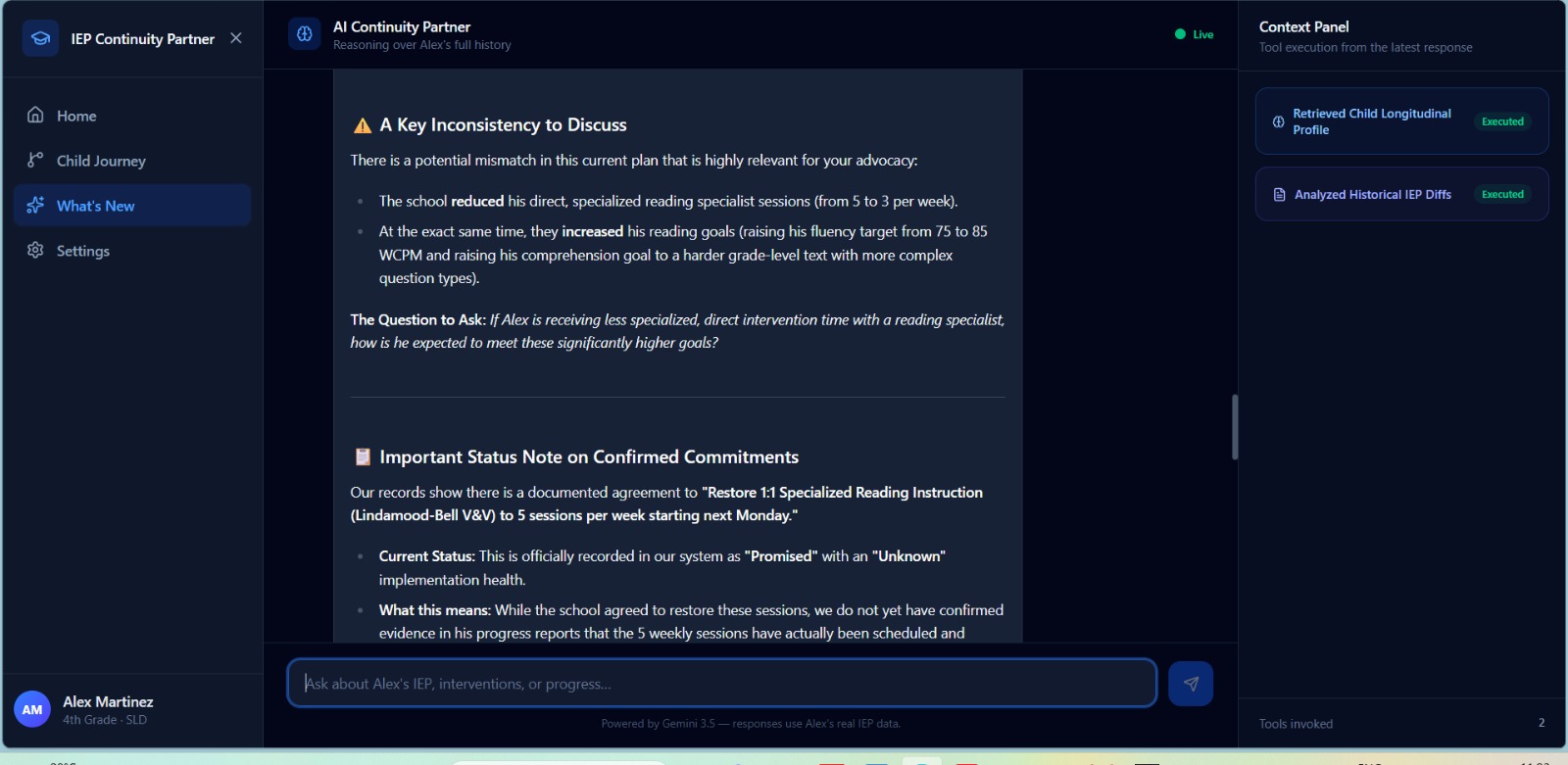
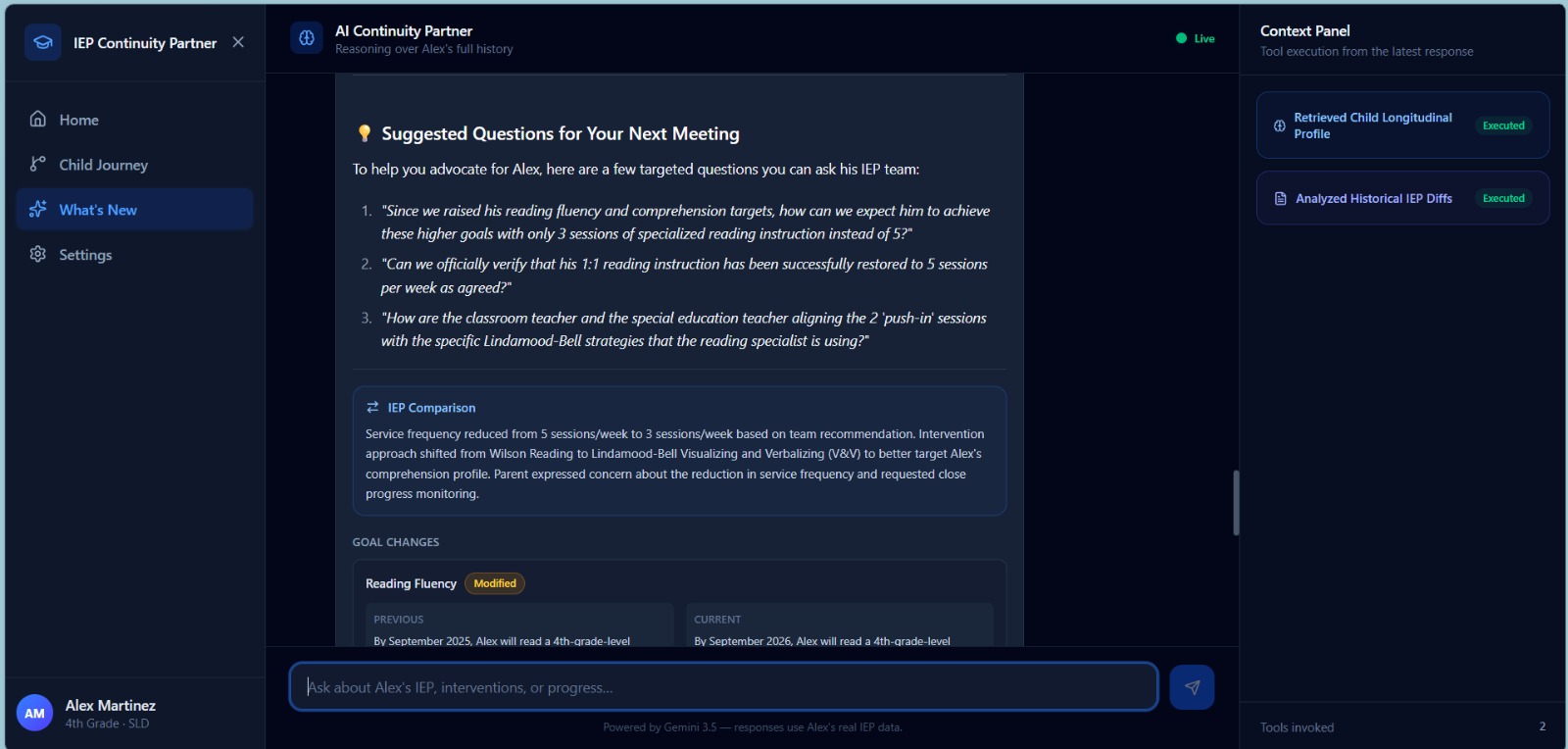
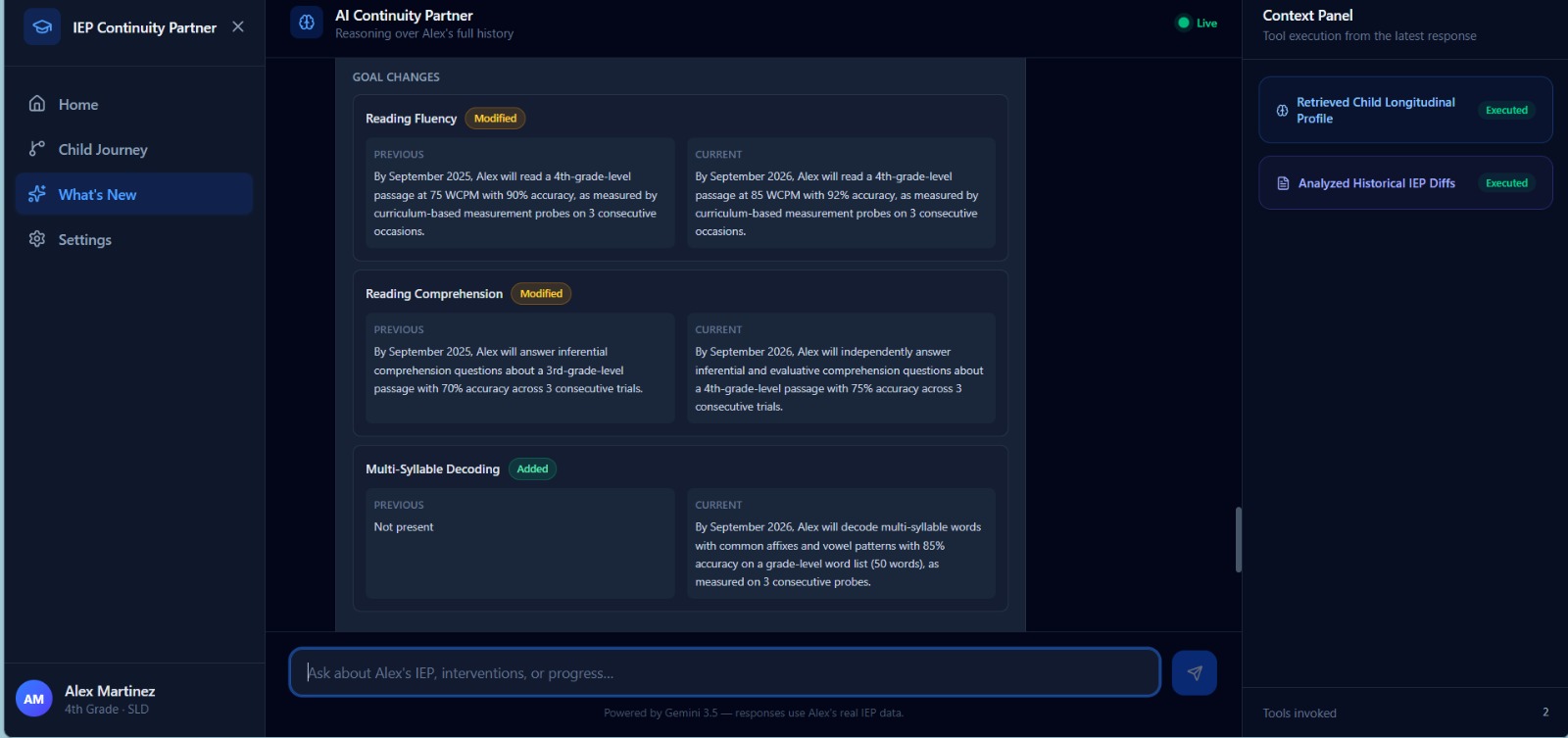
IEP Comparison
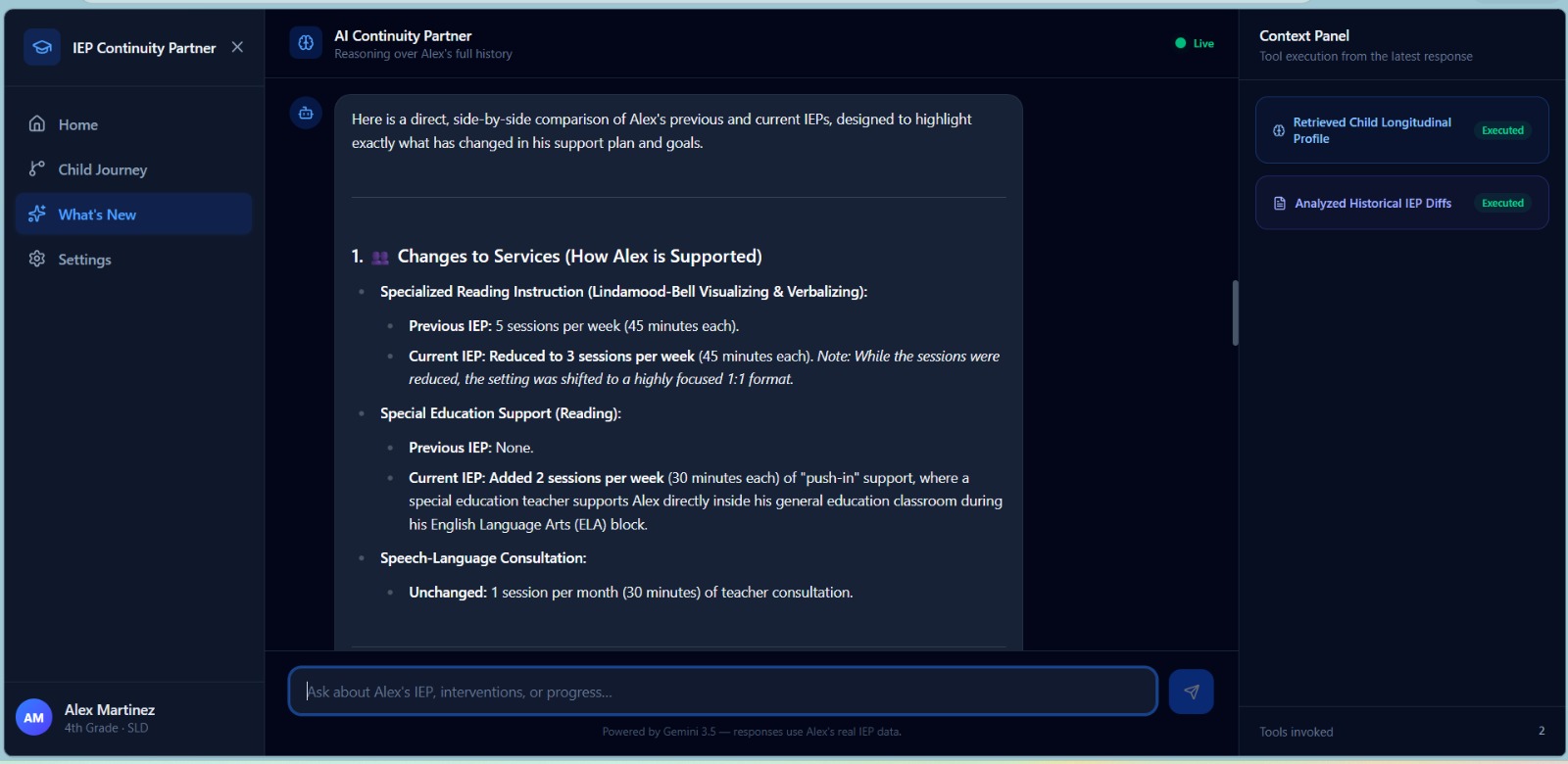
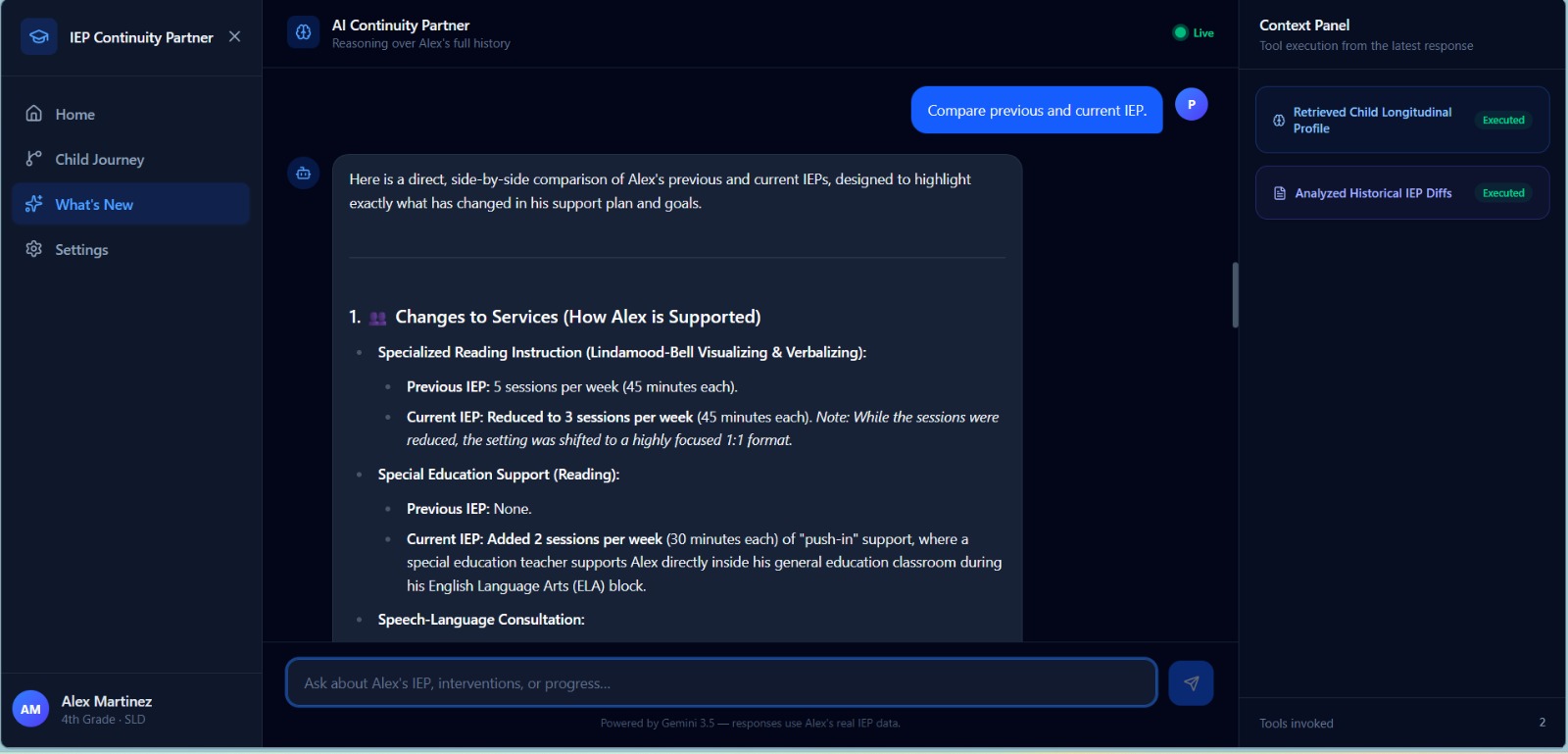
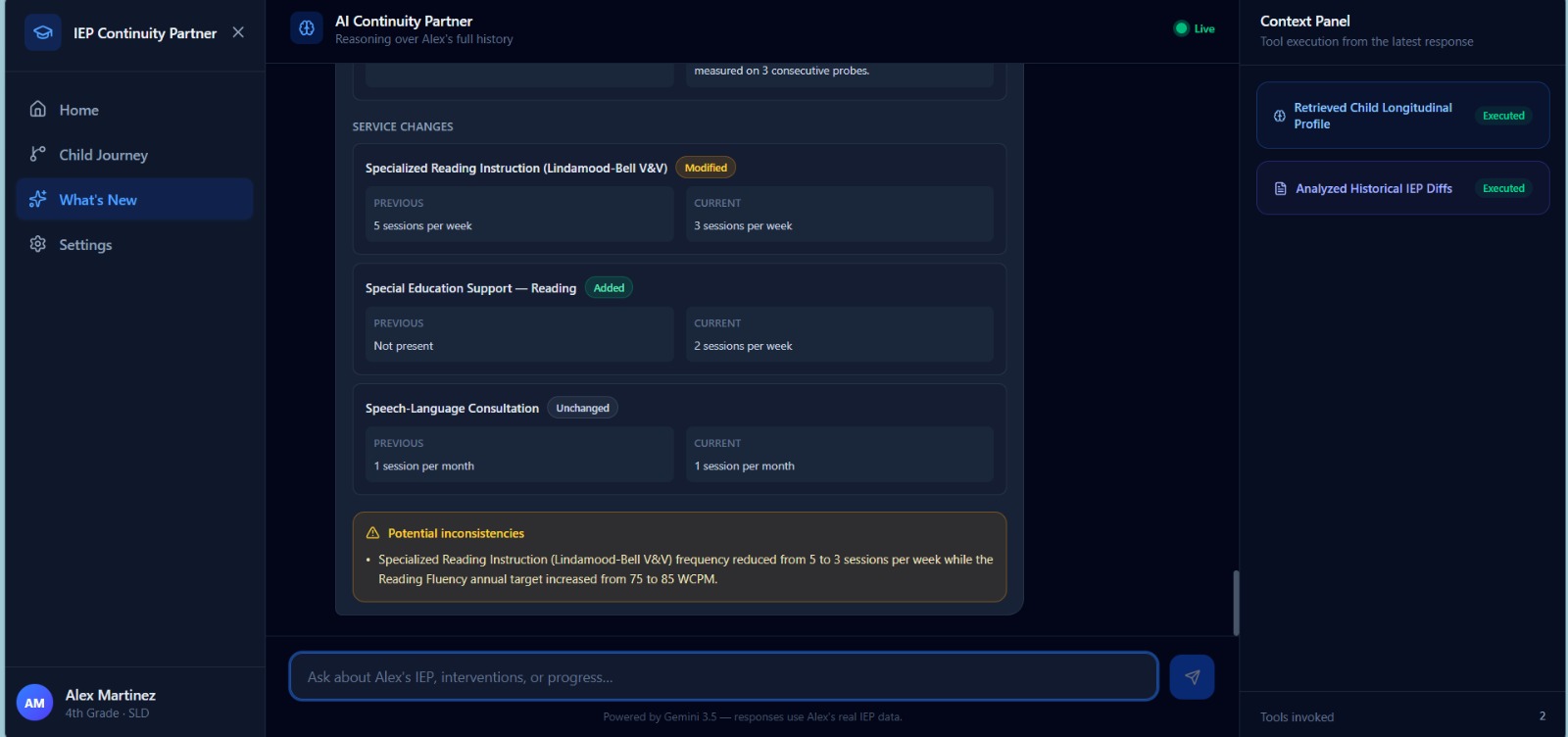
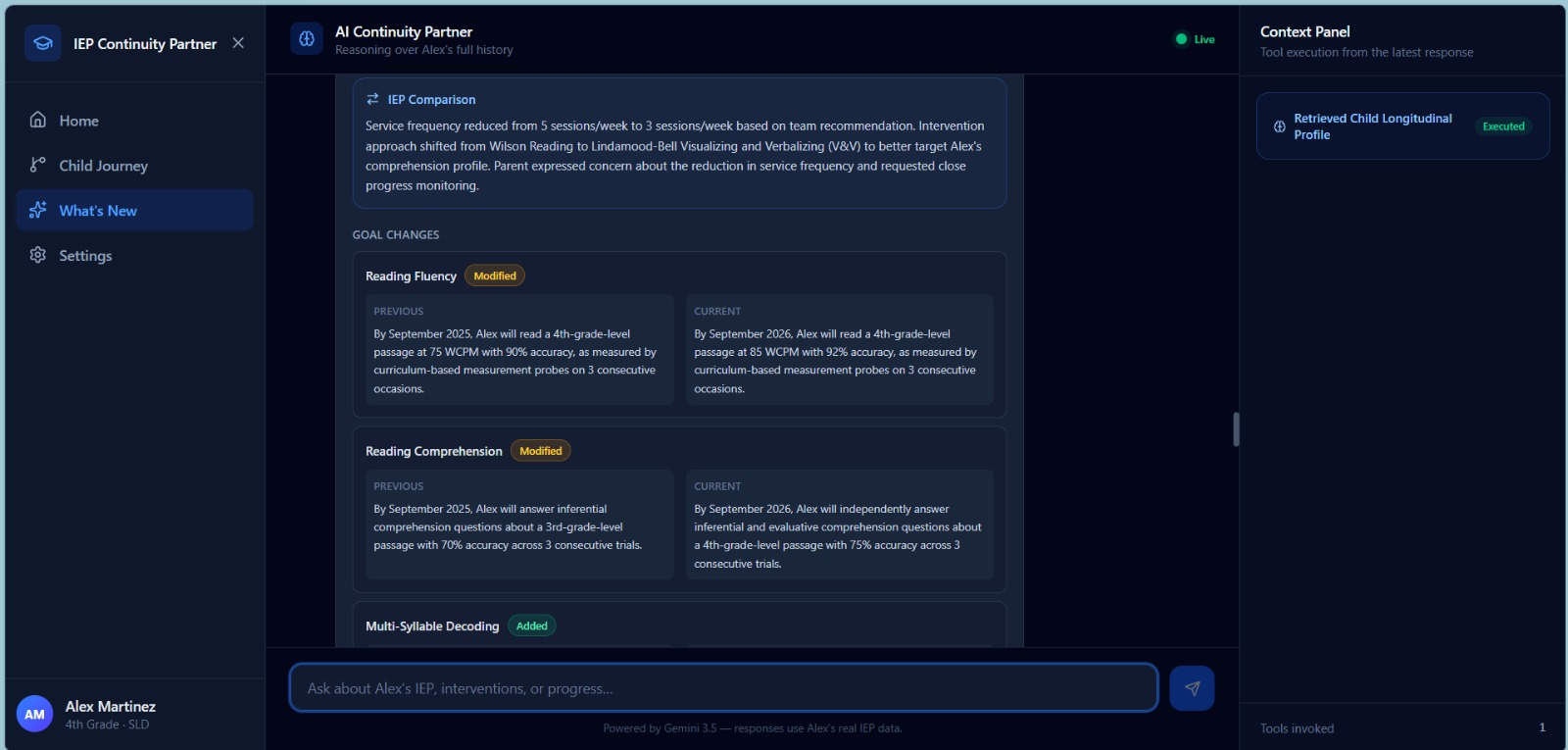
The application also compares historical and current IEP information.
The comparison agent can identify:
- Goal changes
- Service changes
- Accommodation changes
- Potential inconsistencies
- Important differences in progress-related information
The goal is not simply to summarize two documents. It is to help the parent understand what changed and identify areas that may need discussion with the IEP team.
Longitudinal Memory
Google Cloud Firestore provides persistent memory for the child's history, confirmed commitments, chat sessions, messages, and audit information.
The commitment structure maintains implementation health and an audit trail, allowing the system to preserve continuity across future interactions.
Agentic Architecture
The system uses Google ADK-based agents for AI interpretation.
There are two important agent behaviors:
- An IEP comparison agent that analyzes previous and current IEP information.
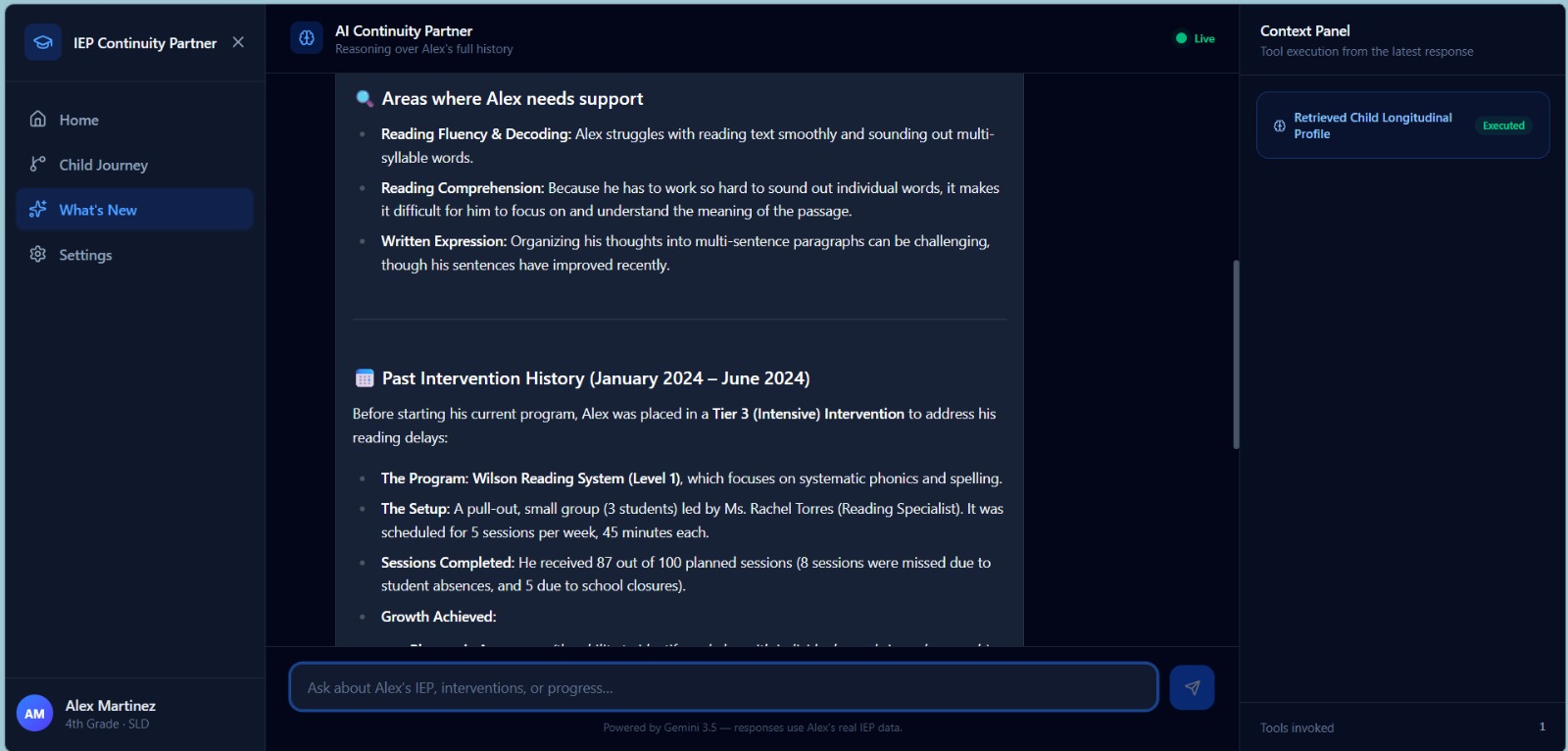
- A collaborative partner agent that uses the child's longitudinal context, parent concerns, and IEP comparison information to provide contextual guidance.
The agent is designed to work collaboratively with the parent rather than functioning as a stateless question-answering chatbot.
Safety and Reliability
The system deliberately separates probabilistic interpretation from state-changing logic.
Gemini can interpret evidence and extract relevant information, but deterministic backend logic performs the commitment comparison.
Permanent state changes require explicit parent approval.
Evidence must support the observed value before an implementation-health transition can be persisted.
This design provides a reviewable and auditable boundary between AI assistance and persistent state changes.
What We Learned
Building the project showed us that an effective collaborative agent is not only about generating good responses.
For a longitudinal workflow, memory, evidence linkage, deterministic validation, human approval, and persistence are equally important.
The key lesson was that AI should assist with interpretation while important state changes remain transparent, deterministic, and under human control.
Future Direction
The architecture can be extended with richer document ingestion, retrieval-augmented generation, personalized parent preferences, broader evidence sources, outcome tracking, and a living knowledge layer that identifies new developments that could be relevant to a particular child's educational journey.
The long-term goal is to make the system feel like a continuously adapting partner rather than another standalone AI tool.

Log in or sign up for Devpost to join the conversation.