-
-
SCU ACM WINTER CHALLENGE
Inspiration
Before applying to study in the United States, international students must take an English proficiency test to demonstrate their ability to understand and use the language effectively. One of the most widely used testing systems is the IELTS (International English Language Testing System). IELTS assesses candidates' English proficiency across four key skills: reading, writing, listening, and speaking. Among these, speaking tends to be the most challenging skill to improve, largely due to the lack of resources and opportunities for students to practice with a partner or receive feedback. As an international student who faced this same challenge, I decided to develop an IELTS Speaking Assistant app to help students enhance their speaking skills by providing an accessible and practical solution to this common problem.
What it does
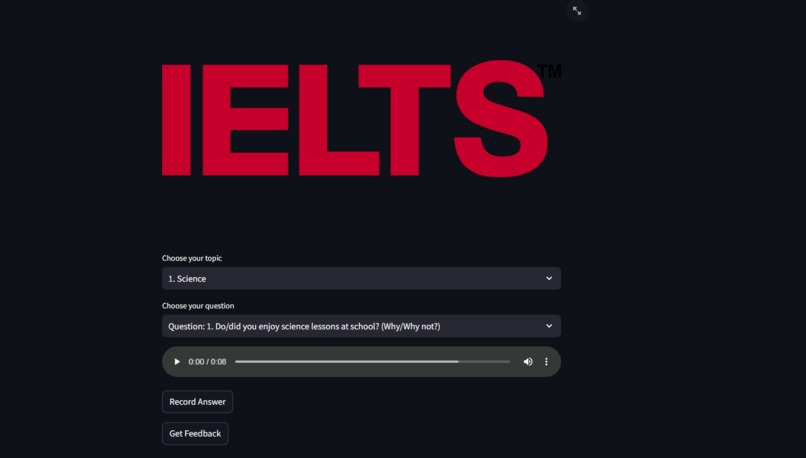
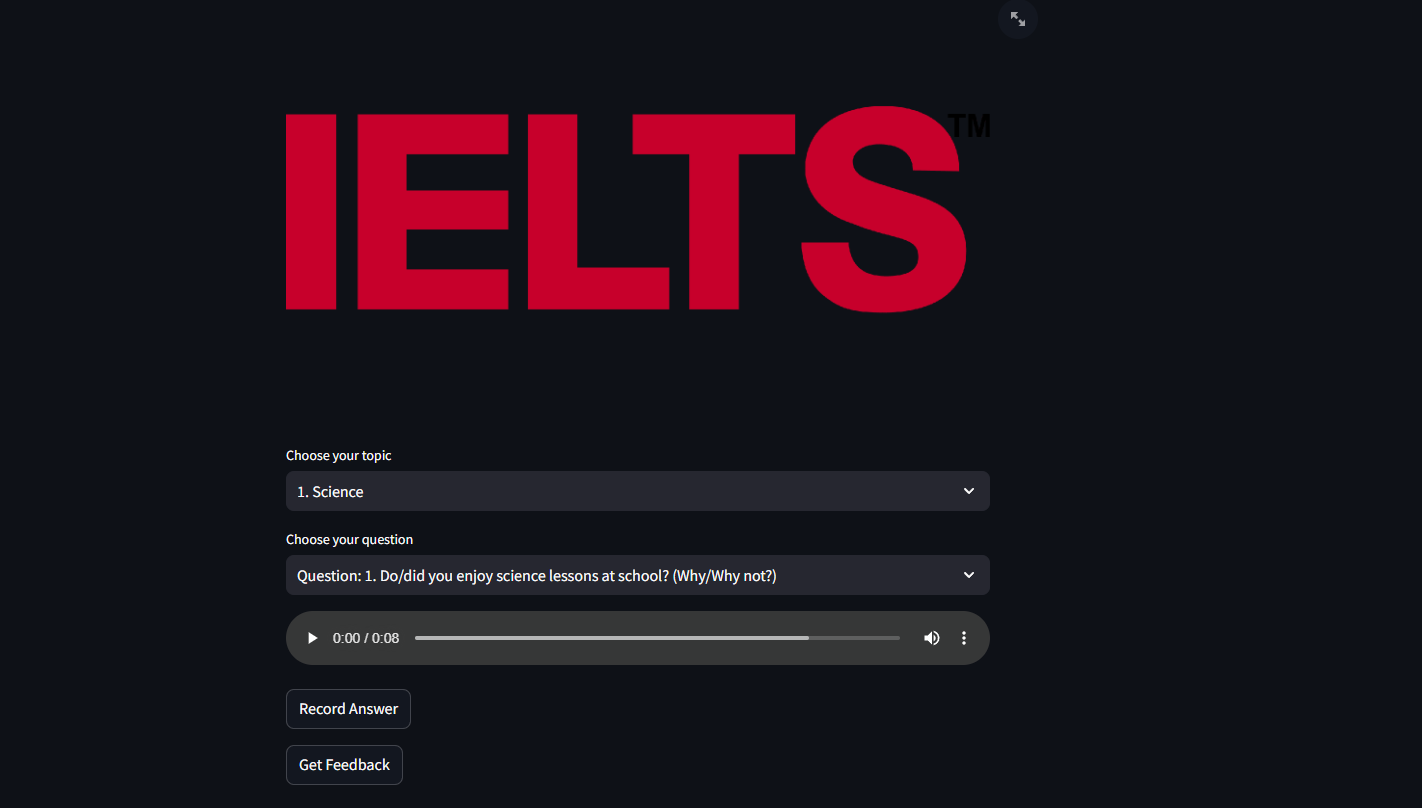
The app will offer users a variety of IELTS-themed prompts and questions, allowing them to record their responses. Once the recording is complete, the app will generate detailed feedback along with a band score, helping students identify areas for improvement and track their progress over time.
How we built it
The backend of the IELTS Speaking Assistant app is built with a robust set of features, leveraging key libraries and APIs to deliver an automated, interactive learning experience. The app uses Python for backend development, with the OpenAI API playing a central role in providing AI-driven feedback. The OpenAI API is responsible for evaluating user responses by simulating an IELTS examiner. It generates detailed feedback based on essential IELTS criteria—fluency, lexical resource, grammatical range, pronunciation, and relevance to the given question. This feedback is accompanied by a band score, helping users gauge their performance and identify areas for improvement.
Challenges we ran into
During the development of the IELTS Speaking Assistant app, we encountered several significant challenges. One of the primary issues was ensuring the accuracy and reliability of speech recognition. Since the app relies on converting spoken input into text for analysis, handling varying user accents, speech clarity, and background noise proved to be difficult. We had to fine-tune the use of the speech_recognition library and experiment with different audio processing techniques to improve transcription accuracy.
Accomplishments that we're proud of
One of the key accomplishments we are proud of is successfully integrating advanced AI-driven feedback using the OpenAI API. This feature allows the app to simulate an IELTS examiner, providing users with detailed evaluations and personalized feedback on their speaking skills. The feedback covers critical IELTS criteria such as fluency, grammatical accuracy, lexical resource, pronunciation, and overall relevance, offering users a realistic assessment and actionable insights for improvement.
What we learned
Throughout the development of the IELTS Speaking Assistant app, we gained valuable insights into building AI-driven applications and integrating various technologies to create a seamless user experience. One of the most significant lessons was understanding how to effectively use the OpenAI API for natural language processing tasks. We learned how to craft detailed prompts to simulate the behavior of an IELTS examiner and generate meaningful feedback that closely aligns with the exam's scoring criteria.
What's next for Ielts Speaking Assistant
The next steps for the IELTS Speaking Assistant app involve expanding its features, enhancing the user experience, and increasing its accessibility. One of our key priorities is to improve the feedback mechanism by incorporating advanced AI models that provide even more nuanced evaluations, such as identifying specific grammar errors or offering vocabulary improvement suggestions. We also plan to introduce real-time feedback, where users can receive hints or corrections as they speak, making practice sessions more interactive.
Built With
- apis
- openai
- python
- pyttsx3
- streamlit

Log in or sign up for Devpost to join the conversation.