-
-
What makes Idle Hours different?
-
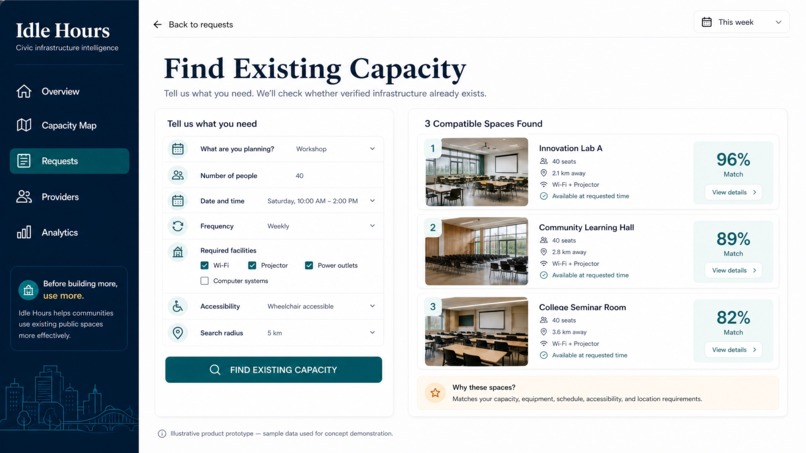
User need → compatible existing spaces
-
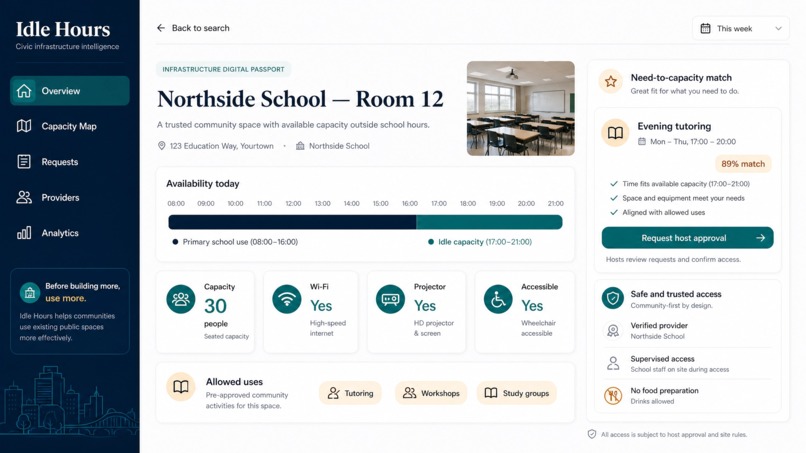
Availability → capacity → equipment → accessibility → rules → approval
-
Idle hours → available capacity → providers → capacity map → recommended matches
Inspiration
The project began with a simple question:
How often do we decide to build something new before understanding what already exists?
Across communities, classrooms, labs, halls, meeting rooms, and other facilities can sit unused for predictable periods. At the same time, students, educators, community groups, and organizations struggle to find affordable, suitable places to learn, collaborate, and deliver services.
This revealed a simple but important paradox:
Infrastructure can exist without being accessible.
The problem is not always a shortage of physical space. Often, existing capacity is difficult to discover, poorly described, hard to coordinate, or unavailable without a trusted process.
A room may be empty, but that does not automatically make it usable.
Potential users need to know:
When it is genuinely available. How many people it can support. What equipment it contains. Whether it is accessible. What activities are permitted. What safeguards and approval requirements apply.
That led us to a different starting point.
Instead of asking:
"What should we build next?"
Idle Hours asks:
"What capacity already exists—and can it solve the problem first?"
What it does
Idle Hours is an infrastructure intelligence concept that helps identify, structure, match, and activate underutilized capacity before new infrastructure is considered.
The concept initially focuses on facilities such as classrooms, laboratories, halls, meeting rooms, and community spaces with recurring periods of underutilization.
Idle Hours operates through six connected stages:
DISCOVER → PASSPORT → REQUEST → MATCH → ACTIVATE → MEASURE Discover
Identify recurring periods where infrastructure is underutilized.
Passport
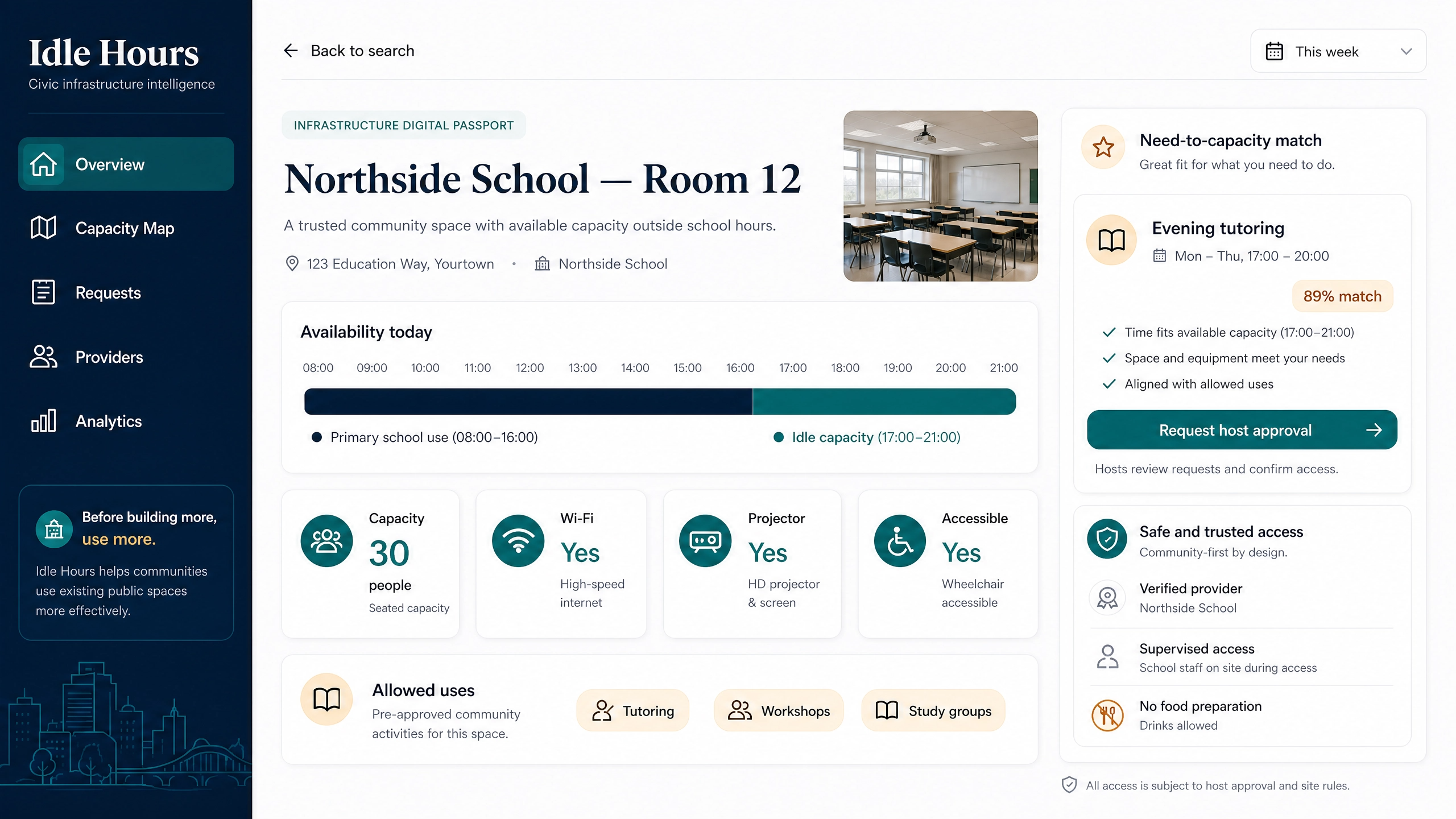
Create a structured digital profile containing capacity, equipment, accessibility, availability, permitted uses, access conditions, and operating rules.
Request
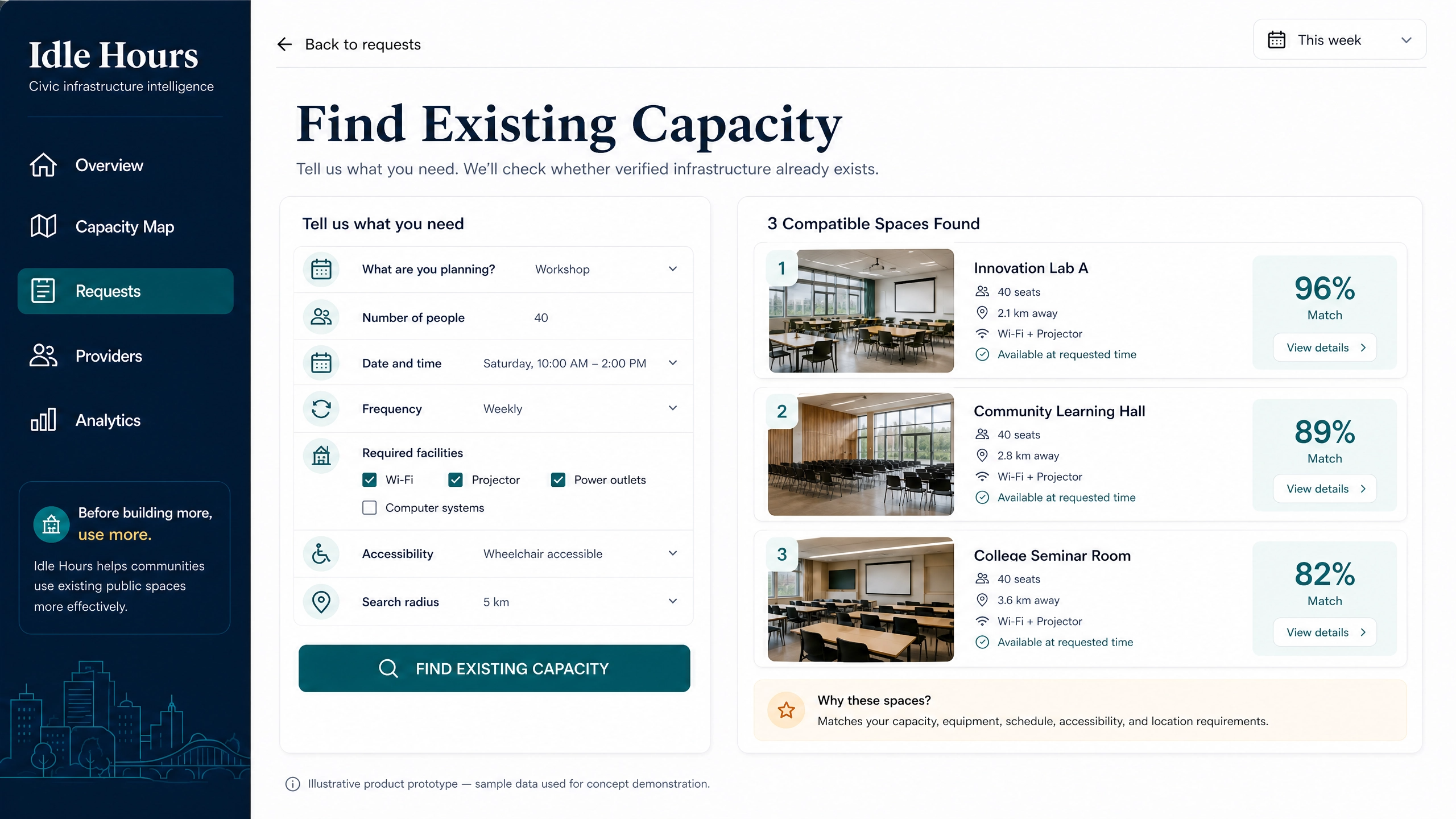
Allow users to describe what they actually need instead of simply searching through a list of venues.
Match
Evaluate compatibility across factors such as capacity, timing, equipment, location, accessibility, and activity requirements.
Activate
Introduce controlled approval so infrastructure providers retain authority over who uses their facilities and under what conditions.
Measure
Track activation, utilization, demand patterns, and outcomes to understand how infrastructure is actually being used.
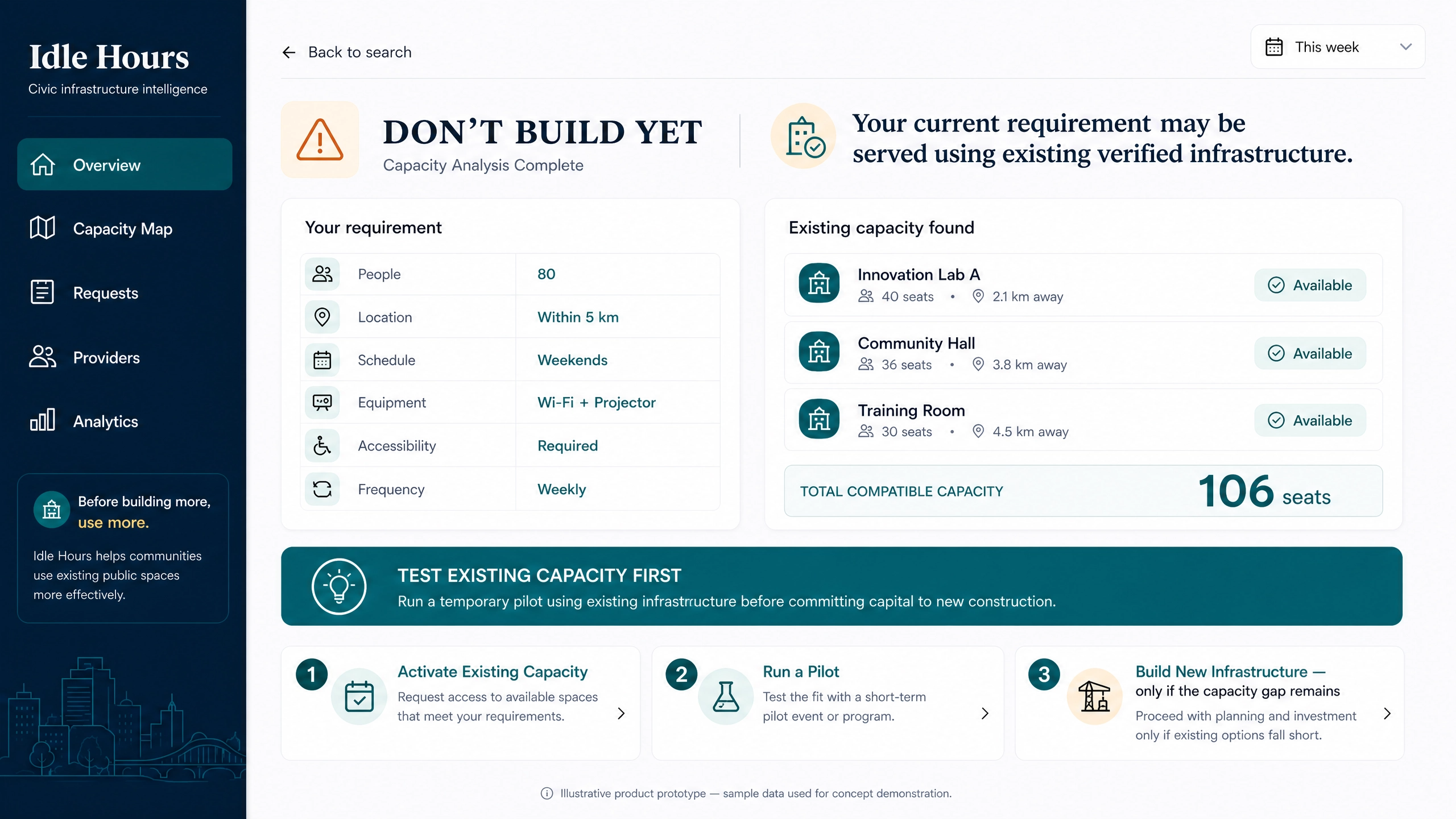
The Don't Build Yet Engine
The central innovation behind Idle Hours is the Don't Build Yet Engine.
When an organization identifies a need for additional infrastructure, the system first evaluates whether compatible, verified capacity may already exist nearby.
The purpose is not to prevent new infrastructure from being built.
It is to make the decision more informed.
The decision process becomes:
Understand the requirement → Evaluate existing capacity → Test compatible options → Build when a genuine gap remains.
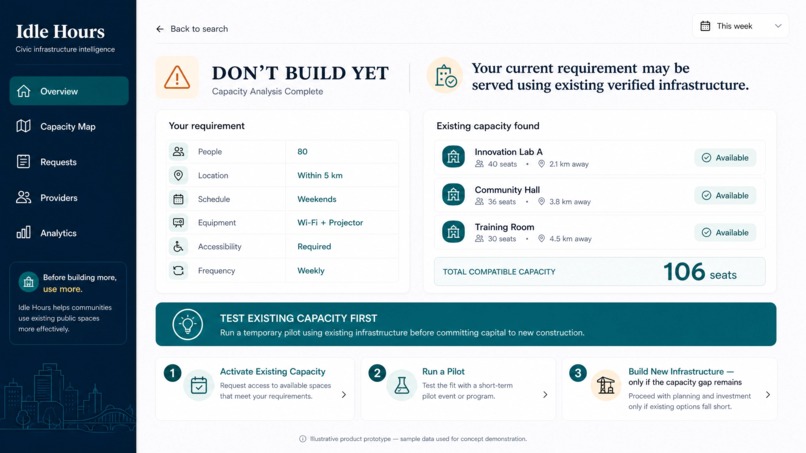
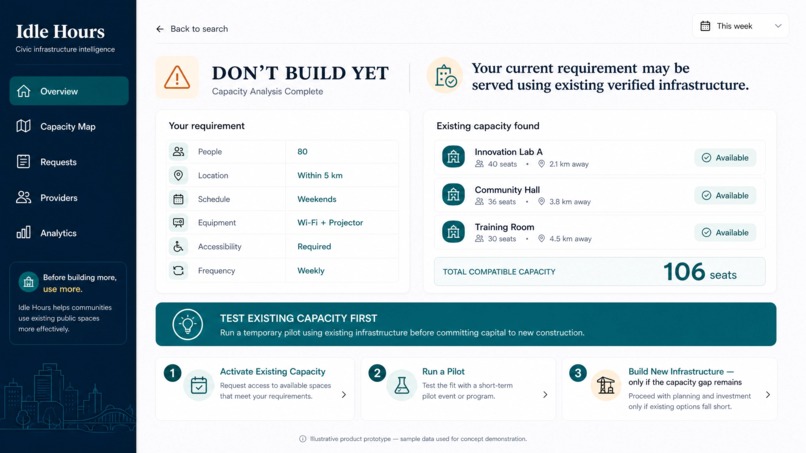
For example, an organization requiring space for 80 people, specific equipment, and accessibility features could first evaluate nearby verified facilities. If existing infrastructure can satisfy the requirement—either through one suitable space or a practical combination—the organization can test that capacity before committing to a new facility.
Idle Hours therefore sits before the build decision, not after it.
How we built it
Because this is a non-code innovation challenge, we approached Idle Hours as a product, systems, and implementation design problem.
We developed the concept in five layers.
- Problem framing
We started with the mismatch between two realities:
Underutilized infrastructure on one side. Unmet demand for suitable space on the other.
The challenge was avoiding an unrealistic assumption that every unused room should automatically become publicly accessible.
Real infrastructure comes with constraints including:
Security. Safeguarding. Maintenance. Liability. Accessibility. Scheduling conflicts. Equipment limitations. Institutional control.
This became a core design principle:
Unused does not automatically mean available.
- Research and competitive analysis
We explored existing approaches to venue discovery, facility management, coworking, shared assets, and infrastructure utilization.
This revealed an important gap.
Many existing solutions begin with:
"Here are spaces you can book."
Idle Hours begins earlier:
What capacity exists? When is it genuinely available? What can it support? Who can use it safely? And can that capacity solve a real requirement?
This shifted the concept away from being a simple booking marketplace and toward an infrastructure intelligence system.
- Designing the operating model
We developed the six-stage framework:
DISCOVER → PASSPORT → REQUEST → MATCH → ACTIVATE → MEASURE
The framework connects both sides of the ecosystem:
Infrastructure providers. Space seekers. Institutional approvers. Community users. Future infrastructure decision-makers.
This created a complete journey from identifying unused capacity to activating and measuring it.
- Designing the product experience
We designed a connected prototype rather than isolated screens.
The product experience includes:
An Infrastructure Intelligence Dashboard showing available and underutilized capacity. A Capacity Map for visual discovery. A Need-First Request & Match experience based on actual requirements. A Provider Passport containing verified infrastructure information. The Don't Build Yet Engine, demonstrating how existing capacity can inform future infrastructure decisions.
Together, these screens demonstrate the complete journey:
Discover capacity → Understand it → Match it to a need → Request approval → Activate it → Learn from the outcome.
- Testing feasibility
We developed supporting work around the concept to test whether Idle Hours could move beyond an attractive prototype.
This included:
A pilot model. Business model assumptions. Financial scenarios. Sustainability considerations. Risk and governance thinking. Implementation planning.
All prototype metrics and financial figures are clearly presented as illustrative planning assumptions rather than real-world performance results.
Challenges we ran into
The biggest challenge was avoiding an oversimplified solution.
At first, Idle Hours could easily have become:
"A platform for booking empty rooms."
But that would ignore the hardest part of the problem.
An empty room is not necessarily an available room.
It may be restricted because of safeguarding requirements, maintenance, security, equipment limitations, scheduling conflicts, or institutional policies.
This changed our approach.
Instead of designing for unrestricted access, we designed for controlled activation.
Providers retain visibility and authority. Users describe their requirements. Compatibility is evaluated before access is requested. Approval remains part of the process.
Another challenge was making the Don't Build Yet Engine realistic.
We did not want to suggest that every infrastructure problem can be solved by reusing existing facilities.
Some needs genuinely require new infrastructure.
The engine therefore acts as a decision-support layer, not an anti-construction argument:
Define the requirement. Check compatible existing capacity. Test feasible alternatives. Build when the capacity gap is real.
We also faced the challenge of balancing ambition with credibility.
Rather than presenting invented adoption statistics or impact results, we clearly separated:
Research-backed observations. Prototype demonstrations. Illustrative pilot assumptions.
That distinction became an important part of the project's design philosophy.
Accomplishments that we're proud of
Our biggest accomplishment was transforming a simple observation about unused infrastructure into a complete and connected innovation concept.
We are particularly proud of:
Creating the Don't Build Yet Engine as a decision layer before new infrastructure investment. Designing the Provider Passport, which transforms a physical space into structured and understandable infrastructure. Developing a need-first matching model rather than another browse-and-book experience. Creating a connected prototype that demonstrates the journey from discovery to activation. Designing for real-world constraints such as approval, accessibility, safeguarding, and provider control. Developing supporting work around feasibility, sustainability, business models, and implementation. Maintaining a clear distinction between what the prototype demonstrates and what still needs real-world validation.
Most importantly, we are proud that Idle Hours does not simply propose another platform.
It proposes a different infrastructure question:
Before adding more capacity, have we fully understood the capacity we already have?
What we learned
The biggest lesson from developing Idle Hours was that innovation does not always begin with creating something entirely new.
Sometimes it begins with seeing an existing system differently.
We learned that infrastructure is not valuable simply because it exists.
Its value depends on whether people can:
Discover it. Understand it. Trust it. Access it. Coordinate around it.
A physical room without reliable information is difficult to use.
But when that same room has a clear capacity profile, availability window, equipment information, accessibility details, activity rules, approval workflows, and accountability structure, it becomes part of a usable system.
We also learned that a strong innovation must acknowledge its limitations.
Idle Hours does not assume that every unused space should be activated.
And it does not assume that new infrastructure should never be built.
Instead, it introduces a better decision point:
Understand what exists. Test what can be activated. Build when the gap is real.
What's next for Idle Hours
The next step is to move from concept validation to a focused real-world pilot.
Rather than attempting to launch across an entire city, Idle Hours could begin with a small network of verified schools, colleges, and community facilities.
The pilot would focus on:
Mapping real recurring availability. Creating verified Provider Passports. Testing the requirement-to-capacity matching model with real users. Validating approval, safeguarding, and access workflows. Measuring utilization and stakeholder value. Improving the Don't Build Yet Engine using real demand and capacity patterns.
Over time, the concept could expand beyond educational spaces to libraries, community facilities, public buildings, innovation centres, and other infrastructure with recurring underutilized capacity.
The long-term ambition is not to eliminate new infrastructure.
It is to make future infrastructure decisions more informed, more efficient, and more intentional.
Before we build more, let's use more.
Built With
- accessibility
- business-modeling
- data-analysis
- decision
- financial-modeling
- market-research
- product-design
- product-strategy
- service-design
- sustainability
- systems-design
- ui/ux-design

Log in or sign up for Devpost to join the conversation.