what inspired us
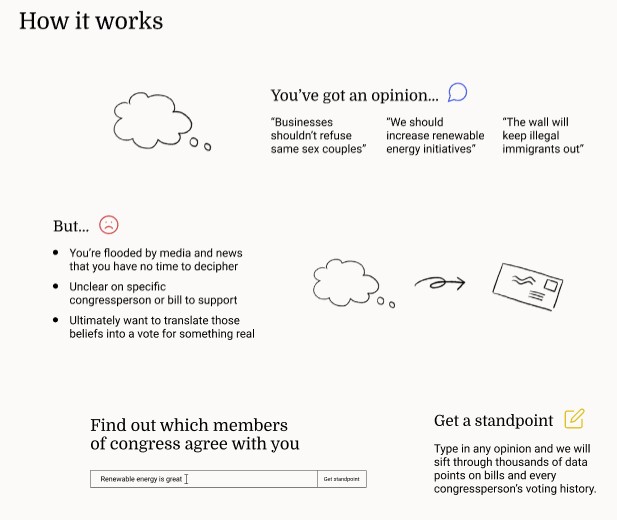
As election season draws near, we citizens are presented with a question: are our representatives in Congress adequately representing us? Disinformation, partisan media, and the overwhelming amount of news about legislators can make it difficult for civic-minded citizens to understand what their legislators actually believe. Our new tool Standpoint allows citizens to be better informed about what their legislators have actually done and what they believe in without having to trawl through legislative records.
how we built our project
Our project compiles data on legislator uses a state-of-the-art deep learning model to learn the meaning of the bills that our legislators vote on. You can provide the model with an idea for a bill and the model will predict how your legislators would have voted on it based on their past votes on the topic. Using this tool, you can see how well your legislators agree with your positions.
the challenges we faced
The primary challenge of the project was figuring out what legislators believe. Though there is an extensive amount of speeches, public statements, bills, and news reports about our legislators, it is often unclear whether political rhetoric translates to actual action. We decided to use voting records to understand ideologies because writing and voting on bills is the work of a legislator, and actions speak louder than words. However, voting records alone won't tell you what a legislator believes. Even if you know the title of a bill, many bills are misleadingly named or don't do what the political rhetoric suggests it would. One striking recent instance is the 2015 FREEDOM act, which re-approved the mass surveillance programs of the PATRIOT act. Thus, we needed to create a model which could interpret the text of a bill and have some understanding of what the bill was about. It turned out that transformers, a type of deep neural network used for natural language processing, proved to be the right tool for this task.

Log in or sign up for Devpost to join the conversation.