Inspiration
I am a senior SAP S/4HANA Solution Architect, and I am personally transitioning toward an SAP AI Architect role. Despite years of experience, I realized something unsettling: most career tools would happily encourage me to “learn AI” or “take courses,” but none could tell me whether the market would actually believe I was ready.
At the same time, I’ve seen countless professionals: testers, developers, consultants - follow roadmaps, earn certifications, and still get rejected.
The common failure pattern is simple: 1/ Learning happens privately 2/ Evidence is missing publicly 3/ Applications fail silently
I wanted to build a system that refuses to lie - even to me. If a tool cannot block me from applying prematurely, it has no right to exist.
What it does
Identity Compiler is structured as a compiler, not a coach. Input Current role Target role Geography and constraints Existing public evidence (if any)
Core Logic (powered by Gemini) Gemini infers: 1/ What the market expects from the target role 2/ What the user currently signals publicly 3/ The non-obvious gaps blocking credibility
Output (four fixed sections)
Compute Identity Delta - expectations vs current signals
Proof-of-Work Questline - weekly artifact mandates (no learning tasks)
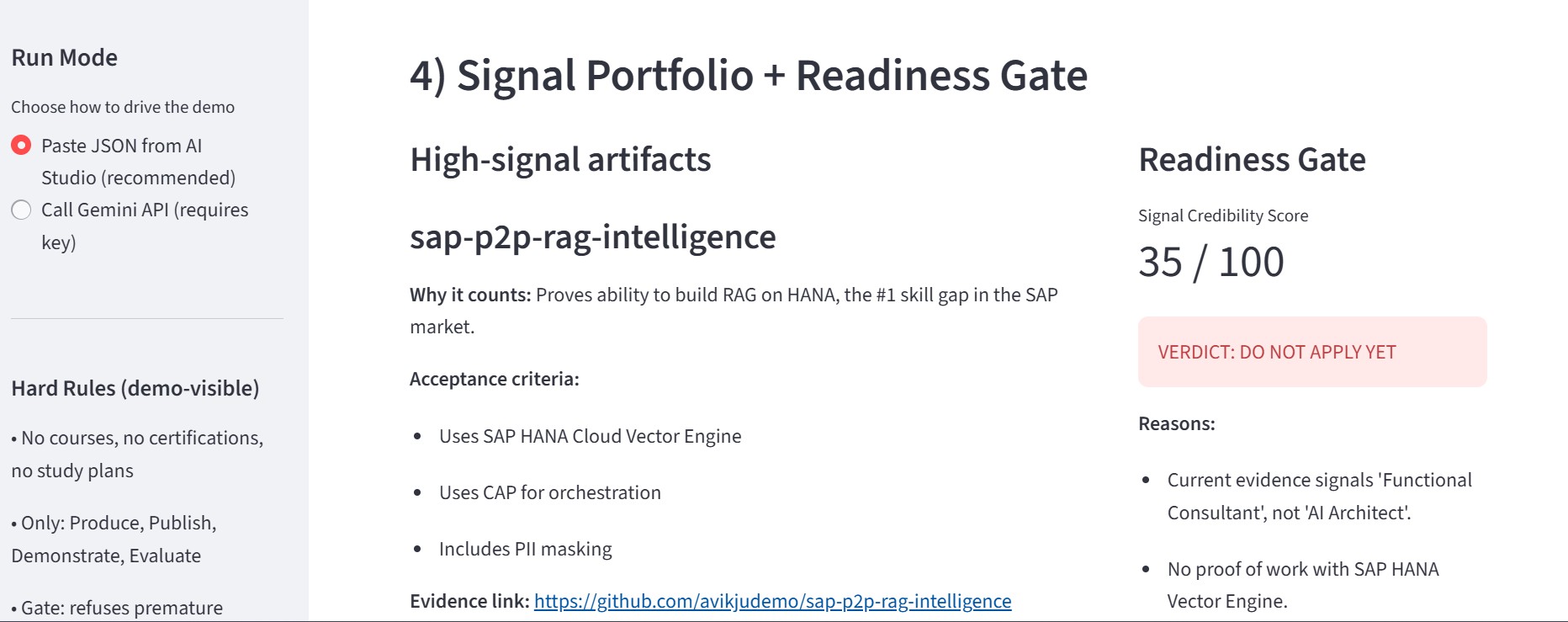
Signal Portfolio - high-signal artifacts with acceptance criteria
Readiness Gate - a score and a hard verdict: APPLY NOW or DO NOT APPLY YET
If no public evidence exists, readiness does not improve.
How we built it
Gemini AI Studio is used to design and test the Identity Compiler logic with strict system instructions. Python + Streamlit is used to build a lightweight, consumer-style UI that renders the four screens clearly.
The demo runs in a deterministic mode by pasting Gemini-generated JSON ( I generate JSON via few shot prompting into Gemini beforehand) into the UI to avoid API and billing risks during judging.
Two personas are demonstrated:
1/ SAP Solution Architect → SAP AI Architect (my own journey) 2/ Junior Tester → Senior SDET (to prove generality)
The UI is intentionally minimal.
Challenges we ran into
Avoiding the “education tool” trap Almost every instinct pushes toward courses and roadmaps. I had to explicitly forbid learning language at the system level.
Designing a system that says “no” Blocking users from applying feels counterintuitive, but it is what makes the product honest.
Keeping the demo simple under time pressure Many demos fail when they overbuild. I focused on four screens, one flow, and a strict narrative!
Accomplishments that we're proud of
Built a working consumer-grade product that refuses to give learning advice and instead enforces market-verifiable proof-of-work - a counterintuitive but deliberate design choice.
Designed a Gemini-driven system that infers market expectations for a target role instead of hardcoding skills, making the product adaptable across professions.
Implemented a readiness gate that blocks premature applications and explains exactly what public evidence is missing - the system can say “no” with reasons.
Demonstrated the product with two very different personas (enterprise SAP architect and junior tester) using the same compiler logic, proving generality without scope creep.
Delivered a deterministic, demo-safe product UI using Python and Streamlit that clearly visualizes complex reasoning in four simple screens.
Used the product on the founder’s own career transition, ensuring authenticity and real-world relevance rather than a hypothetical use case.
What we learned
1/ Learning is not a potent signal. Courses, certifications, and study plans reduce anxiety, but they do not increase market credibility.
2/ Evidence beats explanation Public artifacts, rejected ideas, and defended decisions signal seniority far better than polished resumes.
3/ Saying “no” is the hardest product decision Most tools try to encourage users. Identity Compiler does the opposite - it blocks readiness until proof exists. This refusal is the product.
4/ Gemini is essential, not decorative The hardest part is not generating tasks, but inferring what the market actually expects for a given role and seniority. That inference cannot be hardcoded.
What's next for Identity Compiler - (Compile yourself into your next role)
Built With
- python
- streamlit


Log in or sign up for Devpost to join the conversation.