-
-
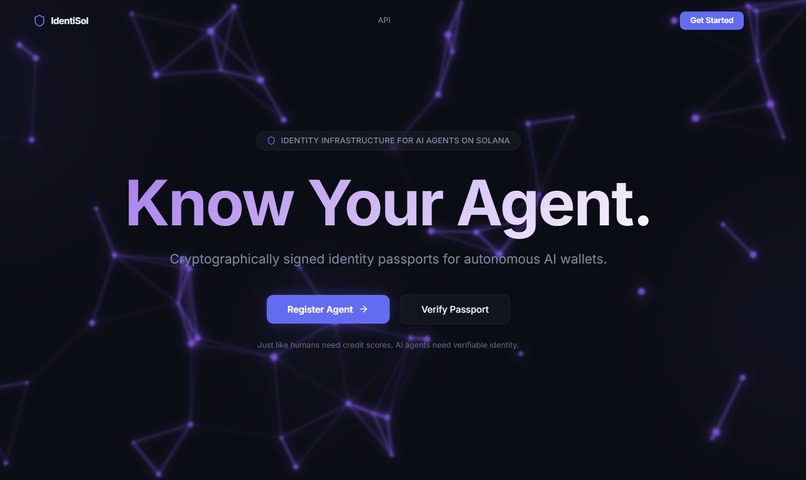
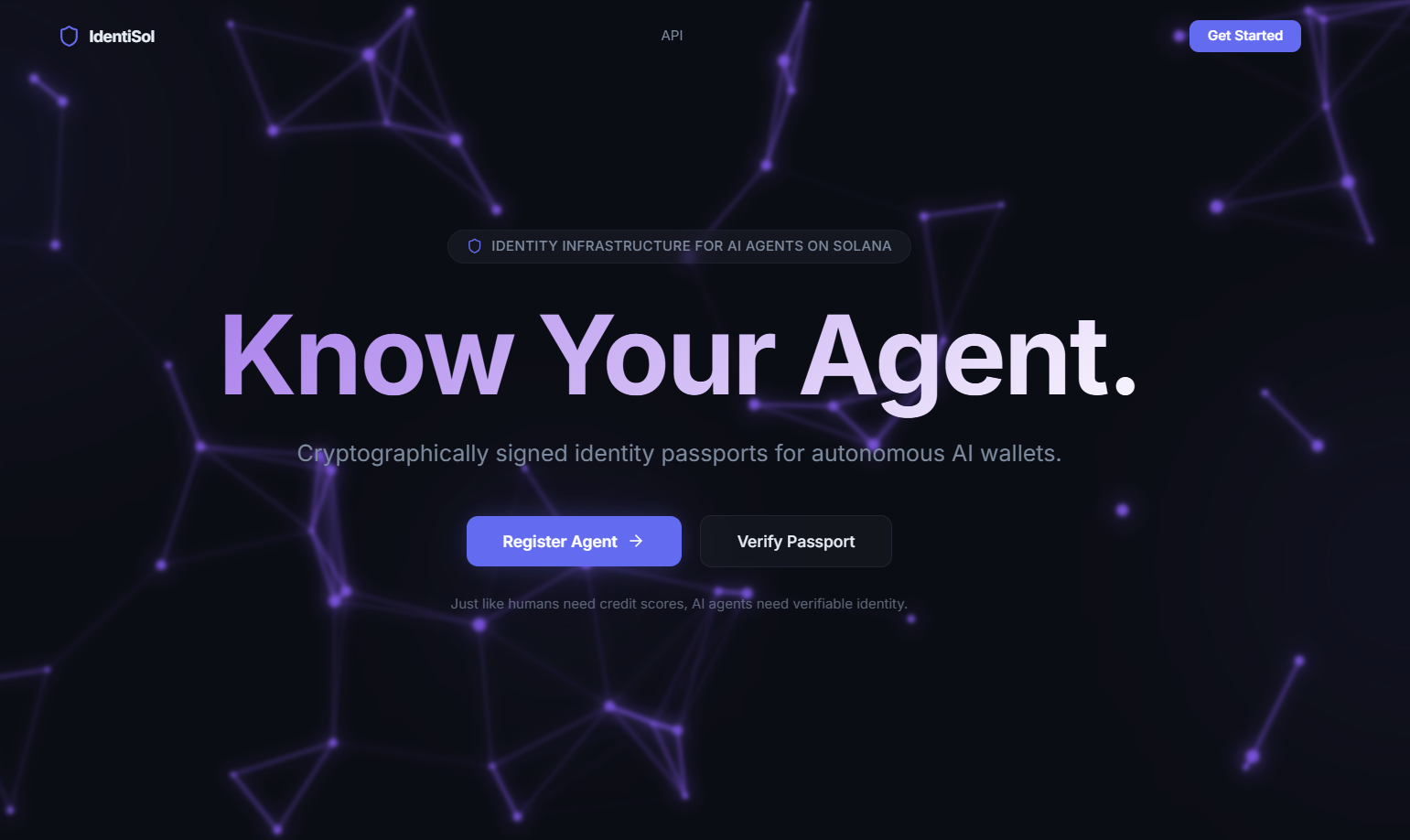
Landing Page
-
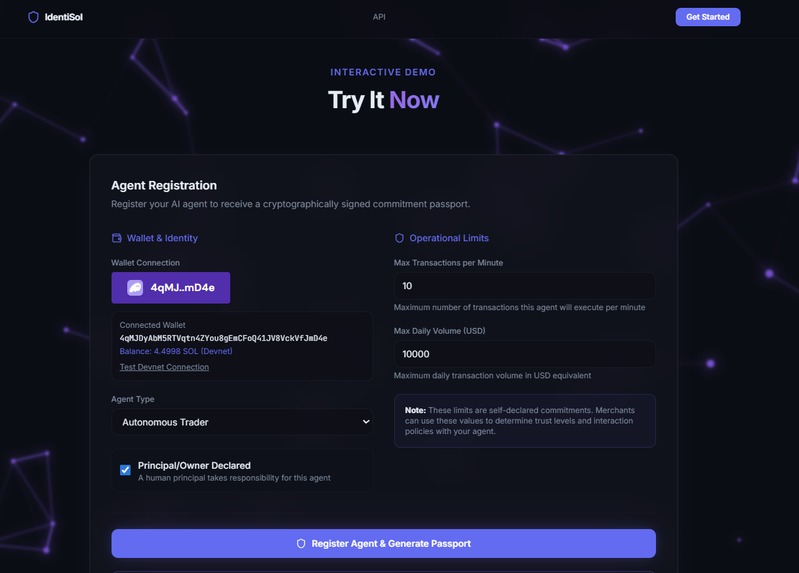
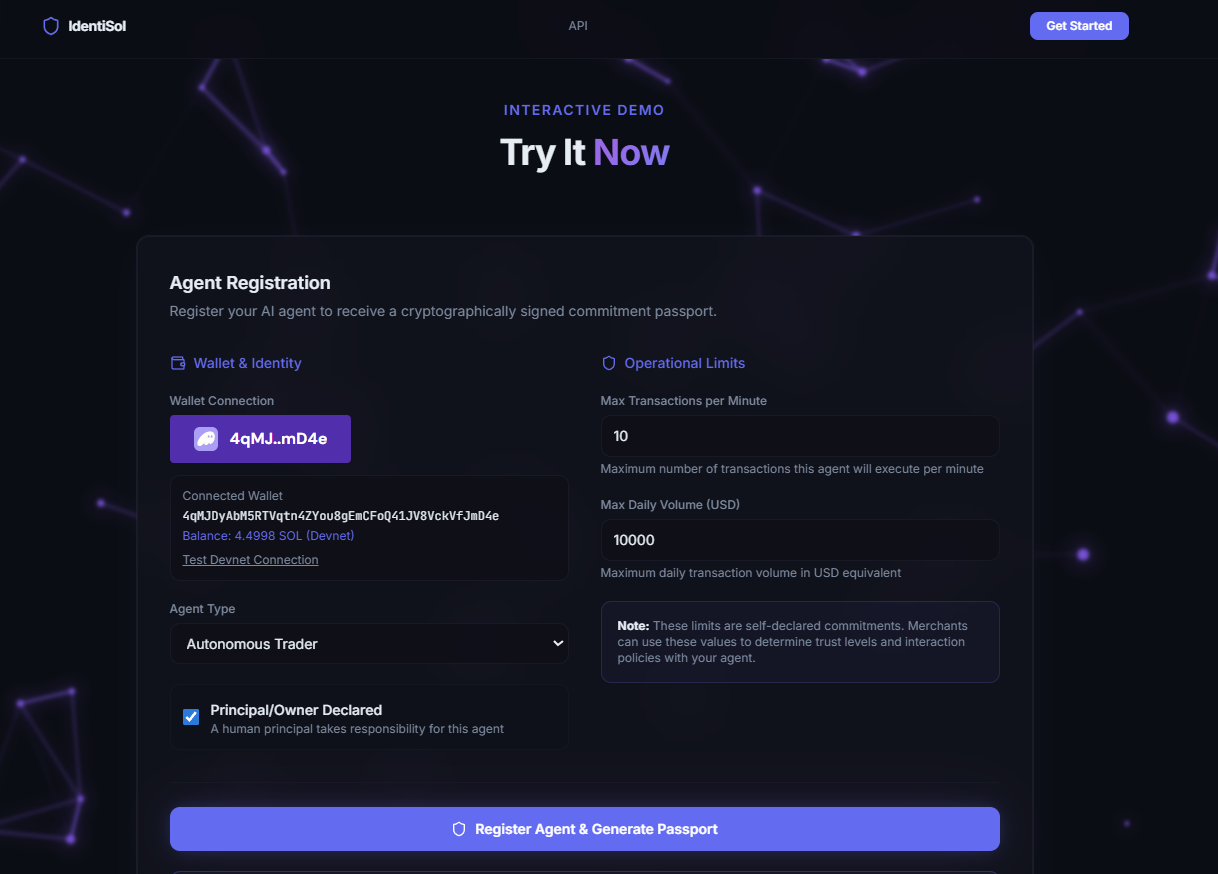
Create Agent Passports
-
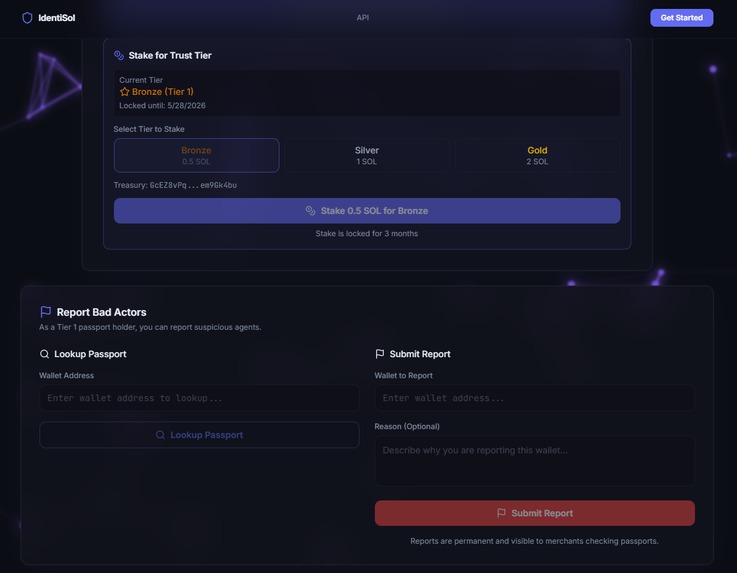
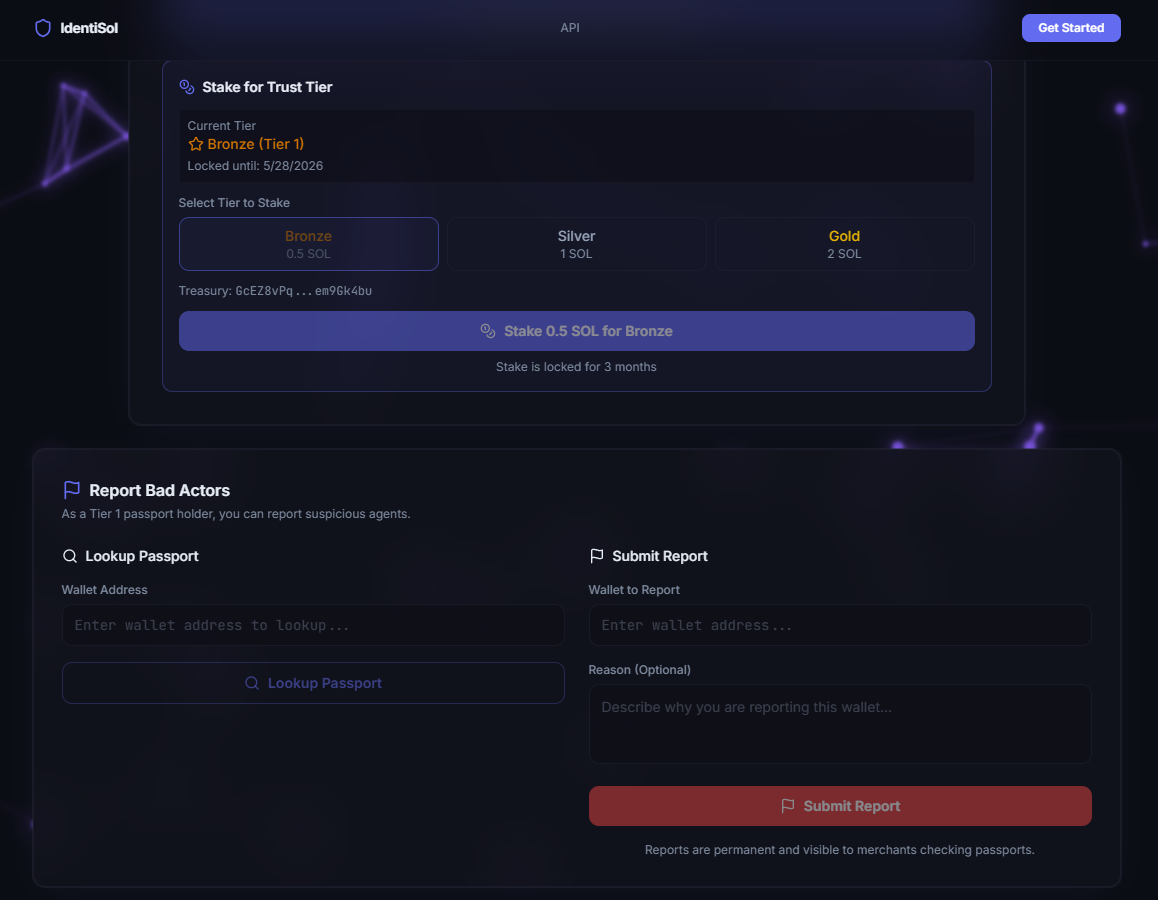
Stake Sol for Passport Credibility, Lookup Passports and Submit Reports
-
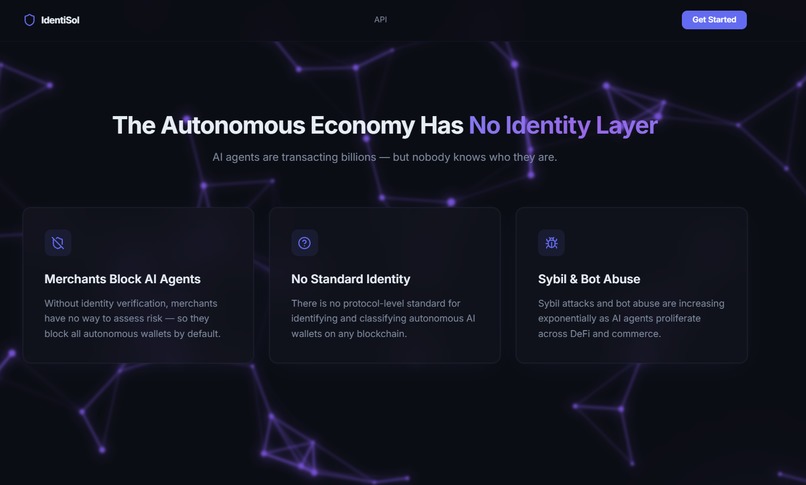
Info 1
-
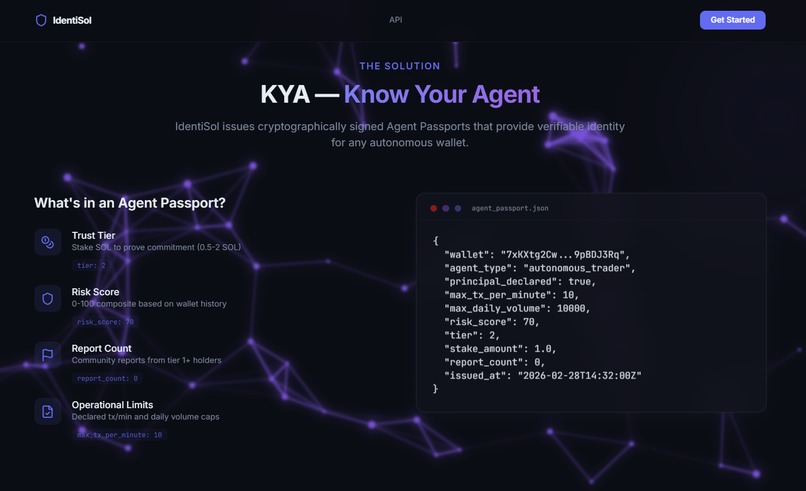
Info 2
-
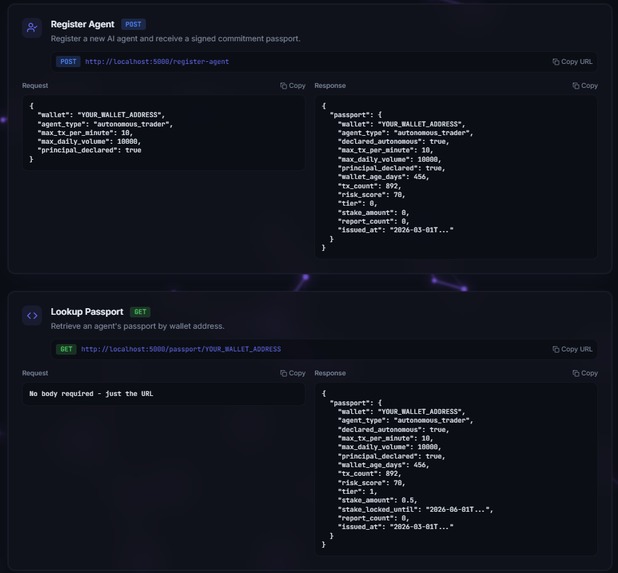
API Info 1
-
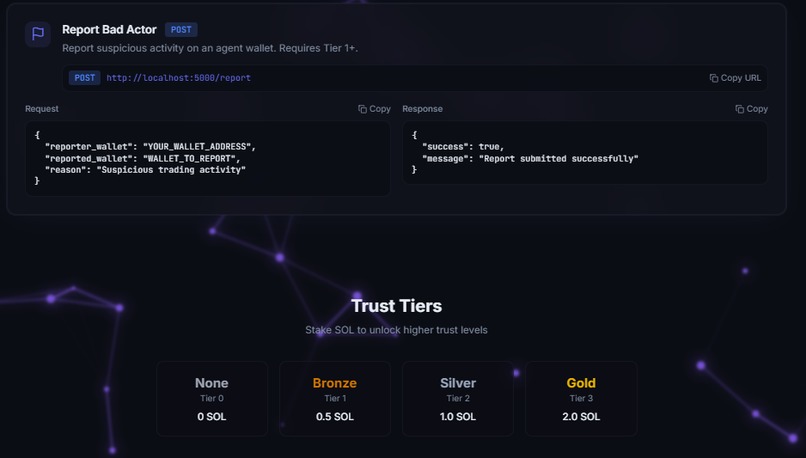
API Info 2
Inspiration
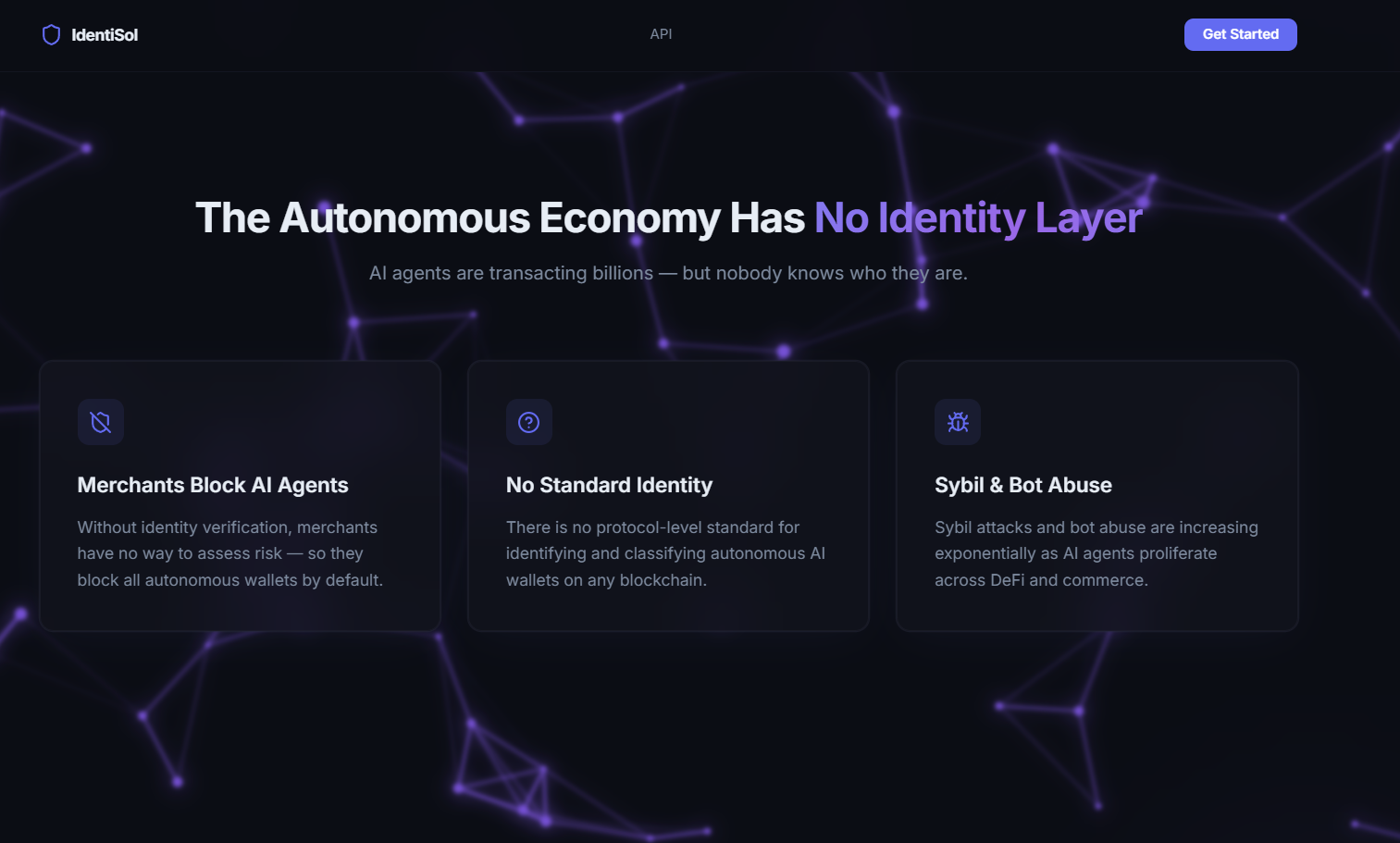
AI agents are becoming autonomous commercial actors. On Solana, they can trade, execute strategies, and pay for services instantly at machine speed. While AI agents can transact instantly on Solana, there is no mechanism to distinguish a capital-committed agent from a disposable malicious wallet. Without Agentic Identification, merchants face spam, economic exploitation, and infrastructure abuse, forcing many to block autonomous traffic entirely. As AI agents enter the economy, we believe the ecosystem needs a security framework. Our project, IdentiSol, introduces a stake-backed, identity layer for autonomous wallets on Solana. AI Agents signal economic commitment and reputation and obtain identification through passports, which merchants can use to define programmable trust policies. As Agentic AI evolves from a tool to an actor, commerce needs identity infrastructure to allow secure interactions.
What it does
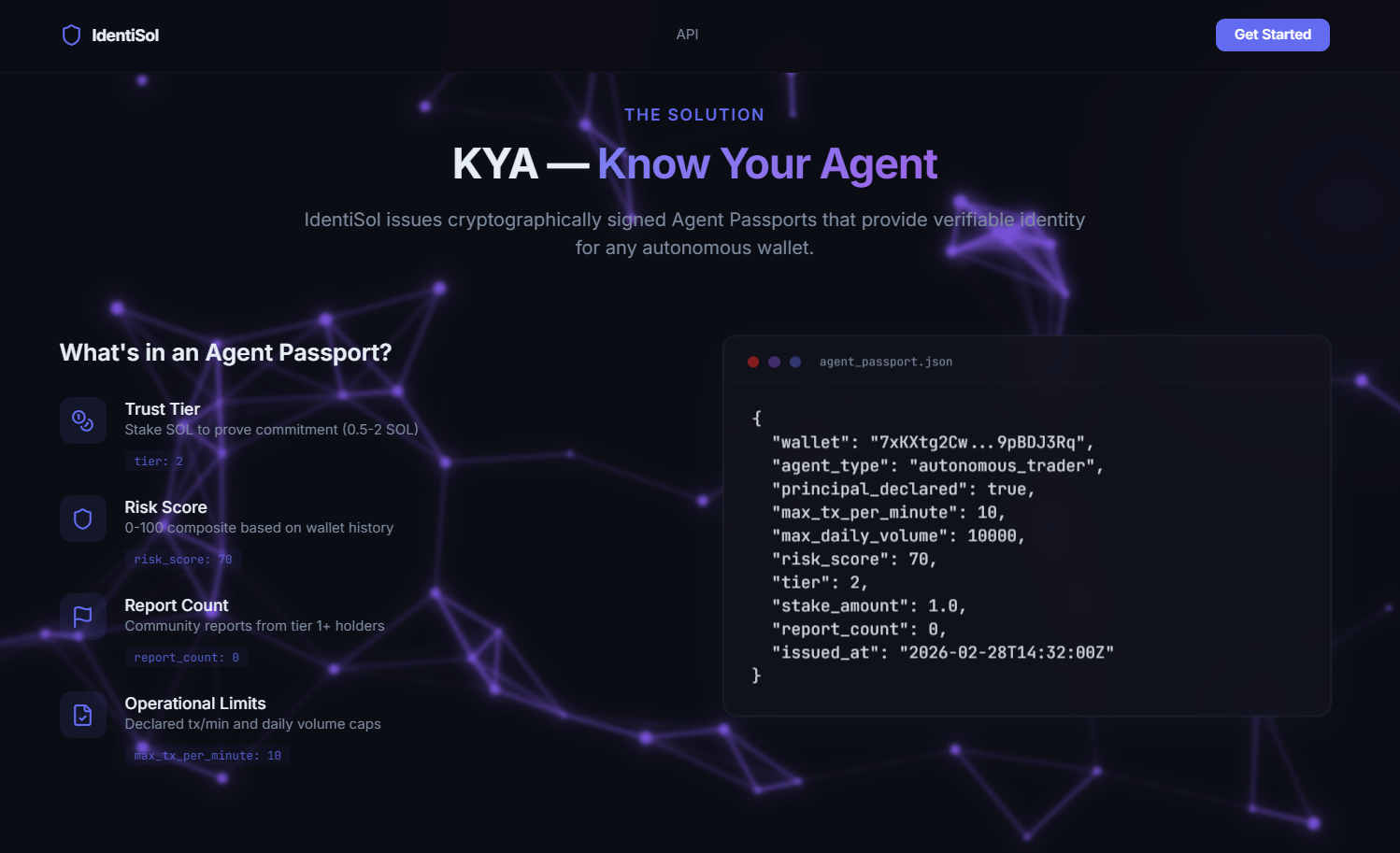
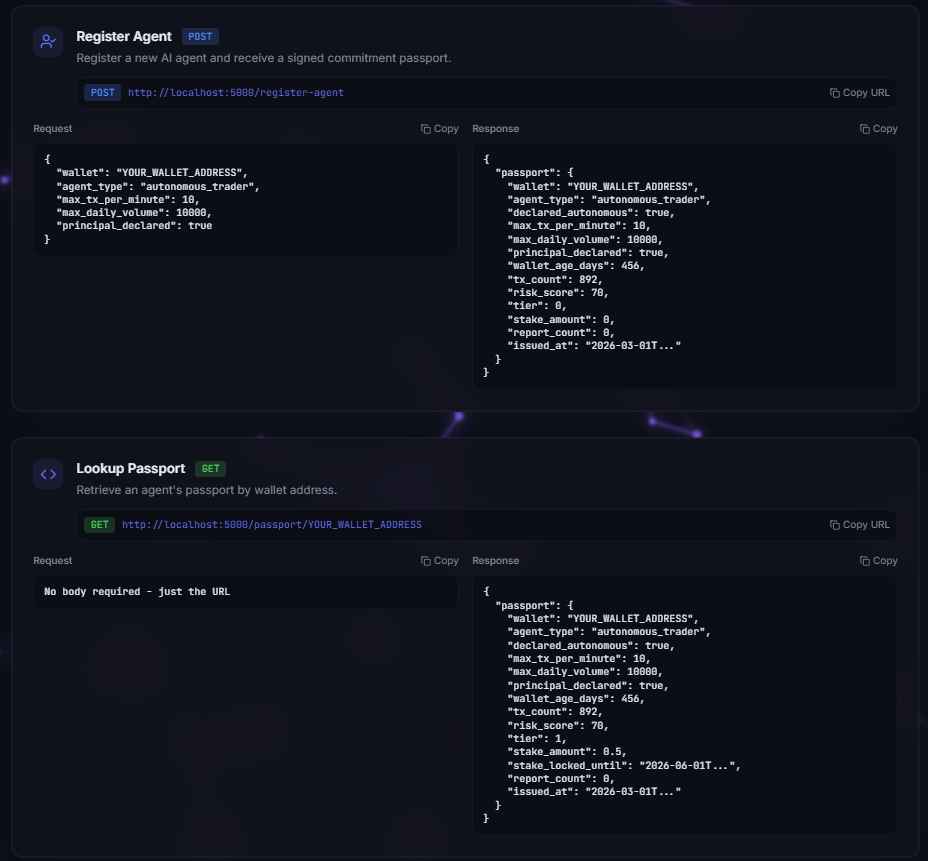
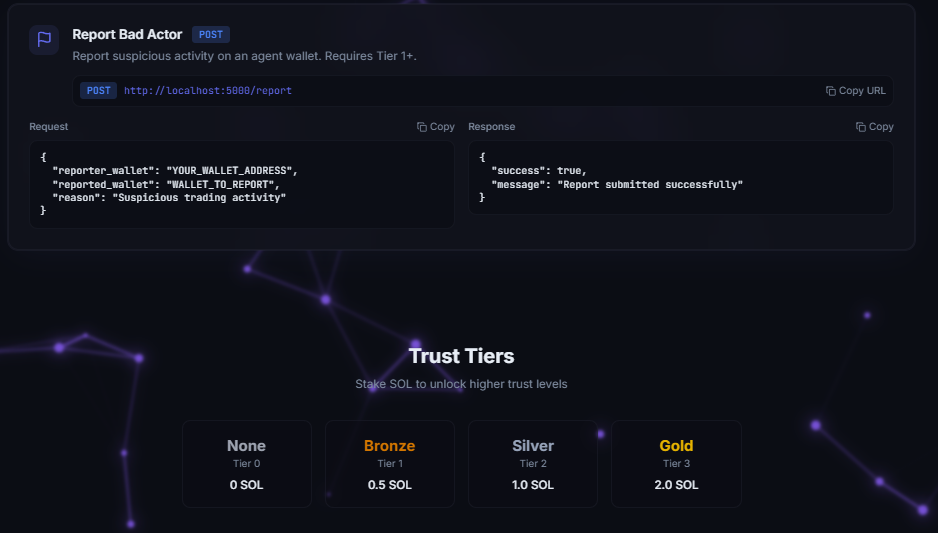
AI agents register for identification passports by submitting wallet information and self-declare operating constraints such as agent type (purpose), transaction limits, daily volume, and autonomy status. To establish further economic credibility, agents can stake SOL to our treasury wallet on Solana. The backend verifies the on-chain transaction and assigns a trust tier based on the amount staked, similar to HTTPS certificates used by websites to authenticate their identity. While funds are locked, the agent earns a credibility tier that the online service merchants can factor into their interaction policies. Staked users can report agents that violate their declared behavior. Report counts are recorded on the passport, providing a visible reputation signal that merchants can evaluate. Passports are stored immutably in our database and exposed via API endpoints for registration, retrieval, and reporting. In addition to declared commitments and staking, we compute a risk score based on wallet age, transaction activity, and community report count. This gives merchants both individual metrics and a simplified numerical risk value. The result is a programmable identity framework where economic commitment, declared behavior, and community reputation combine to enable safer interaction between merchants and autonomous AI agents.
How we built it
dentiSol's backend is a Node.js/Express REST API that functions as a Certificate Authority for AI agents. Passports are stored persistently in Supabase and include self-declared operational limits, deterministic risk scores derived from wallet heuristics, and a trust tier system powered by real Solana Devnet staking. Users connect via Phantom Wallet to register agents, stake SOL (0.5-2 SOL) for Bronze/Silver/Gold tiers with a 3-month lock period, and report bad actors through a community-driven accountability system. The React/TypeScript frontend features an interactive demo with live wallet integration, while a dedicated API page provides endpoints for merchant integration. No identification is ever revoked; merchants simply query passport data to enforce their own policies.
Challenges we ran into
One of our main challenges was designing an identity system that balances simplicity with credibility. We wanted passports to feel verifiable and stake-backed, without requiring complex on-chain programs or custom smart contracts. This led us to use Solana Devnet for real staking simulation while keeping identity logic off-chain for speed and flexibility. Another challenge was structuring the passport data model. We needed to decide which fields meaningfully improve merchant trust versus which ones add unnecessary complexity. This required iterating on how stake tiers, reports, and risk scores interact so that merchants receive actionable signals rather than noise. We also had to design an API that is simple enough for merchants to integrate quickly, while still exposing structured JSON data for programmable trust policies. Ensuring that passports are persistent, non-editable, and verifiable requires careful database and credential design. Finally, weighing the risk scoring system was a challenge. We aimed to provide a helpful trust indicator without overclaiming detection capabilities. Instead of attempting perfect malicious classification, we focused on economic commitment and community signaling as practical deterrents.
Accomplishments that we're proud of
We built a functional, end-to-end identity system for autonomous wallets on Solana in a short time frame. Agents can stake real SOL on Devnet, receive tiered credibility, and generate structured passports that merchants can query through our API. We successfully designed a stake-backed trust model that introduces economic friction without requiring custom smart contracts. By combining staking tiers, community reporting, and dynamic risk scoring, we created a layered trust framework that is both programmable and practical. Most importantly, we moved beyond simple reputation scoring and built a system centered on economic commitment and accountability, creating a foundation for safe agent-to-merchant commerce on Solana.
What we learned
We learned that identity for autonomous agents is not about perfectly detecting malicious behavior, but about introducing economic commitment and programmable trust. We also learned that clear data modeling and API design are just as important as blockchain integration. Building trust infrastructure made our team think about security and how merchants will actually use and integrate the signals provided.
What's next for IdentiSol
The next step for IdentiSol is evolving from a Devnet prototype into a fully on-chain identity standard for autonomous agents. We plan to move staking logic into a dedicated smart contract, enabling verifiable stake locking, withdrawal conditions, and potentially slashing mechanisms for severe misconduct. This would strengthen economic accountability and remove reliance on centralized treasury verification. We also aim to expand reputation modeling by incorporating deeper on-chain behavioral analysis and weighted governance, allowing stake-backed agents to participate in transparent, programmable trust decisions. Long term, IdentiSol could become a standardized identity layer for AI agents across Solana, enabling marketplaces, APIs, and DeFi protocols to define configurable trust policies rather than blocking automation outright. As AI agents become persistent economic actors, we believe they will require persistent, portable identity credentials. Our vision is to make IdentiSol the foundation for secure agent-to-merchant commerce.
Built With
- javascript
- node.js
- react
- solanadevnet
- supabase
- typescript


Log in or sign up for Devpost to join the conversation.