Project Story — IDentify Africa
Inspiration
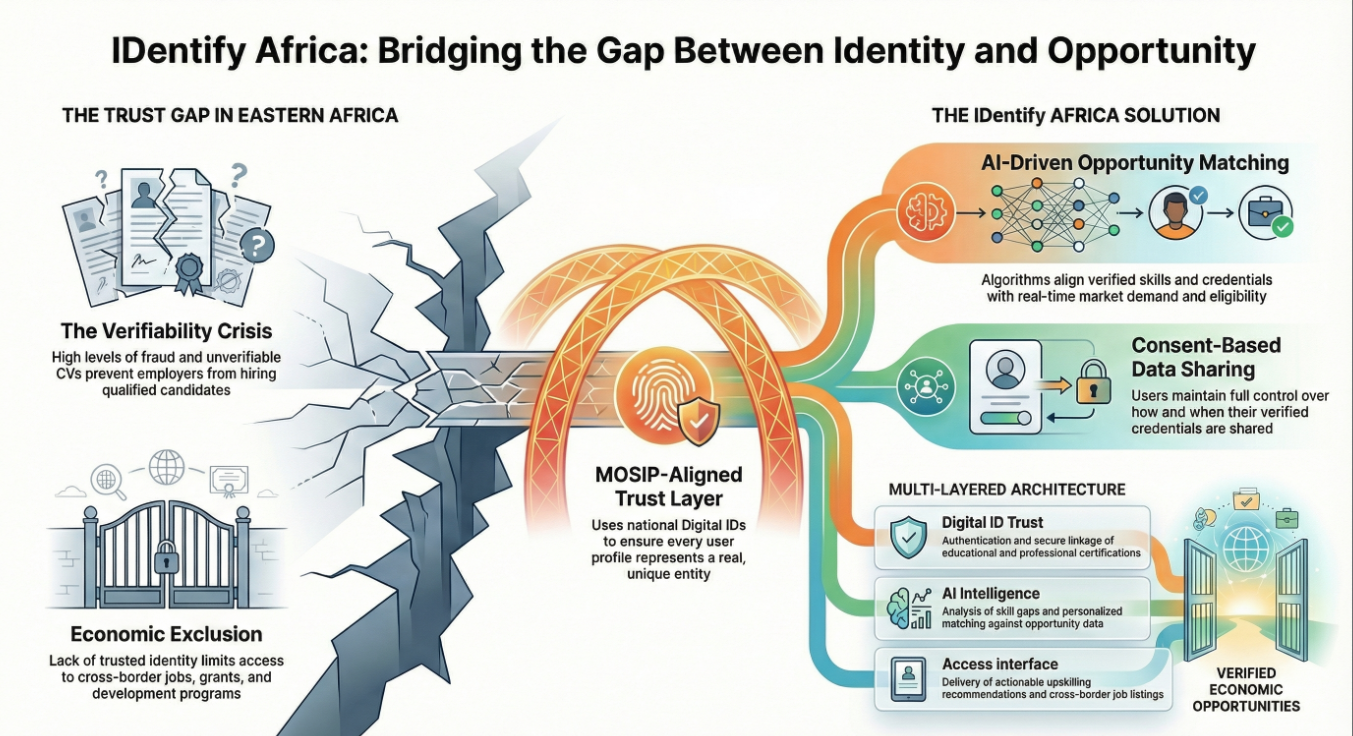
Across Africa, access to economic opportunity is often limited not by lack of talent, but by lack of trust. During our academic and professional experiences, we observed many qualified students, professionals, and early-stage entrepreneurs who struggled to access jobs, grants, and development programs because their identities and credentials could not be easily verified. At the same time, employers, donors, and institutions faced persistent challenges related to fraud, unverifiable CVs, and inefficient ways of identifying credible candidates, especially across borders.
These challenges highlighted a fundamental gap between identity and opportunity. We were inspired by the idea that Digital ID, when designed as public infrastructure rather than a standalone application, can serve as a foundation of trust that enables inclusion, mobility, and economic growth. This insight led to the creation of IDentify Africa.
What it does
IDentify Africa is a Digital ID-powered platform that connects verified individuals and startups with economic opportunities across Africa. At its core, the platform uses MOSIP-aligned Digital ID infrastructure to authenticate users and verify their credentials, ensuring that each profile represents a real and unique entity.
The platform then leverages AI-driven matching intelligence to connect users with relevant opportunities including jobs, grants, expert calls, and development programs. By analyzing verified identity attributes, skills, credentials, and eligibility requirements against real-time opportunity data, the system delivers personalized, actionable recommendations.
Users receive not only matched opportunities but also guidance on upskilling and profile enhancement to improve their long-term employability. The entire process is consent-driven, ensuring users maintain control over their data while benefiting from the trust that verified identity provides.
How we built it
IDentify Africa is designed around a layered architecture that places Digital ID at its core.
The first layer is the Digital ID trust layer. Users authenticate using a MOSIP-aligned Digital ID system, ensuring that each individual or startup profile represents a real and unique entity. Verified credentials, such as educational qualifications or certifications, can be securely linked to the user's identity and shared only through explicit consent.
The second layer is the AI-powered matching and labor intelligence engine. This component analyzes verified identity attributes, skills, credentials, and eligibility requirements against real-time opportunity data, including jobs, grants, and expert calls. The matching process prioritizes relevance and fairness by optimizing profile–opportunity alignment using weighted factors:
$$ \text{Match Score} = \sum_{i=1}^{n} w_i \cdot f_i(\text{verified identity, skills, eligibility}) $$
where wi represents the importance of each factor based on market demand.
The final layer is the opportunity access interface, which presents users with personalized, verified opportunities and actionable recommendations for upskilling and profile enhancement. This ensures that users are not only matched to opportunities, but are also guided toward improving their long-term employability.
Challenges we ran into
One of the primary challenges was ensuring that Digital ID enhanced inclusion rather than creating barriers. While verified identity increases trust, not all users possess complete formal credentials. We addressed this by supporting progressive credential building and alternative forms of verification.
Another challenge involved balancing intelligence with privacy. Designing AI-driven insights while strictly adhering to consent-based data sharing and data minimization principles required careful system design.
Finally, narrowing the scope of the platform to align strongly with the hackathon's focus on Digital ID required deliberate refinement. We ensured that Digital ID is foundational to the solution, such that removing it would significantly reduce the platform's effectiveness and impact.
Accomplishments that we're proud of
We are proud of building a solution that positions Digital ID not as a mere authentication mechanism, but as foundational infrastructure that unlocks economic opportunity at scale. By demonstrating how verified identity can reduce fraud, increase trust, and enable cross-border mobility, we have created a model that addresses real challenges faced by millions across Africa.
We are also proud of designing a system that balances technological sophistication with ethical responsibility, embedding privacy, consent, and inclusion by design. The AI-powered matching engine represents a significant technical accomplishment, combining identity verification with intelligent labor market analysis in a way that is both effective and respectful of user autonomy.
What we learned
Through the Digital ID upskilling sessions and exposure to the MOSIP platform, we gained a deeper understanding of Digital ID as a core component of Digital Public Infrastructure. We learned that identity systems are most impactful when they are interoperable, consent-driven, and user-centric.
We also learned that solving opportunity access problems at scale requires more than digitizing existing processes. It requires combining trusted identity with intelligent systems that can interpret market demand, eligibility criteria, and skill requirements. Most importantly, we learned that privacy, trust, and inclusion must be embedded by design, not added later.
What's next for IDentify Africa
Moving forward, we plan to pilot IDentify Africa in partnership with educational institutions, workforce development agencies, and startup ecosystems to validate the platform with real users and refine the matching algorithms based on feedback.
We aim to expand credential verification partnerships to include more issuers such as universities, professional certification bodies, and skills training providers, creating a comprehensive ecosystem of verified credentials that users can leverage throughout their careers.
We will also work toward full interoperability with national Digital ID systems across Africa, ensuring that IDentify Africa can serve as a regional trust infrastructure that enables seamless cross-border opportunity access.
Finally, we envision developing additional features such as reputation systems for employers and opportunity providers, advanced analytics for policymakers to identify skills gaps, and integration with financial services to unlock access to credit and insurance based on verified identity and credentials.
Built With
- docker
- fastapi
- google-gmail-oauth
- jwt
- mongodb
- mosip
- openid
- pytorch
- react.js
- redis
- scikit-learn
- spacy
- tailwindcss
- typescript
- w3c

Log in or sign up for Devpost to join the conversation.