-
-
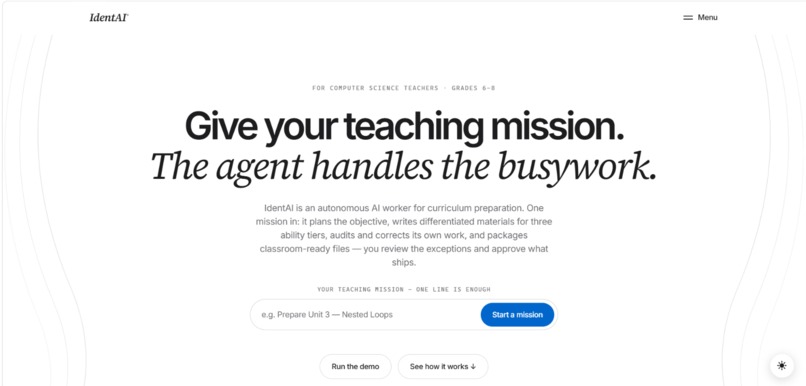
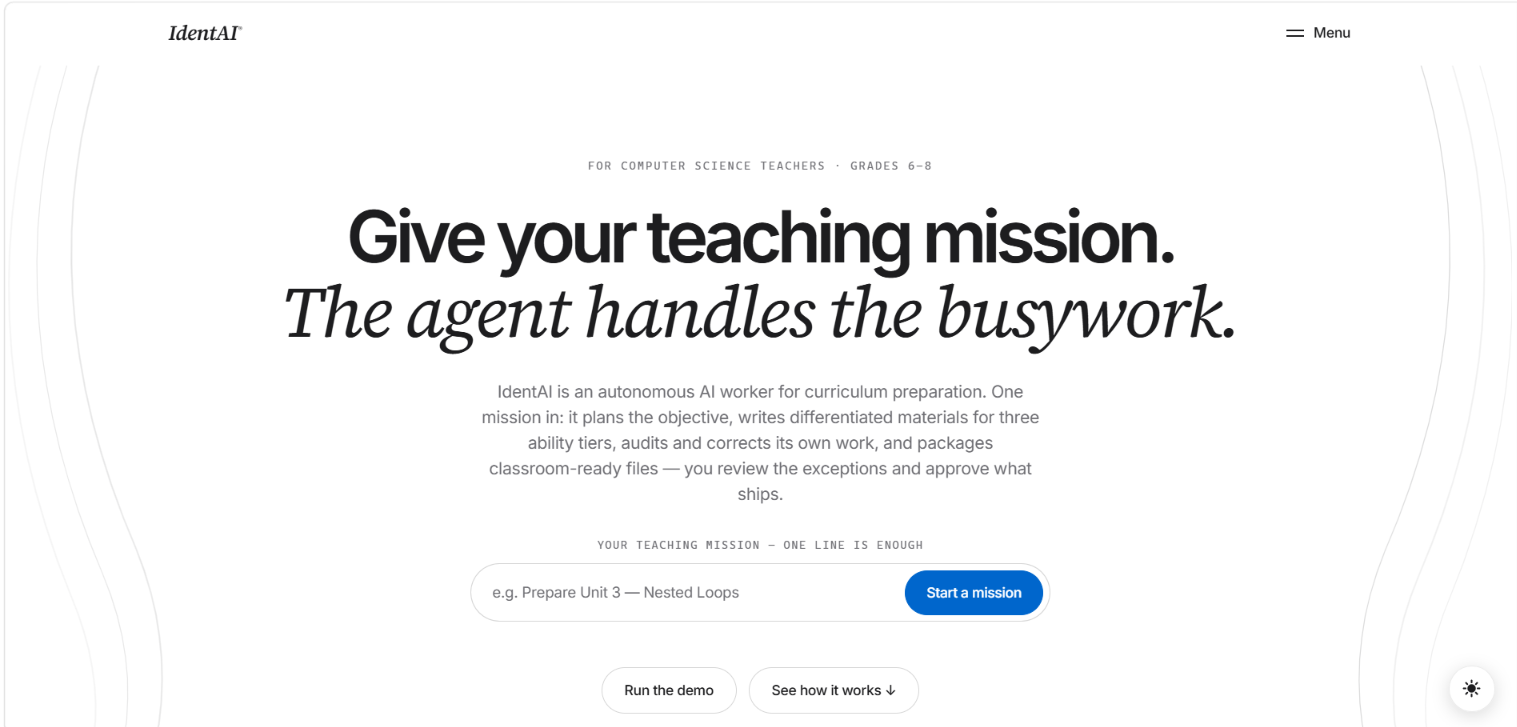
IndentAI Hero — One mission prompt to differentiated curriculum.
-
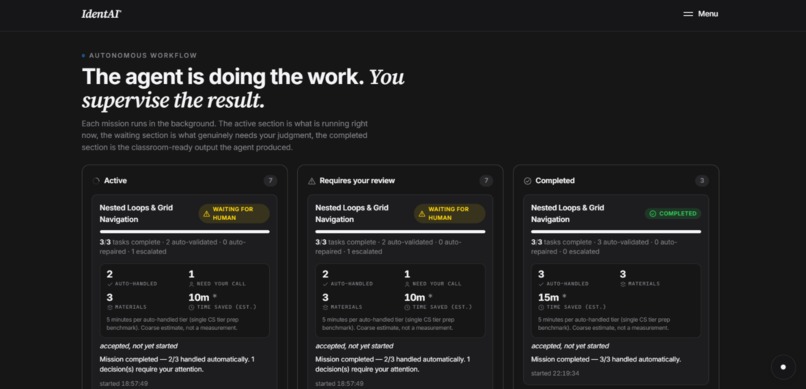
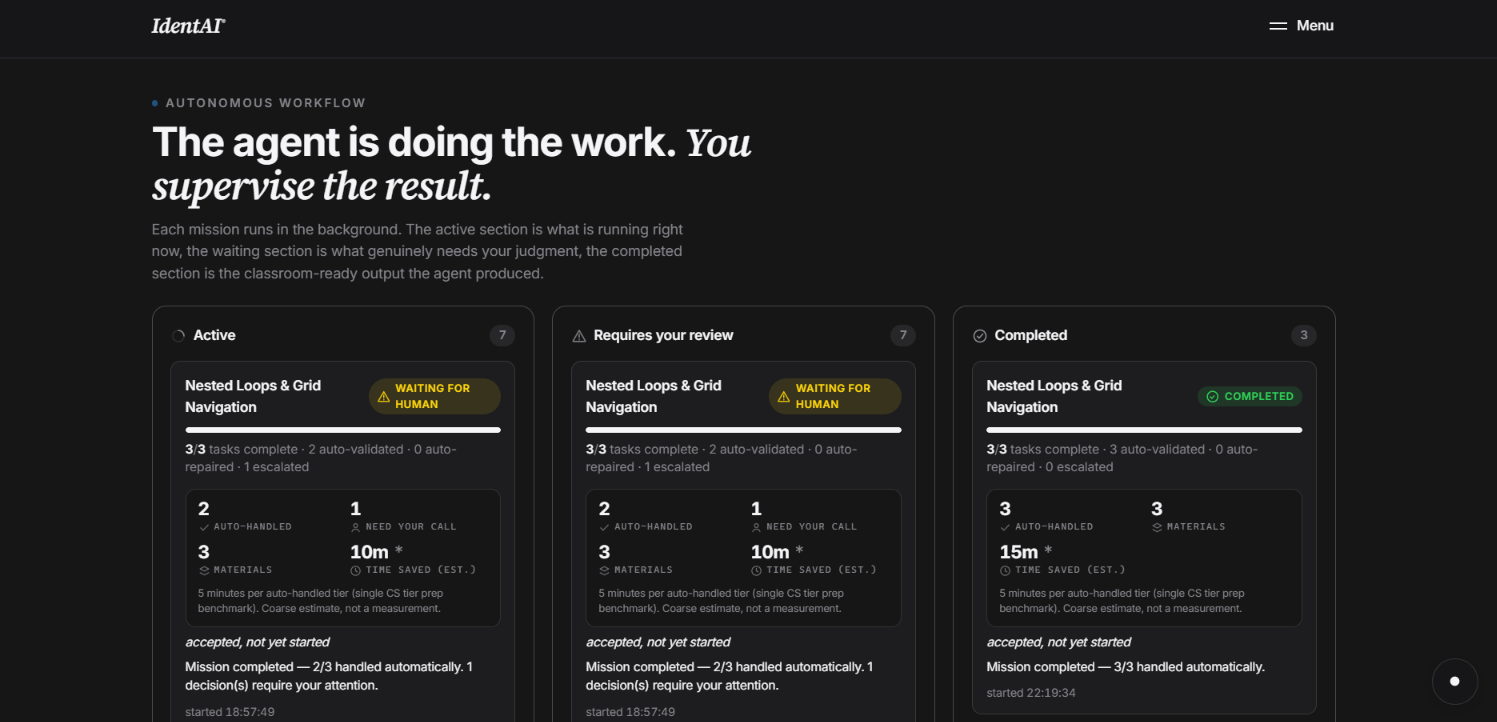
Teacher Review Desk — Human-in-the-loop escalation queue and live mission tracking.
-
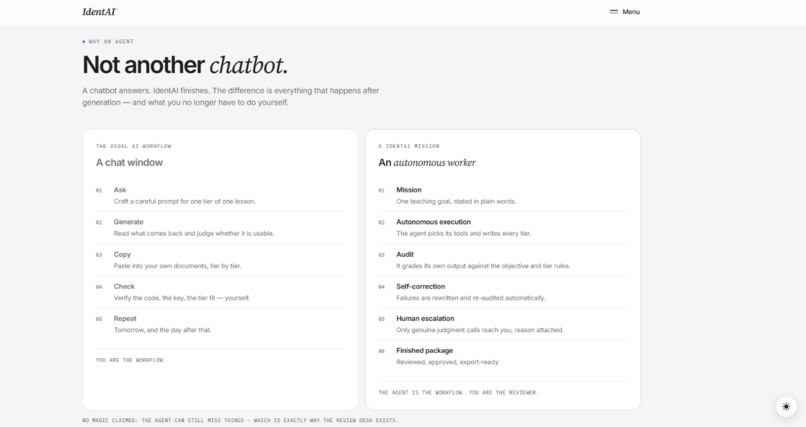
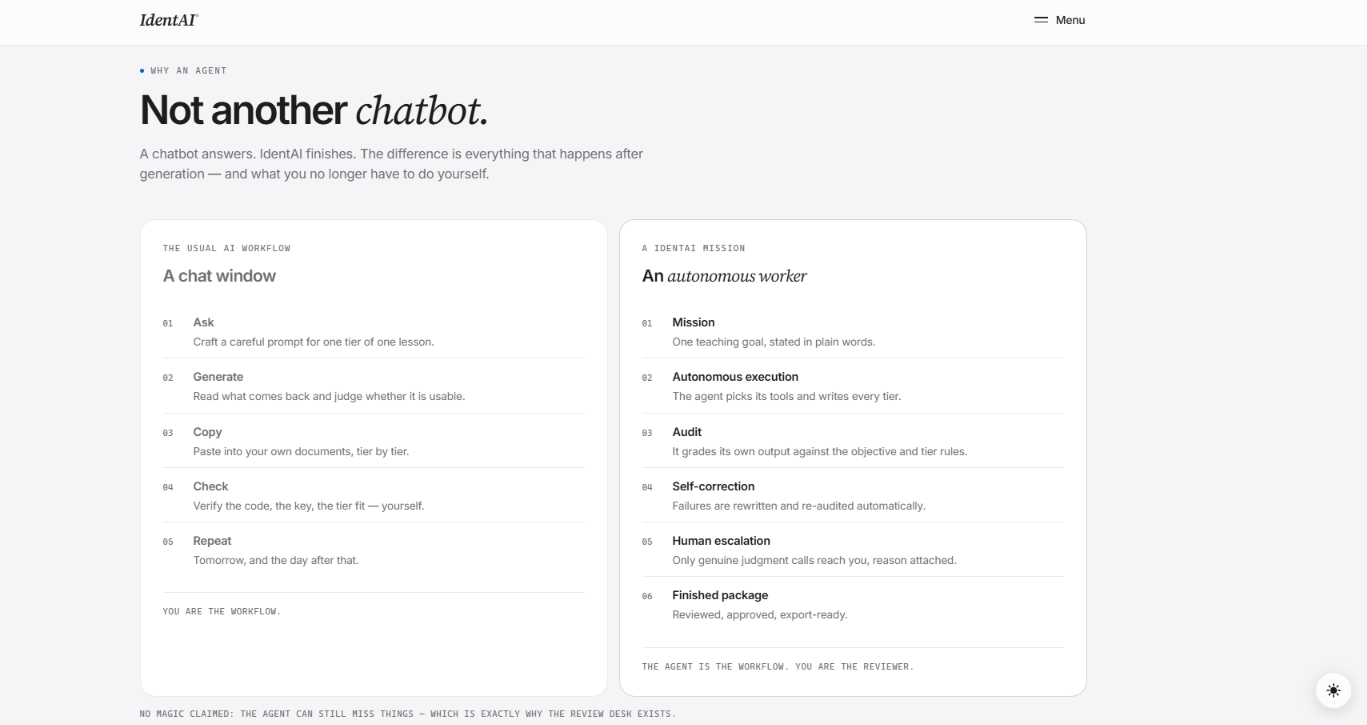
Architecture philosophy — Autonomous audit loops instead of manual copy-pasting.
-
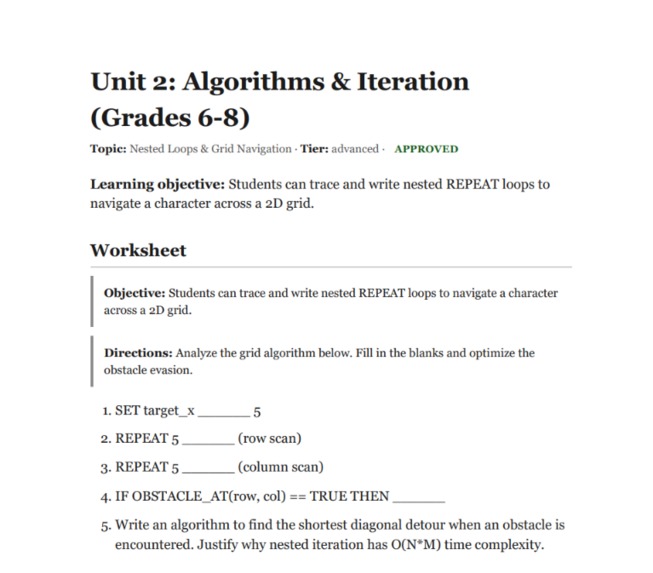
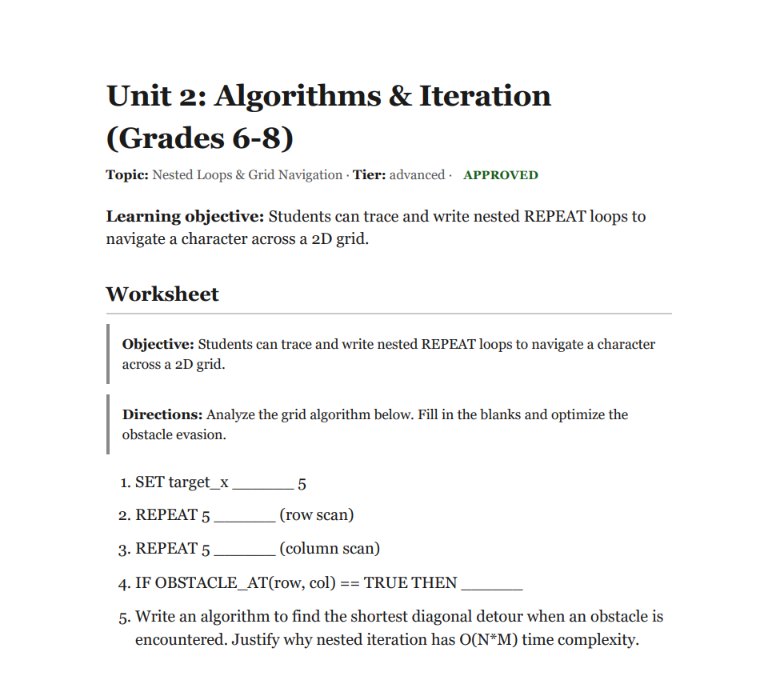
Classroom-ready output — Printable, differentiated Unit 2 worksheet and assessment.
Inspiration
Over the past year teaching computer science in high school, I lived the same structural friction every Sunday night: preparing differentiated curriculum for thirty students with wildly disparate skill levels.
In any introductory programming session, five students finish in minutes and need open-ended algorithmic challenges, fifteen move at grade level, and ten are completely blocked by indentation, syntax, or variable scoping errors. Hand-crafting three tiered worksheets, three aligned quizzes, and three matching answer keys takes hours of repetitive drafting before a teacher ever steps foot in the classroom. Furthermore, generic AI chatbots fail educators because they act as "answer dispensers," outputting copy-paste code that circumvents the cognitive struggle required for real mastery.
I built IndentAI to solve the exact problem I faced in my classroom: an autonomous worker that plans, generates, audits, and formats differentiated curriculum while keeping the educator firmly in the loop.
What It Does
IndentAI turns a single learning objective (e.g., "Unit 2: Nested Loops & Grid Navigation") into an export-ready, classroom-verified instructional package:
- 3-Tier Differentiated Scaffolding: Autonomously synthesizes three aligned difficulty tiers:
- Tier 1 (Foundational): Word banks, fill-ins, and execution trace tables for struggling students.
- Tier 2 (On-Level): Guided self-correction and syntax-to-logic problem sets.
- Tier 3 (Advanced): Open-ended optimization, complexity analysis, and algorithmic extensions.
- Self-Auditing & Auto-Repair Loop: The agent evaluates its own generated assets against pedagogical rules. If an asset fails (such as a missing trace table in Tier 2), it self-corrects and re-audits in the background before the educator ever sees it.
- Misconception-Driven Assessments: Multiple-choice distractors are mapped directly to conceptual flaws (e.g., choosing 7 instead of 12 for nested loops of 3 and 4 indicates additive instead of multiplicative thinking), showing teachers what to reteach rather than just who lost points.
- The Teacher Review Desk: When the agent encounters a genuine pedagogical decision (such as whether Grade 7 advanced students should use coordinate pairs or matrix notation), it halts and routes the item to the review queue for one-click human authorization.
- Classroom-Ready Export: Generates clean, print-ready PDFs, Markdown, and HTML packages with teacher notes and answer keys.
How We Built It
- Agent Core & Reasoning: Powered by Amazon Bedrock invoking Amazon Nova Pro (
us.amazon.nova-pro-v1:0) via theConverseStreamAPI for schema-adherent curriculum synthesis and self-audit evaluations. - Deterministic Code Evaluation: Built an Abstract Syntax Tree (AST) inspection engine in Python (
app/interpreter/evaluator.py) to validate student code structures, extract nodes, and detect syntax errors without execution hazards. - Resilience & Dual-Engine Design: Engineered an autonomous fallback mode (
MODEL_PROVIDER=mock) backed by SQLite (data/lessons.db) to ensure complete operational continuity during intermittent school internet connections or API quarantines. - Backend & API: Powered by FastAPI with structured Pydantic data schemas, background session logging, and RESTful endpoints for lesson generation and review desk approvals.
- Infrastructure & Deployment: Fully containerized via Docker (
agentcore/Dockerfile) for reproducible local or cloud deployment.
Challenges We Ran Into
- Classroom Connectivity & Cloud Resilience: School networks frequently suffer from strict proxy firewalls and connection drops. We solved this by designing a dual-engine runtime where the system deterministically falls back to local AST parsing and SQLite-cached lesson progressions if cloud endpoints become unreachable.
- Preventing Hallucinated Answer Keys: Language models often hallucinate answers to synthetic code challenges. We introduced an automated self-audit verification loop where the agent cross-checks every question against the generated worksheet before saving drafts.
- Balancing Autonomy with Oversight: Defining the boundary between what the agent should auto-repair versus what requires human judgment. Formatting bugs and missing tables are repaired automatically, while curriculum scope decisions are explicitly escalated to the teacher.
Accomplishments That We're Proud Of
- Validated by real high school teaching requirements—producing documents ready to print and hand to students immediately.
- Implementing a complete self-healing audit loop where the agent catches and fixes its own defects without human intervention.
- Achieving a sub-second human-in-the-loop dashboard that respects teacher time and domain expertise.
What We Learned
- Foundation models like Amazon Nova Pro excel at strict, structured JSON schemas when given clear role boundaries and step-by-step evaluation rubrics.
- Autonomous agent design is most effective when paired with deterministic validation layers (like Python ASTs) rather than relying exclusively on LLM outputs.
What's Next for IndentAI
- Expanding language support beyond Python to JavaScript, Scratch block translation, and C++.
- LMS integrations with Google Classroom and Canvas to assign tiered worksheets with one click.
- Live student IDE telemetry, allowing real-time hint escalation during in-class lab sessions.
Built With
- amazon-bedrock
- amazon-bedrock-agentcore
- amazon-nova
- amazon-web-services
- aws-strands
- docker
- fastapi
- python
- sqlite
- strands-agents

Log in or sign up for Devpost to join the conversation.