-
-
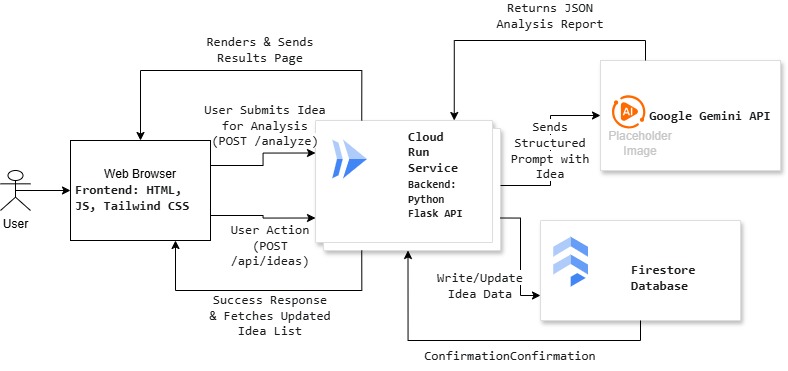
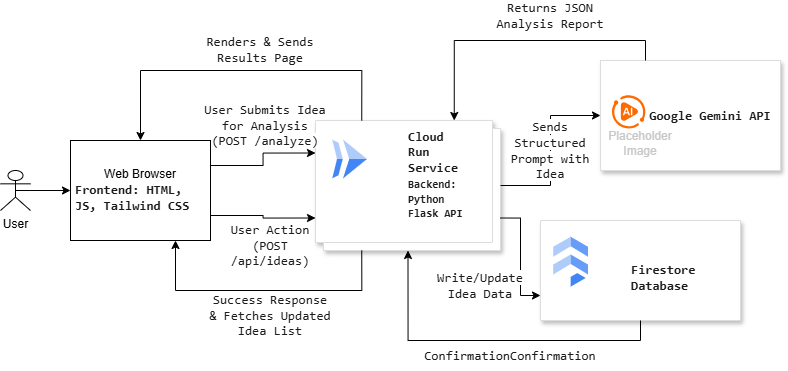
IdeaSpark - Architechture
Inspiration
As a solo developer and creator, I've personally felt the friction between having a spark of an idea and knowing if it's truly viable. The initial validation phase is often a lonely, slow, and uncertain process filled with doubt. You can spend weeks building a prototype only to find out the core concept has a fundamental flaw. I was inspired to build a tool that I wished I had myself: a launchpad that could provide instant, multi-faceted feedback to accelerate that crucial first step. I wanted to create a platform that could give a lone creator the analytical power of a consulting firm and the broad perspective of a community, all within seconds.
What it does
IdeaSpark is a dual-powered validation engine for new ideas. It provides two distinct layers of feedback: The Community Feed: Users can anonymously submit their ideas to a public feed. Here, the community provides organic feedback through a simple upvote/downvote system and comments, allowing the most promising ideas to gain traction and social proof. A scalable Cloud Run backend and a serverless Firestore database power this. The AI Idea Analyzer: For a deeper, immediate dive, users can submit any idea to the AI Analyzer. Powered by Google's Gemini model, it generates a comprehensive business analysis report in moments. This report includes a full SWOT analysis, a detailed target customer persona, a feasibility score with potential risks, marketing angles, and an actionable checklist of next steps to bring the idea to life. In essence, IdeaSpark transforms the validation process from a roadblock into a runway, empowering creators to pursue their ideas with more confidence and clarity.
How we built it
As a solo developer with a tight deadline, my strategy was built on speed and leveraging the right tools for maximum impact. The entire application was built on the Google Cloud ecosystem. Foundation: I used Google AI Studio as my co-pilot to rapidly generate the foundational Python code for my Flask backend and the HTML/CSS/JavaScript for the frontend. This "vibe-coding" approach saved me hours of boilerplate setup. Backend: The core application logic is a Python Flask API deployed as a serverless container on Google Cloud Run. This gives me a robust, auto-scaling backend that I don't have to manage. Database: I chose Google Cloud Firestore as the database. Its serverless, NoSQL nature was perfect for the fast-paced development of a hackathon, allowing me to store and retrieve data for ideas, votes, and comments without any database administration overhead. AI Integration: The star of the AI Analyzer is Google's Gemini API. I engineered a specific, structured prompt to ensure Gemini returned a clean JSON object, which my Flask backend could then parse and render into a beautiful, user-friendly report. Frontend: The UI was built with Tailwind CSS for a clean, modern, and responsive design, ensuring the application looks and feels professional on any device.
Challenges we ran into
The primary challenge was architecting a system that felt dynamic and real-time without the complexity of true real-time technologies like WebSockets, which would be difficult to implement alone in a short timeframe. My solution was a "smart refresh" system: after any user action like voting or submitting an idea, the frontend automatically re-fetches the latest data from the Cloud Run API. This provides a seamless user experience that feels instant, while keeping the technical implementation simple and robust. Another challenge was prompt engineering. Getting Gemini to return a perfectly structured, non-hallucinated JSON object consistently required several iterations of testing and refining the prompt to be as specific and restrictive as possible.
Accomplishments that we're proud of
I'm incredibly proud of going from a simple concept to a fully-deployed, dual-feature application in such a short period. Specifically, the "AI Seeder" script was a key accomplishment. By using Gemini to pre-populate the database with realistic ideas and comments, I was able to make the platform feel alive and bustling from the very first visit, which is crucial for demonstrating the vision of a community-based application. Integrating the two distinct features, the community feed and the AI analyzer, into a single, cohesive user experience is something I'm particularly proud of.
What we learned
This project was a masterclass in the power of serverless architecture and AI-assisted development. I learned that by leveraging tools like Cloud Run, Firestore, and AI Studio, a single developer can build and deploy a surprisingly complex and scalable application in a fraction of the time it would traditionally take. It reinforced the idea of building a Minimum Viable Product (MVP) that looks like a Maximum Viable Product. The key isn't just to build features, but to build a compelling and complete experience for the user, even if some of it is cleverly simulated.
What's next for IdeaSpark
The current version of IdeaSpark is a powerful proof-of-concept, but it's just the beginning. The roadmap for the future includes: Gamification and User Profiles: Introducing "Spark Points" for submitting popular ideas and providing insightful comments, creating a reputation system, and a leaderboard to encourage high-quality engagement. Team Formation: Allowing users to create teams around the most promising ideas directly on the platform, turning IdeaSpark from a validation tool into an incubator. Investor Matching: Developing a feature where top-voted ideas, after passing a more rigorous AI analysis, can be flagged for potential angel investors and VCs who are part of the platform. Deeper AI Integration: Using AI to detect duplicate ideas, suggest collaborations between users with similar concepts, and provide even more in-depth market analysis by integrating with real-time data sources.
Built With
- css3
- flask
- google-ai-studio
- google-cloud
- google-cloud-firebase
- google-cloud-run
- google-gemini-api
- html5
- javascript
- python
- tailwind-css

Log in or sign up for Devpost to join the conversation.