Inspiration
Every meaningful research project begins with a question. But turning that question into a strong research direction is not always easy. Researchers often spend hours searching for related papers, checking whether an idea has already been explored, identifying research gaps, and deciding which methodology might work best. For students and early-stage researchers, the hardest part is often knowing where to start.
That is what inspired me to build IdeaProof AI.
I wanted to create a tool that helps people move beyond a rough idea and take the first meaningful steps toward research. Rather than immediately generating a paper, IdeaProof AI focuses on the earlier stages: exploring an idea, examining relevant literature, identifying possible research directions, and organizing a more structured research plan.
My goal is simple: make the beginning of research less confusing and help researchers approach their ideas with greater clarity and confidence.
What it does
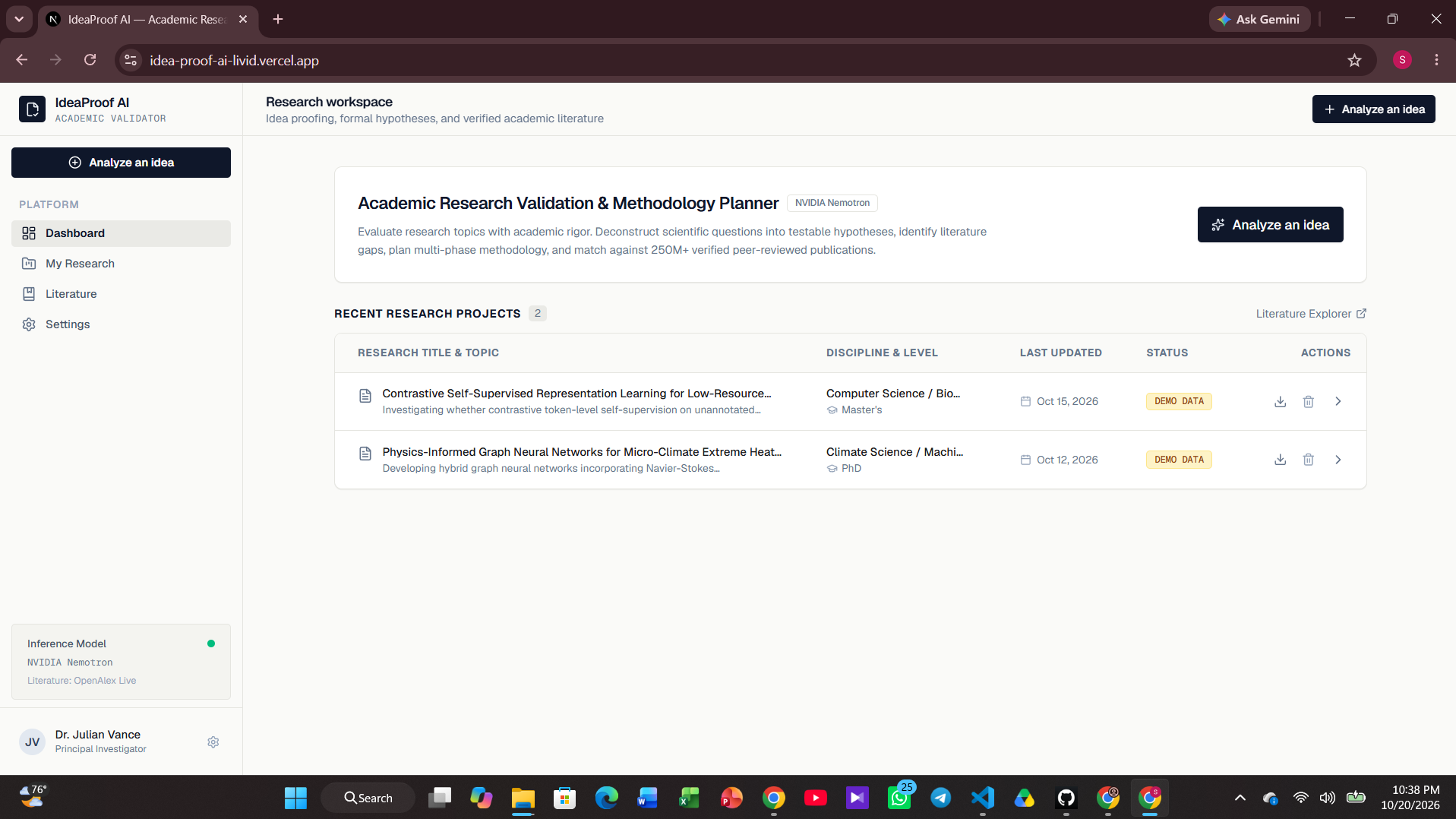
IdeaProof AI is an AI-powered research companion designed to help users turn early-stage ideas into structured, evidence-informed research plans.
It supports the research process by helping users:
- Explore and refine research ideas: Turn an initial concept into a clearer research direction.
- Evaluate research potential: Examine an idea's scope, relevance, feasibility, and possible challenges.
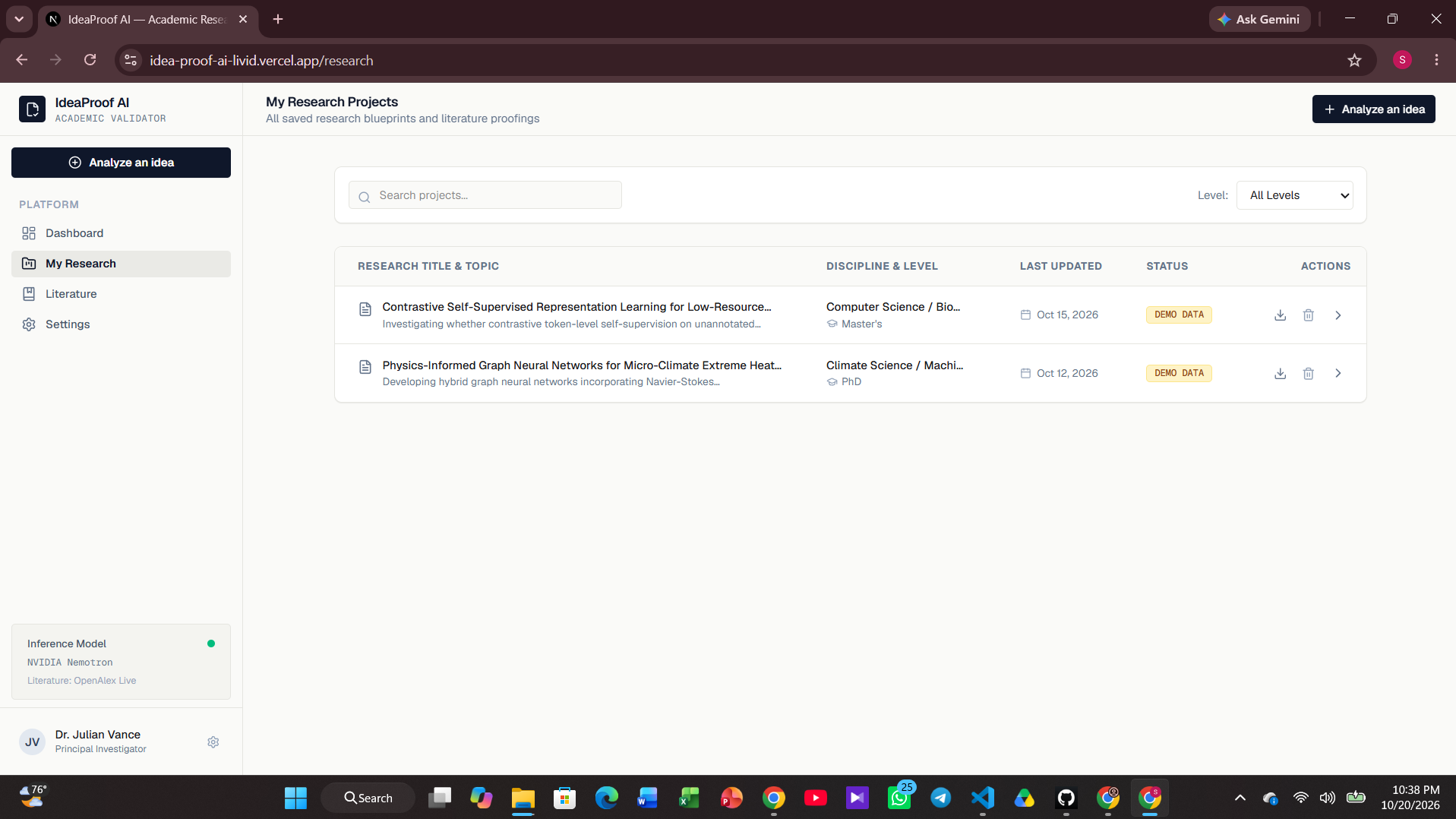
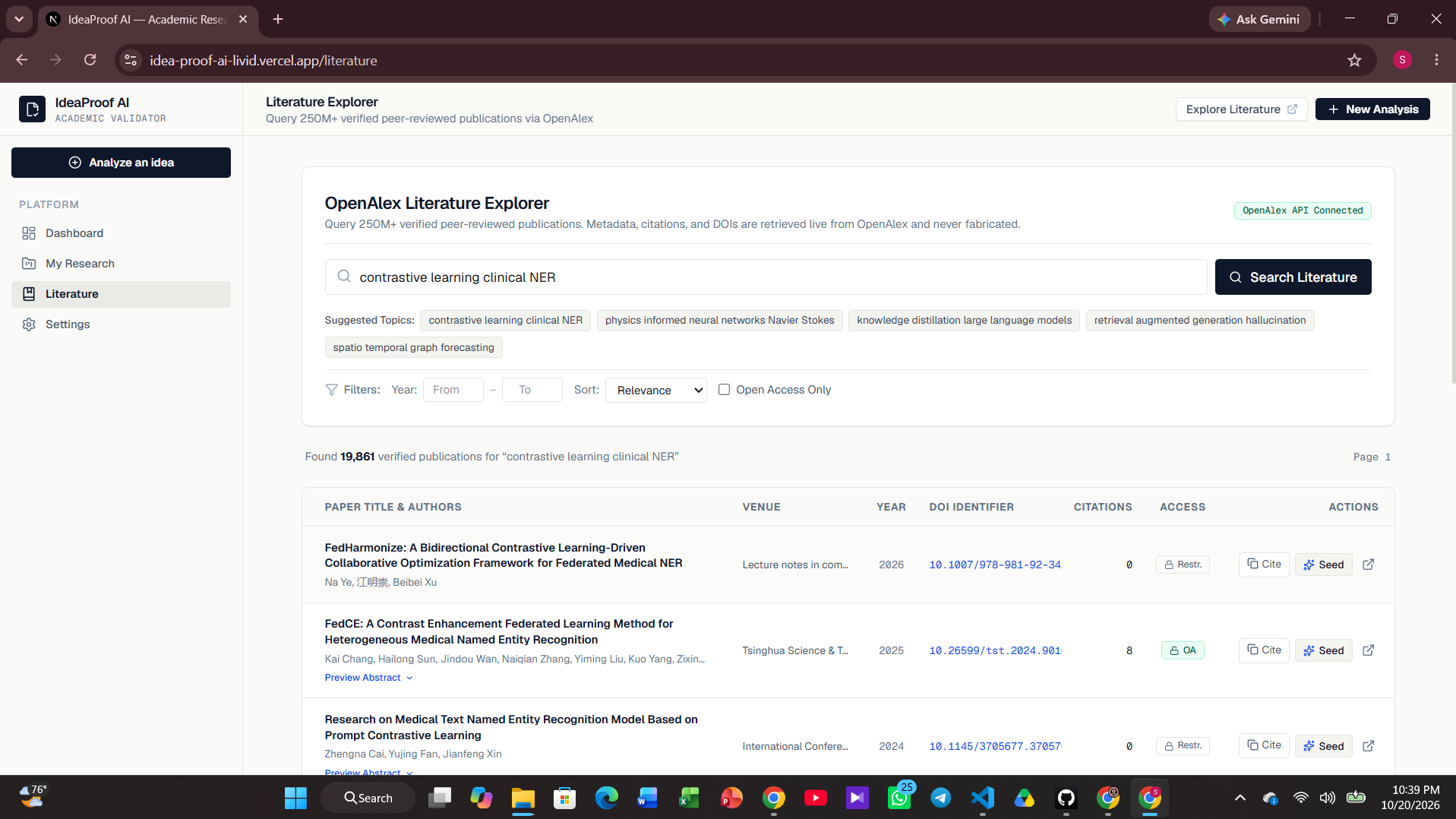
- Explore related literature: Discover relevant research and investigate what has already been studied.
- Identify potential research gaps: Use available evidence to explore unanswered questions and possible opportunities for further investigation.
- Plan research methodology: Develop an initial direction for research questions, methods, and next steps.
- Organize the research journey: Keep the early stages of idea development and planning in a more accessible workflow.
The goal is not to replace researchers or make scientific decisions on their behalf. IdeaProof AI is intended to support human judgment, encourage critical thinking, and make research planning easier to navigate. Literature and AI-generated suggestions should still be independently verified.
How we built it
I built IdeaProof AI as a web application with a focus on usability and a practical research workflow. The interface is designed to help users focus on their ideas rather than struggle with a complicated set of tools.
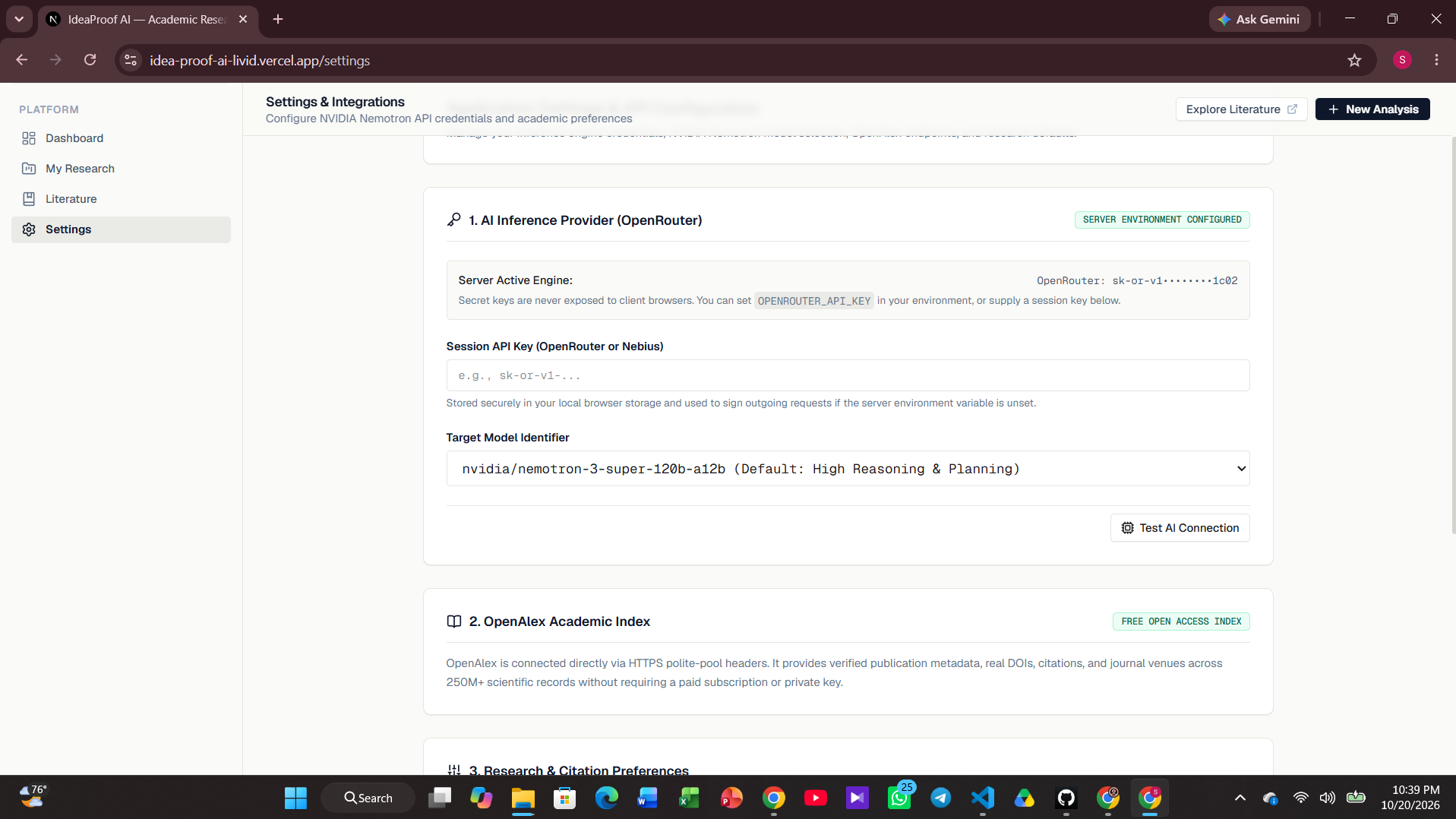
For AI inference, the application uses an NVIDIA Nemotron model through OpenRouter's OpenAI-compatible API. This integration powers the AI-assisted parts of the research workflow. The application is configured through environment variables so that the inference provider can be changed without redesigning the entire application, provided the replacement provider supports the required API interface.
I also prepared the project for public access through a deployed web application and a public code repository, with setup and configuration information documented for future development.
Throughout development, I focused on making the experience approachable for researchers who may have a research question but are unsure how to develop it into a workable plan.
Challenges we ran into
One of the biggest challenges was accessing the infrastructure required for the hackathon.
I attempted to use Nebius Token Factory, but encountered difficulties with the country-of-residence selection and billing requirements from Bangladesh. Activating API access also required a payment card that I did not have available. I reached out to the hackathon organizers and the Nebius community on Discord on October 19, 2026, but could not find a workable path in time.
Rather than claim an integration that I could not use, I continued development with OpenRouter and an NVIDIA Nemotron model. I documented the limitation and the intended provider migration path transparently.
Another challenge was ensuring that the application’s configuration and error messages matched the actual inference provider. This reinforced an important lesson: a working AI application requires more than a model call. Environment variables, server-side authentication, deployment configuration, and clear error handling all matter.
The infrastructure limitation remains relevant to hackathon eligibility because the project currently uses OpenRouter rather than a verified Nebius runtime integration.
Accomplishments that we're proud of
The biggest accomplishment is turning an idea into a working, publicly accessible application.
I'm proud that IdeaProof AI brings AI-assisted research planning into a single experience instead of treating the beginning of research as a collection of disconnected tasks. The project has a dedicated interface, an integrated NVIDIA Nemotron inference workflow through OpenRouter, and a public deployment that people can explore.
I'm also proud of being transparent about the technical and infrastructure limitations encountered during development. When the original provider was inaccessible, I adapted the implementation rather than misrepresenting what the application actually uses.
Most importantly, IdeaProof AI represents my effort to build something practical around a real problem faced by students and researchers: figuring out whether an idea is worth investigating and deciding what to do next.
What we learned
Building IdeaProof AI taught me that developing an AI-powered product involves much more than selecting a model and writing prompts.
A useful research tool needs a clear problem definition, a thoughtful user experience, reliable API integration, secure secret management, deployment testing, and honest communication about AI limitations. We also learned how important it is to distinguish an AI-generated suggestion from a conclusion supported by verified research evidence.
The experience also highlighted how infrastructure access can affect development, especially when account eligibility, regional availability, or billing requirements become obstacles. Designing a provider layer
Built With
- css
- nemotron
- next.js
- nvidia
- openalex
- openrouter
- react
- tailwind
- typescript


Log in or sign up for Devpost to join the conversation.