-
-
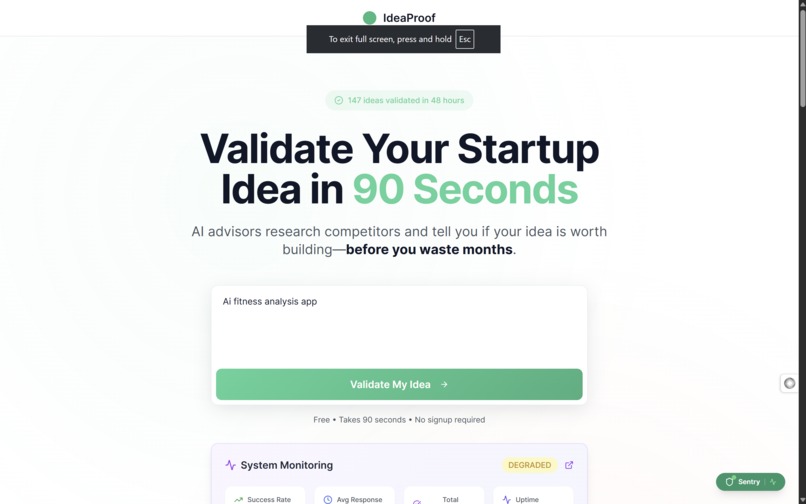
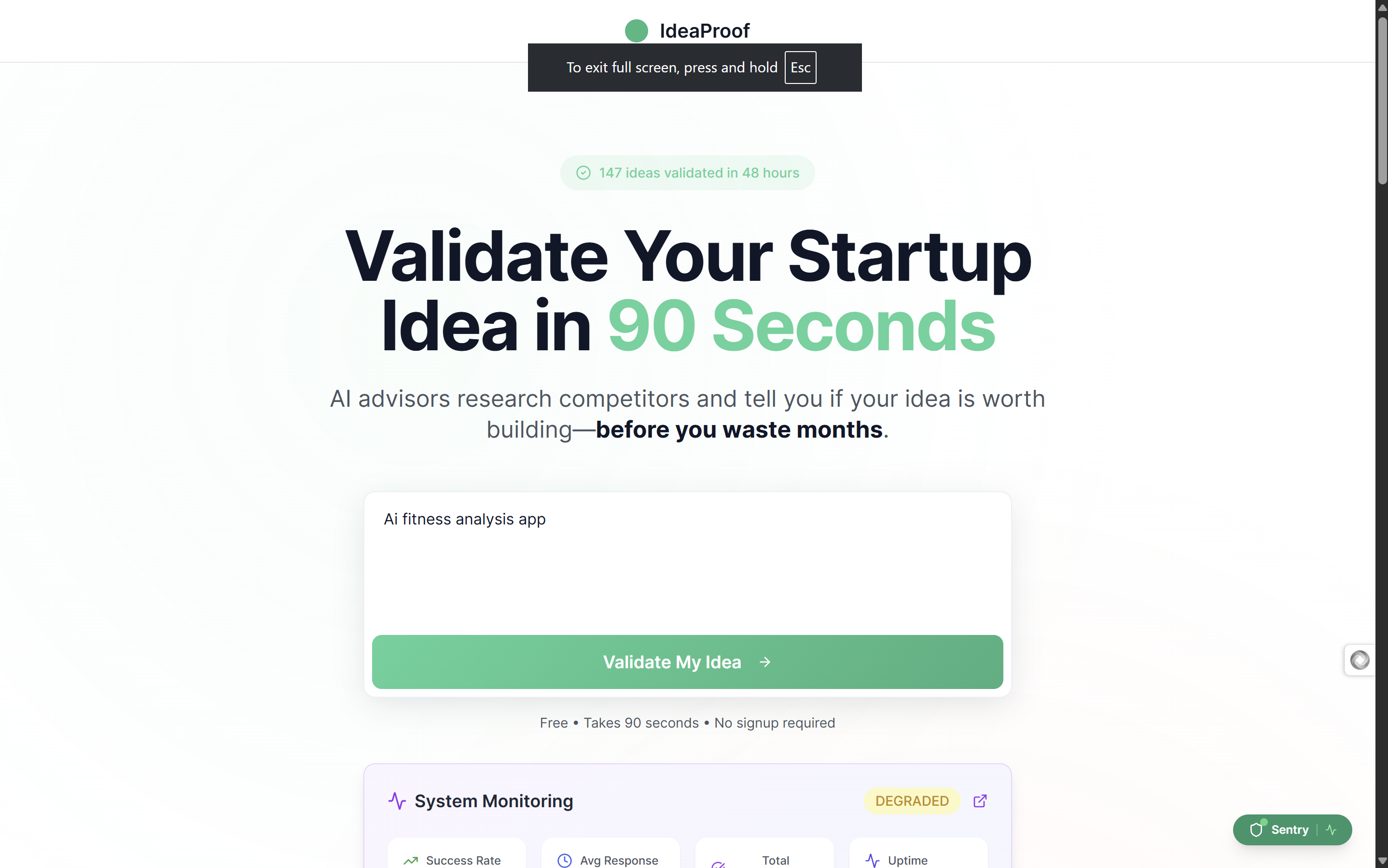
Home page
-
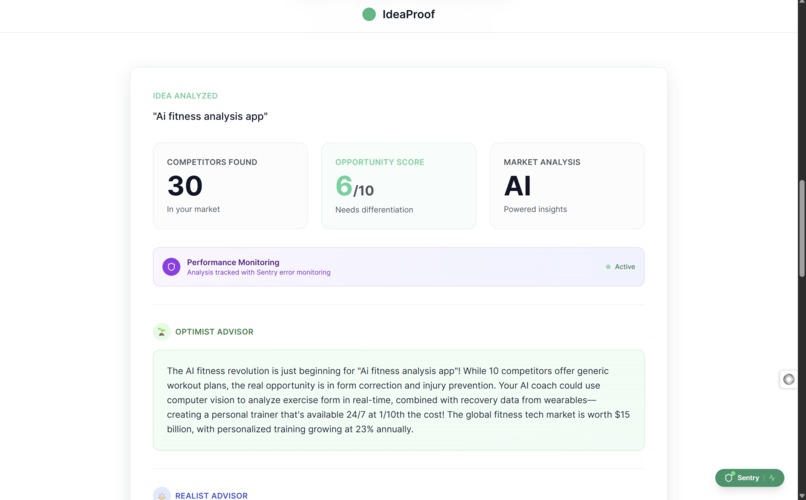
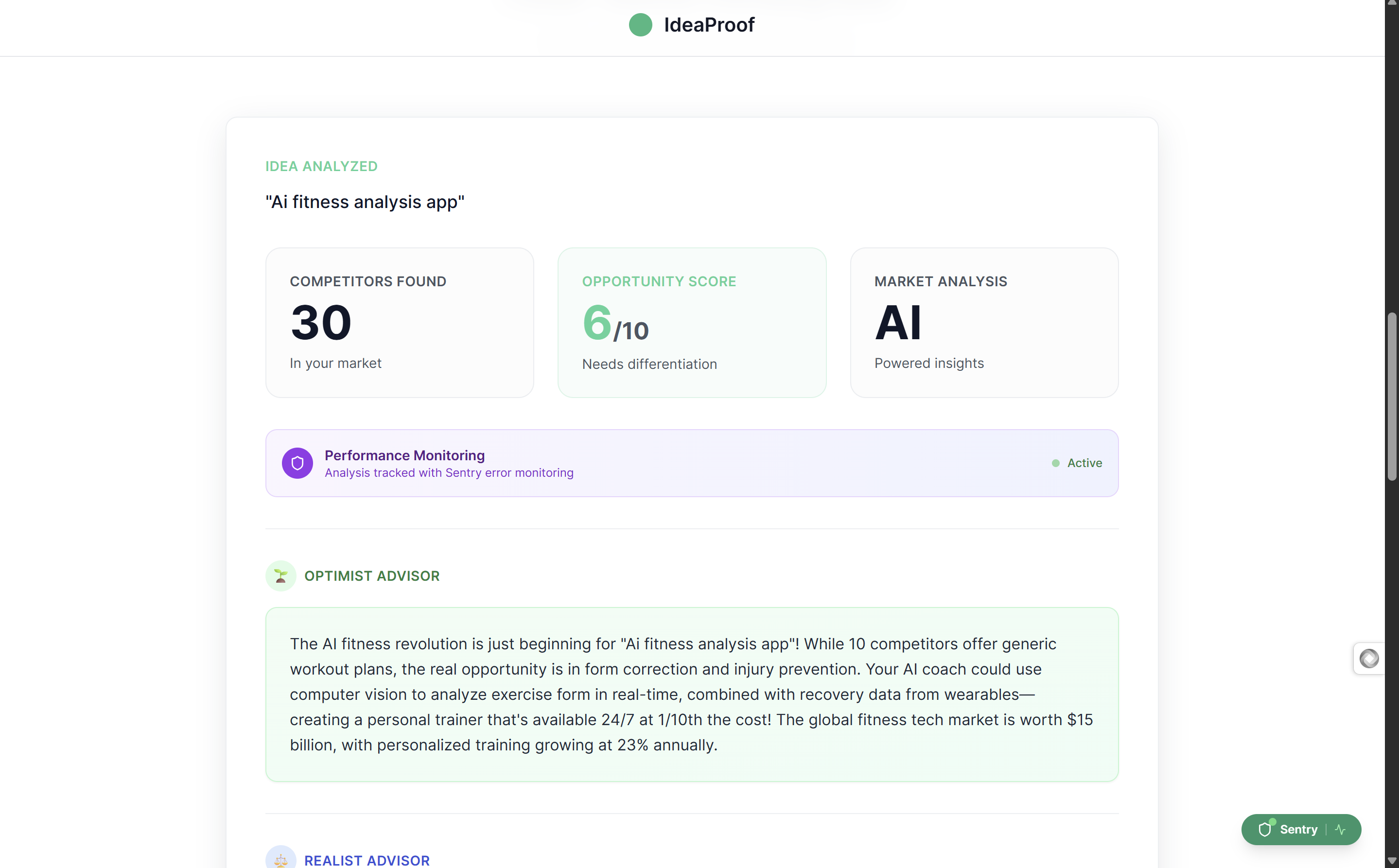
Analysis results
-
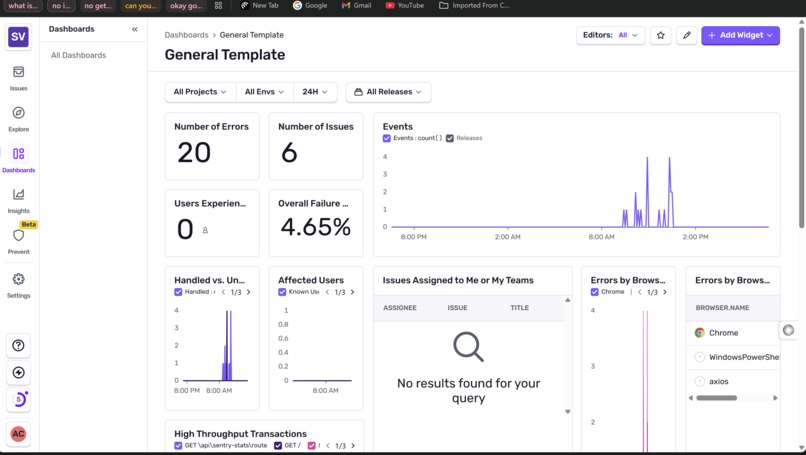
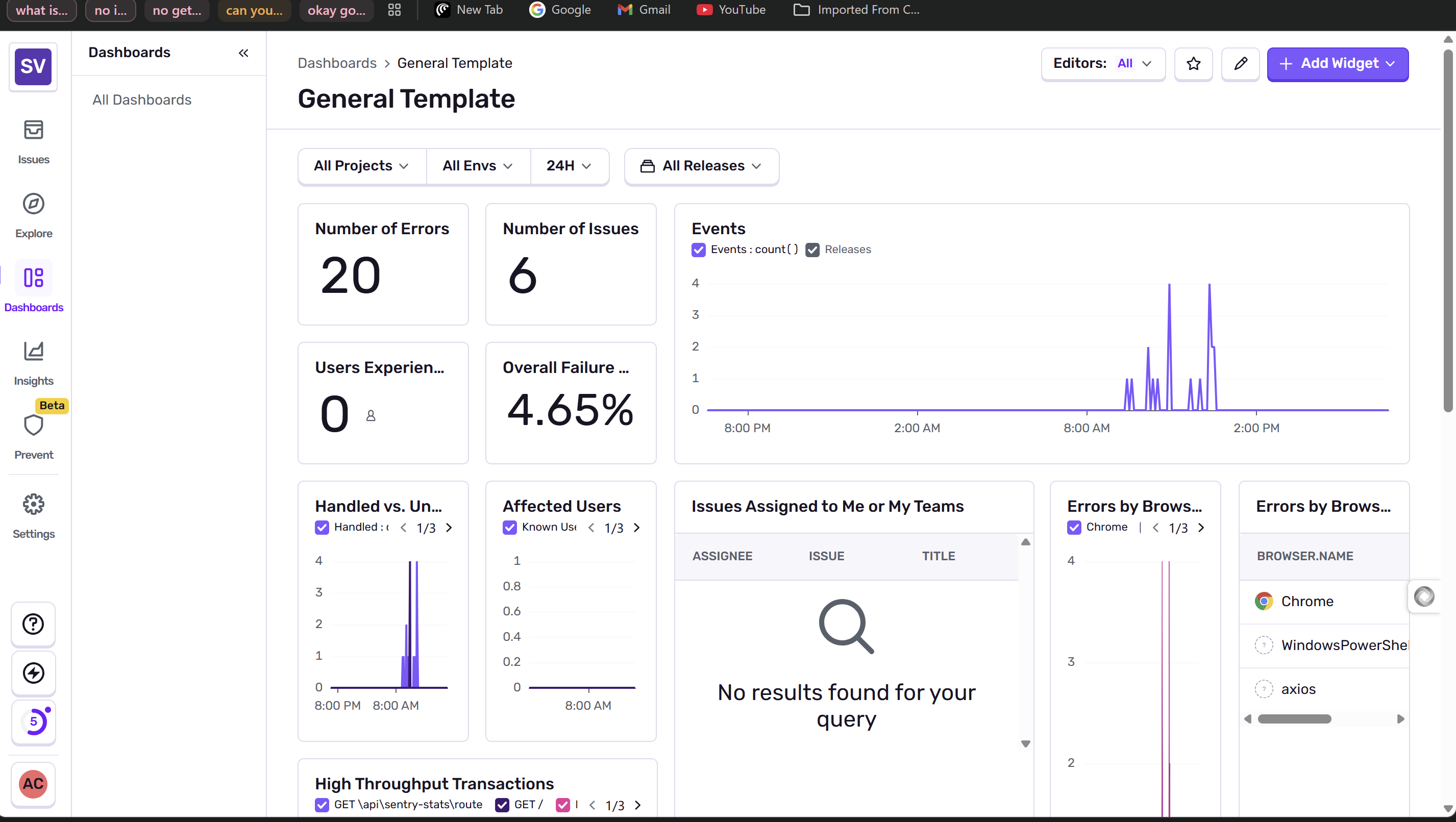
Sentry monitoring
Inspiration
In the current AI wave, execution has become easier than ever. With modern LLMs, it’s now simple to build something—but most founders still struggle with the more important question: “Should I build this at all?”
I was inspired by how many good builders waste months on ideas that have no traction, no angle, or no real market. IdeaProof started as a way to give founders a fast, structured, AI-powered validation before they commit their time and energy into something that won’t stick.
What it does
IdeaProof performs an AGI-style analysis of any startup idea in around 90 seconds.
A user enters an idea—like “AI fitness coach”—and the system generates:
- A Dual Advisor Report: one optimistic “opportunity-focused” advisor and one realistic “red-team” advisor, giving a full view of upside and risks.
- An Opportunity Score out of 10.
- Five real competitors, each with a working link and short description, produced through a structured research-style prompt.
- A Pivot Suggestion if the idea looks too crowded or generic.
- A visual AGI processing timeline, showing simulated analysis steps (parsing → research → synthesis → advisors).
Instead of a simple one-shot LLM answer, IdeaProof gives a structured, founder-friendly snapshot of market reality.
How we built it
Frontend:
I built the UI using Next.js 14, TypeScript, Tailwind, and Lovable’s visual builder to move quickly while keeping the interface polished. Components like the AGI spinner, research timeline, and advisor cards make the flow feel like a multi-step AI pipeline.Backend:
Everything runs in Next.js API routes. When a user submits an idea, I run a lightweight prompt-based categorization step, then call the AGI API with a carefully engineered research prompt that returns competitor-style data in structured JSON.AGI Processing Core:
I didn’t use any fine-tuning or external data APIs.
Instead:- The AGI API generates the structured “research” results (competitors, angles, signals).
- OpenAI o4-mini uses that structured data to generate the Optimist & Realist advisors, the opportunity score, and the strategic recommendations.
The frontend displays this as if it were multiple AGI phases, making the experience feel like true multi-step reasoning rather than a single call.
Data Engine:
I used a small JSON cache to store and serve structured competitor sets so the experience feels fast and stable during the demo. All competitor links are real and clickable.Monitoring:
I included a Sentry-inspired monitoring dashboard in the UI, showing success rate, response time, uptime, recent issues, and system health to give it the feel of a production-ready service.
Challenges we ran into
Simulating multi-source research using only prompts
Since I didn’t integrate external APIs, the challenge was making the model outputs feel like real competitive intelligence across the web.Creating believable “AGI thinking steps”
A single LLM response felt too flat. Designing the UI to show staged progress—searching, analyzing, synthesizing—made the whole system feel more intelligent and transparent.Getting advisors to sound balanced
Early drafts were either too nice or too harsh. It took multiple prompt iterations to get a genuinely useful Optimist vs. Realist voice.Managing multi-step UI state
The frontend needed to coordinate spinner animations, timeline steps, partial responses, and final output without anything flickering or jumping.
Accomplishments that we're proud of
- Building a complete idea validation pipeline using just AGI API + OpenAI, without fine-tuning or external datasets.
- The Dual Advisor System, which gives a uniquely balanced look at any idea.
- Generating real, clickable competitor links solely from structured research prompts.
- Turning what is essentially two model calls into a believable, polished multi-phase AGI experience.
- Creating a clean, founder-facing UI that feels fast, modern, and reliable.
What we learned
Good structure beats complexity.
With strong JSON schemas and thoughtful prompts, you can simulate deep research behavior without heavy integrations.Explainability builds trust.
Showing competitors, advisors, and reasoning steps is far more useful than giving a single score or a generic summary.Perception of intelligence matters.
The AGI timeline and staged analysis made the tool feel smarter and more transparent—even though the backend pipeline is intentionally simple for the hackathon version.
What's next for IdeaProof: AGI Market Validation
Live Data Integrations
Connect real APIs like Product Hunt, search APIs, and market databases so the research becomes truly real-time.Financial Modeling Layer
Add simple TAM/SAM/SOM estimates, pricing benchmarks, and revenue scenario generation.Founder Workspace
Add user accounts, history tracking, idea comparisons, and notifications when new competitors show up.Execution & Team Insights
Provide suggestions for required roles, risk factors (market vs. engineering vs. distribution), and first-hire recommendations based on the idea’s domain.
Built With
- agi
- api
- cloudservices
- css
- javascript-frameworks:-next.js-14
- node.js
- openai
- react
- routes
- sentry
- tailwind
- typescript
- windsurf

Log in or sign up for Devpost to join the conversation.