-
-
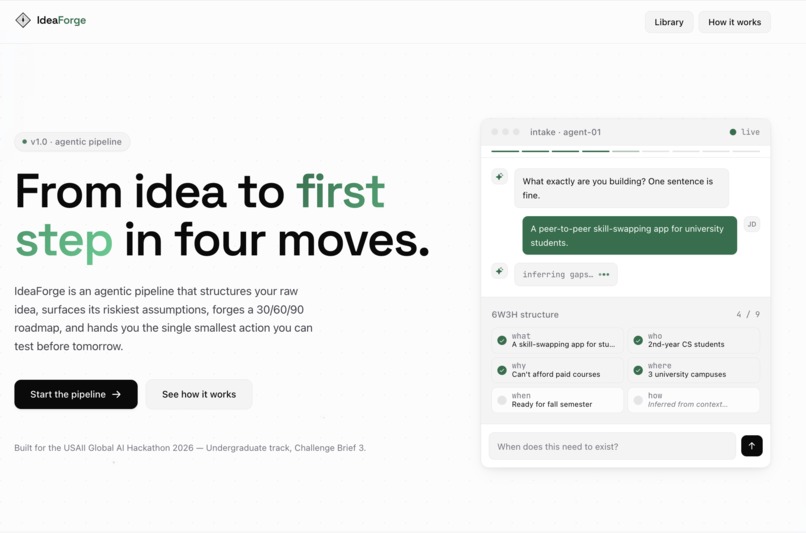
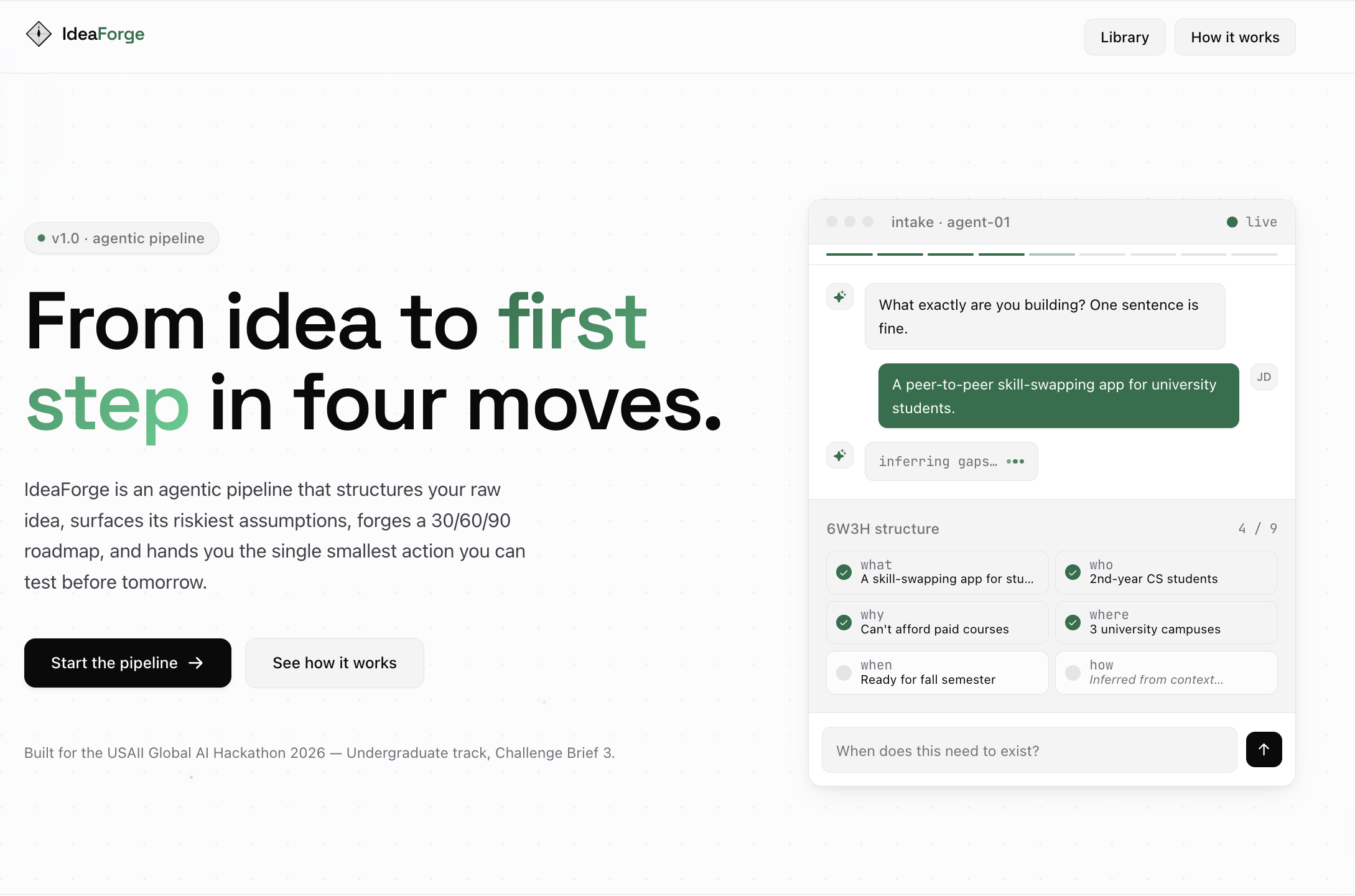
The IdeaForge dashboard: Navigate from a raw startup idea to an actionable 90-day roadmap and your very first testable step.
Inspiration
The USAII Global AI Hackathon 2026 challenged us to build responsible AI tools for "Life, Learning & Work." As an AI student, I constantly see peers and developers struggle not with writing code, but with ideation—finding meaningful, real-world problems to solve. The gap between a vague thought and a structured, executable project is vast.
This inspired IdeaForge, an AI-driven platform that acts as a collaborative brainstorming partner. We wanted to build a system that takes raw concepts and "forges" them into structured, actionable, and risk-aware project blueprints.
What it does
IdeaForge is an intelligent ideation engine designed for developers and innovators. Users input a rough concept or domain of interest (e.g., "AI for healthcare accessibility"). IdeaForge then:
- Expands & Validates: Generates 3-5 distinct, practical project angles.
- Evaluates Risk & Bias: Analyzes the ideas for potential ethical risks, misinformation, or over-reliance on biased datasets, aligning with the hackathon's emphasis on responsible AI.
- Structures the Roadmap: Outputs a step-by-step technical execution roadmap.
How we built it
We leveraged a multi-agent architecture using Python and state-of-the-art LLMs to orchestrate the brainstorming process.
- Frontend: A clean, interactive interface to seamlessly capture user inputs.
- Backend & AI Engine: A Retrieval-Augmented Generation (RAG) pipeline to fetch context from recent technological trends.
- Evaluation Algorithm: We implemented a custom mathematical scoring model to rank generated ideas based on feasibility, novelty, and ethical safety.
The core evaluation function determines the project's viability using the following model:
$$\text{Idea Viability Score} = \alpha \left( \sum_{i=1}^{n} w_i \cdot c_i \right) + \beta \left( 1 - \frac{1}{1 + e^{-k(x - x_0)}} \right)$$
Where \( c_i \) represents constraint metrics (such as data availability and risk factors), and the sigmoid function normalizes the novelty factor. We ensured strict parameter balancing, where \( \alpha + \beta = 1 \), to weigh safety equally with innovation.
Challenges we ran into
One of the hardest technical hurdles was preventing the LLM from suggesting generic, hallucinated, or overly ambitious projects. Early prototypes gave us results akin to "build artificial general intelligence in a weekend."
To fix this, we had to:
- Rigorously refine our system prompts.
- Implement strict temperature controls.
- Build a "Critic Agent" that actively tries to find flaws in the proposed ideas. Quantifying ethical "bias risk" is inherently subjective, making the mathematical modeling of the critic particularly challenging.
Accomplishments that we're proud of
I am incredibly proud of the Risk-Aware Assessment Module. Instead of just generating "cool" ideas, IdeaForge actively flags potential data privacy concerns or model biases right at the conception phase. Getting the multi-agent system to debate itself—where an Ideator proposes and a Critic challenges—was a massive win.
What we learned
This hackathon deeply reinforced the importance of responsible system design. Building AI isn't just about making something smart; it's about making something safe, unbiased, and practically useful. I also gained invaluable hands-on experience orchestrating complex LLM pipelines and refining prompt chaining mechanisms.
What's next for IdeaForge
We are just getting started! Our next steps include:
- GitHub Integration: Allowing users to cross-reference their forged ideas with existing open-source projects to avoid reinventing the wheel.
- Collaborative Mode: Introducing multiplayer brainstorming sessions for remote teams.
- Automated Bootstrapping: Generating starter boilerplate code based on the finalized idea roadmap.
Built With
- api
- css
- express.js
- framer
- gemini
- motion
- next.js
- node.js
- orm
- prisma
- react
- shadcn
- sqlite
- tailwind
- typescript
- zustand


Log in or sign up for Devpost to join the conversation.