-
-
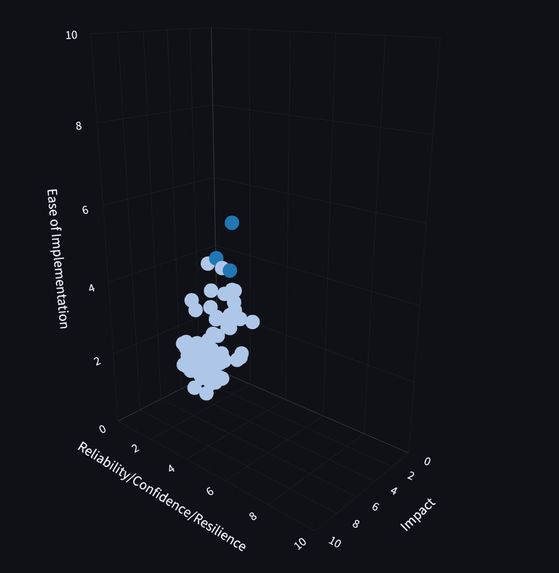
Visual Representation of Idea Prioritization (Ease of Prioritization)
-
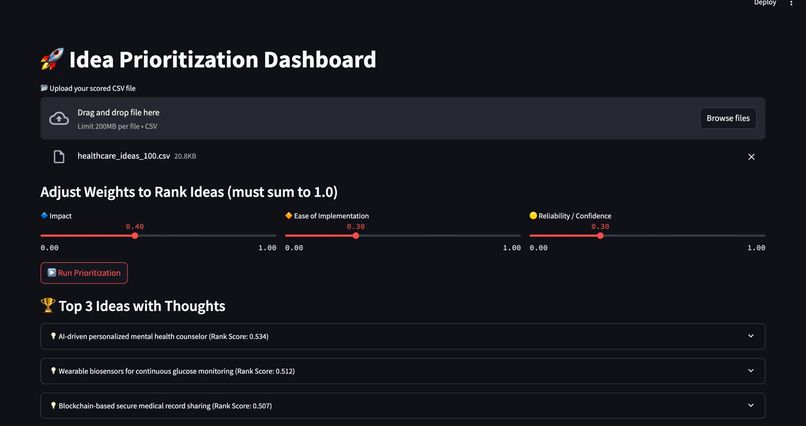
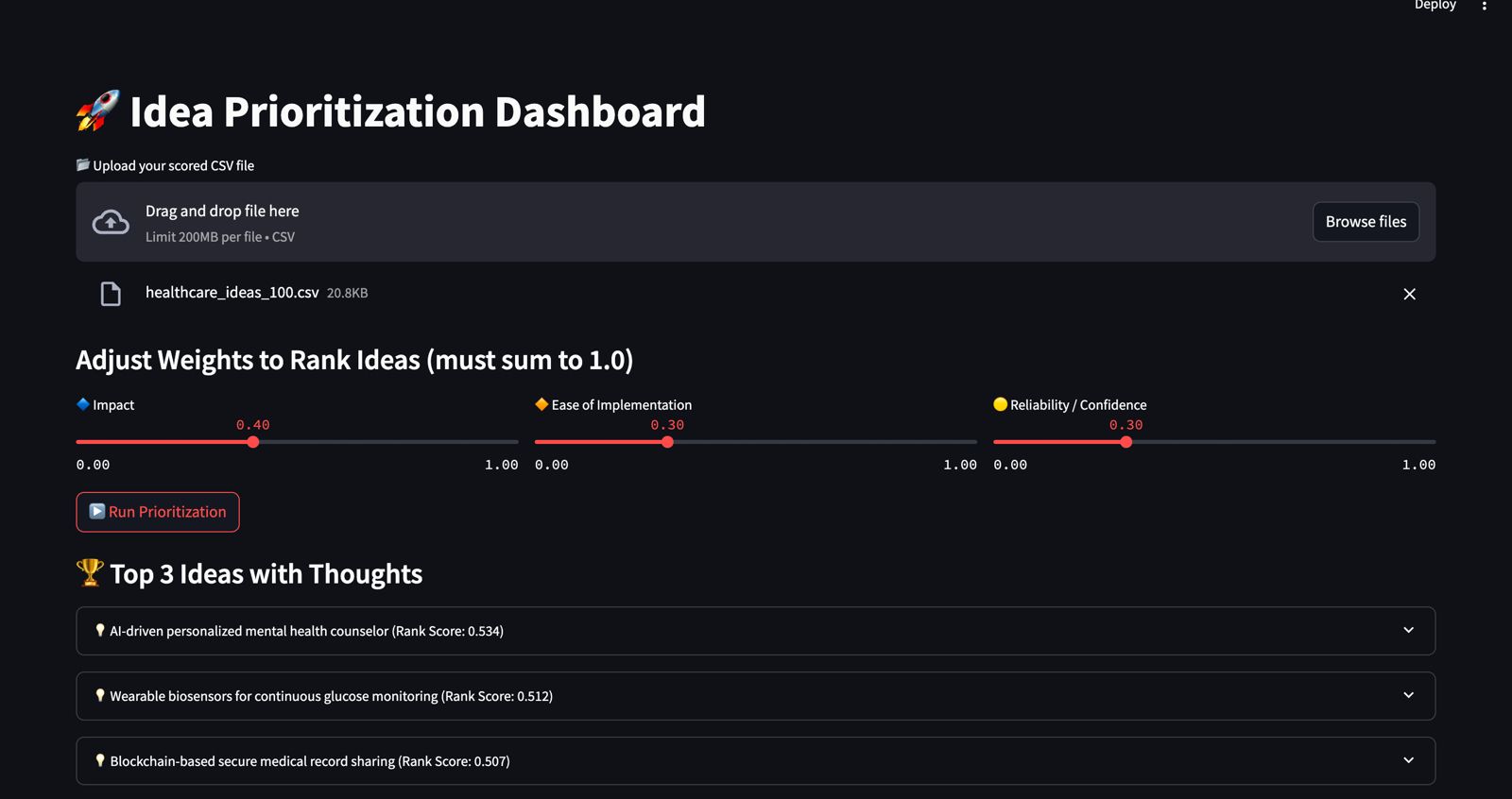
User Interface
-
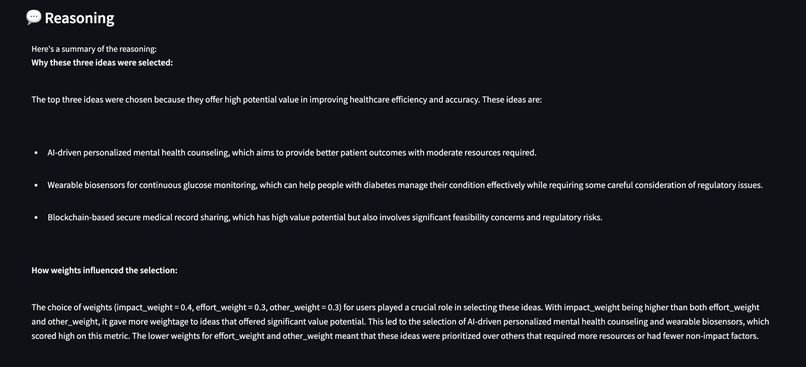
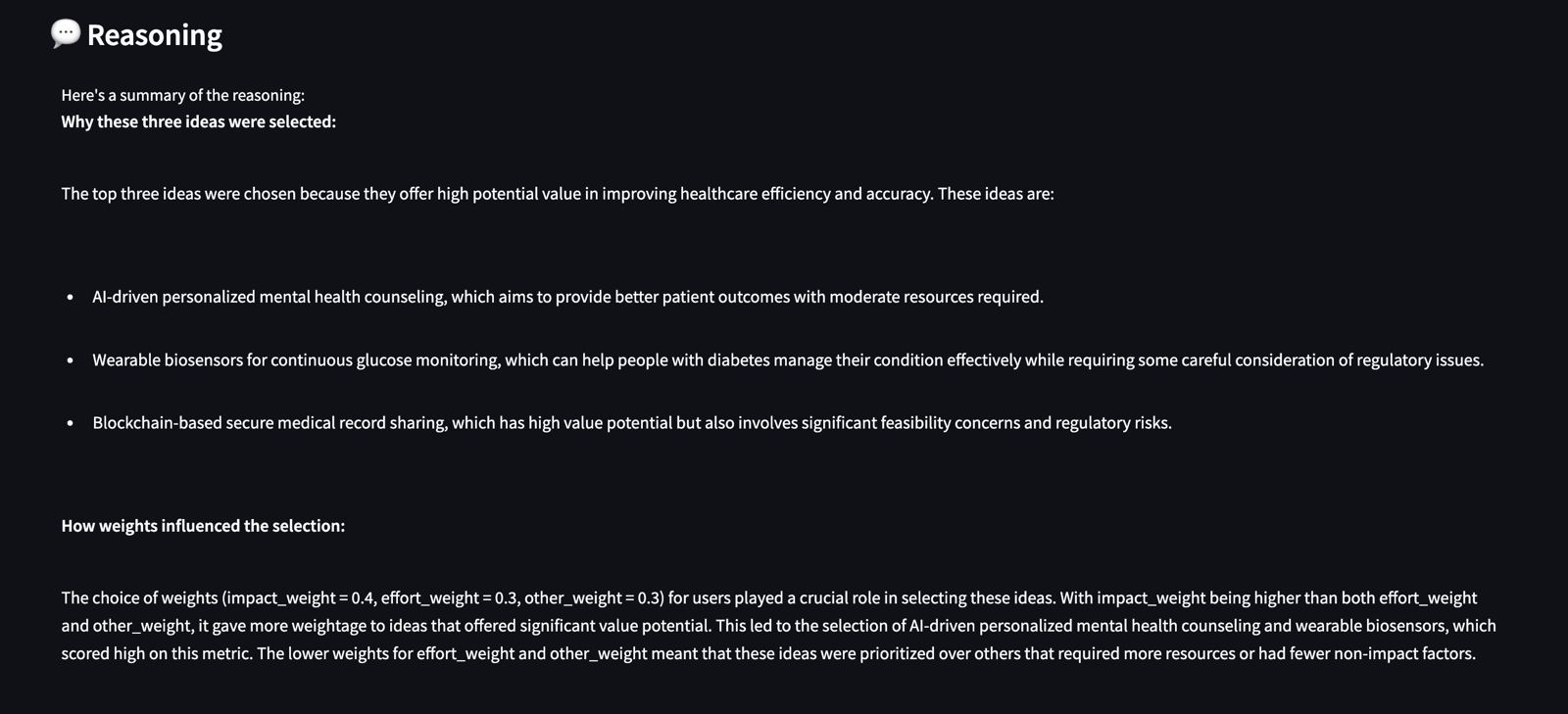
ReAct Style Reasoning for Ranking
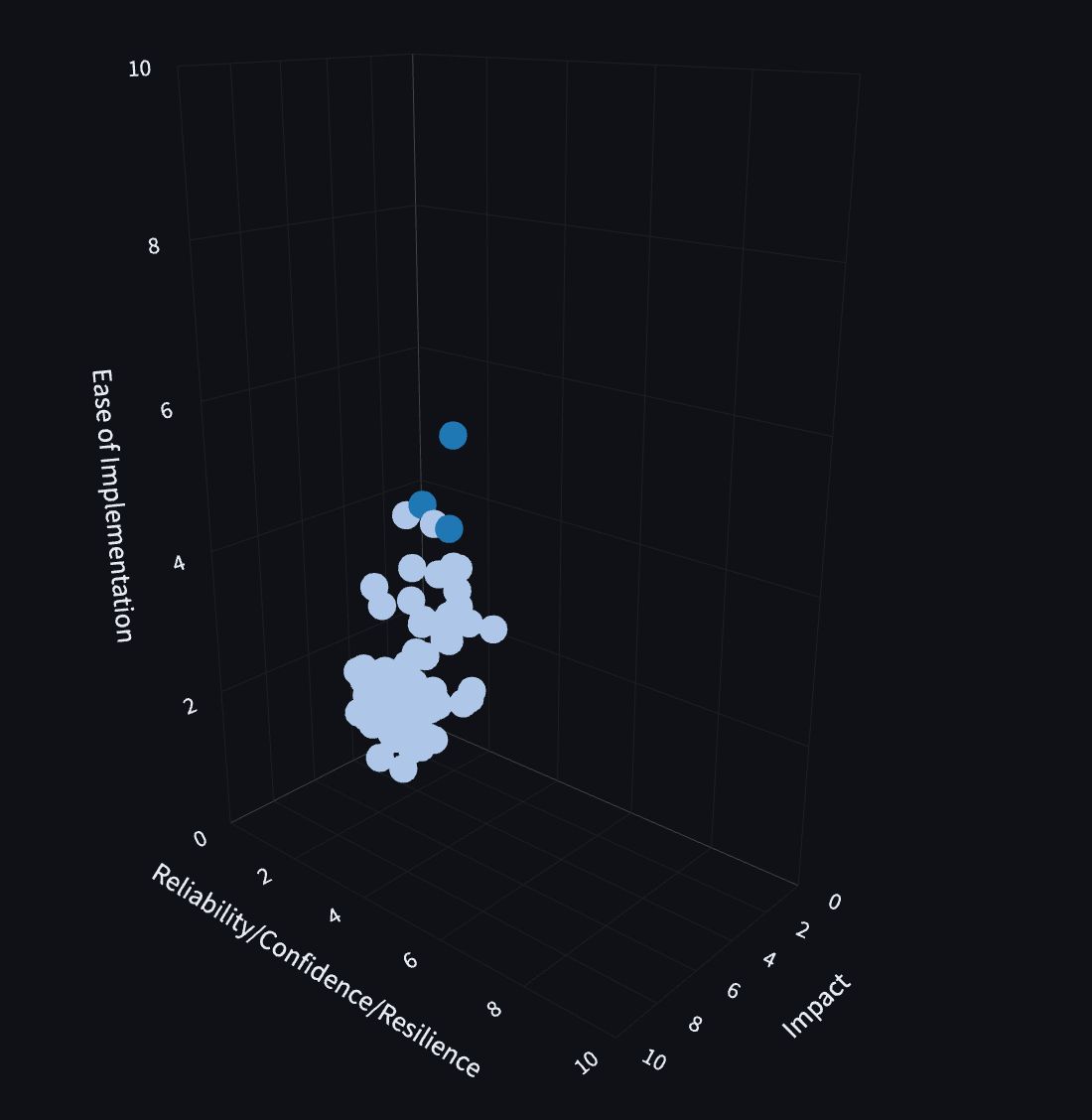
Pluto – AI Agent for Prioritizing Innovation Ideas
Case #1 – ReAct-based Idea Portal Assistant
Team Pluto
Team Members: Mukund Komati, Parvez Shaik, Vijay Sunkugari, Yamini Ane
🚀 Inspiration
We’ve all seen how organizations collect hundreds of ideas through internal portals, but very few ever make it to implementation. The challenge isn’t a lack of creativity — it’s figuring out which ideas are actually worth the time, resources, and effort.
We were inspired to solve this decision-making bottleneck using AI.
We wanted to build a system that could think like a product manager, balancing effort, impact, and strategy — but also explaining why it made its decisions.
💡 What We Built
We built Pluto, a GPT-powered AI agent that helps organizations:
- Evaluate and prioritize innovation ideas
- Rank the top 3 ideas to pursue
- Provide transparent reasoning
- Let the user tune priorities (ROI, effort, alignment)
- Learn from past feedback
We implemented Pluto using:
- Python & Ollama for backend
- Streamlit for the user interface
- LLaMA 3.2 as our language model
Note: Pluto doesn’t just score ideas — it justifies its reasoning using the ReAct (Reasoning + Action) framework.
👥 Team Collaboration
We’re a team of four. We divided responsibilities based on strengths but collaborated closely throughout:
- Frontend and interface design
- GPT prompt engineering and logic flow
- Data modeling and simulation
- Feedback loop and ReAct integration
Everyone contributed to multiple parts of the stack.
🗃️ Custom Dataset
We created a realistic idea portal dataset of 116 innovation ideas based on challenges in a health tech company.
Each idea included fields such as:
- Effort-related: Ease of implementation, resource availability, dependency freedom
- Impact-related: Value created, user demand, business impact
- Strategic & feasibility factors: Scalability, regulatory fit, adoption likelihood, brand alignment, technological feasibility
We also factored in Strategic Alignment, which adjusted based on whether the organization was in a growth or profit-maximizing phase.
We used GPT to simulate and estimate these values where needed.
🧠 Reasoning Logic with ReAct
Pluto uses a layered approach for scoring:
- Custom weights for each field (ROI, effort, etc.)
- GPT evaluates each idea’s value holistically
- ReAct logic applies structured reasoning before action
🧭 Here’s how it works:
- The user uploads a CSV of ideas
- Pluto parses each idea’s fields
- GPT evaluates parameters and provides a score
- Pluto ranks the Top 3 Ideas
- Each ranked idea includes a clear explanation of why it was chosen
- Users can adjust sliders to tweak the weights
- Optional feedback allows users to share past context or organizational priorities
- Pluto incorporates feedback into future analysis
📊 Key Features
- CSV Upload: Load your idea portal data easily
Interactive Dashboard:
- Top 3 recommendations with detailed reasoning
- Full idea list with scores
- Sliders to adjust importance of ROI, effort, etc.
- Top 3 recommendations with detailed reasoning
Effort vs ROI Plot:
Visualizes trade-offs and quick winsLive Feedback Loop: Users can input contextual feedback (e.g., “We are in scaling phase”)
GPT uses this to adapt how it evaluates future ideas
Note: This gives product managers real control without needing to code or retrain the model.
🌐 Real Use Case
Imagine a healthcare startup receiving 50+ product ideas every quarter.
Pluto helps the leadership instantly see:
- Which ideas have the highest ROI with minimal effort
- Which are aligned with their current strategy
- Where effort doesn’t justify value
This turns decision-making into a guided, explainable process, not a guessing game.
📚 What We Learned
- How to implement ReAct-style thinking with GPT
- Structuring real-world data for reasoning-based ranking
- How to balance automation and human control
- Building explainable AI that users can actually trust
- Designing clean UIs that make technical outputs usable
⚙️ Challenges We Faced
- Getting GPT to reason consistently across similar but nuanced ideas
- Designing a scoring system that isn’t too rigid or too loose
- Allowing dynamic weight tuning without breaking logic
- Integrating a live feedback mechanism in a lightweight and meaningful way
- Ensuring our model remained explainable, not just accurate
✅ Final Thoughts
Pluto is not just a tool for idea ranking — it’s a smart assistant that helps teams think clearly, act faster, and explain their choices.
It mirrors how real product teams work: reason, decide, and learn.
We’re proud of how well Pluto bridges the gap between AI-driven insights and human priorities.


Log in or sign up for Devpost to join the conversation.