💡 Inspiration: The Pivot that Sparked Idea Lint
Like many developers entering this hackathon, I didn't start with the project you see today. My original project was an ambitious autonomous vulnerability scanner and patch tournament (CodeColosseum-AI). The plan was deceptively simple: clone an arbitrary Kotlin project from GitHub, compile and run it in a sandbox, and have agents discover and remediate security vulnerabilities.
However, reality hit fast: the initial assumption that one can "simply" compile, build, and run arbitrary third-party repositories from GitHub without deep environment idiosyncrasies was completely unrealistic under hackathon constraints.
I found myself spending days doing grueling manual research:
- Is this concept novel?
- What is the feature matrix of existing tools?
- Where is my competitive niche?
- Is there an actual market need, and is it technically feasible in 3 days?
After burning hours on manual market comparisons and hitting a massive feasibility roadblock, I hit the pause button and had an epiphany:
"What if I had an autonomous AI tool that could have saved me those days of manual research in 3 minutes—and warned me upfront that the idea had critical feasibility flaws before I wrote a single line of code?"
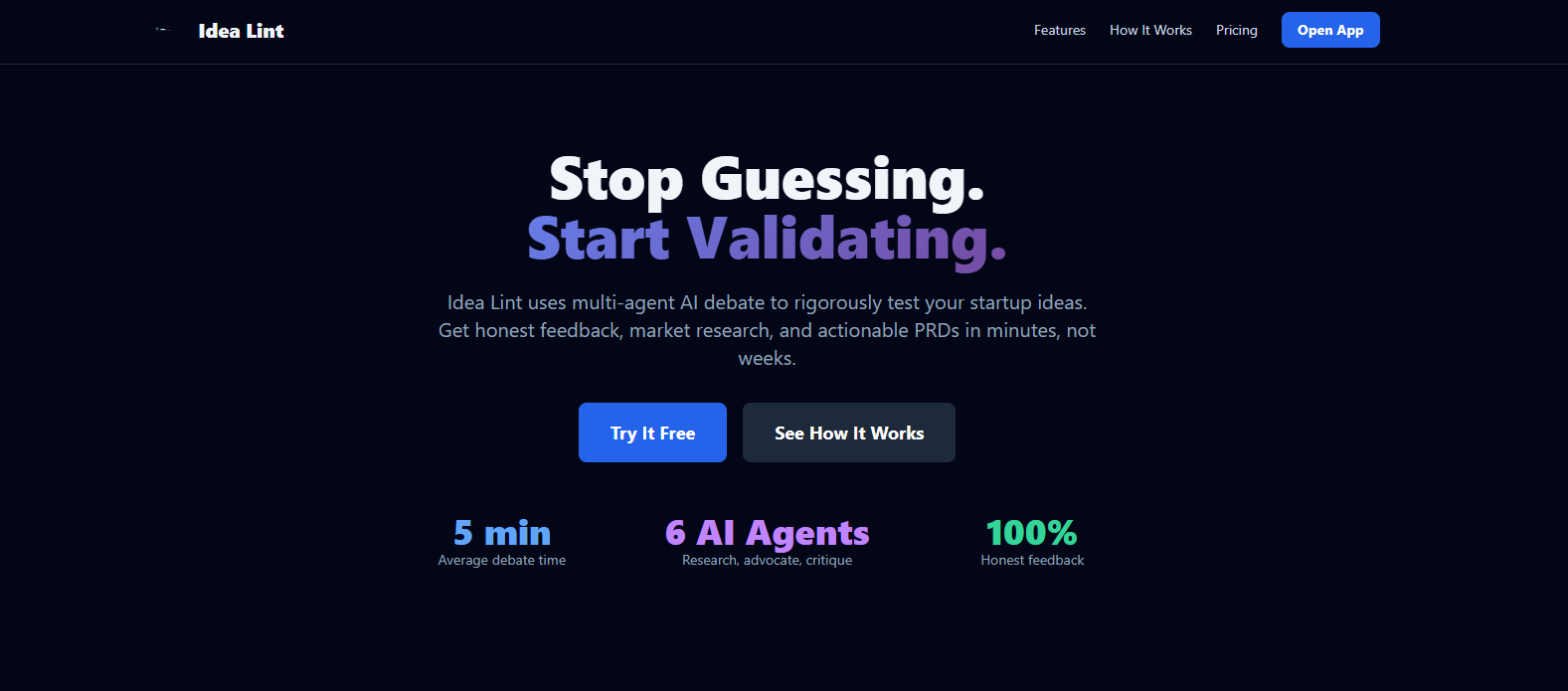
As someone who starts projects often and has always had to do this validation manually, I decided to pivot and build the exact tool I desperately needed: Idea Lint—an autonomous multi-agent panel that rigorously vets startup concepts, debates pros and cons, checks feasibility, and drafts actionable PRDs.
🚀 What It Does
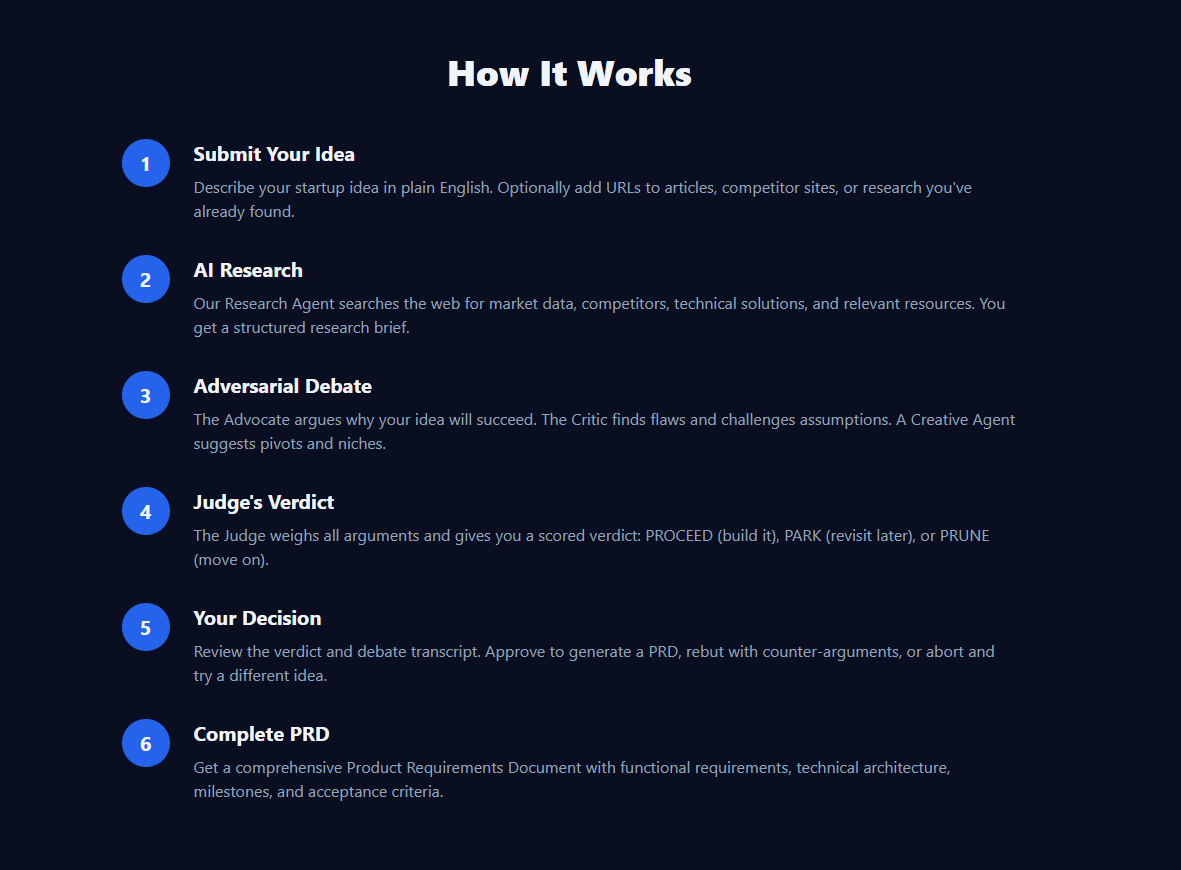
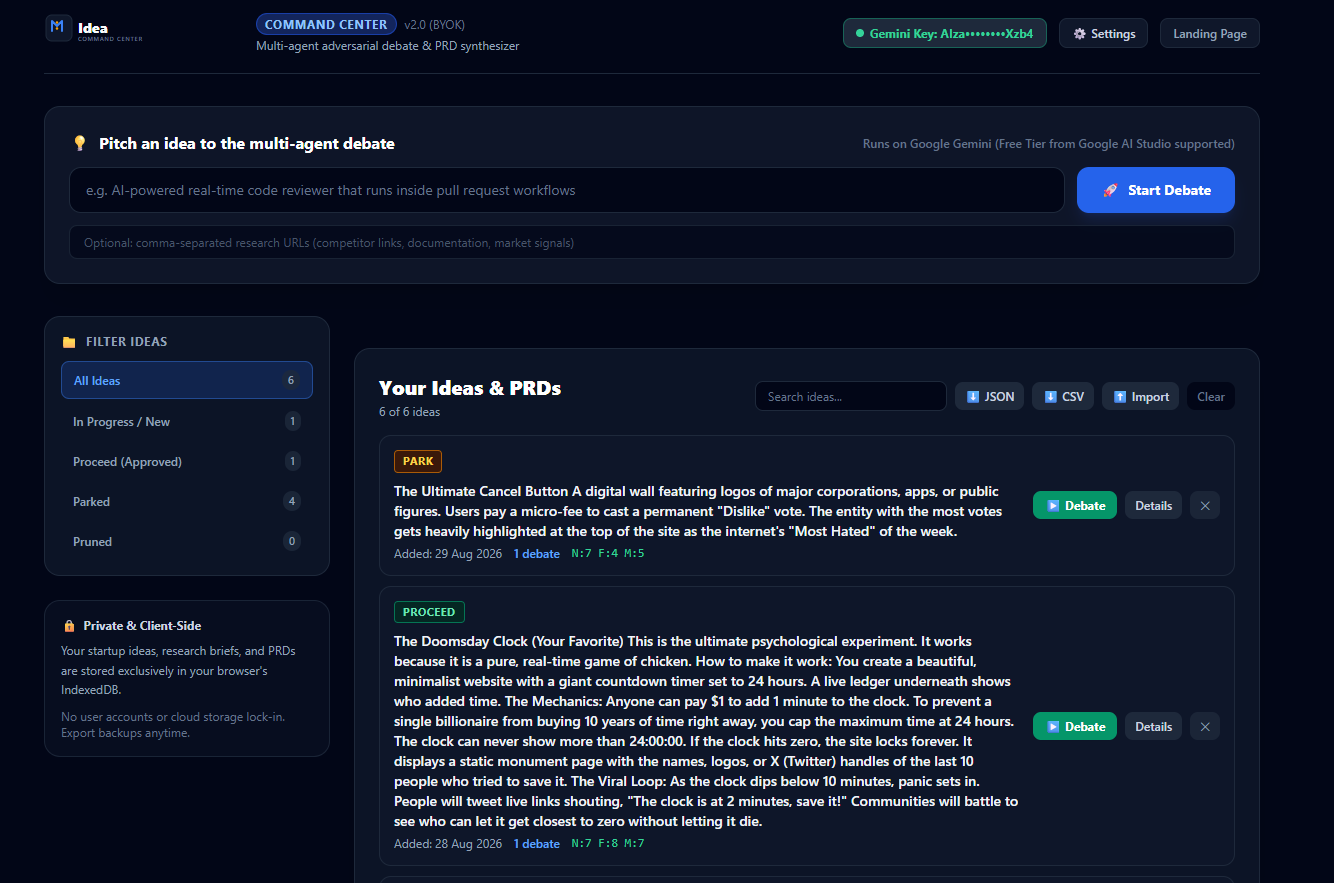
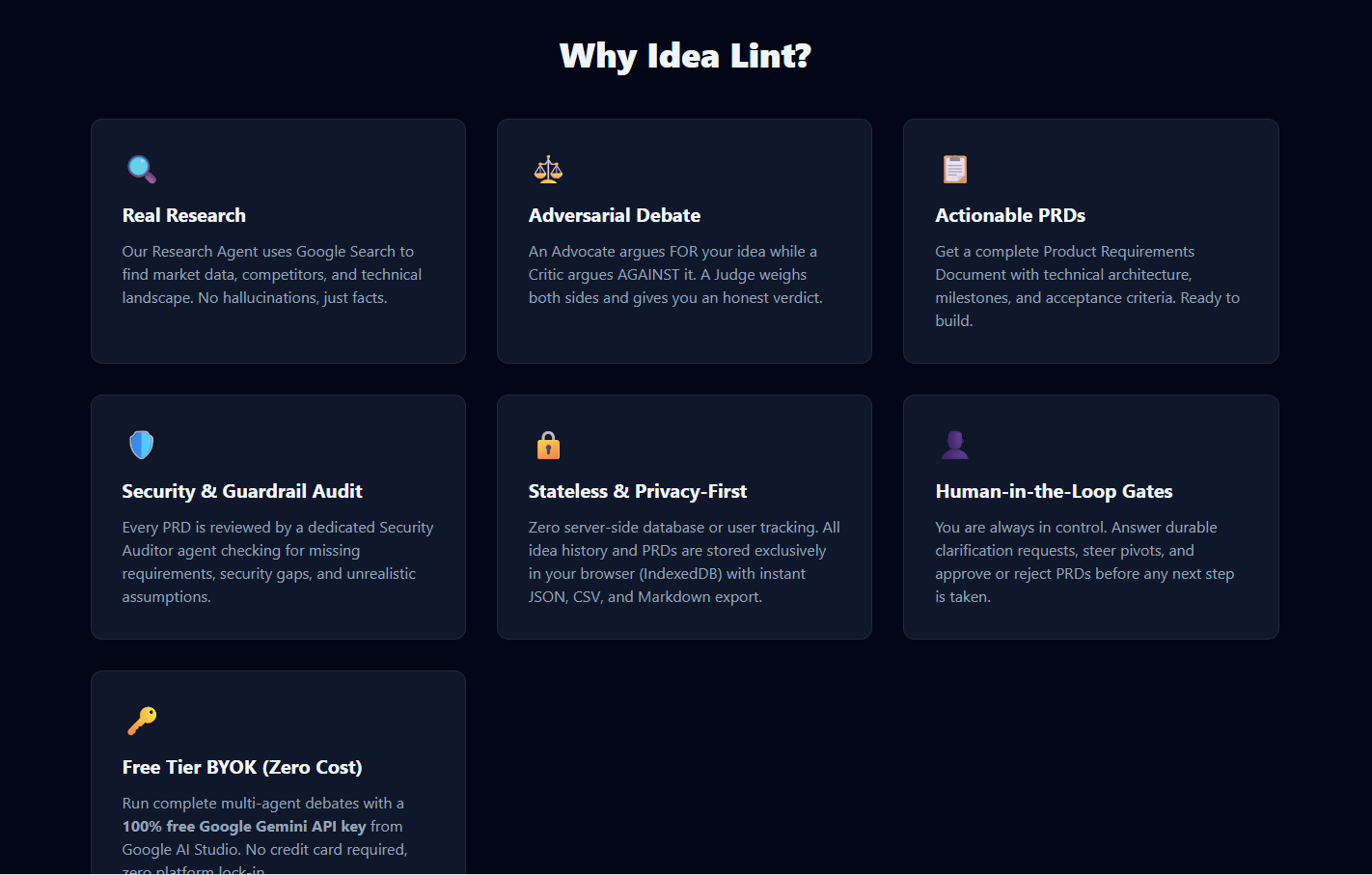
Idea Lint transforms raw startup concepts into battle-tested PRDs through an autonomous 7-agent debate:
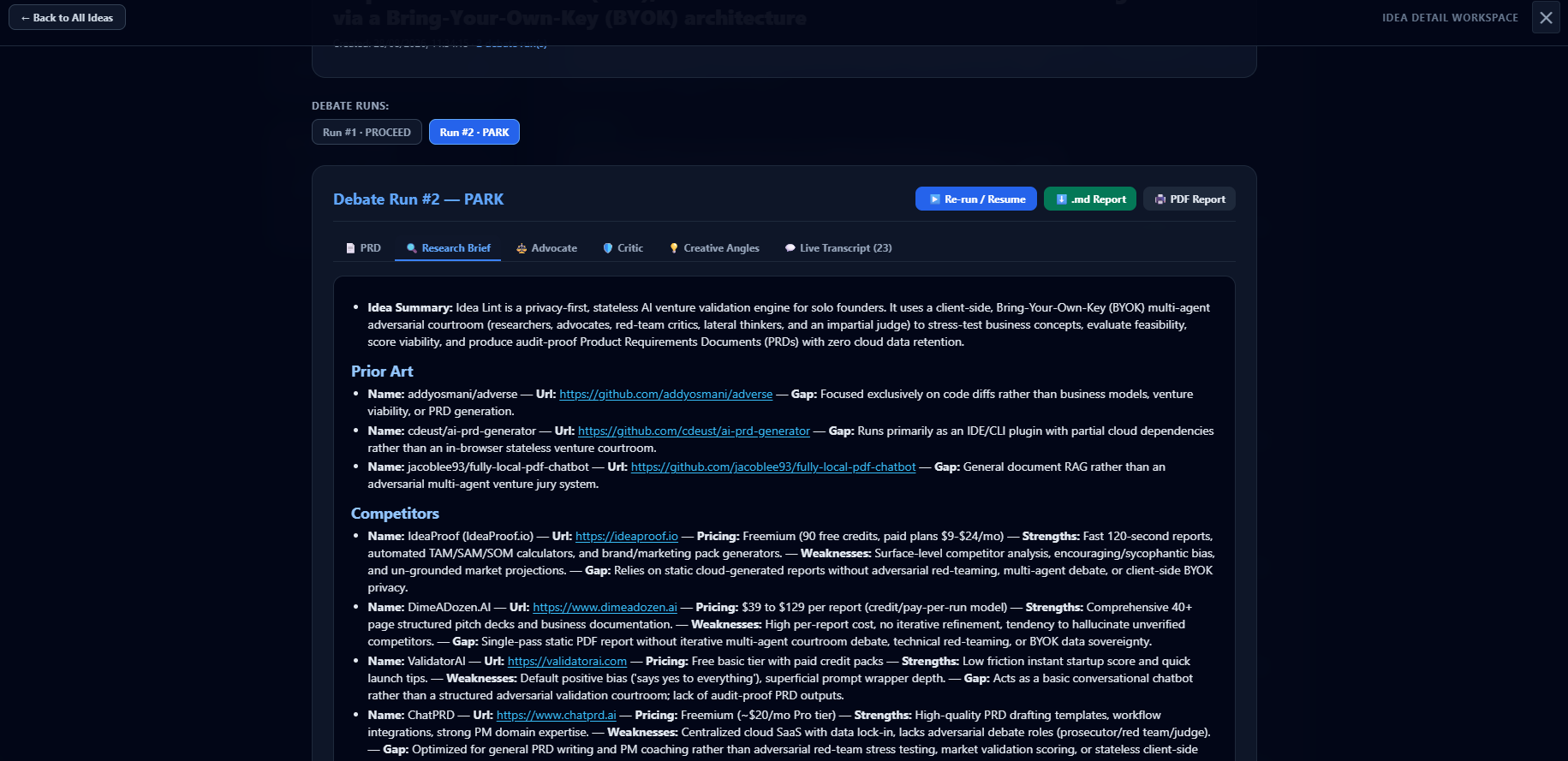
- Autonomous Market Research (
Researcher): Performs live web research via Google Search tools powered bygemini-3.7-flashto map competitors and market signals. - Dialectic Debate (
Advocatevs.Critic): The Advocate (gemini-3.7-flash) builds the strongest case for the idea, while the Critic (gemini-3.1-pro-preview) red-teams every claim with live counter-evidence. - Lateral Pivot Engine (
Creative): Generates high-temperature pivots, untapped customer segments, and non-obvious business models usinggemini-3.7-flash. - Structured Scoring (
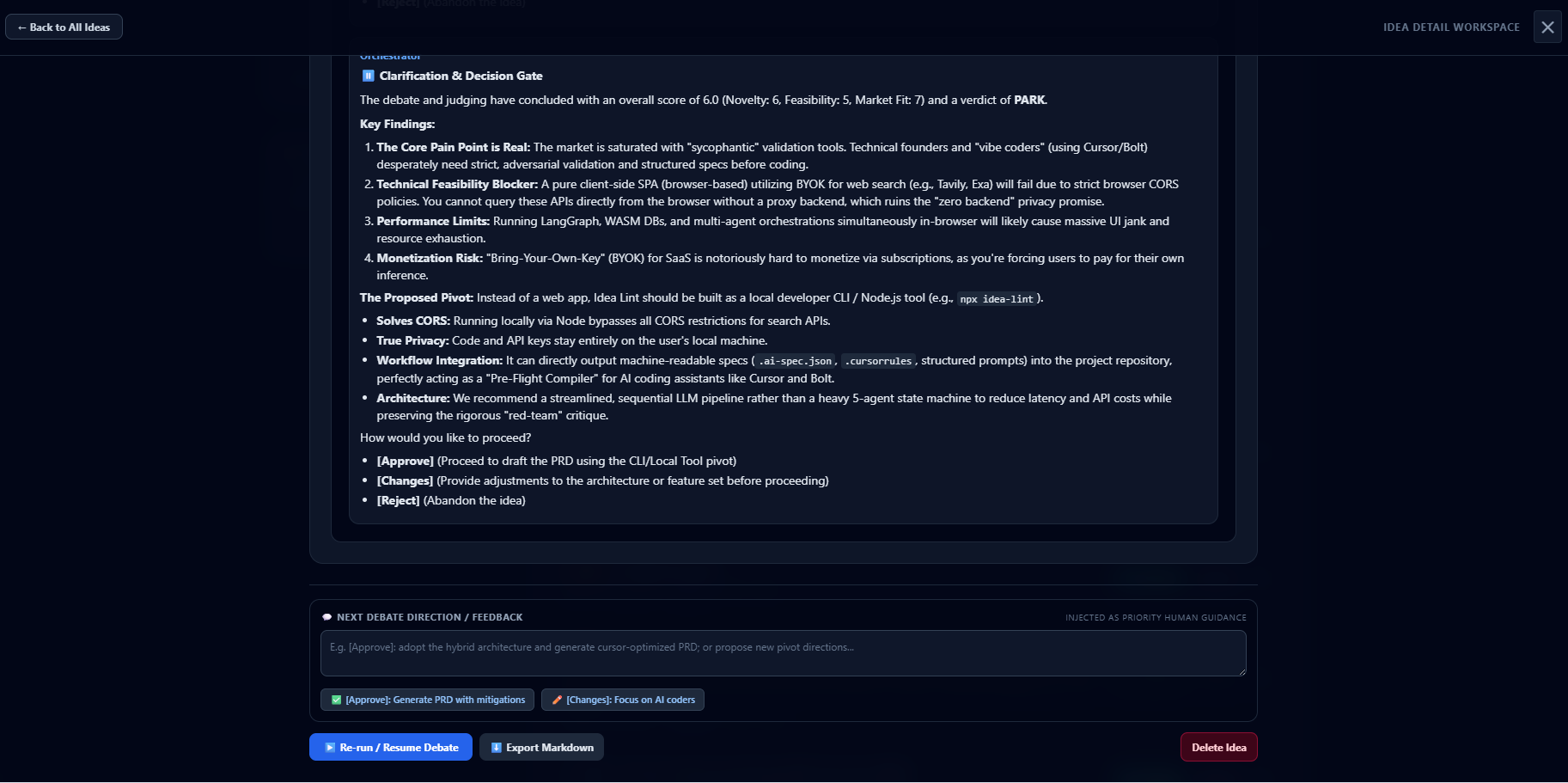
Judge): Objectively scores Novelty, Feasibility, and Market Viability (1–10) with detailed risk assessments usinggemini-3.1-pro-preview. - Human-in-the-Loop Clarification Gate: When an idea hits a roadblock or receives a
PARKverdict, the orchestrator (gemini-3.1-pro-preview) durably pauses to let the founder steer or approve pivots. - PRD & Security Synthesis (
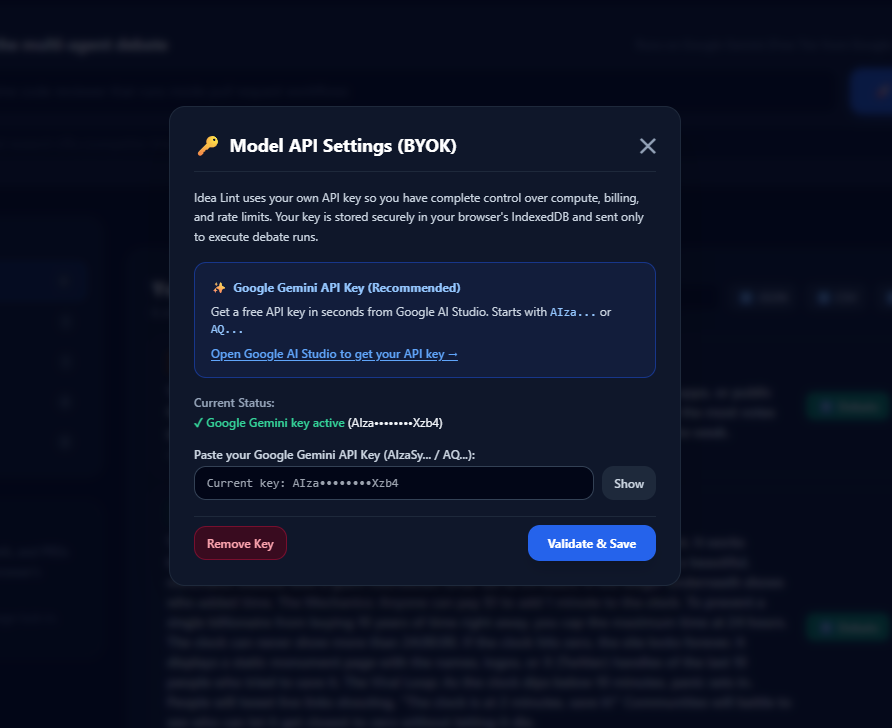
PRD Writer&Security Auditor): Produces an exhaustive Product Requirements Document audited for technical gaps and compliance risks usinggemini-3.1-pro-preview. - Client-Side Privacy (Zero-Trust BYOK): Ideas and API keys stay exclusively in your browser's IndexedDB. The backend is completely stateless and ephemeral.
🛠️ How We Built It
- Vibe Coding with Antigravity & Pi Agent: The entire application was engineered using Google Antigravity paired with a detached Pi agent workflow, enabling rapid, test-driven iterations.
- Agent Framework: Built natively on Google ADK (Agent Development Kit Python) using
LlmAgent,Runner,FunctionTool, andgoogle_search. - LLM Models: We use Google's latest Gemini 3 models, configured per agent role in
config.json:gemini-3.7-flash: Powers the Researcher (with real-time Google Search grounding), Advocate, and Creative Ideator for fast, cost-effective reasoning.gemini-3.1-pro-preview: Powers the Critic, Judge, PRD Writer, Security Auditor, and Orchestrator for deep analytical evaluation and structured synthesis.
- Stateless Backend: Asynchronous FastAPI service running in-memory ephemeral debate lifecycles with strict BYOK key-scrubbing.
- Local-First Frontend: Pure TypeScript SPA (bundled with esbuild) featuring live status polling, interactive decision gates, and local IndexedDB persistence with JSON/CSV/PDF export.
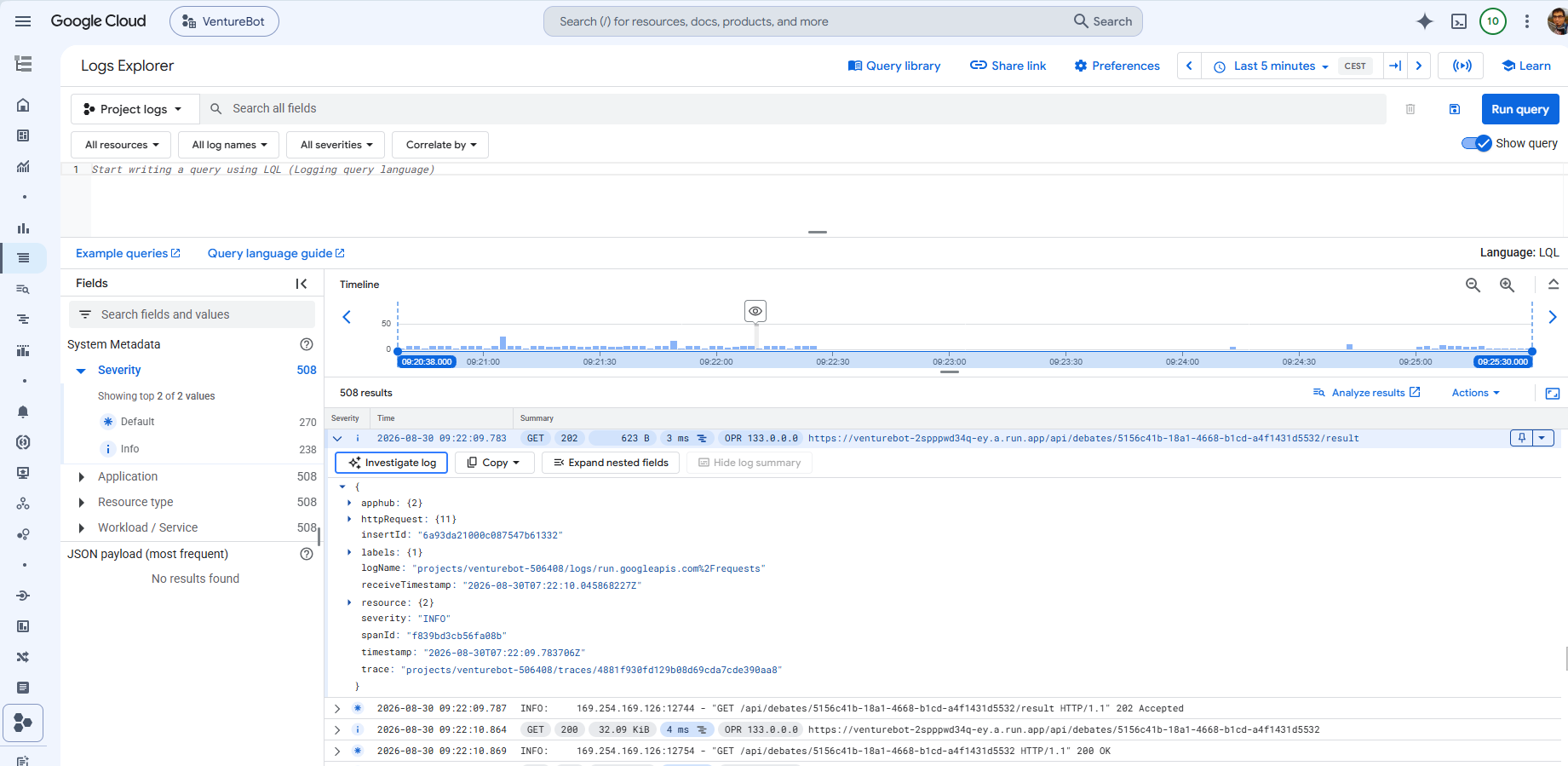
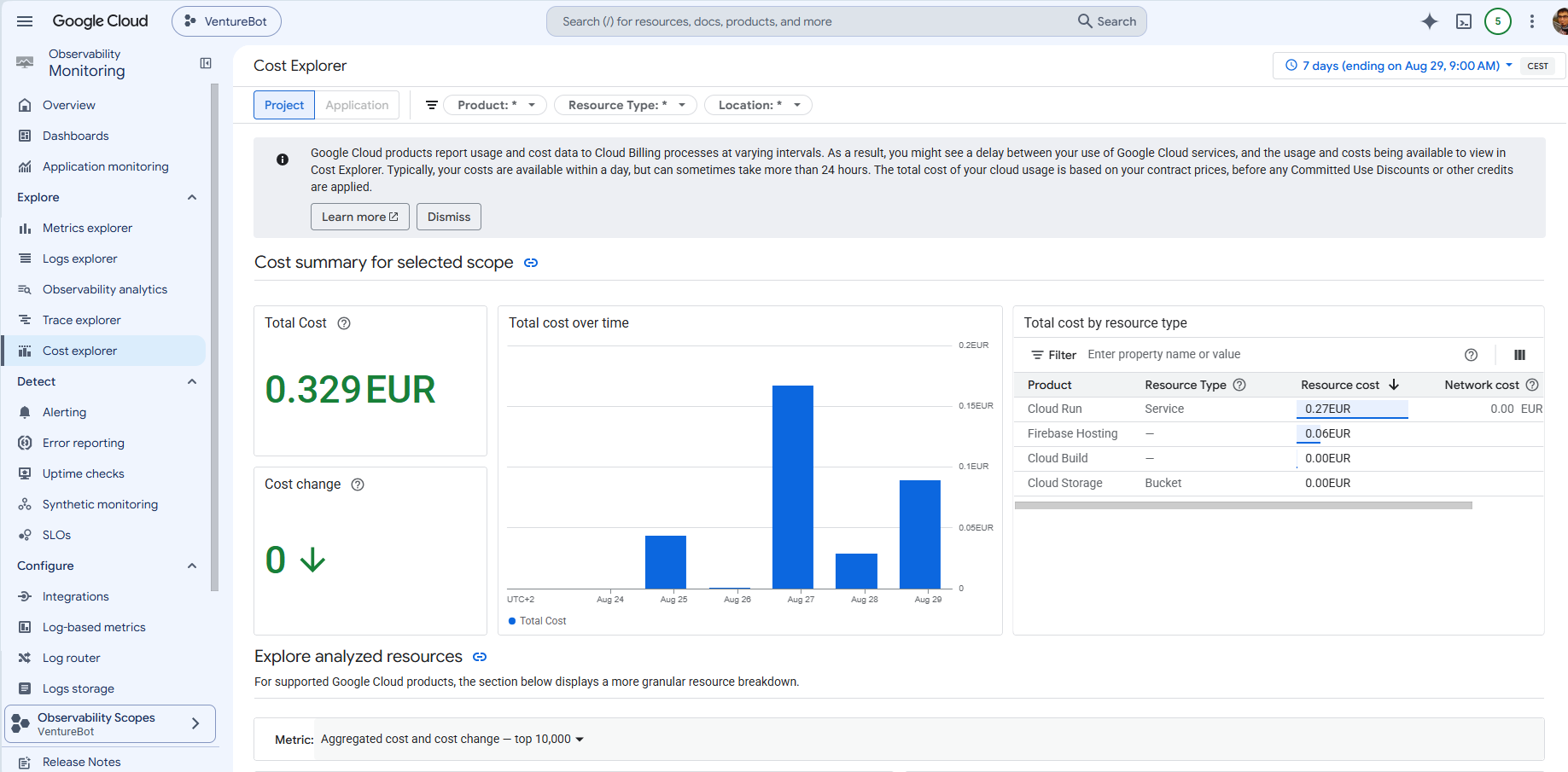
- Infrastructure: Automated container builds and deployment to Google Cloud Run via GitHub Actions CI/CD with custom domain routing via Firebase Hosting (
https://idea-lint.my).
⚡ Challenges We Ran Into & Architectural Pivots
1. From Self-Improving Server to Cloud Reality:
My first local proof-of-concept had a huge scope—a stateful, self-improving server inspired by ADK long-horizon samples. While it worked locally, deploying it via the GCP Console UI proved time-consuming and error-prone. Transitioning to automated gcloud deployment scripts helped, but hitting early API rate limits forced a disciplined rethink of the architecture.
2. The Authentication Rabbit Hole & The Zero-Trust Pivot: I initially built a traditional multi-user system with Google OAuth login. It worked locally and on my VPS, but configuring OAuth consent screens, redirect URIs, and credentials across multiple Cloud Run environments became a huge friction point under the deadline.
The breakthrough decision: I scrapped the complex auth layer entirely and pivoted to a Local-First, Zero-Trust Architecture. Instead of storing user accounts and private startup ideas on a central server database, users Bring Their Own Key (BYOK). Ideas and history are saved strictly in the browser's IndexedDB, and the backend remains 100% stateless. This made the app faster, infinitely more private for founders, and immune to server-side credential leaks.
3. Domain, CDN Proxies, and the Frontend Polling Architecture:
Securing the domain idea-lint.my and pointing it to Cloud Run required routing through Firebase Hosting. However, Firebase Hosting's CDN proxy does not support long-lived SSE streaming (returning 503s). To make the system rock-solid across any CDN or mobile network, I rewrote the frontend into a pure TypeScript polling client that reliably streams each agent turn live.
🏆 Accomplishments That We're Proud Of
- Turning a Failed Idea into a Working Product: Converting a stalled hackathon concept into a meta-tool that prevents the exact trap I fell into.
- 100% Privacy-Preserving Architecture: A zero-trust startup validator where founders can pressure-test sensitive, unreleased ideas without worrying about their IP being saved in a database.
- Autonomous 7-Agent Coordination: Building an ADK multi-agent debate mesh that produces genuinely insightful, adversarial market and technical critiques in under 3 minutes.
- Robust Test Harness: Backed by 159 passing automated tests ensuring API contract fidelity, security headers, and rate-limit guardrails.
📚 What We Learned
- Validate before you build: The harness and rapid feasibility checks matter more than spending days deep in the weeds of unvalidated code.
- Stateless + Local-First wins: For AI tools dealing with sensitive user IP, a stateless server + client-side IndexedDB with BYOK is vastly superior to traditional heavy databases and auth setups.
- Google ADK's modularity: ADK’s clean separation of
LlmAgent, tools, and session runners made coordinating 7 distinct agent personas intuitive and maintainable.
🔮 What's Next for Idea Lint
- One-Click Scaffold Generator: Clicking "Build Prototype" to scaffold starter code directly from the audited PRD.
- Multi-Modal Flowcharts: Using Gemini Imagen to generate conceptual UI mockups and user journey diagrams inside the exported PRD.
- Custom Model Selection: Allowing founders to configure custom model pairs (e.g. testing
gemini-3.7-flashvsgemini-3.1-pro-previewacross different judging criteria) to benchmark evaluation perspectives.
Built With
- docker
- esbuild
- fastapi
- firebase
- gemini-3.7-flash
- github-actions
- google-adk
- google-ai-studio
- google-cloud-run
- google-gemini
- indexeddb
- python
- typescript

Log in or sign up for Devpost to join the conversation.