

Inspiration
Every hackathon starts the same way: staring at a blank page, waiting for an idea. But great products rarely come from nowhere — they come from collisions: Uber × logistics, Tinder × dog owners, Duolingo × streaks. We wanted to build a machine for collisions — one that takes two unrelated domains, slams them together at an interesting angle, and forces out something buildable. Not a random word generator. A cross-pollination engine that treats ideation like a lab experiment.
What it does
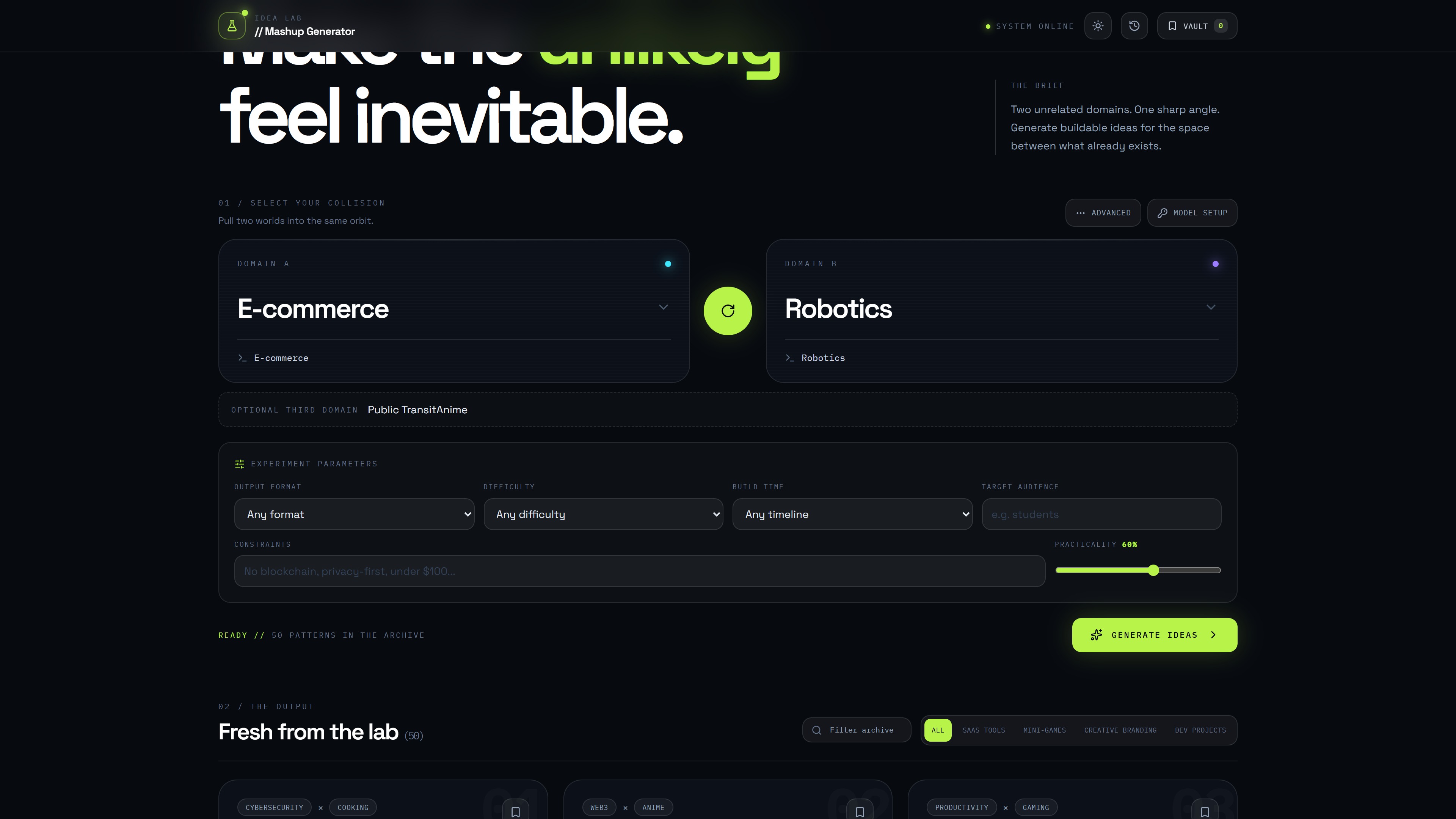
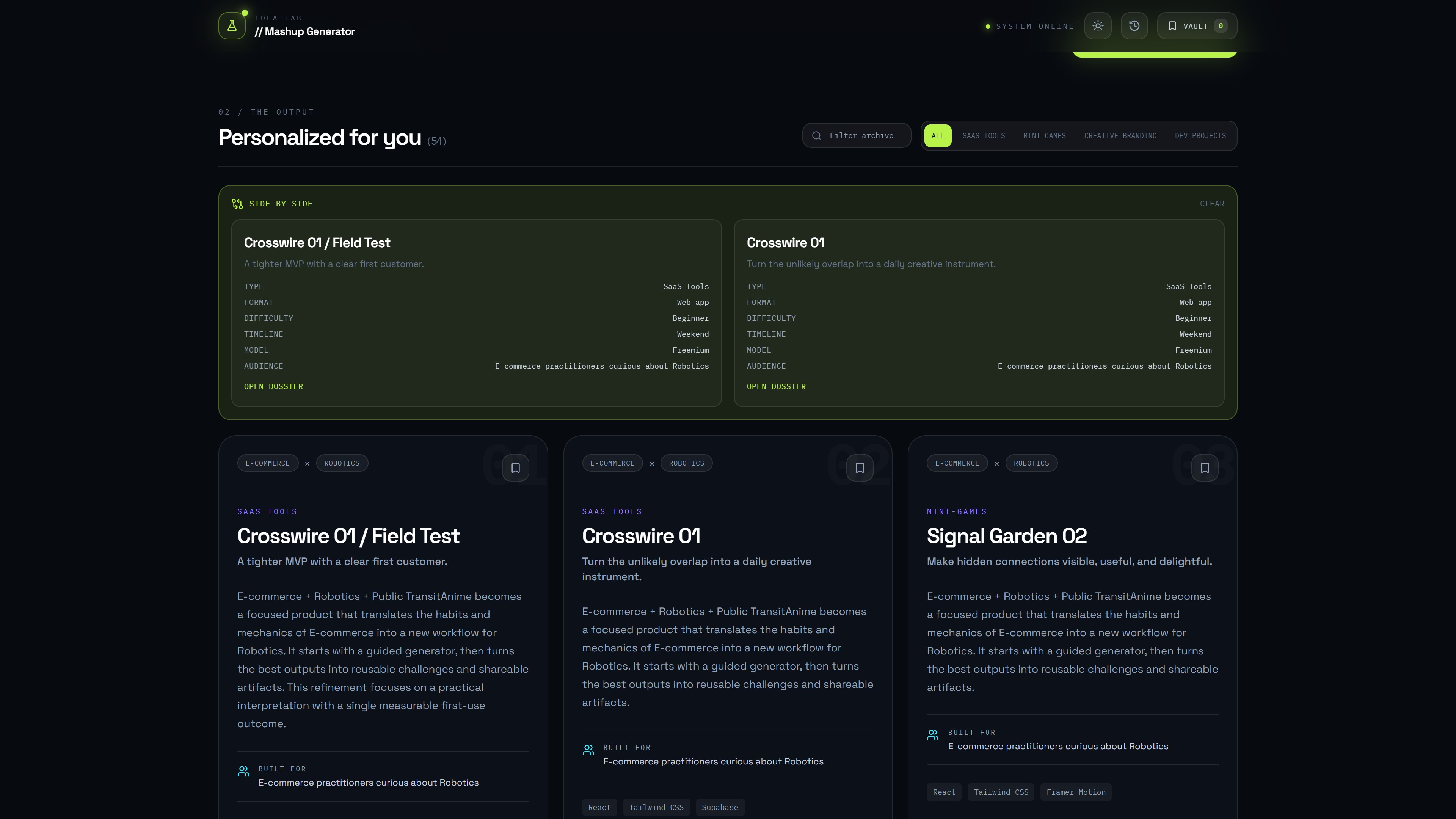
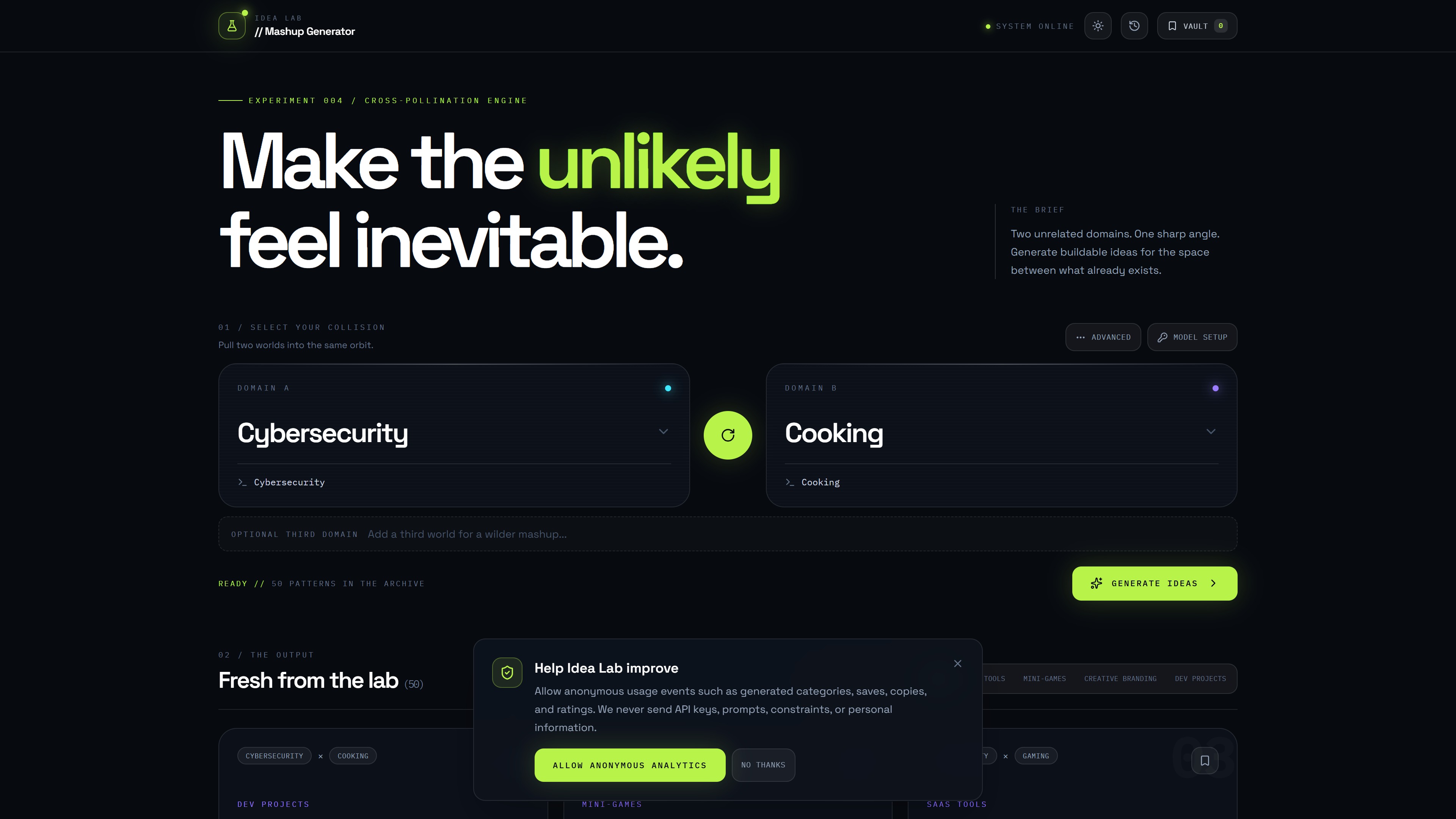
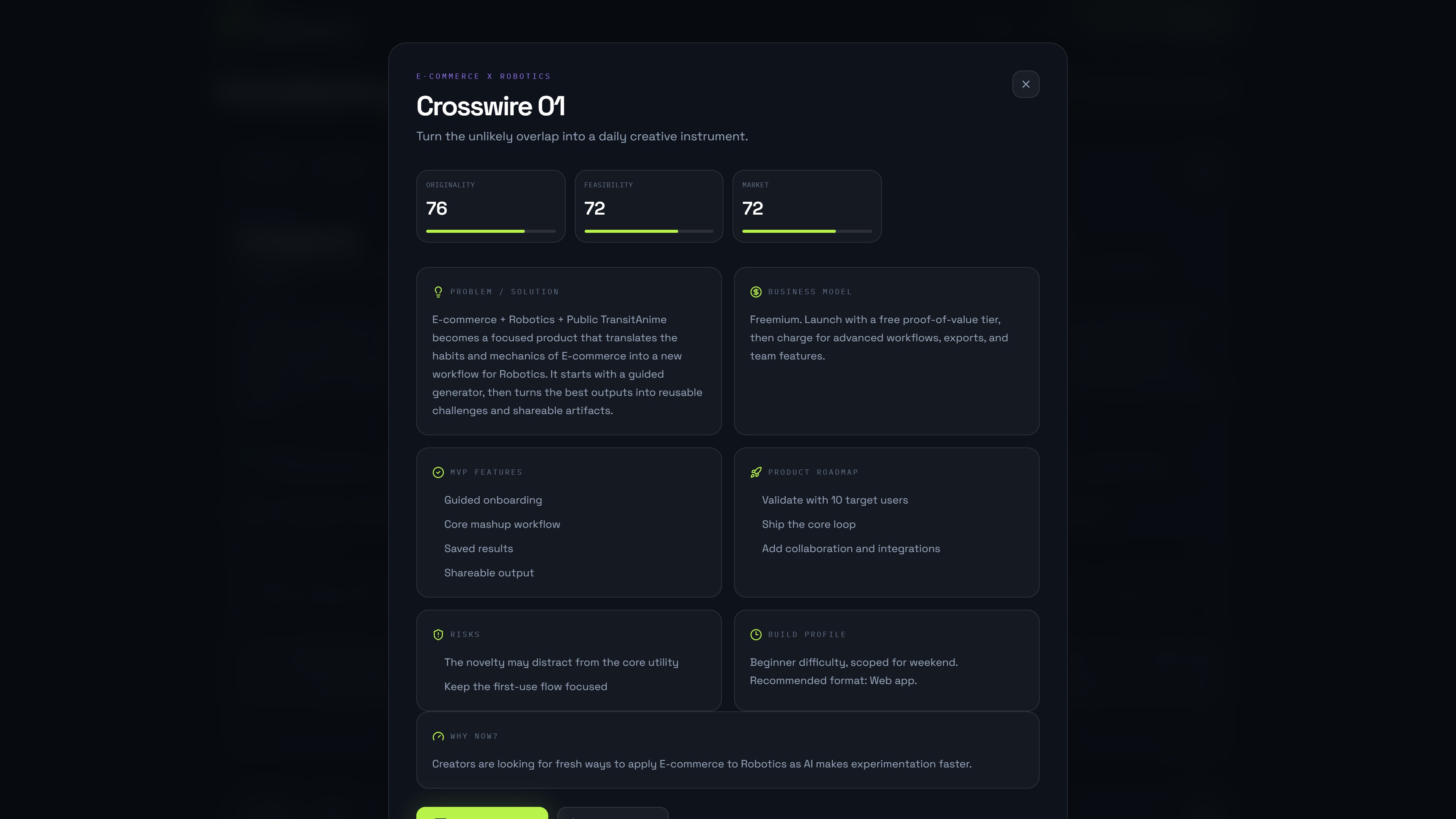
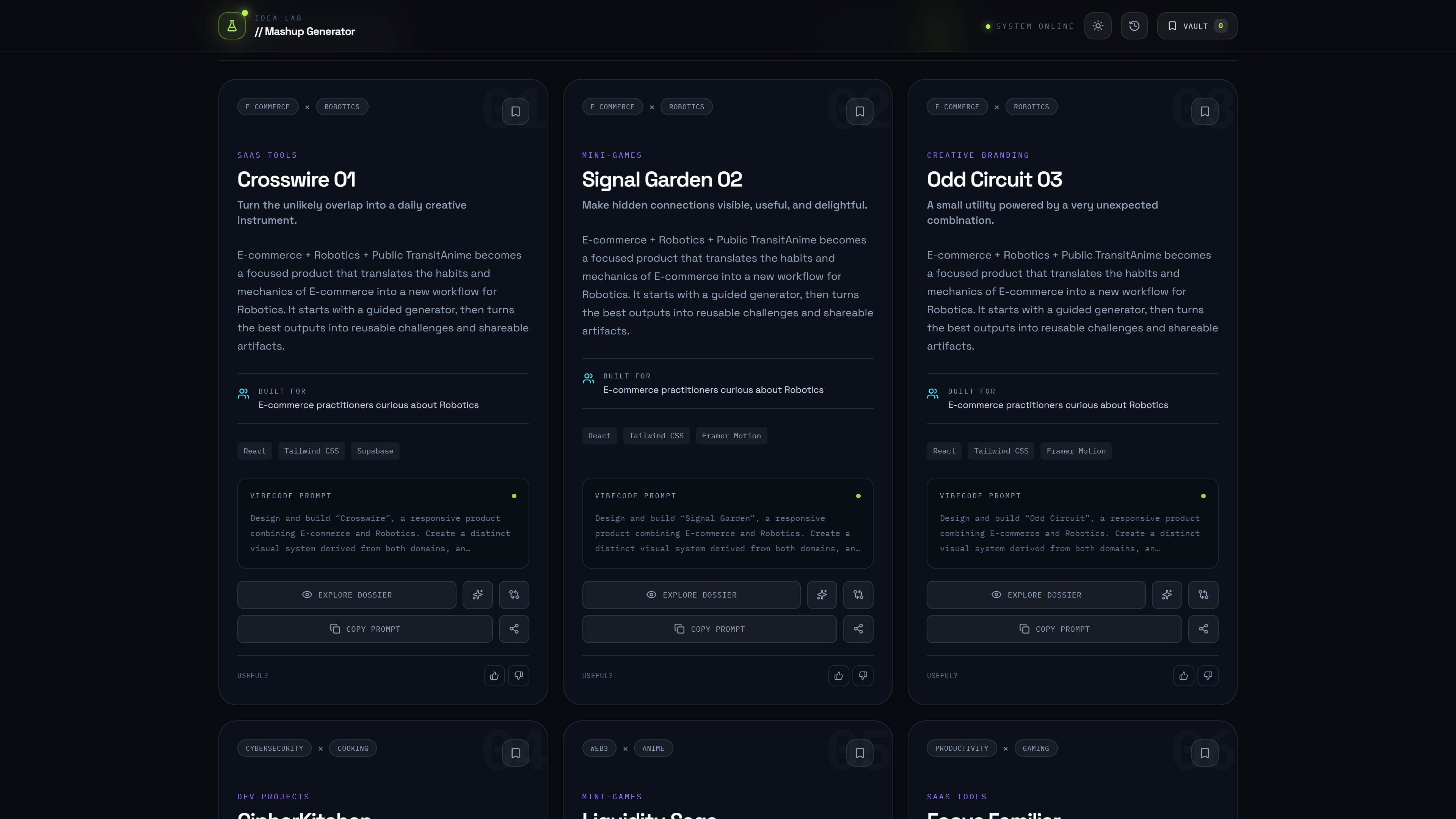
Pick (or spin) two domains from an archive of 31 — say Cybersecurity × Cooking — and Idea Lab generates three fully-developed product concepts for the collision. Each concept ships with:
- a dossier: scores, problem statement, target users, MVP, roadmap, and risks
- a build-ready "vibecode" prompt — one click copies it straight to your clipboard
- remix tools (make it more practical), a 50-pattern archive, and optional third-domain chaos mode
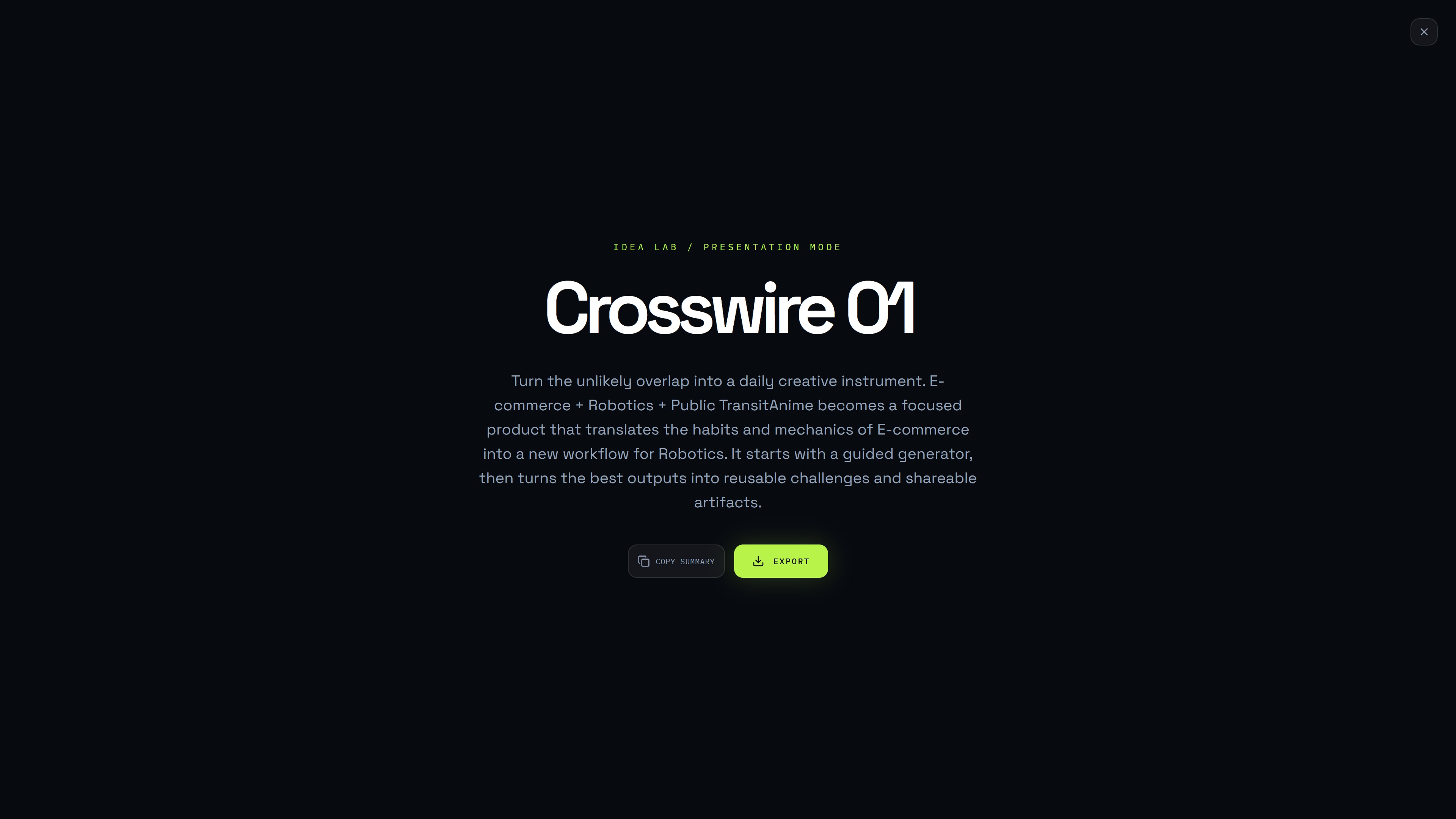
- presentation mode, side-by-side comparison, and a local vault with folders and session history
The math behind the playground:
$$\binom{31}{2} = 465 \text{ two-domain collisions} \quad\Rightarrow\quad 465 \times 3 = 1{,}395 \text{ fully-developed concepts}$$
Add a third domain and the space explodes:
$$\binom{31}{3} = 4{,}495 \text{ collisions} \quad\Rightarrow\quad 13{,}485+ \text{ concepts, before pattern remixing}$$
How we built it
Zero backend. Everything runs in your browser.
- Frontend: React + Vite, Tailwind CSS, and Framer Motion for the lab-instrument feel (spring physics, layout animations, light/dark themes)
- Generation, two ways:
- Offline engine (default): a procedural composition engine over 31 domains × 50 remix patterns — idea generation runs fully offline, nothing leaves your browser
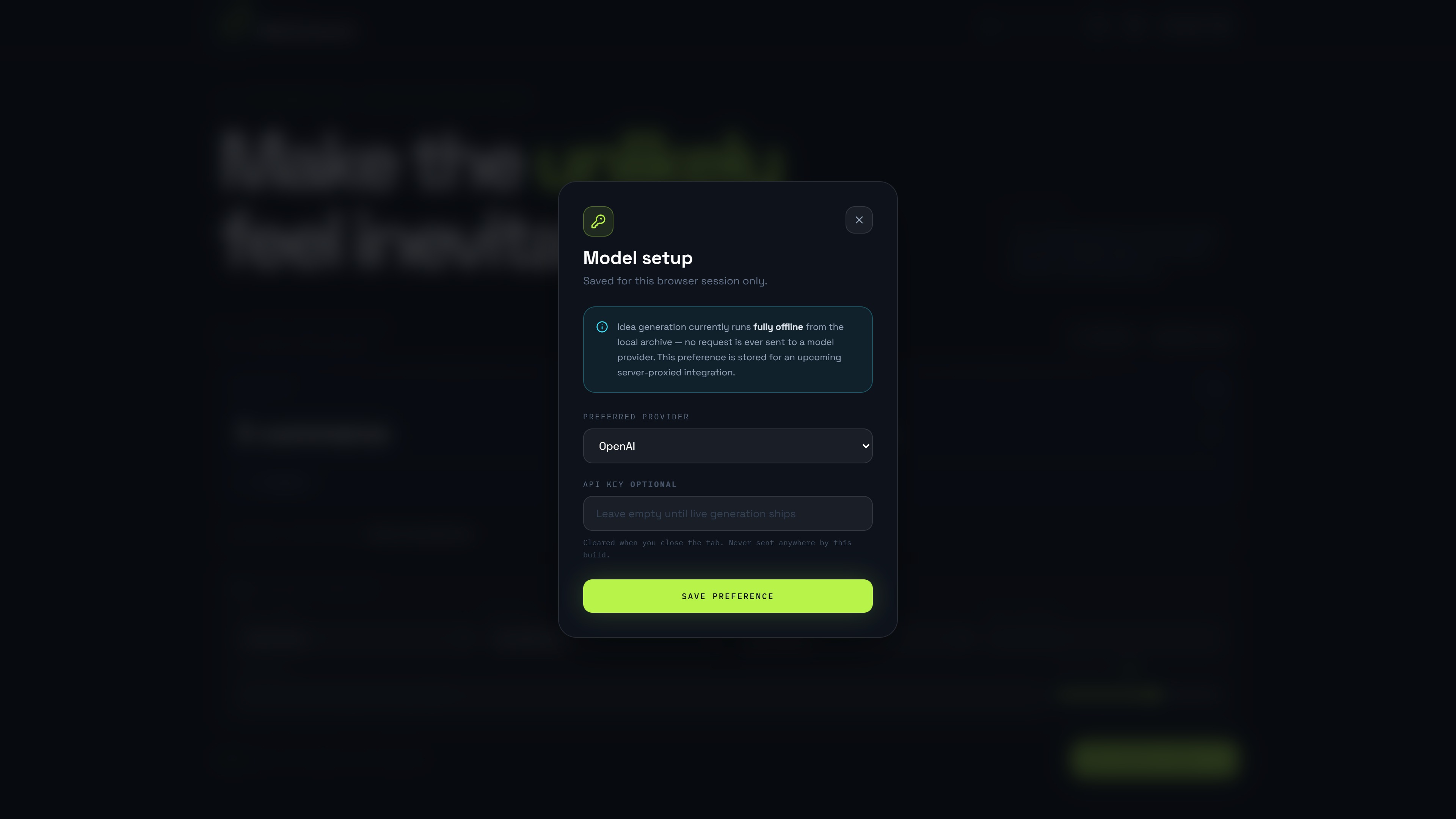
- Bring-your-own-model: plug in your own OpenAI, Anthropic, or Gemini key for LLM-powered blueprints. Keys live in
sessionStorageonly, calls go browser-direct, and structured JSON output is enforced per-provider (OpenAIresponse_format, GeminiresponseMimeType, Anthropic system-prompt contracts)
- Persistence: local-first — vault, folders, and session log live in browser storage, with Markdown and JSON export. Analytics are anonymous and strictly opt-in.
Challenges we ran into
- Structured output across three LLM providers. Every vendor handles JSON differently. We built a provider abstraction with per-provider request formats and defensive parsing, so a malformed response never crashes the lab.
- Offline generation that doesn't feel like a slot machine. Procedural templates easily produce word salad. Curating the 50-pattern archive — each pattern a sharp angle, not a mad-lib — was more editorial work than engineering.
- Shipping the demo honestly. Our demo film is 100% real footage captured from the live app with headless Chrome — including a clipboard shim just to capture the genuine "Copied!" state — graded to strict black & white with an ffmpeg pipeline that mathematically guarantees chroma neutrality.
Accomplishments that we're proud of
- A real ideation tool, not a toy: every idea is actionable within minutes of copying its prompt
- Full-featured local-first product: vault, folders, history, export, privacy consent — all client-side
- An 85-second demo film where every frame is a real screen of the live app
What we learned
- BYO-key, browser-direct AI is viable: no server, no proxies, no stored secrets — users keep custody of their own keys
- Constraint breeds quality: fixing the output schema (scores, MVP, risks) is what turns LLM rambling into a dossier
- Randomness is cheap; the archive is the product. The 50 patterns do more work than the model does
What's next for Idea Lab
- Shared collision links for team ideation
- Community-submitted domains and patterns
- One-click handoff from vibecode prompt → scaffolded repo
Built to make weird useful.
Built With
- anthropic-api
- byok
- framer-motion
- gemini-api
- javascript
- local-first
- localstorage
- lucide-react
- offline-first
- openai-api
- procedural-generation
- prompt-engineering
- react
- structured-output
- tailwindcss
- vite
