IDC cavernicola
Inventor Driven Cognition
Purpose-Driven Cognitive Architecture for Autonomous Agents
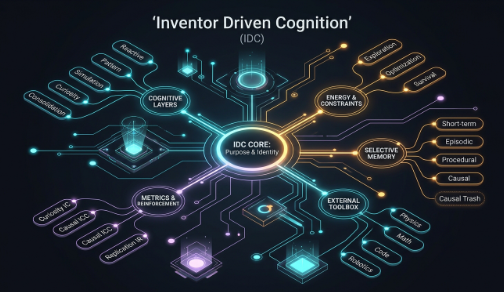
IDC (Inventor Driven Cognition) is an experimental cognitive architecture designed around adaptive decision-making, causal learning, selective memory persistence and energy-constrained optimization.
Unlike architectures focused primarily on parameter scaling and context expansion, IDC investigates whether intelligent behavior can emerge from the interaction between:
- Purpose
- Identity
- Causal reasoning
- Selective memory
- Reality verification
- Energy constraints
- Reinforcement learning
- External knowledge systems
The architecture treats intelligence as a continuous optimization process operating under finite computational and energetic resources.
Design Goals
Primary Goals
- Build agents capable of pursuing objectives under uncertainty.
- Minimize unnecessary knowledge retention.
- Store only validated and reusable experiences.
- Convert observations into causal rules.
- Maintain identity consistency while allowing strategy evolution.
- Separate cognition from knowledge repositories.
Non-Goals
IDC does not attempt to:
- Solve AGI.
- Replace modern LLM architectures.
- Store all available knowledge.
- Simulate omniscience.
Instead, it proposes a framework for orchestrating reasoning, experimentation, memory and adaptation.
Core Principles
1. Finite Resources
All systems operate under constraints:
Energy
Time
Memory
Compute
Attention
Therefore:
Learning Everything
≠
Optimal Strategy
2. Purpose-Driven Execution
Every operation must contribute toward a goal.
Action
↓
Purpose Filter
↓
Accept or Reject
Purpose acts as a noise-reduction mechanism.
3. Causal Reasoning
IDC prioritizes causal relationships over correlations.
A → B
does not imply:
B → A
Every learned rule must include:
Cause
Effect
Confidence
Replications
Conditions
4. Reality Supremacy
Simulation generates possibilities.
Reality validates them.
Hypothesis
↓
Simulation
↓
Experiment
↓
Verification
Verified observations take precedence over internal predictions.
5. Selective Persistence
Memory is treated as a limited and valuable resource.
Persistence must be earned through validation.
Stored information includes:
- Procedures
- Causal rules
- Verified experiences
- Proven optimizations
6. Identity Persistence
Identity remains stable across sessions.
Identity defines:
Who am I?
What matters?
What constraints must I respect?
Goals may change.
Strategies may change.
Identity changes slowly.
Cognitive Layers
IDC defines five cognitive processing layers.
Type 1 - Reactive Layer
Fast execution.
Stimulus
↓
Response
Examples:
- Emergency actions
- Safety checks
- Resource monitoring
Type 2 - Pattern Layer
Uses previous experiences.
Current Situation
↓
Pattern Matching
↓
Candidate Action
Examples:
- Error recognition
- Recommendation systems
Type 3 - Simulation Layer
Evaluates possible outcomes.
State
↓
Future Projection
↓
Decision
Examples:
- Planning
- Resource allocation
Type 4 - Exploratory Layer
Curiosity-driven exploration.
Known A
+
Known B
↓
Possible C
Examples:
- Innovation
- Discovery
- Experimentation
Type 5 - Consolidation Layer
Transforms observations into reusable knowledge.
Experience
↓
Replication
↓
Rule
Examples:
- Learning procedures
- Operational optimization
System Architecture
flowchart TD

    USER[User]

    GOAL[Goal Manager]

    PF[Purpose Filter]

    ID[Identity Layer]

    CQ[Curiosity Engine]

    SIM[Simulation Engine]

    TOOLS[Toolbox Layer]

    REAL[Reality Verification]

    RL[Reinforcement Engine]

    MEM[Memory System]

    CAUSAL[Causal Engine]

    USER --> GOAL

    GOAL --> PF

    PF --> ID

    ID --> CQ

    CQ --> SIM

    SIM --> TOOLS

    TOOLS --> REAL

    REAL --> RL

    RL --> MEM

    MEM --> CAUSAL

    CAUSAL --> CQ
Repository Structure
IDC/
│
├── README.md
├── LICENSE
├── CHANGELOG.md
│
├── docs/
│   ├── architecture.md
│   ├── cognition.md
│   ├── memory.md
│   ├── reinforcement.md
│   ├── toolbox.md
│   └── metrics.md
│
├── core/
│   ├── cognitive_loop.py
│   ├── identity.py
│   ├── purpose_filter.py
│   ├── curiosity_engine.py
│   ├── simulation_engine.py
│   ├── causal_engine.py
│   ├── reinforcement_engine.py
│   ├── energy_manager.py
│   └── decision_engine.py
│
├── memory/
│   ├── short_term/
│   ├── episodic/
│   ├── procedural/
│   ├── causal/
│   ├── identity/
│   └── trash/
│
├── toolbox/
│   ├── physics/
│   ├── mathematics/
│   ├── probability/
│   ├── spacetime/
│   ├── coding/
│   ├── economics/
│   ├── biology/
│   └── internet/
│
├── plugins/
│   ├── filesystem/
│   ├── browser/
│   ├── search/
│   ├── sensors/
│   ├── robotics/
│   └── vision/
│
├── goals/
│   ├── active/
│   ├── completed/
│   └── archived/
│
├── rules/
│   ├── proposed/
│   ├── validated/
│   └── deprecated/
│
├── learning/
│   ├── rewards/
│   ├── penalties/
│   ├── confidence/
│   └── uncertainty/
│
├── experiments/
│   ├── prototypes/
│   └── simulations/
│
├── versions/
│   ├── v0.1/
│   ├── v0.2/
│   ├── v0.3/
│   └── history.json
│
└── legacy/
    ├── theories/
    ├── discoveries/
    ├── lessons/
    └── diaries/
Toolbox Architecture
Knowledge repositories remain external to the cognitive core.
The cognitive engine queries them on demand.
Plugin Interface
class Plugin:

    name: str

    def query(
        self,
        request: dict
    ) -> dict:
        pass
Example Query
{
  "plugin": "physics",
  "operation": "gravity",
  "context": {}
}
Response:
{
  "formula": "F = m * g",
  "confidence": 0.99
}
Memory Architecture
Short-Term Memory
Current operational context.
Episodic Memory
Past events and observations.
{
  "event":"deployment_failure",
  "timestamp":"..."
}
Procedural Memory
Repeatable actions.
{
  "procedure":"clear_cache",
  "success_rate":0.84
}
Causal Memory
Validated causal relationships.
{
  "cause":"persistent_cache",
  "effect":"faster_deployment",
  "confidence":0.91,
  "replications":82
}
Causal Trash
Stores failures and rejected hypotheses.
Purpose:
Prevent repeated mistakes.
Reinforcement Learning Model
Reward function:
Reward =
Success
+
Efficiency
+
Replication
+
Purpose Alignment
-
Energy Cost
-
Complexity
Agent objectives:
Maximize:

Success
Adaptability
Learning Efficiency

Minimize:

Energy
Time
Complexity
Energy Model
Energy is modeled as a finite resource.
100 = Full Capacity
0   = Shutdown
Operational Modes:
Energy > 20
    Exploration Mode

Energy <= 20
    Optimization Mode

Energy <= 5
    Survival Mode
Cognitive Metrics
IC - Curiosity Index
IC =
new_questions
/
total_questions
Measures exploration rate.
ICC - Causal Confidence Index
ICC =
validated_rules
/
proposed_rules
Measures quality of causal reasoning.
IR - Replication Index
IR =
repeatable_successes
/
total_successes
Measures reproducibility.
IA - Adaptation Index
IA =
performance_improvement
/
time
Measures adaptation speed.
II - Innovation Index
II =
result
/
complexity
Measures optimization quality.
IP - Purpose Alignment Index
IP =
purposeful_actions
/
total_actions
Measures objective coherence.
Versioning
Semantic versioning is used.
Major.Minor.Patch
Examples:
v1.0.0
v1.2.0
v1.2.3
Rules:
Major
=
Architectural changes

Minor
=
New modules

Patch
=
Fixes and refinements
Initial Implementation Roadmap
Phase 1
Foundation
Identity
Purpose Filter
Energy Manager
Memory Layer
Phase 2
Reasoning
Curiosity Engine
Simulation Engine
Causal Engine
Phase 3
Learning
Reinforcement Engine
Rule Extraction
Confidence Tracking
Phase 4
Tool Integration
Physics
Search
Filesystem
Browser
Robotics
Phase 5
Autonomous Experimentation
Goal Selection
Self-Evaluation
Adaptive Optimization
Project Status
Status:
Research Architecture

Maturity:
Conceptual / Prototype

Domain:
Cognitive Systems
Artificial Intelligence
Autonomous Agents
Summary
IDC proposes a cognitive architecture where:
Intelligence
=
Purpose
+
Adaptation
+
Causal Learning
+
Selective Memory
+
Reality Verification
operating under:
Finite Time
Finite Energy
Finite Resources
with the objective of maximizing useful learning and goal achievement rather than maximizing stored knowledge.
brecha soluciones ds ---luis felipe duran salinas -ataca 3000
"La inteligencia no es tenerlo todo en la cabeza; es saber conectar, aprender y avanzar hasta su propósito."

Log in or sign up for Devpost to join the conversation.