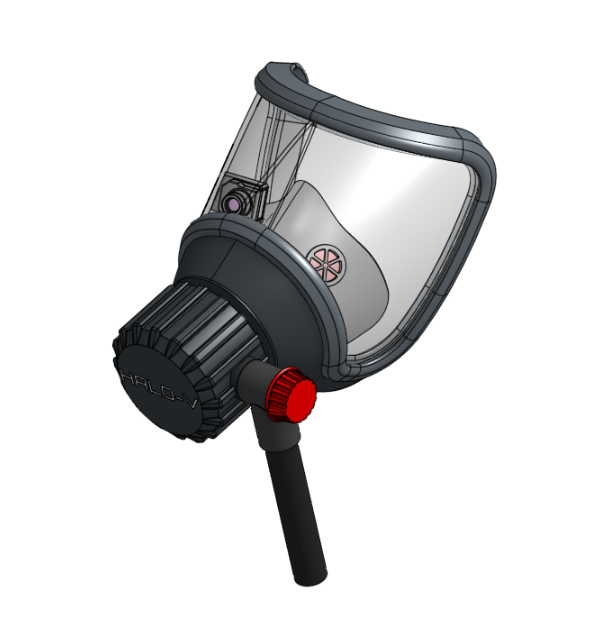
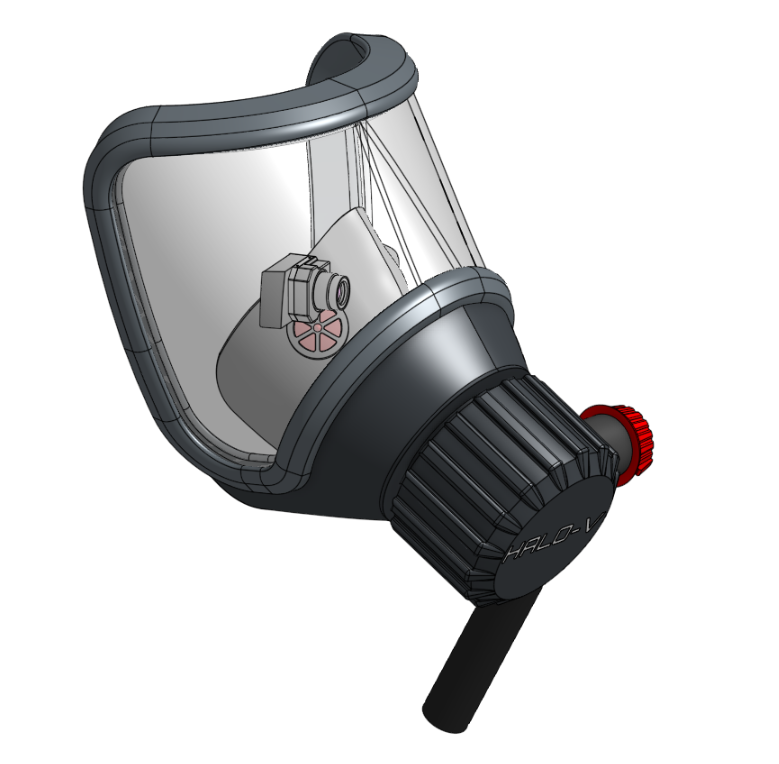
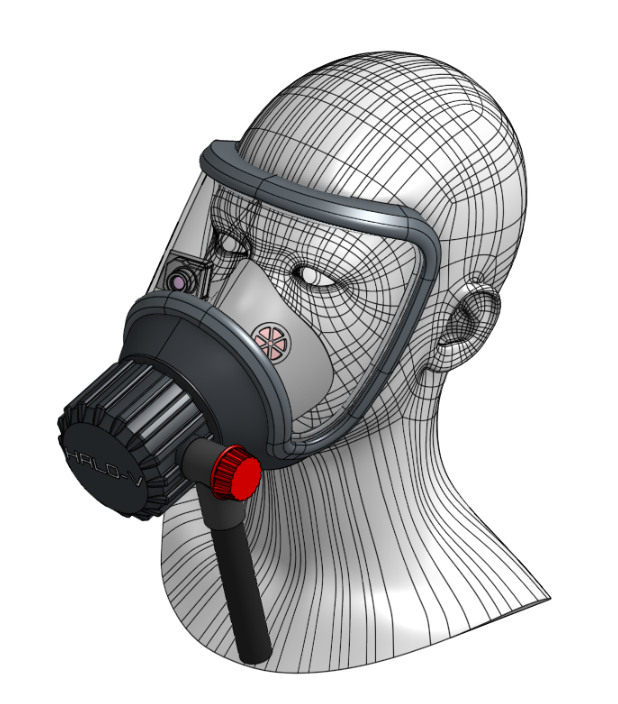
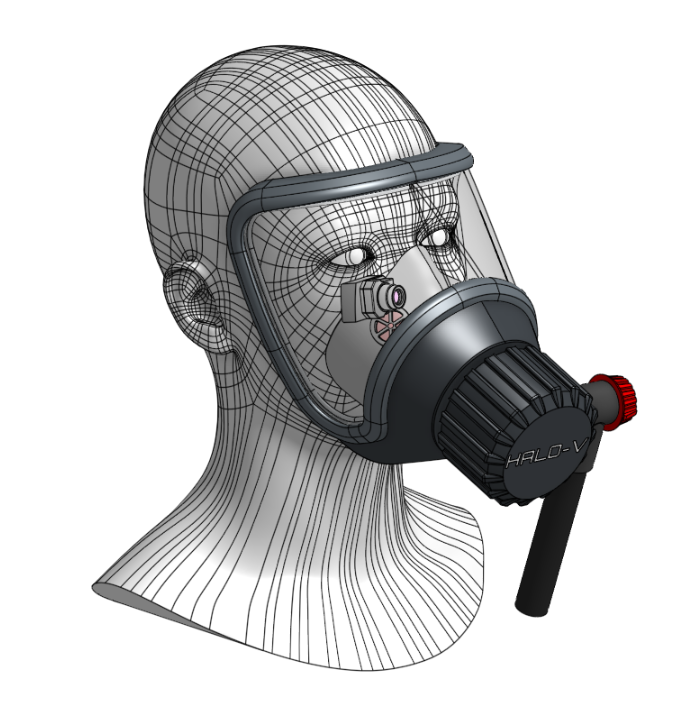
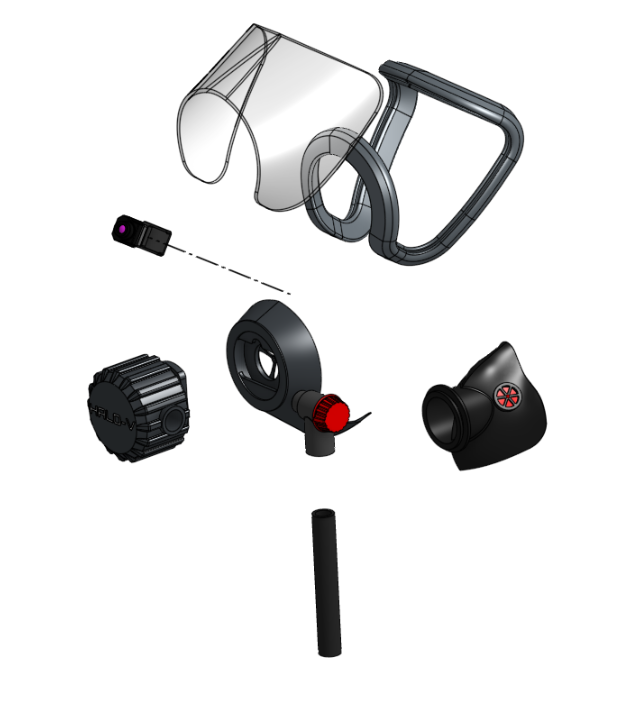
Cad Models
Introduction
Firefighters face life-threatening conditions daily, often working in high-risk, smoke-filled environments where visibility is severely compromised. Thermal Imaging Cameras (TICs) are essential tools that leverage infrared technology to detect heat signatures, allowing firefighters to locate victims, identify fire sources, identify exits, and navigate safely.
While TICs have revolutionized rescue operations, limitations persist. Moisture, debris, and particulates often obscure handheld TIC lenses, especially when water is actively deployed, leading to a washed-out gray/white image. Furthermore, firefighters frequently neglect to clean the lens, which can render the TIC nearly useless in critical moments, increasing the risk of missing trapped occupants due to the obscured TICs
To address these challenges, we propose HALO-V, a modular TIC system integrated into the self-contained breathing apparatus (SCBA) visor with an integrated Heads Up Display (HUD), allowing hands-free operation. HALO-V is designed in compliance with National Fire Protection Association (NFPA) standards, particularly the 1801 NFPA Standard: at least 120 minutes of battery life from a single charge, 50,000-cycle service life, standardized controls with manual override, high resolution, and resistance to harsh environments. It is our utmost responsibility to meet standards to ensure the safety of the fire fighters while using our products while giving them the benefit of enhanced mobility and worry free experience when they are in high-stress environments.
Problem: Traditional handheld TICs are vulnerable to obfuscation due to the exposure of the lens out in the harsh environment, causing them to be ineffective in showcasing highly detailed temperature variations. TICs are considered as another essential tool the fire fighters are required to keep track of, losing its effect be detrimental in their mission and potentially trigger major repercussions.
Solution: A fully protected TIC and real-time heads-up display (HUD) integrated into the SCBA HALO-V integrates a protected TIC and real-time heads-up display (HUD) directly into the SCBA visor, improving visibility, durability, ergonomics, and power efficiency.
Target Users & Needs
Primary Users: Frontline firefighters conducting search and rescue operations, primarily for the squads in the primary and secondary rounds of searches where the fire is ongoing.
Key Needs:
- Clear visibility in high-moisture, low-visibility conditions.
- Hands-free operation to preserve mobility.
- Reliable battery life for extended deployments.
- Intuitive interface to match muscle memory from current workflows.
What it does
Technical Design Features
- TIC Integration: Positioned inside the SCBA visor to minimize moisture interference and lens contamination.
- Heads-Up Display: Projects thermal imaging directly onto the visor for real-time situational awareness without added bulk.
- Power Efficiency: Taps into the SCBA’s existing battery infrastructure, removing the need for additional batteries.
- Controls: Simplified tactile interface with a toggle switch for power and a mode selector for toggling between NFPA-compliant basic and advanced imaging modes.
- Durability: All components housed within the SCBA to meet fire-resistance and impact requirements.
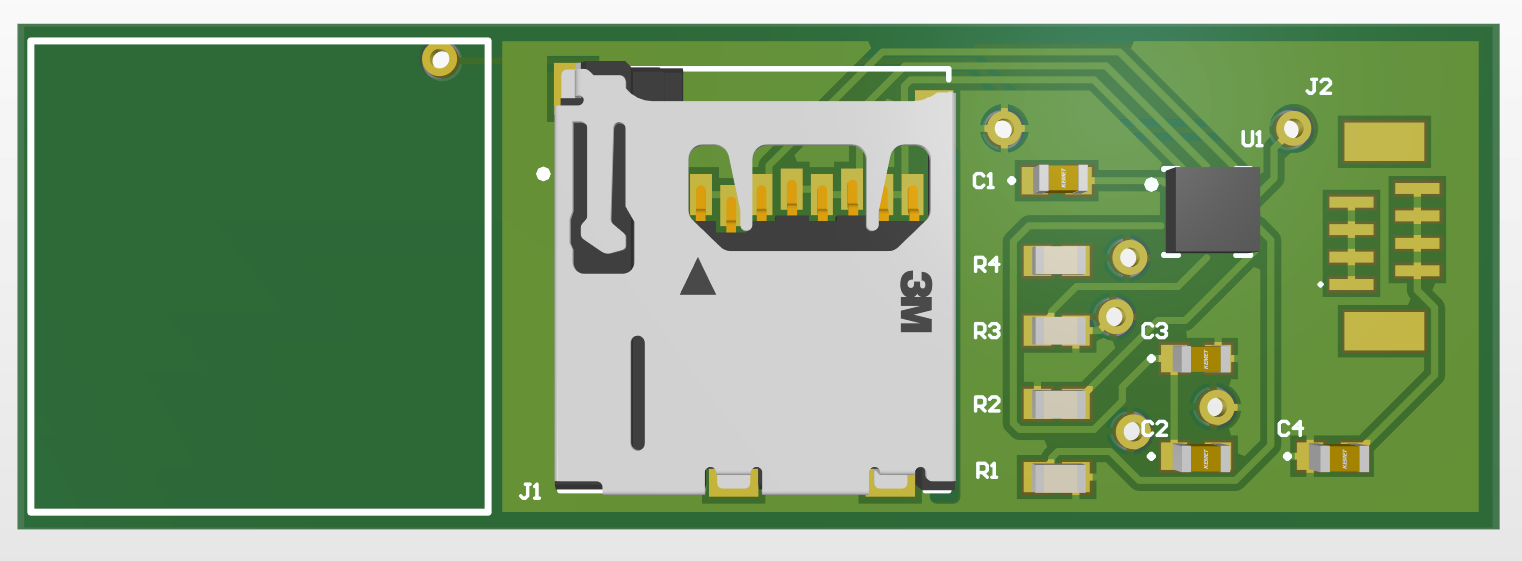
- Custom Printed Circuit Board: Two-layer PCB houses the TIC unit, SD memory storage, ribbon connector for easy connection to power and data transfer to HUD, and a microprocessor to aid in managing the overall functionality of the system.
Design Process & Iterations
We began with user-centered research, identifying the limitations of existing TICs. We sketched multiple prototypes for camera placement, power integration, and HUD projection angles. These sketches evolved into a CAD model, where we refined the ergonomics and fit. Key trade-offs included balancing HUD visibility against visual clutter and ensuring the thermal isolation of internal electronics.
Materials & Manufacturability
Materials: High-temperature polycarbonate for the visor and heat-insulated wiring to integrate into existing SCBA systems.
Manufacturability: All components are producible with current manufacturing technologies such as custom printed circuit boards and off-the-shelf infrared sensors. Integration into SCBA systems follows existing modular attachment frameworks.
Challenges we ran into
One of our challenges was optimizing the user experience of this TIC interface. Since the search process of firefighters should be intuitive and already drilled into their cognitive and muscle memory, our product should enhance their experience, and not interfere with the original workflow. Human-centered design is the ultimate goal of this project.
Accomplishments that we're proud of
Over just three days, we progressed from ideation to a CAD-modeled, fully conceptualized prototype. HALO-V demonstrates how innovation, user empathy, and design thinking can coalesce to solve real-world problems in high-risk professions.
What's next for HALO-V
AI Integration: Future HALO-V models will incorporate machine learning for victim identification under dense smoke. Dr. Chris Lu’s work in thermal-based human segmentation will inform our development.
Design Optimization: Redesign PCB to use more power-efficient SMD components and optimize layout to reduce footprint.
Training Augmentation: Use HALO-V in simulated environments to train firefighters in thermal image interpretation.
Deployment Testing: Validate the system’s durability, usability, and visibility in live-fire simulations.
Expansion: Apply this tech to robotics and augmented reality systems for remote firefighting or urban search and rescue.
Referenences
Cai, K., Xia, Q., Li, P., Stankovic, J., & Lu, C. X. (2023). Robust Human Detection under Visual Degradation via Thermal and mmWave Radar Fusion. Retrieved from arXiv.org website: https://arxiv.org/abs/2307.03623 Emergency Services Ergonomics and Wellness. (2021, February 8). Retrieved from U.S. Fire Administration website: https://www.usfa.fema.gov/a-z/health-safety-wellness/ergonomics/ch1-firefighter-injuries.html NFPA 1801 Standard Development. (2024). Retrieved from Nfpa.org website: https://www.nfpa.org/codes-and-standards/nfpa-1801-standard-development/1801 Suzuki, T., Tsuruda, T., Yamaguchi, K., Ino, Y., Honjo, M., & Miura, D. (2025). EXPERIMENTS ON USING THERMAL IMAGING CAMERA FOR FIRE FIGHTING ACTIVITY . Retrieved March 30, 2025, from Iafss.org website: https://publications.iafss.org/publications/aofst/7/114/view/aofst_7-114.pdf
Built With
- onshape

Log in or sign up for Devpost to join the conversation.