-
-
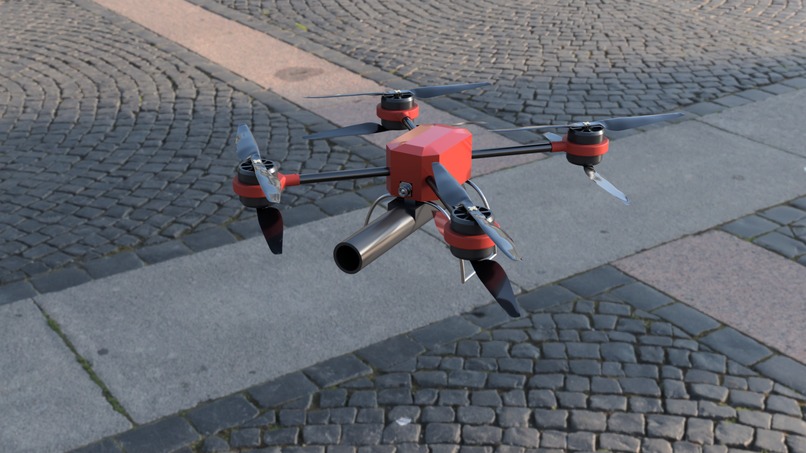
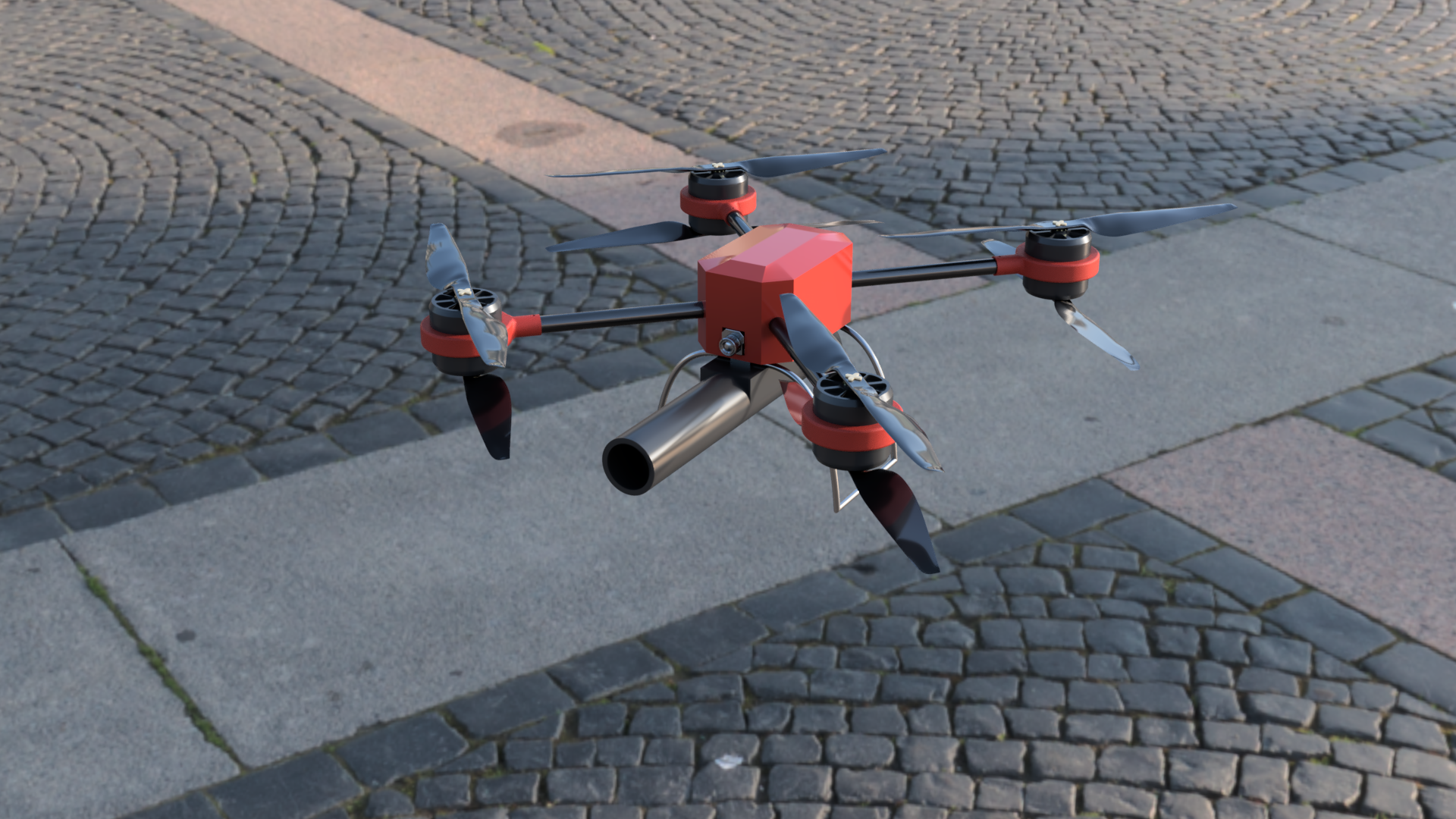
Rendering of Our Project
Inspiration
One of our main concerns was the safety of firefighters when it comes to dealing with fires that are high above ground level. For example, apartment fires in tall buildings or raging fires in buildings with limited access. We wanted to design a device that would be able to not only scope out the severity of the fire and any possible survivors, but could also actively work to put out the fire. In order for safety to be optimized you need to plan for it, and a way this can be achieved is to send in an object that could as your eyes before sending in firefighters. Not only does this increase the firefighters’ safety, by allowing them to have a gist on what they can expect, and have a device that could help fight fires alongside them, reducing stress and fatigue, but it may also help those in need of rescue on higher floors. The less time it takes to pinpoint and locate rescues, the less time they stay in the building, ensuring the health of both the rescues and firefighters. The answer and solution to this is HydroStrike.
What it does
HydroStrike is a firefighting drone with thermal imaging capabilities that is designed to combat fires in hard to reach places by channeling water through a hose system. Hydrostrike has two main systems: the drone, and the pipeline.
Drone: The drone itself is quadcopter with an X8 configuration, and coaxial contra-rotating propellers. The body of the drone has dimensions 969 * 889 * 379 mm and 28 inch propellers. The drone is designed to easily carry a payload of 60 kilograms. Embedded in the body of the drone is a thermal imaging camera (TIC) that captures real time footage of the fire and relays it back down to the fire chief.
Water Distribution System: The bottom of this hose has an adapter that connects to a standard booster line that gives it the ability to spray water as it flies. When the hose is attached to the drone, it’s attached through a J-hook, in order to control the direction of the spray in the way we position it through the drone.
How we built it
Initial design considerations: An initial design consideration was coming up with a drone blueprint that would allow us to have a drone that’s able to be flown with less experience, able to handle high amounts of payload, and have a more compact design while simultaneously exerting high amounts of force, which led us to a coaxial configuration. According to Ascent Aerosystems and TytoRobotics, the coaxial configuration benefits are that it’s compact, rugged, heavy-lift capacity, and easier to handle [1], [2]. First, with a more compact design advantage, we’re able to fit 8 motors on 4 arms. This allows us to generate more torque, for less amount of arms, which is required for carrying a hose and wanting to direct the water pressure in a direction that’s wanted. Next, we want to calculate the amount of force our drone is able to exert, and how this can equate to how many stories the drone can climb with a certain amount of payload. For example, calculating that in order to climb 8 building stories maximum, we’re able to carry around a 60 kg payload. For our water distribution system, we need a quick and easy way to attach our hose to fire hydrants or a fire engine. We also want our hose to be the same diameter across different stations in order to ensure consistency. Lastly, we want the drone to be able to be more versatile and easier to fly compared to other drones, especially in high stress and high paced environments. When wanting to direct water in a certain direction and also scope out a floor, having a drone that requires less focus on how to fly it, would increase the efficiency when using it.
Thrust Calculations: To ensure that our drone would be able to carry our desired payload of 60kg while weighing roughly 20kg, we first needed to calculate the thrust that needed to be generated. The minimum thrust required for this system to take off could be expressed as T = Drone Weight + Payload Weight = g × (60 + 20) = 80 × g T=W⋅g=80 × 9.81=784.8N The above figure is the minimum thrust needed. Generally for drones carrying payloads, a thrust to weight ratio of around 1.5. This puts our necessary at around 1569.6 newtons Trecommended=1.5 × 784.8=~1177.2N When two propellers are coaxial contra-rotating, the bottom propeller is typically less efficient due to the turbulent air generated by the top propeller. In our research, this efficiency ranges from 70% - 90%. Our team decided to use 0.7 as the coaxial efficiency factor in our calculations in order to ensure safety. [3]
Drone Component Selection: Batteries, Propellers and Motors: After researching different components, our team decided on using a 70kV rated for 12S lipo batteries. Based on empirical data from propellers of the same size, at 3100 RPM, each propeller would be generating roughly 220 Newtons of thrust. Returning to our thrust calculations, taking into consideration our coaxial efficiency factor of 0.7: T = 4 × (220) + 4 × (220 × 0.7) = 1496 N We find that we are able to generate 1496 Newtons of force, which should be more than enough for purposes, and will provide more maneuverability. Chassis: We decided that the chassis, composed of the body, and the four arms, would be made using a carbon fiber layup. This was chosen due to the strong, stiff nature of carbon fiber, while still being incredibly light. Thermal Imaging Camera: Our group chose the FLIR Vue Pro R as our Thermal Imaging Camera.
Landing Gear: We designed a simple plastic landing gear based on inspiration from helicopters and preexisting drones
Water Distribution System Design One factor that we needed to take into account was the way we would attach our hose to a water source. Fire hydrants in the United States use National Standard Thread (NST), sometimes called National Hose(NH). While the threads are standardized, the size is not. Because of this, fire stations would have multiple adapters that could attach to different outlet sizes, that would feed water into the hose When designing these adapters, we realized that the pressure from the water would naturally want to straighten out the flexible hose. Because of this, we designed our rigid adapter in the shape of J. This adapter is meant to absorb the horizontal force from the water pressure, and direct it upwards. This same design is used in reverse on the nozzle attached to the drone.
Challenges we ran into
Our largest challenge by far was coming up with an idea. Due to the short amount of time given, there was very little time to set up interviews with first responders with well prepared questions, and the only first hand source available to us was the seminar with Tim Walsh, who mostly pointed out how particles such as Polycyclic aromatic hydrocarbons, benzenes, and hydrogen cyanide can impact long term health of firefighters. This was nice information, however, try as we might we didn’t believe any of the ideas we could come up with with this information were good. Some of our other designs before coming up with HydroStrike was a TIC camera battery compartment for for firefighter’s jackets, a better way to blow particles off of PPE after firefighters leave the fire, and and a ladder that would allow the user to move up the ladder without needed to move up the rungs. Due to our indecision as a team of coming up with an idea for a design, we were left with very little time to CAD. As a team, we needed to make sure that we were very clear about which parts were done, how each part would connect as a whole to other parts, and ensure that between steps, all the parts were aligned, and we were all on the same page. To achieve this, at the beginning of the CADing process our team drew on a chalkboard of generally how all the parts were going to be put together, with rough guidelines for dimensions. Each of us then took a part to CAD, and the first person who finished their part became the assembler, taking each part and putting them into the assembly as others finished their parts, and calling out if any parts did not fit together. The other three members of our group CAD-ed the remaining parts until all parts were finished, allowing us to efficiently complete these parts and put together the CAD models in a short amount of time while not sacrificing quality of the product.
Accomplishments that we're proud of
With a limited amount of time for the competition, and a variety of different schedules with school, one of the accomplishments we were able to achieve was finding the time and finding the skill to maximize efficiency through the limited time and skills we had. We were able to take a simple idea and problem we identified, and bring it into a reality that we’re able to create and test out, in order to help first responders and their safety. When it came to technicalities and software, despite complications and challenges, such as the ones listed above, we were able to research and reason through, not allowing setbacks to prevent us from completing this project. When there were problems with our design or the idea in general, we were able to collectively collaborate on a design that would put all our concerns into consideration and create the best solution and best model for our product.
What we learned
An insight we discovered and explored throughout this project was first responder safety. Specifically, we examined current protocols and measures designed to maximize safety. However, we found that despite decades of improvements, many issues still persist. One of them includes firefighters’ PPE. While the material and self-filtering system has come a long way, there are still many issues especially with their exposure to carcinogens. Even though they have procedures in order to minimize exposure, firefighters still have a 9% higher risk of cancer diagnosis. This expands to the equipment that they use, such as TIC cameras and power tools, suffering through problems such as batteries dying and power tools creating more hazard than needed. Overall, we were able to learn and possibly think of inventions and solutions that could advance these current issues, and work through bringing an innovative idea into reality. Not only can this apply to firefighters and first responder safety, but it’s a skill that helps us become engineers into bettering current technology and complications.
What's next for IDC 2025: HydroStrike
As technology continuously advances, we’re able to enhance and build on previous inventions, in order to cater towards modern day problems. Similarly, with further and longer research, there are many ways we can improve the HydroStrike, and drones in general, in order to strengthen the safety of our first responders. A couple of ways we can expand the line of drones is looking into other activities that take up time, that would be better used through drones that are AI powered, such as removing or replacing smoke with drone turbine power or supplying and distributing fire-stopping gel around any survivors. They could also be used as surveillance, scoping out the area for firefighters before they go in, preventing tripping and falling, but also could be used for other first responders such as law enforcement officers. In conclusion, technology and AI is continuously upgrading, which creates an opportunity to improve ways to keep our first responders as safe as possible, while maximizing the safety of others too.

Log in or sign up for Devpost to join the conversation.