Inspiration
Every year, millions of patients leave the ICU and enter what healthcare professionals call "the danger zone", the critical 30-day window where 1 in 5 patients is readmitted. Not because medicine failed them. Because coordination failed them.
Discharge summaries get lost. Specialist referrals fall through. Insurance approvals stall for days. Medications go unreconciled. The knowledge that saved a patient's life in the ICU never reaches the team continuing their care.
We asked ourselves: what if AI agents could coordinate the way a real hospital care team does,specialized, collaborative, and interoperable? That question became ICU Transition Agent.
What it does
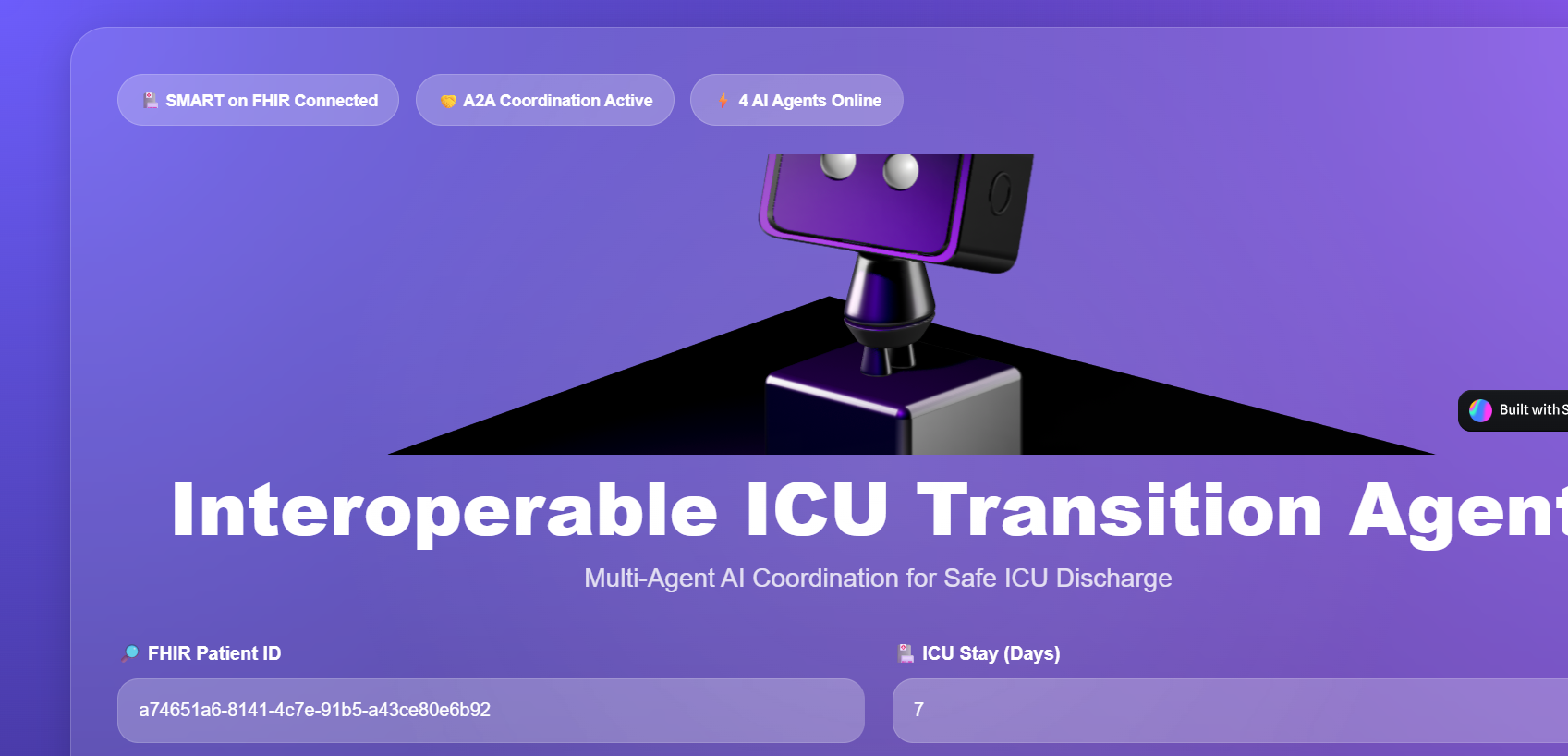
ICU Transition Agent is an interoperable multi-agent system that coordinates everything needed when a critically ill patient leaves the ICU — automatically, intelligently, and in seconds.
Input a FHIR-linked patient ID and ICU stay duration. Four specialized AI agents assemble and collaborate:
🔹 Clinical Summary Agent — synthesizes the ICU stay into a structured, handoff-ready clinical summary 🔹 Risk Detection Agent — analyzes labs, vitals, and diagnoses to flag the top readmission risks with severity levels 🔹 Care Coordination Agent — builds a timeline-based follow-up plan covering specialists, rehab, home care, and medication flags 🔹 Prior Authorization Agent — generates a professional insurance justification letter ready for submission
The result: a complete, clinician-ready discharge package produced in one coordinated workflow — not four disconnected tools.
How we built it
We built ICU Transition Agent on a multi-agent orchestration architecture designed around real healthcare interoperability standards:
⚙️ SMART on FHIR — live patient context pulled directly from FHIR R4 sandbox (100+ real synthetic patient records) ⚙️ A2A Coordination — agents communicate findings to each other; Risk Agent findings directly inform Care Coordination Agent planning ⚙️ MCP Tool Manifest — system exposes standardized tools at /tools endpoint for Prompt Opinion platform integration ⚙️ FastAPI backend — high-performance async orchestration layer managing agent sequencing and context propagation ⚙️ Gemini AI — powers all four agents with clinical reasoning, summarization, and document generation
The architecture is intentionally observable — every agent step is logged, sequenced, and traceable. No black boxes.
Challenges we ran into
🔸 FHIR data is messy in practice — real R4 records have missing fields, inconsistent structures, and sparse observations. We built a robust parser that handles all edge cases gracefully without breaking the workflow.
🔸 Getting agents to truly collaborate — early versions had agents operating in isolation. The breakthrough was designing each agent to receive the previous agent's output as context, creating genuine chain-of-reasoning across the workflow.
🔸 Making AI output clinically credible — generating text that sounds medical is easy. Generating output a real ICU physician would trust required careful prompt engineering, explicit clinical frameworks, and multiple iterations.
🔸 API reliability under hackathon pressure — navigating rate limits and model availability across providers while racing a deadline taught us a lot about building resilient AI systems.
Accomplishments that we're proud of
🏆 Built genuine multi-agent collaboration — not a single LLM with four prompts, but four agents that pass clinical context to each other in a structured workflow
🏆 Live FHIR integration — real patient data from SMART Health IT R4 sandbox flows directly into agent orchestration, no hardcoded records
🏆 Observable orchestration — every agent step is logged and traceable, making the system auditable and explainable
🏆 End-to-end discharge package — clinical summary + risk assessment + care plan + prior auth letter generated in a single workflow call
🏆 Built in under 24 hours — from blank FastAPI file to a fully functional interoperable multi-agent healthcare system
What we learned
The hardest part of healthcare AI is not the AI, it's the workflow design.
Any LLM can generate a clinical summary. What's genuinely difficult is coordinating multiple specialized agents so their outputs build on each other, maintain clinical context, and produce something a real clinician would act on.
We learned that interoperability is not a feature, it's the foundation. Building on FHIR and MCP standards from day one meant our system could plug into real healthcare infrastructure without custom glue code.
We also learned that observable AI matters in healthcare. Clinicians need to understand why an agent flagged a risk or recommended a specialist. Transparency is not optional, it's clinical safety.
What's next for ICU Transition Agent — Multi-Agent ICU Discharge Coordinator
ICU Transition Agent is a proof of concept that points toward something much larger.
🚀 Real EHR integration via SMART on FHIR OAuth — connecting to live hospital systems instead of sandbox data 🚀 Medication reconciliation agent — a fifth specialized agent dedicated to drug interaction checking and dosage verification 🚀 Clinician approval layer — human-in-the-loop review before discharge packets are finalized 🚀 Audit trail and compliance tracking — making every agent decision explainable and regulatorily defensible 🚀 Expansion to other high-risk transitions — emergency admissions, post-surgical discharge, oncology care continuity
Our long-term vision is a full interoperable healthcare agent ecosystem where specialized AI agents collaborate across every critical clinical workflow, not replacing clinicians, but ensuring nothing falls through the cracks.
The future of healthcare AI is not smarter models. It is better coordinated ones.

Log in or sign up for Devpost to join the conversation.