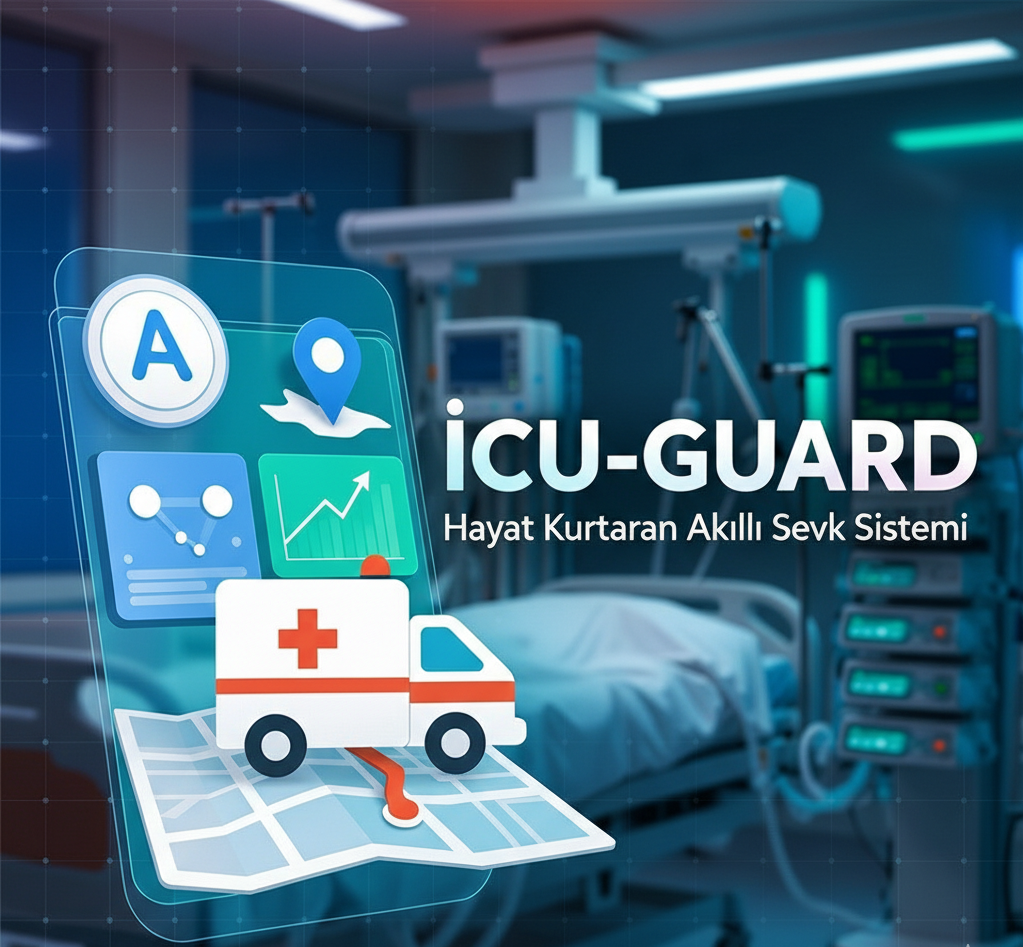
Inspiration: The Invisible Barrier
In emergency healthcare, the most critical bottleneck globally isn't just the physical shortage of beds, but their "invisibility." Even if a hospital has a vacant bed, 112 Command Centers often cannot instantly verify if that bed matches the patient's specific needs (e.g., Is there a ventilator? Is it a pediatric unit? Is there a burn unit?). The resulting phone traffic wastes precious minutes, causing patients to miss the "Golden Hour" and leading to preventable fatalities. We developed ICU-Guard to end this chaos.
Solution: "Cognitive Triage" with Gemini
ICU-Guard is a Neural Decision Support System powered by Google Gemini 3*, going far beyond traditional database queries. Our project leverages Gemini API's **Multimodal and Reasoning capabilities to:
- Multimodal Analysis: It doesn't just process text; it analyzes photos of patient monitors or ECGs sent from ambulances using Gemini Vision to automatically determine the urgency level (SOFA score).
- Semantic Reasoning: Gemini reads and understands unstructured hospital notes (e.g., "Burn unit under renovation"). When it sees "5-year-old patient," it acts like a doctor, reasoning that a "Pediatric ICU" 10km away is a better choice than a general ICU just 2km away.
- Automated Reporting: Once a transfer is approved, Gemini generates the medical admission note for the receiving hospital in seconds.
How It Works
- Input: The operator enters patient status in natural language or uploads a monitor photo.
- The Brain (Gemini Engine): The API compares patient data against the hospital inventory (simulated via Google AI Studio).
- Output: The system recommends the top 3 hospitals, accompanied by a "Medical Rationale" (e.g., "Selected because ECMO is available and traffic density is low").
ICU-Guard is not just a data storage tool; it is a next-generation health assistant that transforms data into a life-saving reflex.
Built With
- elevenlab
- gemine
- leatfet
- lovable


Log in or sign up for Devpost to join the conversation.