Every year, hundreds of thousands of people lose their lives to sepsis—not because we don't know how to treat it, but because treatment comes too late. We already have the answers. We know that with every hour antibiotics are delayed, the risk of death rises by 7%. Just one hour can make the difference.
The protocols exist. The guidelines are clear. The thresholds are well defined.
But reality isn't a textbook. It's 3 a.m. on a crowded ward. One junior doctor. Dozens of patients. Endless charts, alarms, and decisions. In that environment, things don't get missed because someone doesn't care—they get missed because someone is human.
That's why we built ICU Copilot.
Not to replace doctors, but to support them. To make sure that the knowledge we already have is actually used—consistently, accurately, and on time. It applies guidelines, checks interactions, tracks warning signs, and never gets tired—so that no patient slips through the cracks when it matters most.
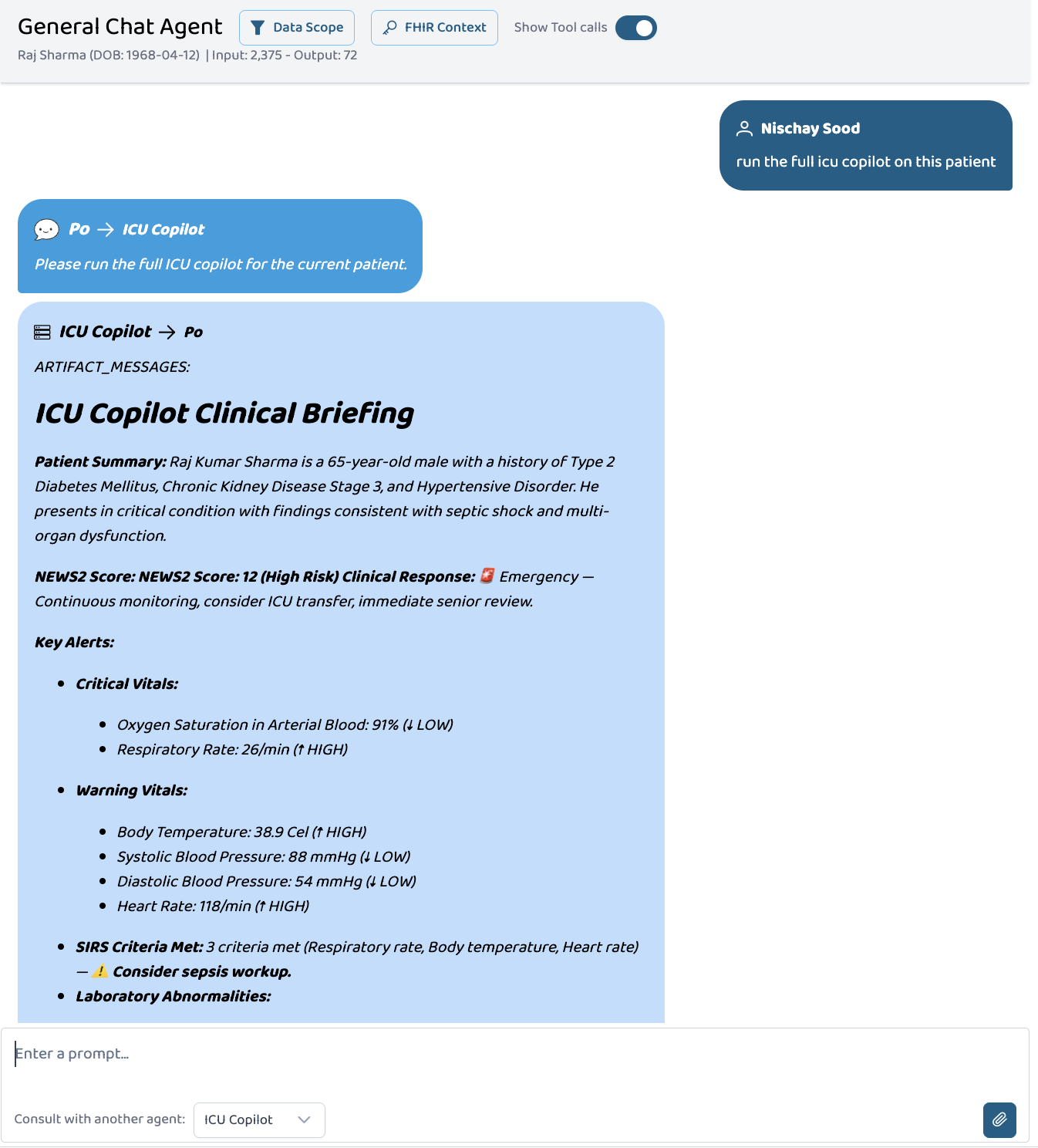
ICU Copilot connects to Prompt Opinion through the A2A protocol and runs a full clinical check in the background—quietly, quickly, and consistently. It works on real FHIR patient data, pulling in vitals, conditions, and medications, then stitching everything together into a clear picture.
Behind the scenes, it runs a 10-stage clinical pipeline: calculating the NHS NEWS2 early warning score, reviewing every medication for dangerous interactions or confusing overlaps, and automatically checking six evidence-based clinical guidelines — GOLD 2024 for COPD, GINA 2024 for Asthma, ADA 2024 for Type 2 Diabetes, ACC/AHA for Hypertension, KDIGO 2024 for Chronic Kidney Disease, and the Surviving Sepsis Campaign guidelines for Sepsis-3. Each one applied in real time, to the actual patient in front of you. What comes out isn't noise—it's a structured clinical briefing, with clear next steps and an SBAR handover ready to go.
In one demo case, a patient showed signs of septic shock: a NEWS2 score of 12, blood pressure at 88/54, and a creatinine level of 3.54 while on metformin. Within 90 seconds, ICU Copilot flagged the risk of lactic acidosis, triggered the Sepsis Hour-1 bundle, and highlighted every gap in guideline-based care.
It doesn't replace clinical judgment—it strengthens it. By making sure critical signals aren't missed and time-sensitive actions aren't delayed, ICU Copilot helps turn existing medical knowledge into timely, lifesaving decisions—when every minute counts.

Log in or sign up for Devpost to join the conversation.