-
-
ICE SAFE Guardian: a privacy-first Android, web, and browser system for reclaiming control over digital attention.
-
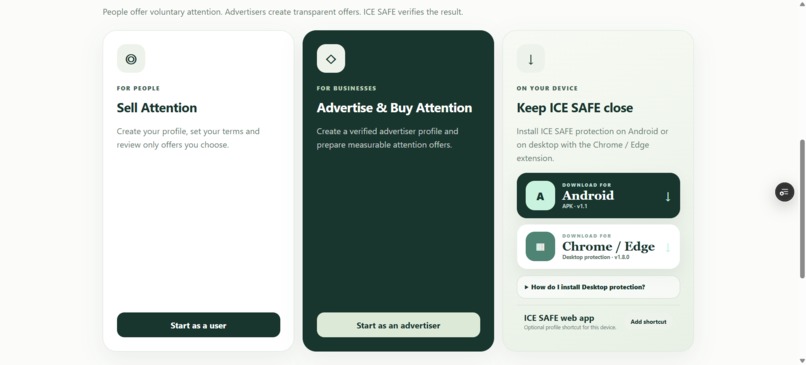
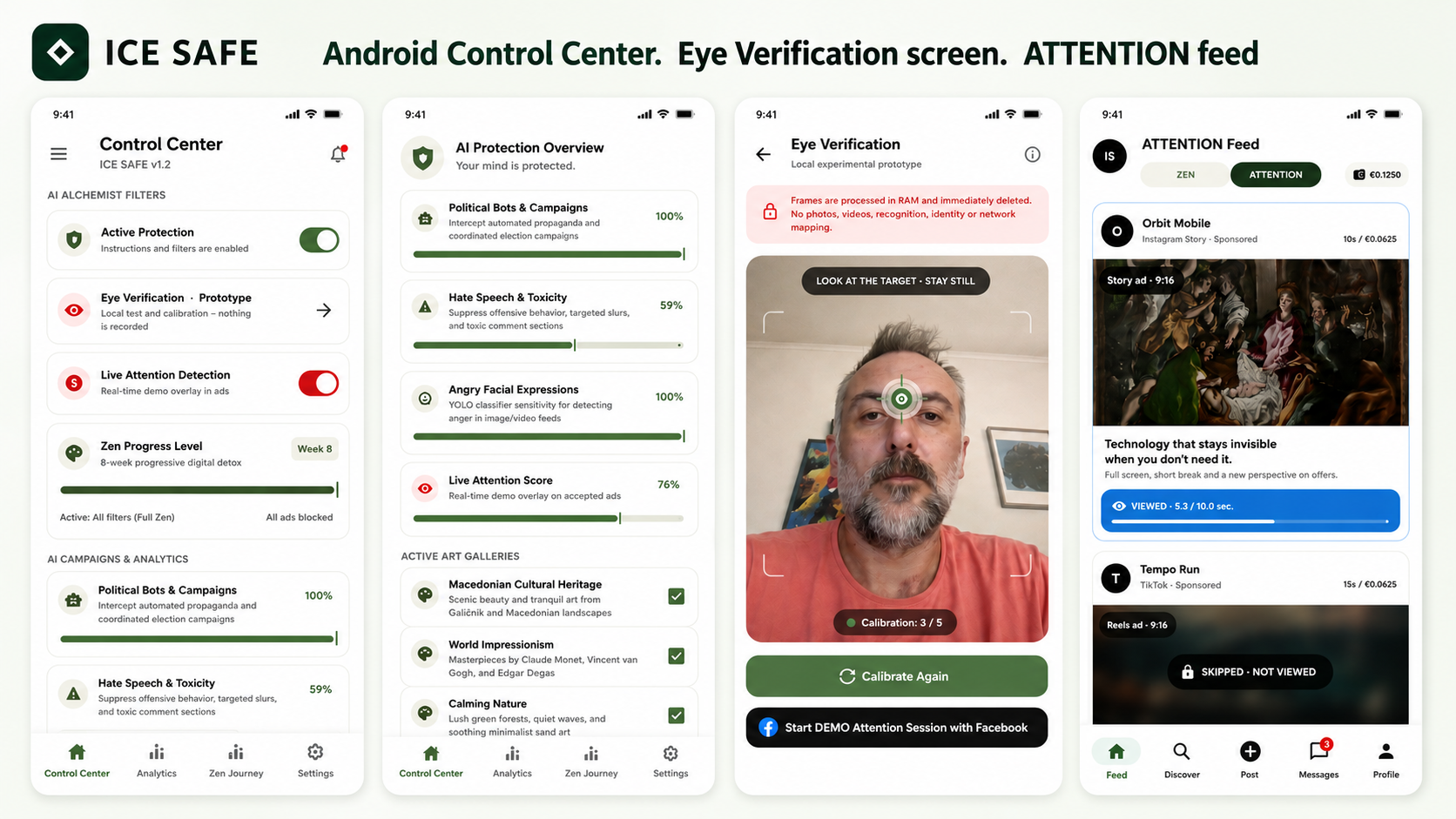
ICE SAFE across Android, web, and browser: ZEN protection, Attention controls, and synchronized account access.
-
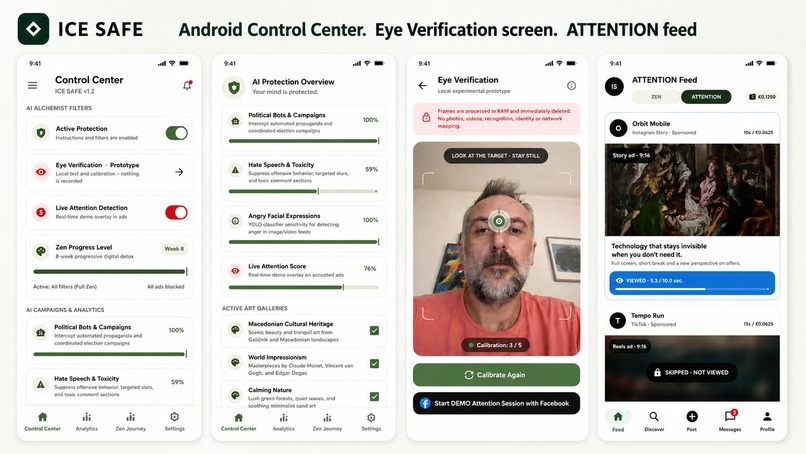
Android Control Center, local Eye Verification, and an opt-in ATTENTION feed with transparent value estimates.
-
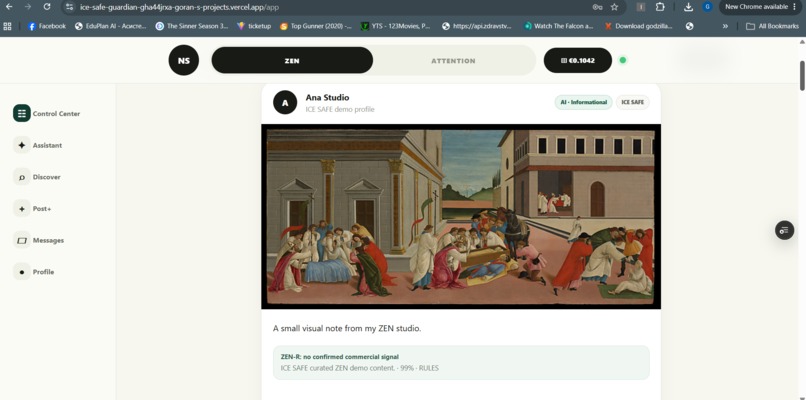
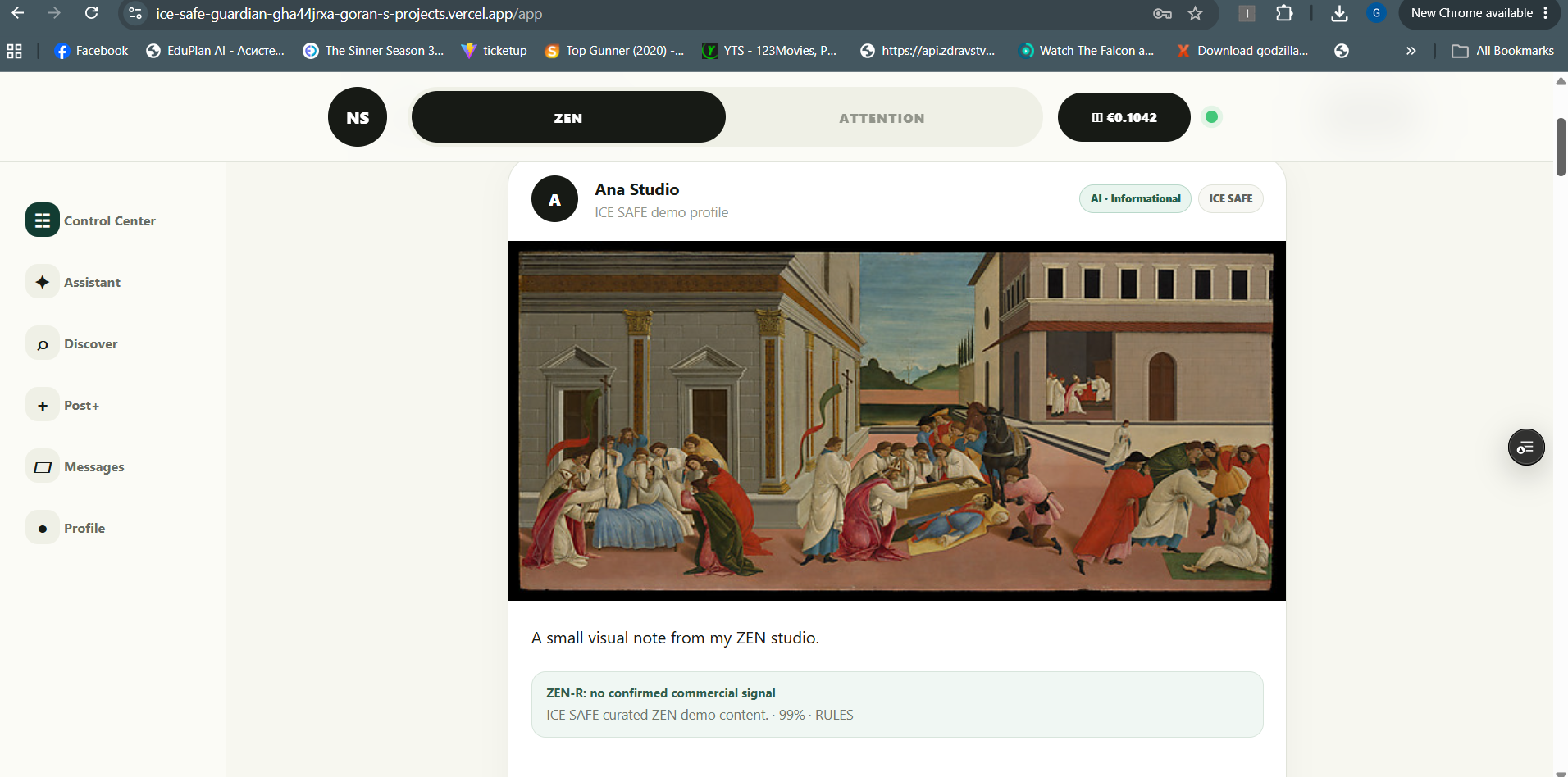
The desktop ZEN feed: personal and educational content without advertising pressure or attention measurement.
-
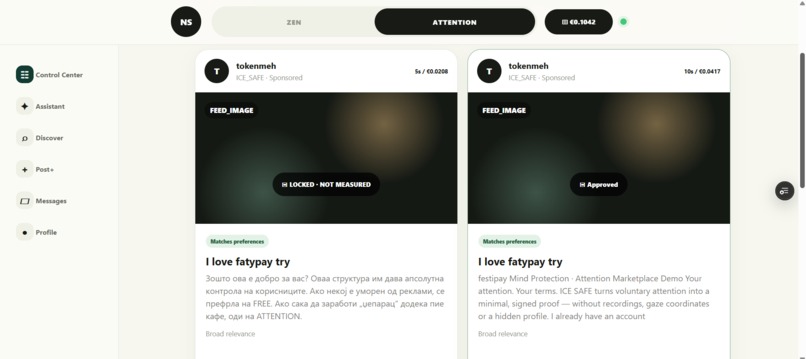
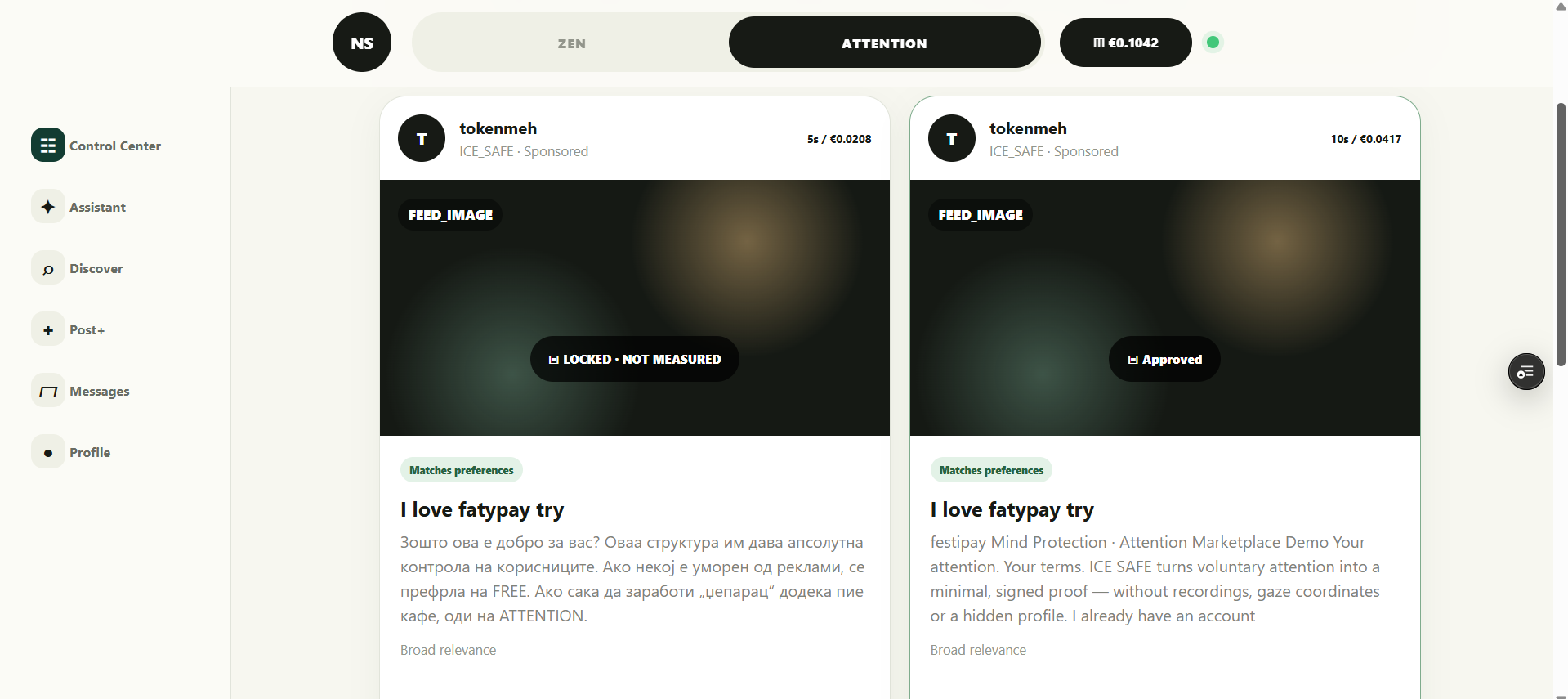
The ATTENTION feed keeps promoted content blurred until the user explicitly chooses to view and participate.
-
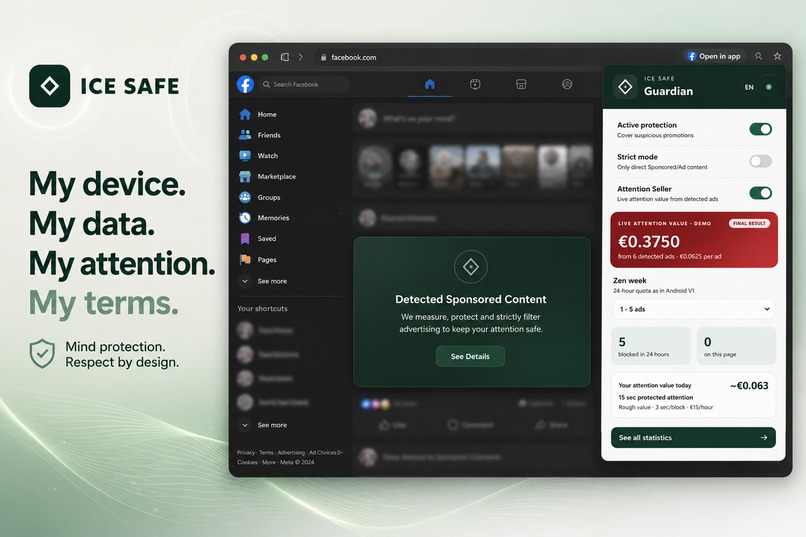
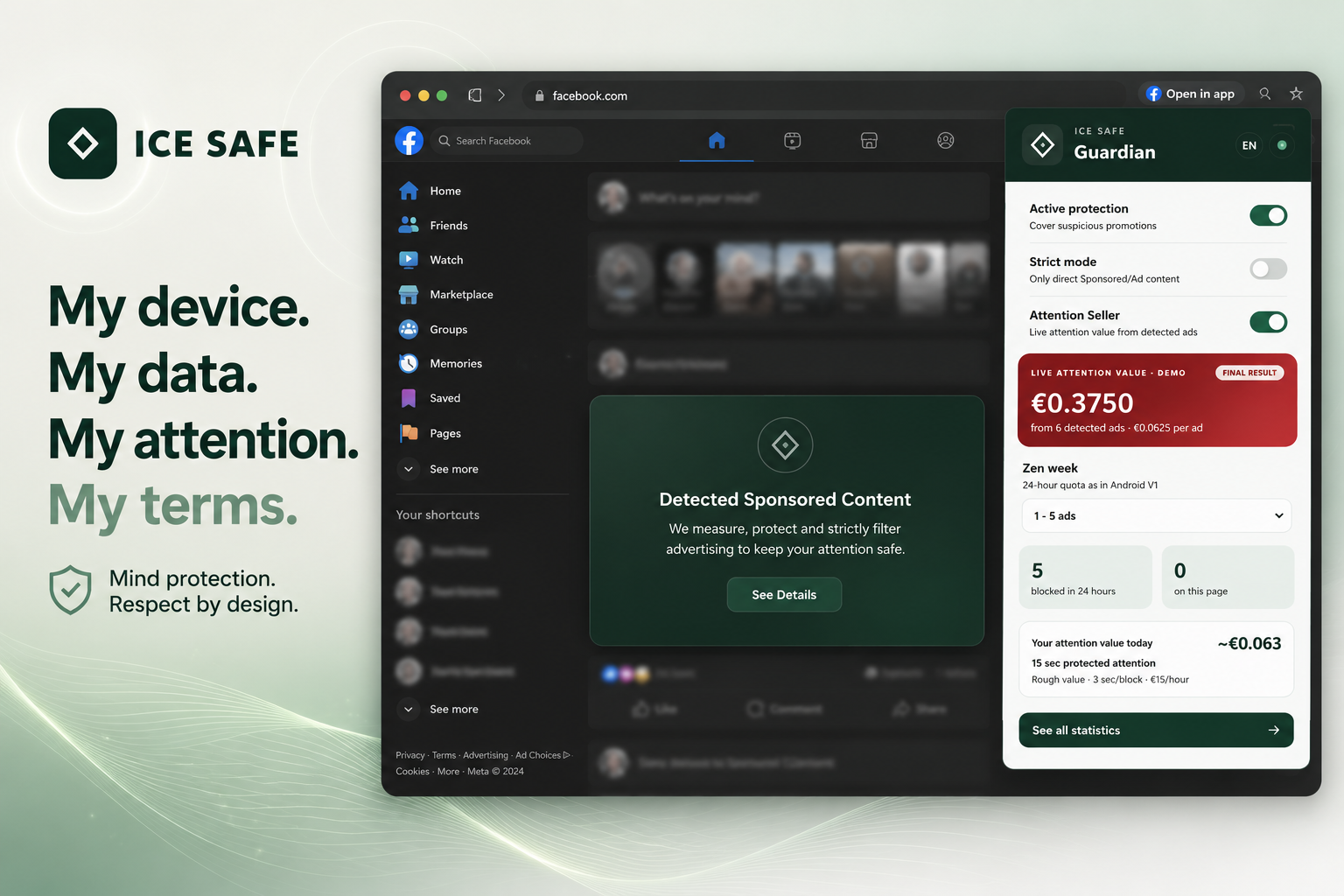
Chrome/Edge Guardian detects sponsored Facebook content locally and shows protection and estimated value controls.
Inspiration
In 2026, the internet is at a crossroads. Through my work as a Senior Production and Event Manager, I observed how human attention had become an invisible resource that digital platforms could extract and monetize, often without meaningful user control.
The inspiration for ICE SAFE Guardian came from one principle:
My device. My data. My attention. My terms.
I wanted to move beyond traditional ad blocking and explore a model where people protect their attention by default, consciously choose when to engage with commercial content, and see a transparent estimate of the value of their time.
What it does
ICE SAFE Guardian is a privacy-first digital wellbeing system operating across:
- an Android application;
- a responsive web application;
- a Chrome/Edge browser extension;
- a synchronized Neon database.
The product separates the digital experience into two spaces:
- ZEN is a calm personal feed for posts, learning, friends, and useful information without commercial pressure or attention measurement.
- ATTENTION is an opt-in prototype marketplace where promoted content becomes active only after the user consciously chooses to participate.
The prototype displays a transparent estimated attention value using a reference rate of €15 per hour:
[
\text{estimated value}
\text{verified seconds} \times \frac{15}{3600} ]
This is a prototype estimate, not a real cash balance or guaranteed payout.
ICE SAFE also provides:
- local sponsored-content detection on Facebook;
- protection overlays for recognized feed advertisements and Reels;
- an eight-week progressive ZEN protection plan;
- Attention Seller banners and scroll timers;
- synchronized Android and web feeds;
- text, image, and short-video posts;
- reactions, comments, saved posts, sharing, and messages;
- a synchronized Control Center;
- experimental local eye verification;
- AI-assisted ZEN, ATTENTION, or REVIEW recommendations.
AI assists the user but does not make the final commercial decision. Low-confidence classifications remain in manual review, and the user keeps control through the Bridge Protocol.
How we built it
I designed ICE SAFE as a protocol-oriented ecosystem built around six connected layers: First Protocol, Zen-R Protocol, Advertiser Protocol, User Zen Protocol, User Attention Protocol, and Bridge Protocol.
The Android application uses Kotlin, Jetpack Compose, CameraX, MediaPipe, Room, Retrofit, and Android Keystore. Eye-verification frames are processed locally in RAM and discarded immediately.
The web platform uses TypeScript, React, Next.js, Neon PostgreSQL, and secure server routes. It synchronizes posts, classifications, messages, preferences, linked devices, and Control Center policies.
The desktop protection layer is a Manifest V3 Chrome/Edge extension. It analyzes Facebook feed cards and Reels locally without sending the page’s content to an external extension service.
The AI Feed Protocol begins with deterministic rules and may use Gemini, with an optional OpenAI fallback, for additional context. It produces a category, confidence score, explanation, and recommended zone. Uncertain results remain in human review.
ICE SAFE existed before Build Week as a product vision and early Android/browser experiments. During OpenAI Build Week, I used Codex and GPT-5.6 to meaningfully extend it into a synchronized, testable, multi-platform product.
Codex helped me inspect the Android behavior, translate it into desktop interaction patterns, build the responsive web application, create Neon migrations and secure routes, synchronize Android and web data, implement the AI Feed Protocol, package the browser extension, and validate the system through automated tests and production deployments.
I remained responsible for the product vision, privacy boundaries, protocol rules, economic model, and final engineering decisions.
Challenges we ran into
One major challenge was the difference between Facebook’s mobile and desktop layouts. Desktop feed cards, Reels, headers, scrolling behavior, and frequently changing page structures required separate geometry rules and automated tests.
Privacy-preserving eye verification was another challenge. I designed it as a local experiment: frames remain in memory and are discarded immediately. The server receives only a minimal signed result rather than photographs, video, face identity, or gaze coordinates.
Synchronizing Android, web, the extension, and Neon required shared definitions, explicit protocol fields, careful database migrations, and consistent API contracts.
AI overconfidence also required strong boundaries. ICE SAFE uses deterministic rules, confidence thresholds, safe fallbacks, and manual user decisions instead of allowing AI to silently commercialize personal content.
Finally, I needed to clearly separate working functionality from the future marketplace vision. Production escrow, payments, KYC, Play Integrity verification, and a complete fraud engine are future components and are not presented as finished features.
Accomplishments that we're proud of
ICE SAFE Guardian now works as one connected product rather than a collection of isolated screens.
The Build Week version includes:
- a public responsive web platform;
- an Android application with synchronized account data;
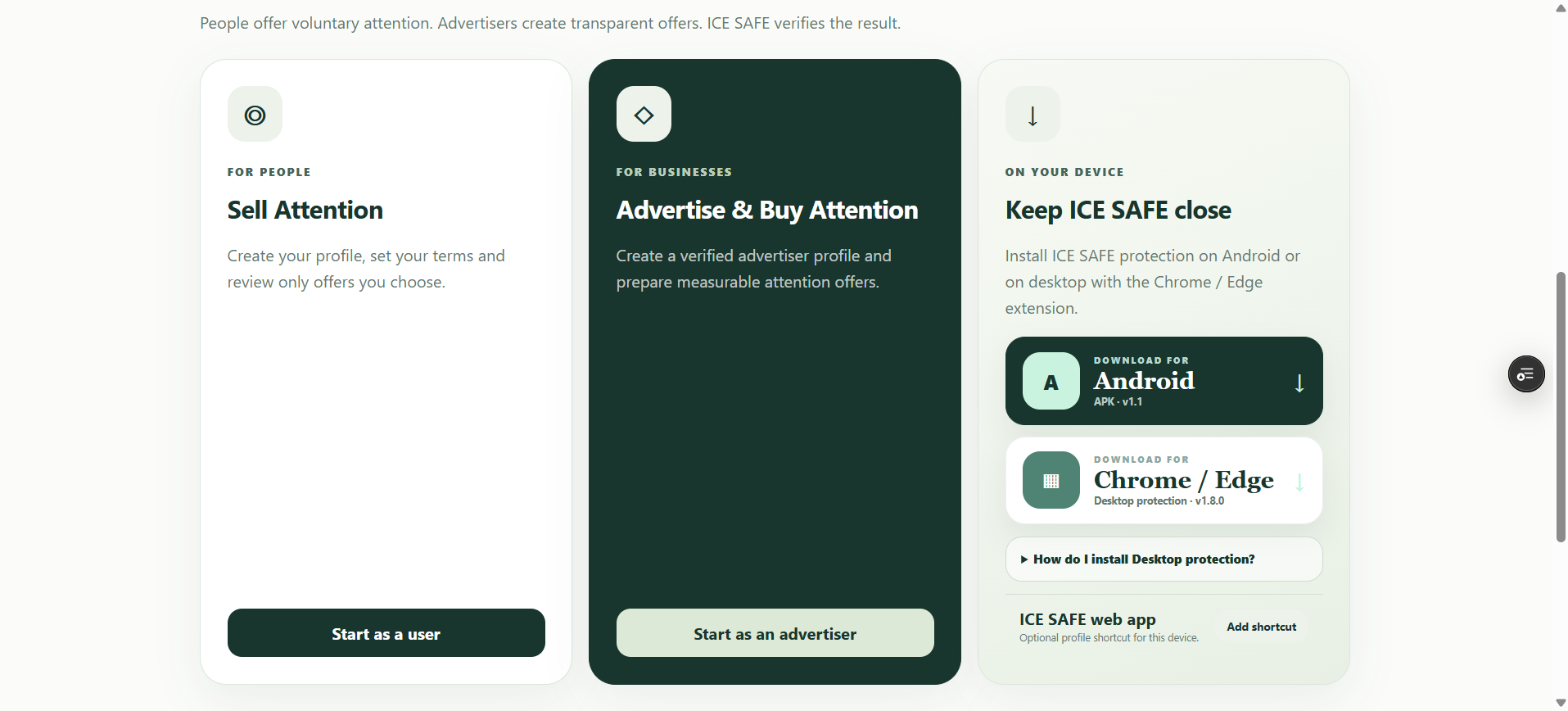
- an installable Chrome/Edge extension;
- AI-assisted feed classification;
- local Facebook feed and Reels protection;
- media posts and social interactions;
- private messages;
- a synchronized Control Center;
- Android Keystore-signed attention proofs;
- local passive-liveness and eye-verification experiments;
- direct Android and desktop downloads.
The AI Feed Protocol tests pass 5/5, the desktop extension tests pass 42/42, the Next.js production build succeeds, the Android synchronization test passes, and the web and Android GitHub checks pass.
What we learned
The most important lesson was that protecting attention is not only a filtering problem. It is a question of consent, product architecture, economics, and user rights.
I learned that privacy is most effective when it becomes an architectural boundary rather than a promise added later. Local processing, minimal server data, explicit consent, manual decision gates, and safe AI fallbacks shaped the entire system.
I also learned that AI works best as an advisor. It can classify, explain, and recommend, but the user should remain the final authority.
Codex demonstrated how one person can work across Android, web, databases, browser extensions, testing, and deployment while remaining responsible for the product’s final vision and decisions.
What's next for ICE SAFE Guardian
The next stage is to expand real-device testing, improve feed and Reels detection, calibrate eye verification across different lighting conditions and devices, and strengthen the AI classification evaluation set.
A future production Attention marketplace would require verified advertisers, funded campaign budgets, escrow, KYC, payment providers, production Play Integrity verification, an independent fraud engine, security audits, and a complete legal framework.
The current prototype establishes the foundation:
Attention should not be taken silently. It should be protected by default and shared only by conscious choice.
Built With
- android
- css3
- gpt-5.6
- html5
- javascript
- kotlin
- neon
- next.js
- node.js
- postgresql
- react
- retrofit
- room
- typescript
- vercel

Log in or sign up for Devpost to join the conversation.