-
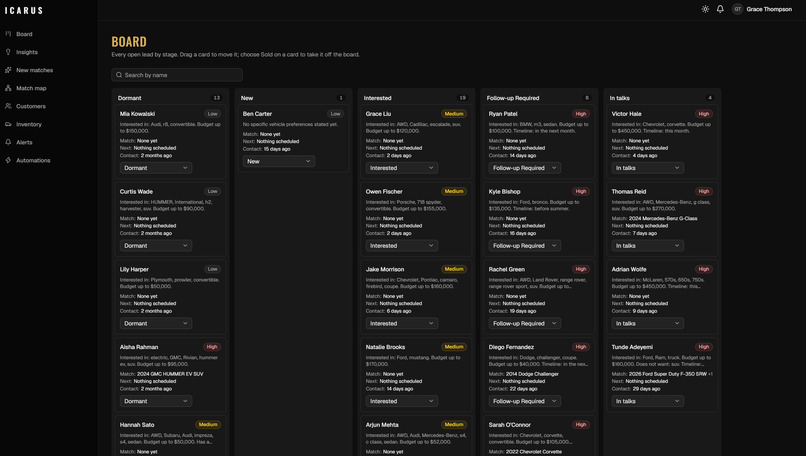
Home page, tracking board
-
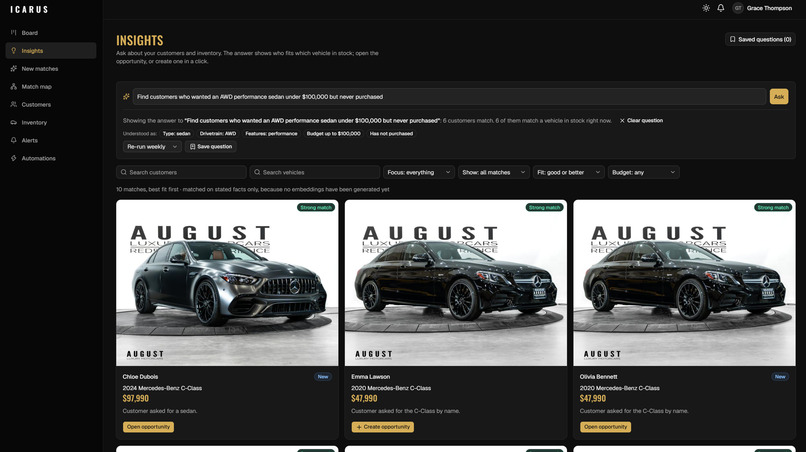
Intelligent insights page
Icarus
Inspiration
Dealerships don't just lose sales because they don't have the right car. They lose them because they forget the right customer. Icarus gives those opportunities a second life.
What it does
Icarus reads a dealership's old conversations and works out what each customer was really looking for. When the right car shows up, it puts that customer back in front of the manager, quoting the customer's own words: "James asked for this exact thing in August. Here's what he said."
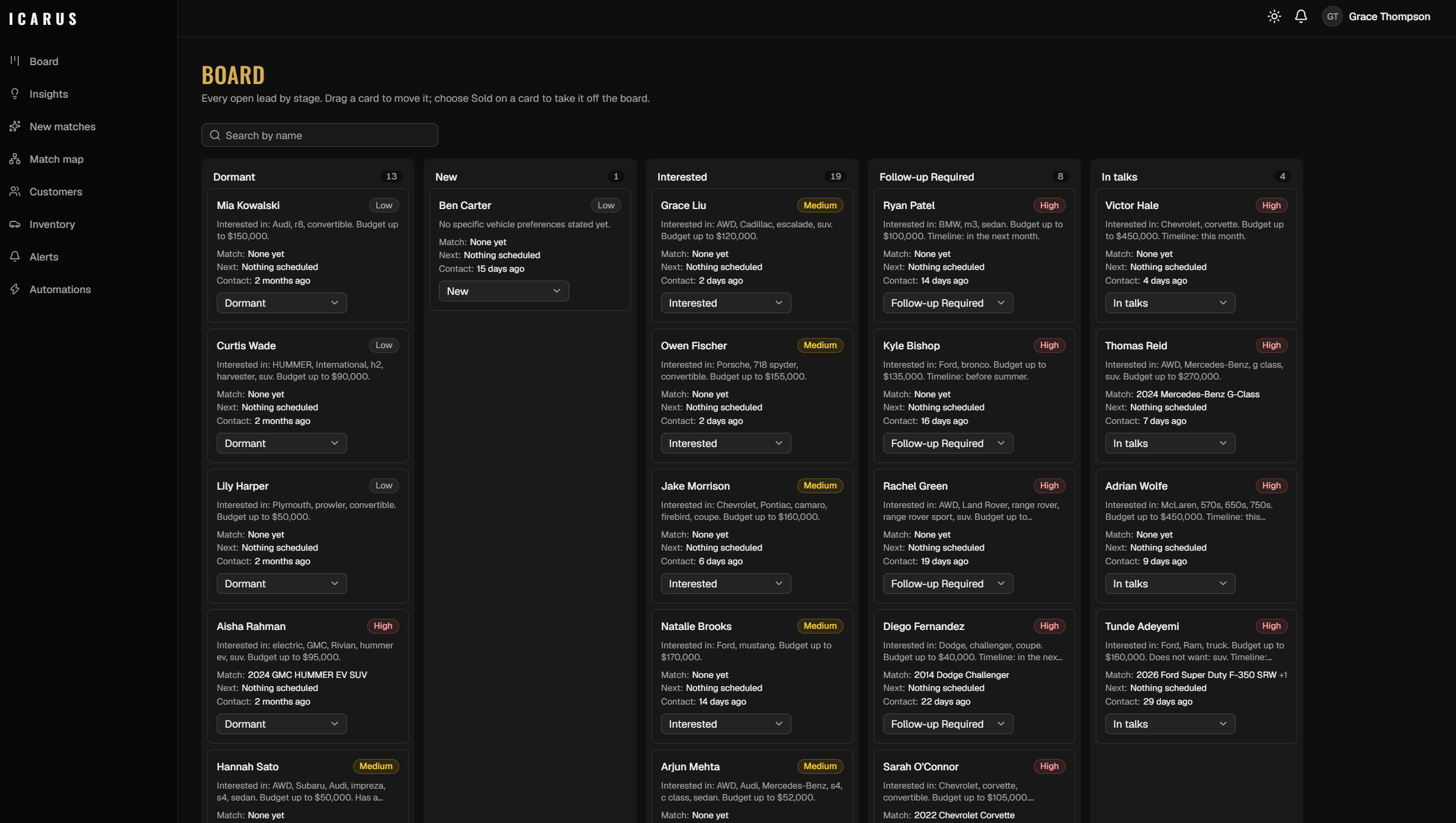
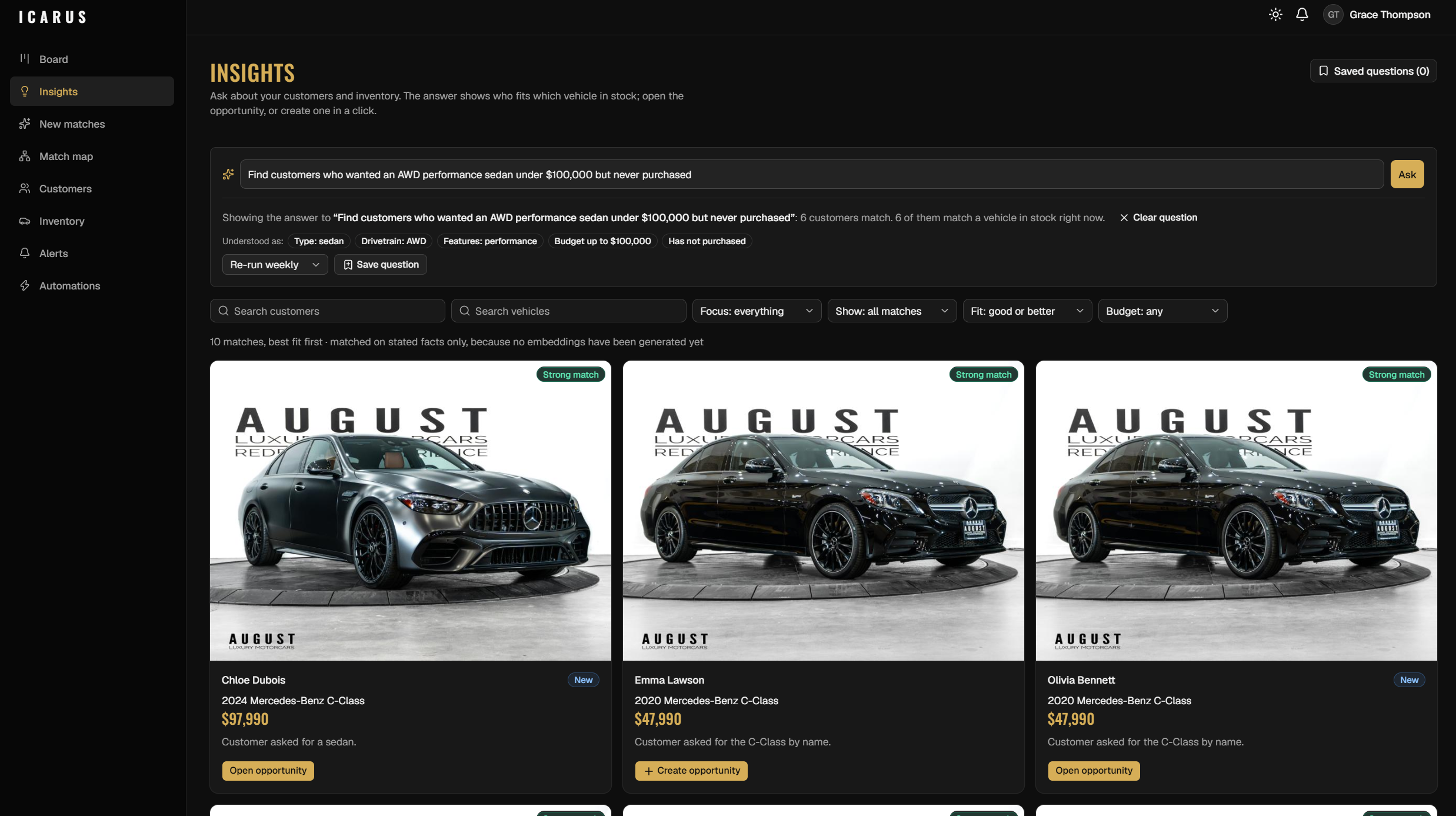
- For the dealership: a board of every open lead, the ability to ask questions in plain English ("who would want this vintage Corvette?"), and a live feed that lights up the moment a new car matches a forgotten customer.
- For the buyer: a simple shop page where you describe what you want in your own words and see real cars that fit. You can sign up so the dealership knows to look out for you.
Icarus never contacts a customer on its own. It finds the opportunity, and a person decides what to do with it.
How we built it
We started from one question: what would a great salesperson with a perfect memory do? They'd read every conversation, remember what each person said, notice when the right car came in, and be able to explain why it was a fit.
We split that job in two:
- The AI does the reading. It goes through each conversation and pulls out what the customer wanted, along with the exact sentence they said it in.
- Plain, predictable rules make the decisions. Who matches which car, and how well, is decided by logic we can test and explain. It is not a black box.
If the AI claims a customer wanted something but can't point to the words where they said it, we throw that claim out. So every match Icarus shows comes with a receipt.
To make the demo feel real, we used a real inventory of 68 cars from a luxury dealership in Kelowna, BC, and wrote invented customers whose stories fit those cars. It runs on Next.js, Supabase and OpenAI.
Challenges we ran into
- AI that makes things up. Early on, the model would invent preferences nobody had mentioned, like "wants leather seats." Requiring a real quote behind every preference fixed it.
- People don't talk like databases. Customers say "I want a track car" or "something for the cottage," not "twin-turbo, rear-wheel drive." Teaching Icarus to turn fuzzy wishes into things a car listing actually says was the hardest part.
- Tiny bugs, big embarrassment. At one point, asking for a McLaren returned Chevrolets because of a single capital letter. Small details matter a lot when you're trying to earn a manager's trust.
Accomplishments that we're proud of
- The demo moment works. We add a BMW M5 to the inventory, and within seconds Rachel, a customer who went quiet three months ago, pops up with her original request quoted next to it.
- It's honest. A customer who said "just browsing" is never pushed a car. One who said "hard limit of \$100k" is never shown a \$106k truck.
- It's built like a real product, with proper security between dealerships and a large set of automated checks, not just a pretty demo.
What we learned
- AI is a great reader but a poor judge. It's brilliant at understanding messy human messages. The decisions are better left to rules people can see and trust.
- "I don't know" beats a confident guess. When Icarus isn't sure what a phrase means, it says so, and that makes people trust everything else it says.
- Smaller is better. We kept cutting pages until each one did one job well. The product got clearer every time.
What's next for Icarus
- Plug into the inboxes and CRMs dealerships already use, so conversations flow in on their own.
- Draft a personal follow-up message, using the customer's own words, for a salesperson to review and send.
- Grow from one dealership to many, so every forgotten customer gets a second chance.
Built With
- next.js
- openai
- pgsql
- pgvector
- react
- semantic-search
- supabase
- tailwind
- typescript
