Inspiration
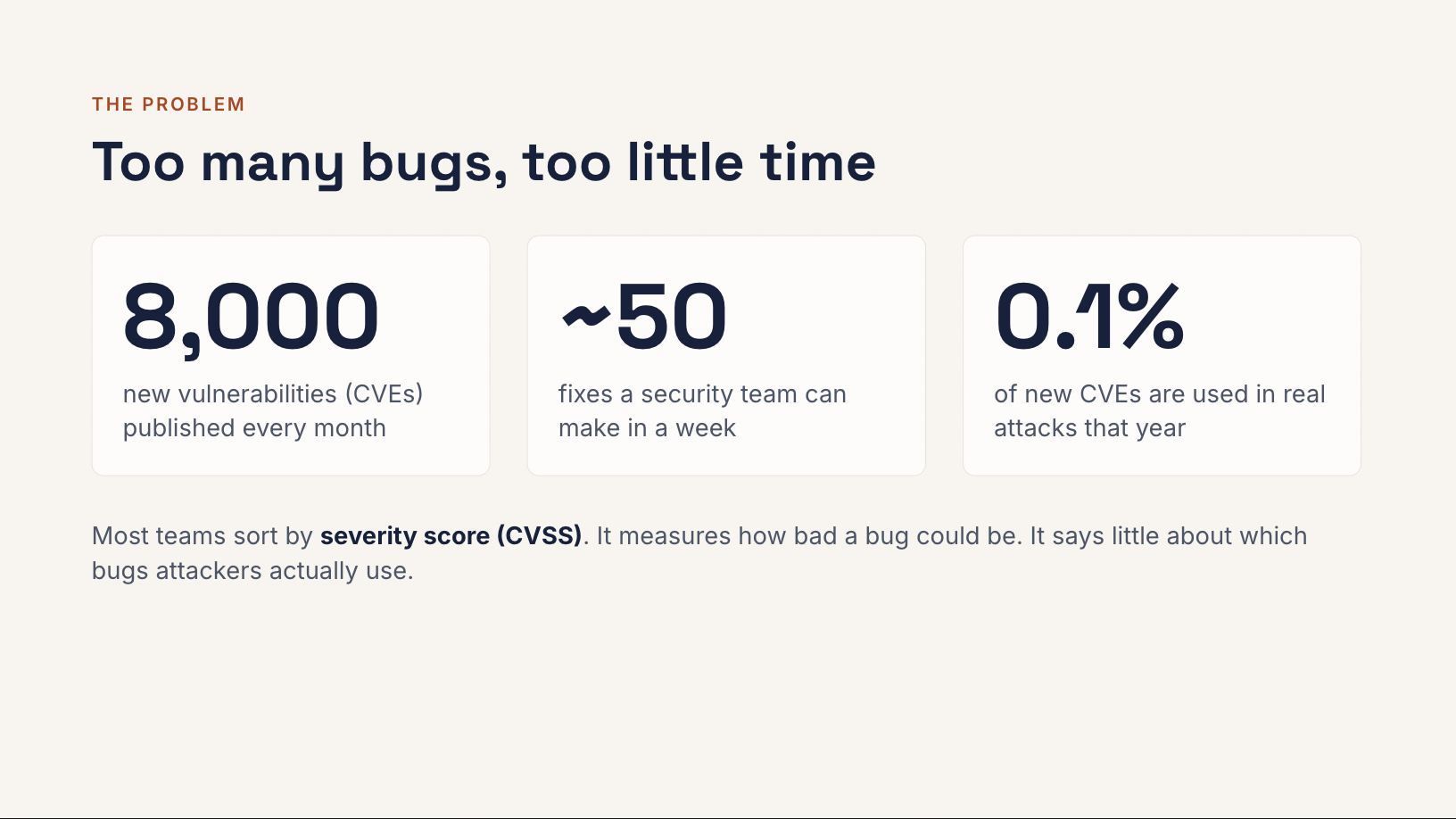
About 8,000 vulnerabilities (CVEs) are published every month, and a security team can fix maybe 50 a week. Most teams sort by severity score (CVSS), which measures how bad a bug could be. Only about 0.1% of new CVEs are used in real attacks that year, and severity says little about which ones.
What it does
Bullseye ranks the 72,670 CVEs on the 2026 scoreboard by how likely attackers are to use them, using only what was known at each CVE's snapshot.
The demo app:
- builds a weekly list sized to the team's patch budget, with a vendor filter
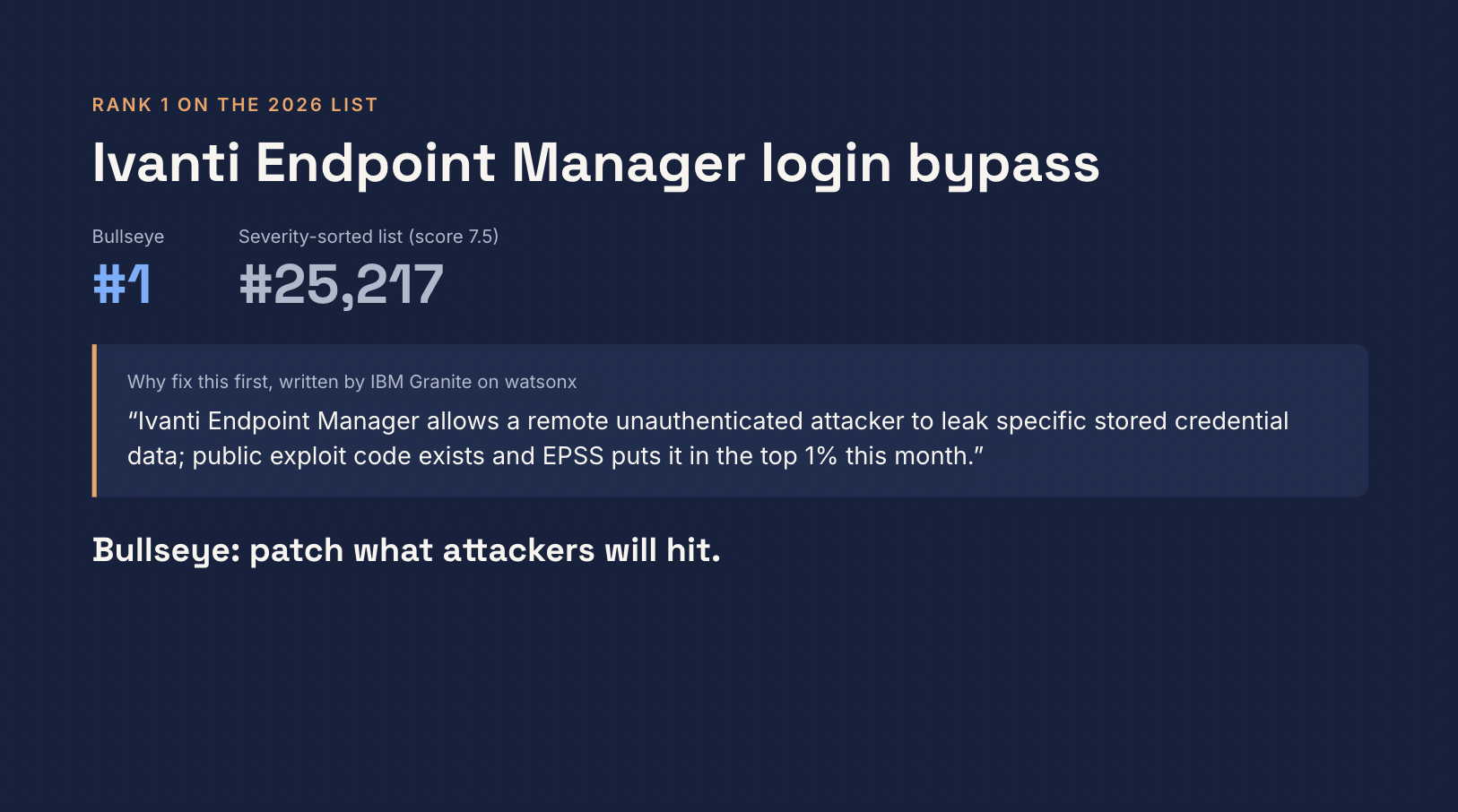
- gives each pick a one-line "why fix this first", written by IBM Granite
- shows where each pick would sit on a severity-sorted list
How it was built
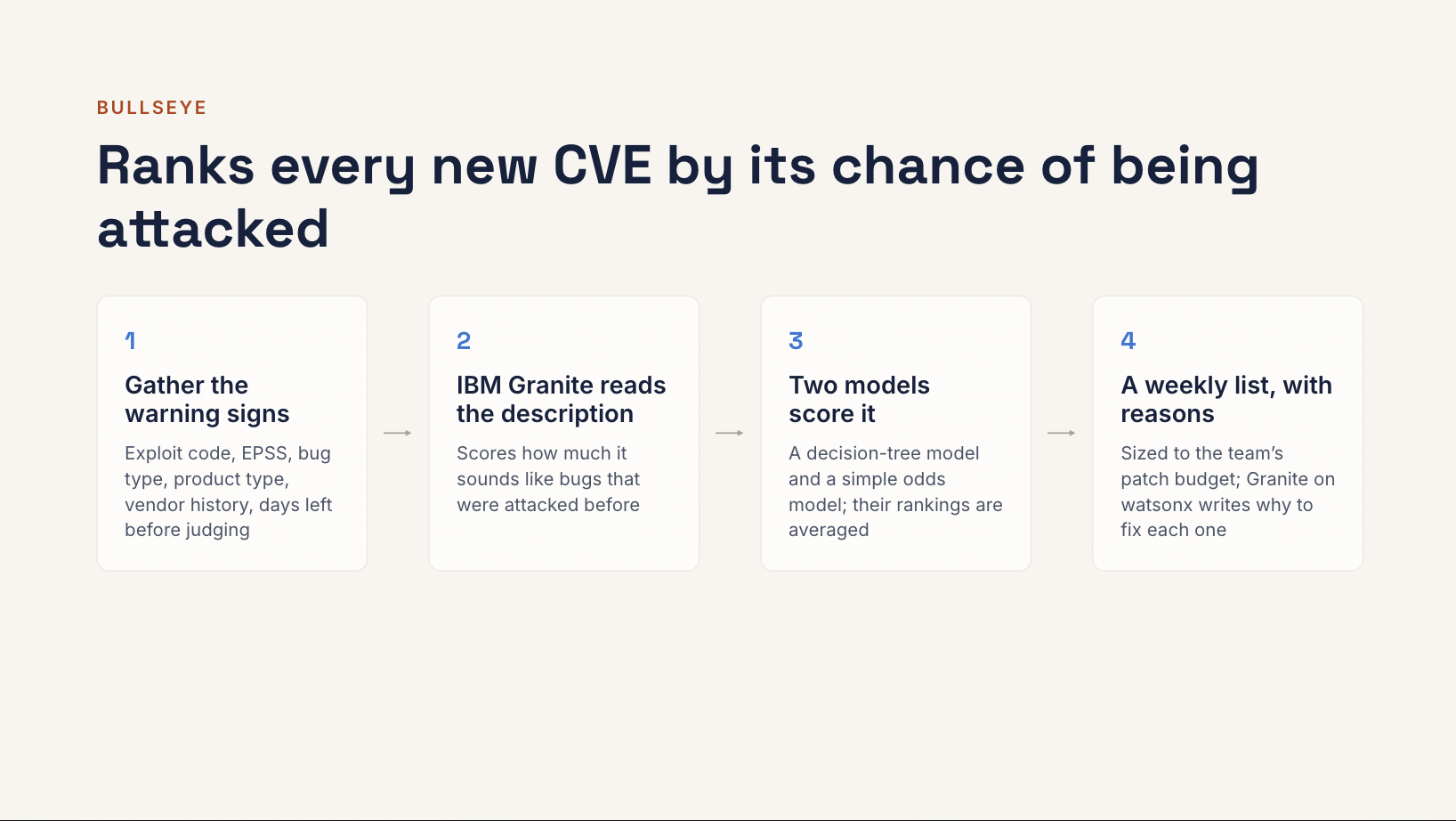
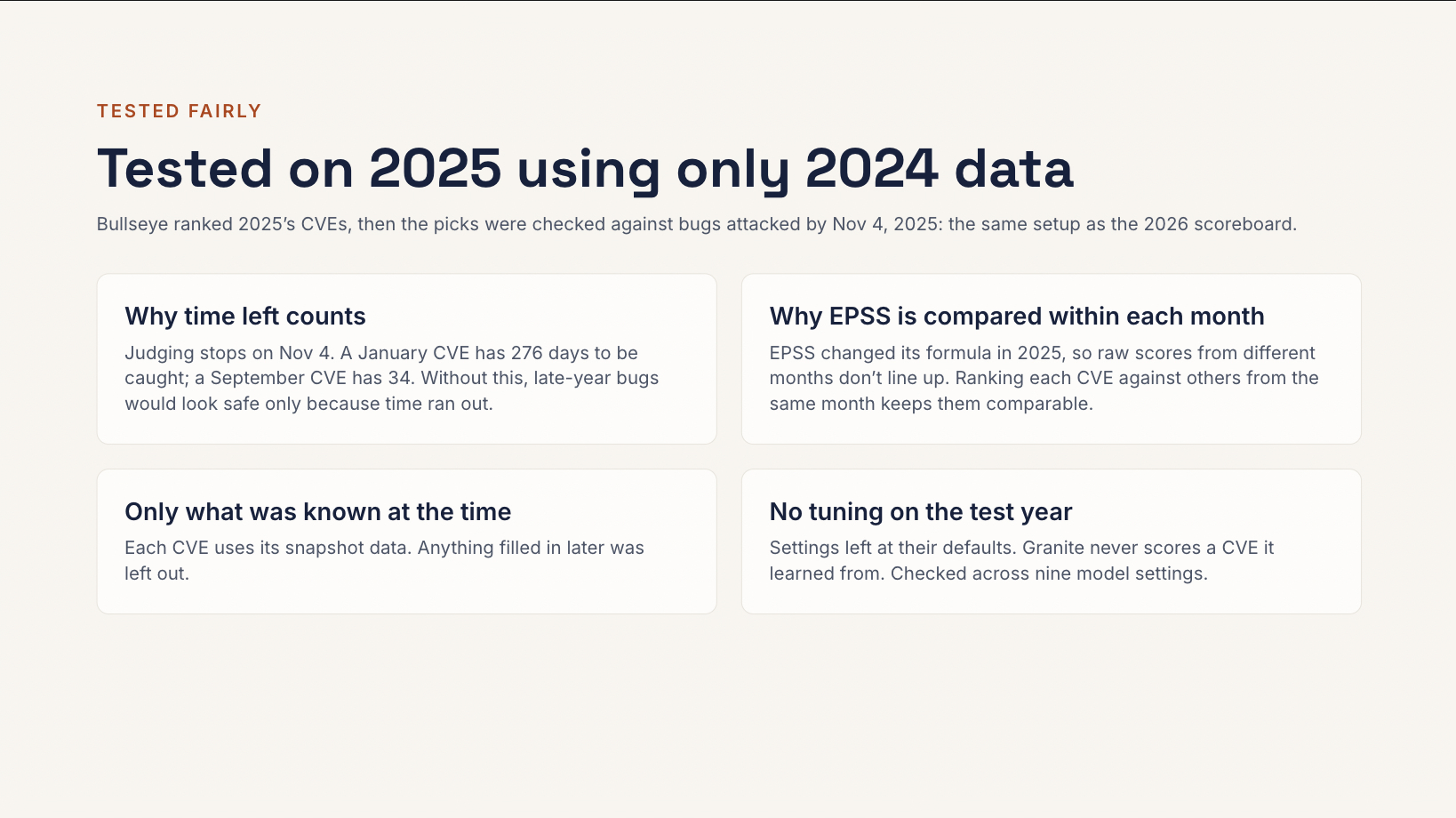
- Warning signs for each CVE: public exploit code, EPSS (ranked within each month, because EPSS changed its formula in 2025), bug type, product type, the vendor's recent history on CISA's Known Exploited Vulnerabilities (KEV) list, and days left before judging.
- IBM Granite embeddings (
granite-embedding-small-english-r2, run locally) turn each description into numbers. A simple model trained on every KEV entry since 2015 scores how much it sounds like an attacked bug. - Two models score every CVE: gradient-boosted decision trees and a simple odds model (Naive Bayes). Their rankings are averaged. The odds model's biggest factors become each pick's reasons.
- IBM Granite 4 on watsonx.ai (
granite-4-h-small) writes the one-line explanation from facts already in the data. It does not change the ranking.
What was learned
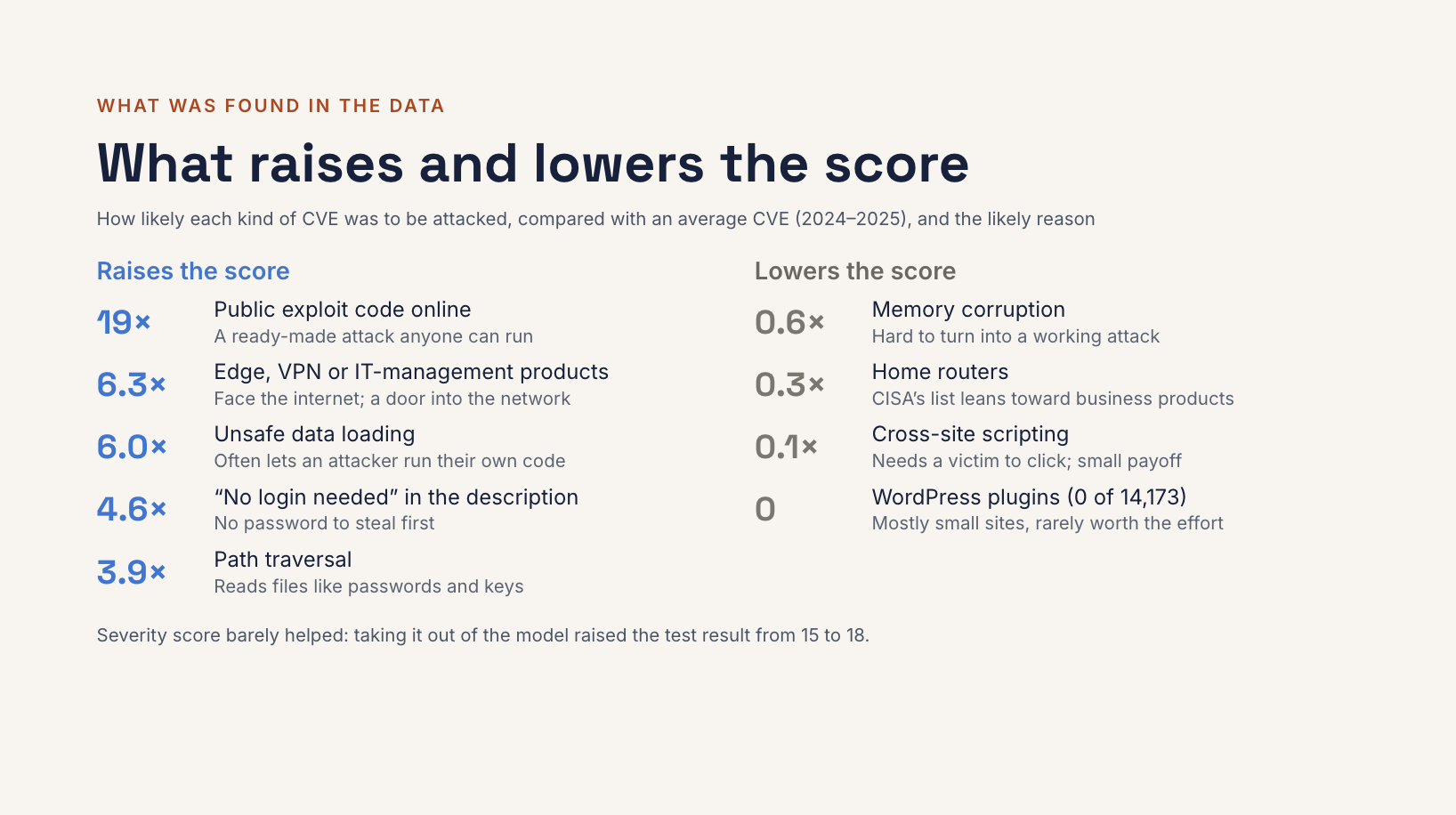
- Public exploit code made a CVE 19× as likely to be attacked. Edge, VPN and IT-management products: 6.3×. Unsafe data loading: 6.0×. "No login needed": 4.6×. WordPress plugins: 0 of 14,173.
- 44 of the 75 CVEs attacked in 2024–25 had no public exploit code, so exploit code alone misses most of them.
- Severity score barely helped: removing it raised the test result from 15 to 18.
Challenges
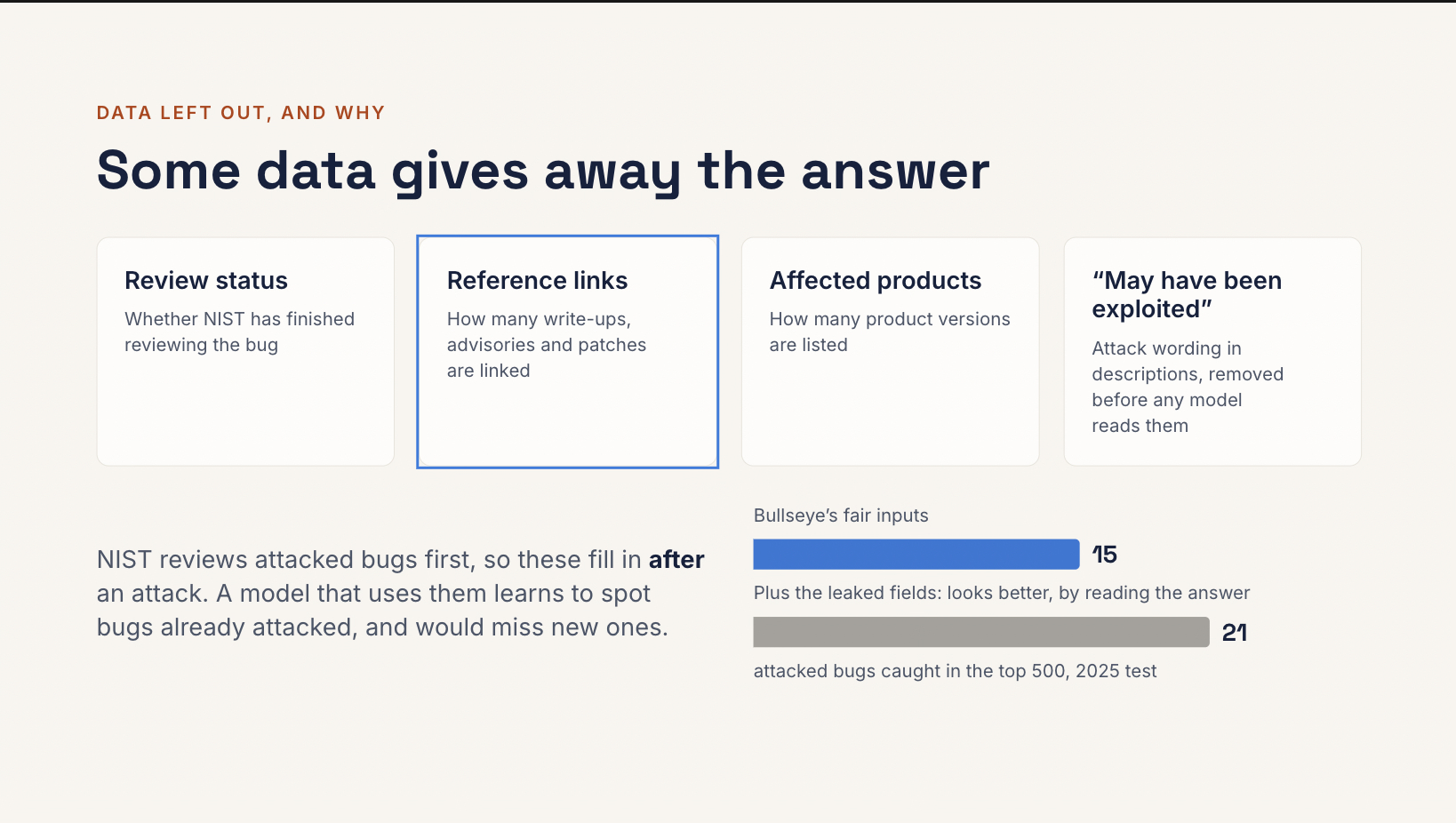
- Data that gives away the answer. NIST reviews attacked CVEs first, so review status, number of reference links and number of affected products fill in after an attack. A model using them scored 21 in the test by reading the answer. These fields were left out, and phrases like "may have been exploited" were removed from descriptions.
- Uneven time. A January CVE has 276 days to be caught before judging; a September CVE has 34. The model is told how many days each CVE has left.
- Trustworthy explanations. Early Granite lines named the fixed version as the vulnerable one. The prompt now bans version numbers, and every line is checked automatically. One line was corrected by hand and is marked as corrected.
Results
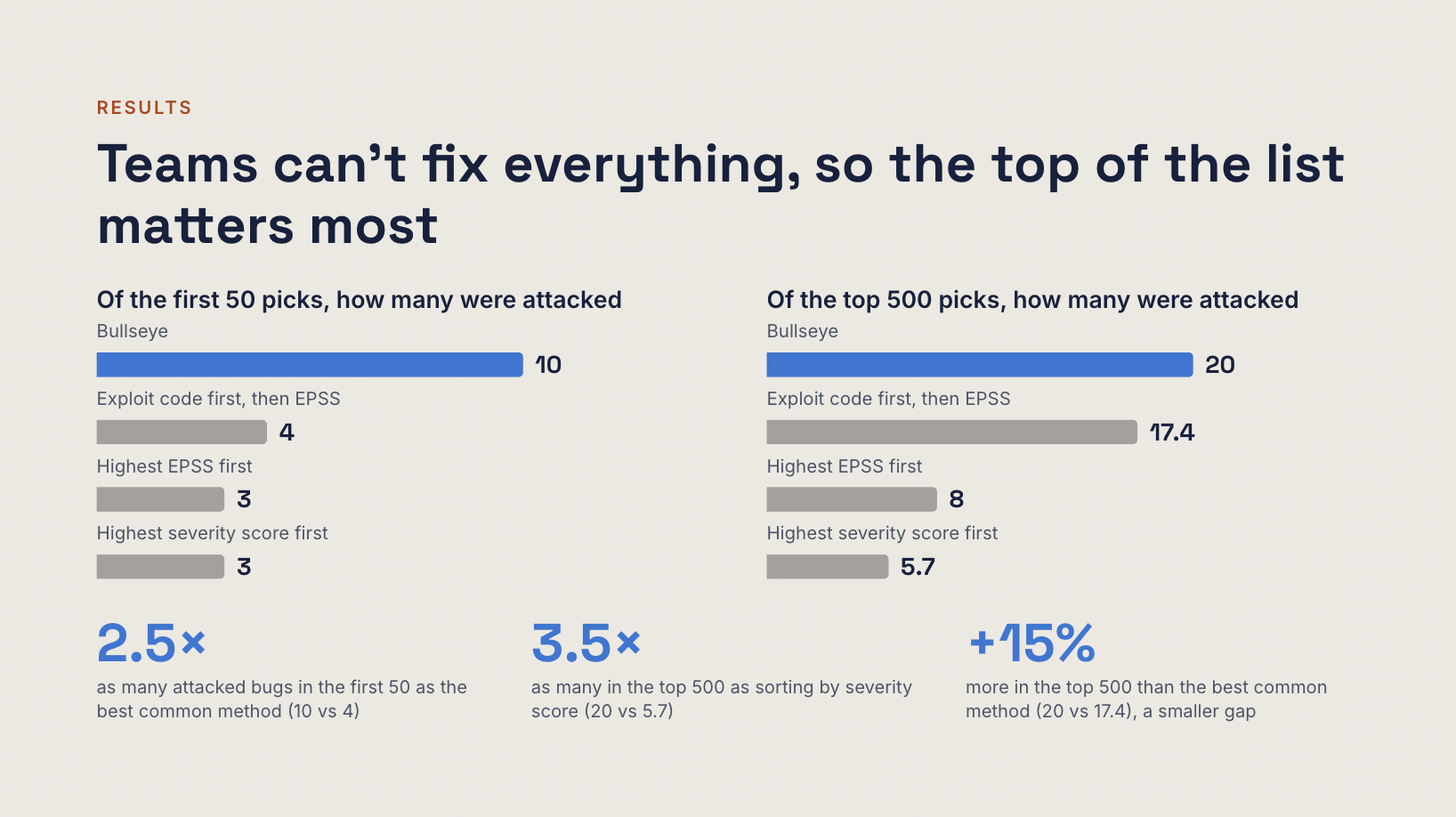
Tested on 2025 using only 2024 data, the same setup as the 2026 scoreboard. Attacked CVEs caught in each method's top 500 (and first 50):
- Bullseye: 20 (10)
- Exploit code first, then EPSS: 17.4 (4)
- Highest EPSS first: 8 (3)
- Highest severity first: 5.7 (3)
In the first 50 picks, Bullseye caught 2.5× as many attacked CVEs as the best common method. In the top 500, it caught 3.5× as many as sorting by severity. Only 48 test CVEs were attacked, so small gaps could be luck; the first-50 gap is the clearest.
What's next
Update the list weekly as signals change, and let teams upload what they run so the list covers only their systems.