Inspiration
Making a mystery, history. Cultural heritage is disappearing faster than it can be preserved. Instead of relying on experts alone, this system enables anyone to document and reconstruct artifacts using photogrammetry, generative AI, and AR.
Rather than producing a single “correct” restoration, it generates multiple plausible reconstructions based on architectural logic such as symmetry, motifs, and typology. These reconstructions are not presented as definitive truths, but as informed interpretations of the past.
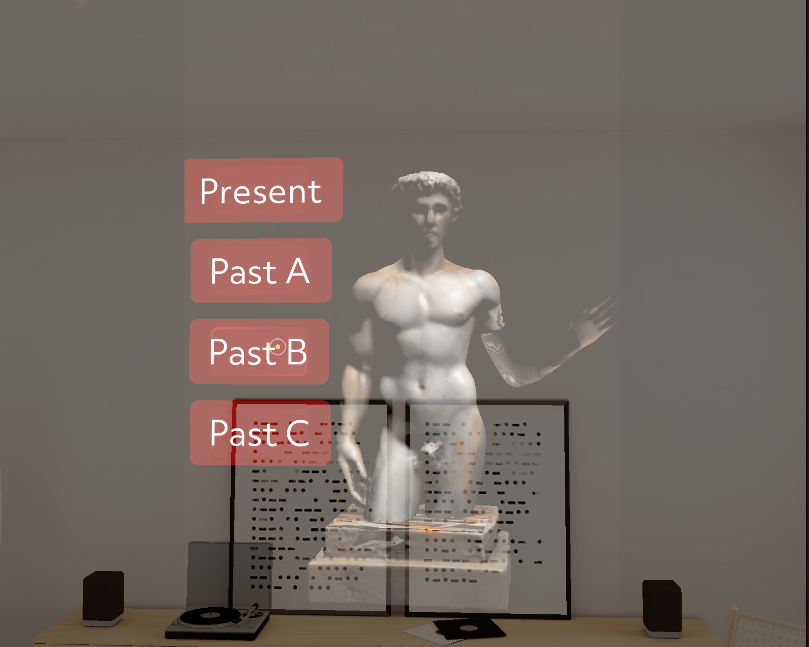
In an XR environment, users can interact with, compare, and evaluate different restoration hypotheses. By switching between multiple possible pasts, they can experience how different interpretations shape the meaning of space and history.
Restoration is no longer a fixed answer, but an evolving and collective process. By lowering barriers to participation and enabling user contribution, this approach transforms preservation into something more accessible, scalable, and participatory.
What it does
Around the world, countless cultural heritage sites and artifacts are disappearing at an alarming rate, fading not only physically but also from collective memory. Traditional preservation methods, led by professionals, are often costly, time consuming,limited and it is impossible to document and preserve every site before it is lost. This project is inspired by the need to democratize preservation. Rather than relying solely on experts, we envision an archival platform where individuals around the world can document places, objects, and histories that matter to them, and explore how they may have once existed. By leveraging accessible and low-cost technologies such as generative AI and AR, we aim to lower the barriers to participation and empower communities to actively engage in preserving their own cultural narratives. Fragments of recorded artifacts are reconstructed through architectural analysis, while generative AI is used to predict and reimagine how they may have once appeared. These reconstructions are not presented as definitive truths, but as informed interpretations, allowing users to visualize possible past conditions.
These generated restorations are shared, compared, and collectively refined. Through AR, they are overlaid onto the present environment, enabling users to switch between multiple interpretations and experience how different reconstructions shape the meaning of space. As users contribute, modify, and share their own interpretations, the archive evolves into a dynamic, collectively refined repository of memory.
Challenges we ran into
The major challenge we faced was working on an entirely new platform, Lens Studio. While it bears some resemblance to other game engines, it has its own quirks and limitations. In particular, we spent a significant amount of time trying to establish a stable connection to the device. Even when following the documented steps, it was often difficult to get the content to properly sync and display. In addition, creating interactive elements within Lens Studio such as click based interactions and user triggered events proved to be more complex than expected. Designing responsive and intuitive interactions required a deeper understanding of the platform’s workflow and scripting system, which we had to quickly learn during the hackathon.
Accomplishments that we're proud of
We explored new tools such as Meshroom and PCA to generate 3D data from photographs and experimented with hypothesis driven restoration, successfully translating these processes into actual 3D models. We were also all eager to learn new technologies and development environments, which allowed us to make more interactive projects using XR.
Accomplishments that we're proud of
We explored new tools such as Meshroom and PCA to generate 3D data from photographs and experimented with hypothesis driven restoration, successfully translating these processes into actual 3D models.We were also all eager to learn new technologies and development environments, which allowed us to make more interactive projects using XR.
What we learned
We learned so much from this Hackathon about the process of making an entire XR application from frontend to backend.
What's next for IamNOTia: From Ruin to Memory
When exploring restored artifacts and personal inventories, the experience can be enhanced by situating them within contextually appropriate environments that reflect their historical and cultural background. In addition, future developments may include interactive features such as the ability to zoom into restored artifacts, allowing users to closely examine details and engage more deeply with the reconstruction.
Built With
- blender
- javascript
- lensstudio

Log in or sign up for Devpost to join the conversation.