-
-
Hackathon 2025: IAM Policy Guard
Inspiration
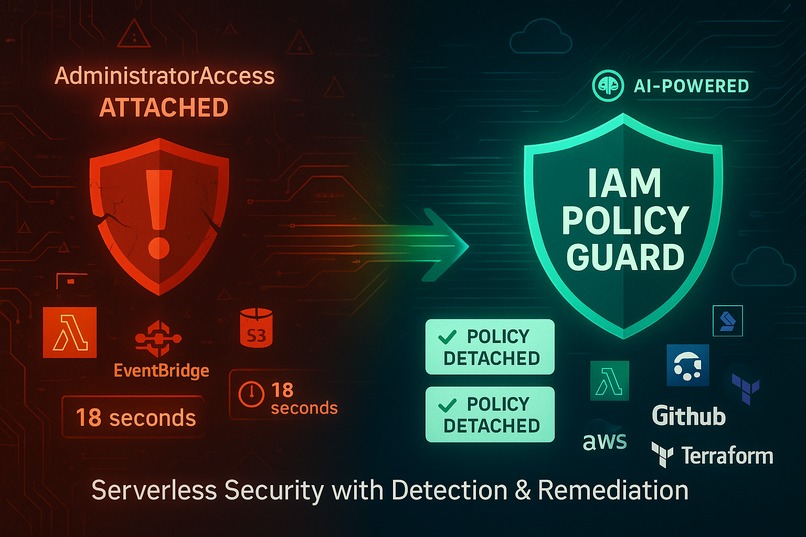
Modern AWS environments quickly grow crowded with IAM users, roles, and policies. A single accidental attachment of AdministratorAccess can expose your organization to massive risk—often discovered only after an audit or, worse, a breach.
We wanted a self-healing security layer that:
- Detects dangerous IAM changes in real-time
- Instantly rolls them back if needed
- Explains what happened in plain language
- Runs for (almost) free, with no servers to manage
Using just Lambda, EventBridge, and S3, we built IAM Policy Monitor—a lightweight but powerful guardrail for AWS IAM.
What it does
- Real-time detection – CloudTrail events stream into a Detector Lambda that evaluates every IAM API call against YAML-defined rules.
- AI triage – For medium-severity changes, the Detector queries Claude 3 Sonnet via Amazon Bedrock to explain the potential risk.
- Automated rollback – High and critical violations go straight to an SQS queue, where a Remediator Lambda detaches or deletes the offending policy—usually within seconds.
- Audit + analytics – Every event is written to versioned S3 buckets, partitioned for low-cost querying in Athena.
- Alerting + dashboards – Slack/SNS alerts plus a CloudWatch dashboard give real-time visibility into IAM trends.
All of this deploys with a single terraform apply and runs entirely within the AWS free tier.
How we built it
- Runtime – Python 3.13 Lambdas packaged as a reproducible ZIP, built with Bash.
- Infrastructure – Terraform module (~2 KLOC), with optional submodules for Bedrock, Athena, dashboards, and CodeBuild tests.
- Rules engine – YAML-as-code evaluated with glob matching; no heavyweight policy-as-code tools.
- Safety net – A
remediator-config.jsonfile lets teams exclude critical users or policies. - CI/CD – GitHub Actions runs lint/tests and builds; CodeBuild runs live sandbox tests.
Challenges we ran into
- Cold starts – Bedrock SDK bloated the ZIP. We trimmed dependencies and lazy-loaded the client to keep p95 < 600 ms.
- IAM eventual consistency – DetachPolicy took up to 2 mins to reflect in ListAttached* calls. We added retries with backoff.
- Overbroad protection – Our early blocklist prevented remediation of
AdministratorAccess. We refined it and added S3-based overrides.
Accomplishments that we're proud of
- Secure by default: 0 publicly exposed endpoints and strict least-privilege permissions.
- Average time from detection to remediation: 18 seconds.
- Entire solution—Terraform, Lambda, tests, docs—fits in < 5 MB.
What we learned
- A simple rules engine beats complex frameworks when scoped well.
- Bedrock is worth the latency/cost for ambiguous cases.
- Terraform's
filemd5()trick enables hot-reload of config files without redeploy.
What's next for IAM Policy Monitor
- Multi-account support – One deploy, org-wide impact via EventBridge Pipes.
- Custom remediators – Teams can plug in their own logic, e.g., to update SCPs.
- Vault-style approvals – Slack buttons for "Fix / Ignore / Justify" workflows.
- OpenTelemetry – Trace flows into X-Ray for observability.
Built With
- amazon-web-services
- athena
- bedrock
- cloudwatch
- codebuild
- eventbridge
- githubactions
- lambda
- parameterstore
- python
- s3
- slack
- sns
- sqs

Log in or sign up for Devpost to join the conversation.