-
-
Interactive Prototype, Must Try
-
Surface Your Self-Becoming
-
New Senses, iAM Unlocks
-
You Identity, Your Choice
Inspiration
We started with a single question from psychology: why do people consistently underestimate how much they've changed? The answer is Habituation. Just as you stop smelling the scent of your own home after a few days, you stop noticing your own identity shifting. The 1% daily drift in how you see a "career," a "relationship," or a "home" is too gradual to flag as new information. Accumulate a decade of that, and you don't recognize your own values.
Fitness trackers measure the body. Mood apps capture moments. Nothing tracks the slow mutation of the self across years. We wanted to build iAM that closes that gap, not to judge who you've become, but to make it chosen rather than something that just happened to you while you were busy.
What it does
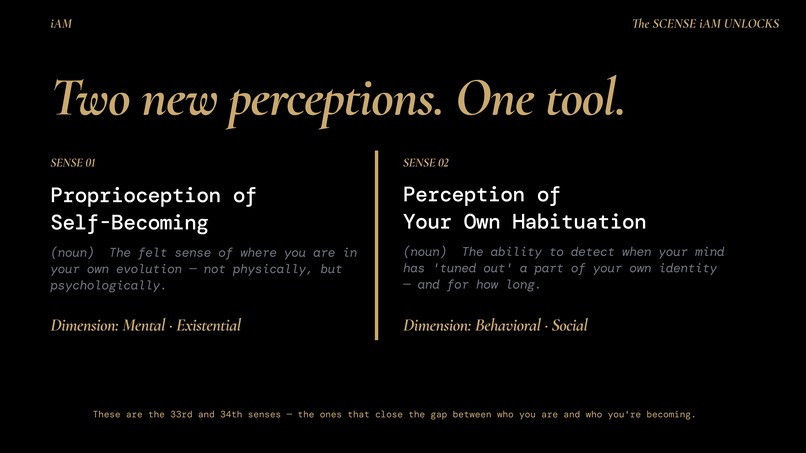
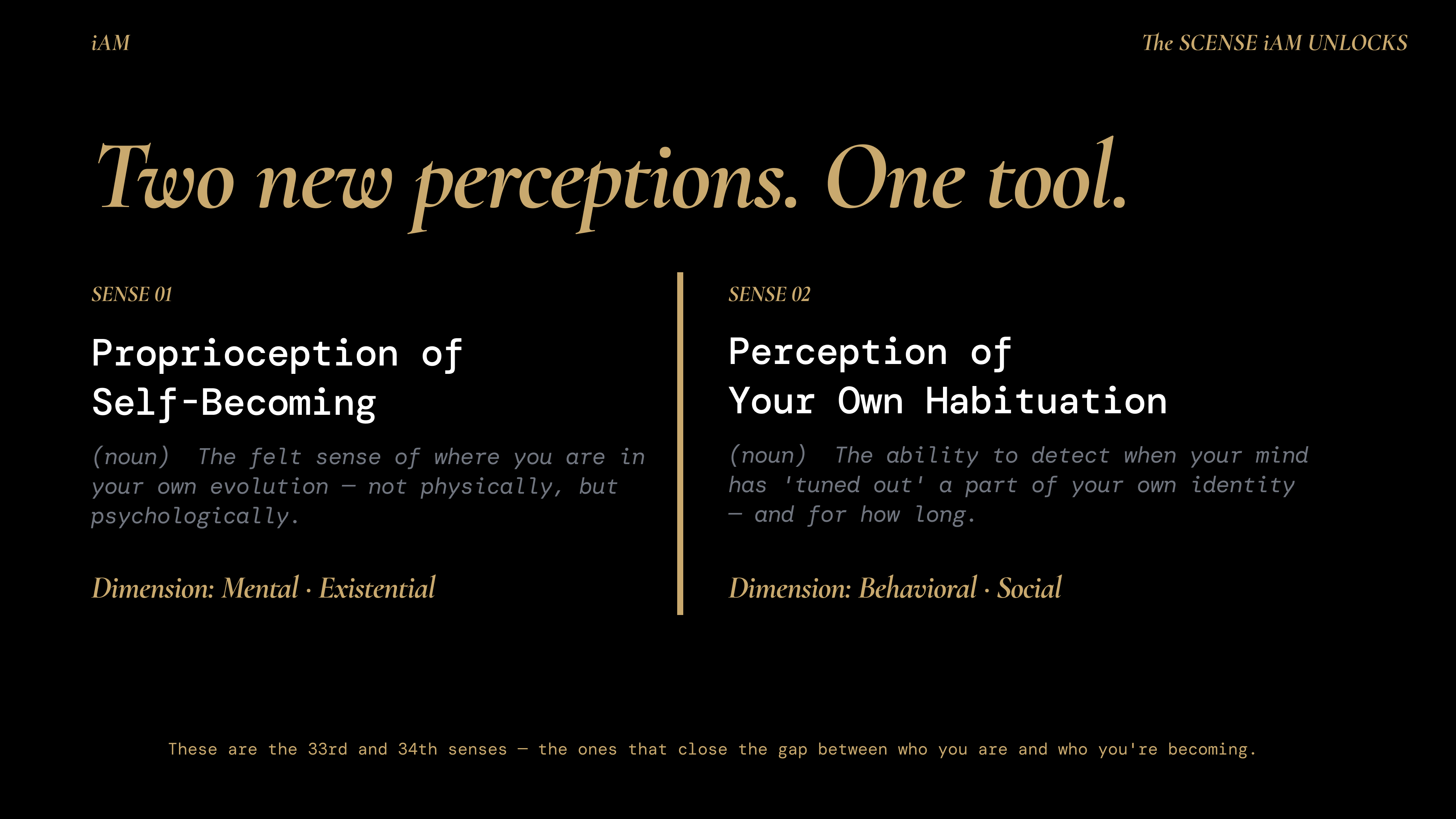
iAM is a speculative smart glasses interface that unlocks two senses humans have never had access to:
- Proprioception of Self-Becoming — a felt sense of where you are in your own psychological evolution across time.
- Perception of Your Own Habituation — the ability to alert and detect when your mind has tuned out a domain of your identity.
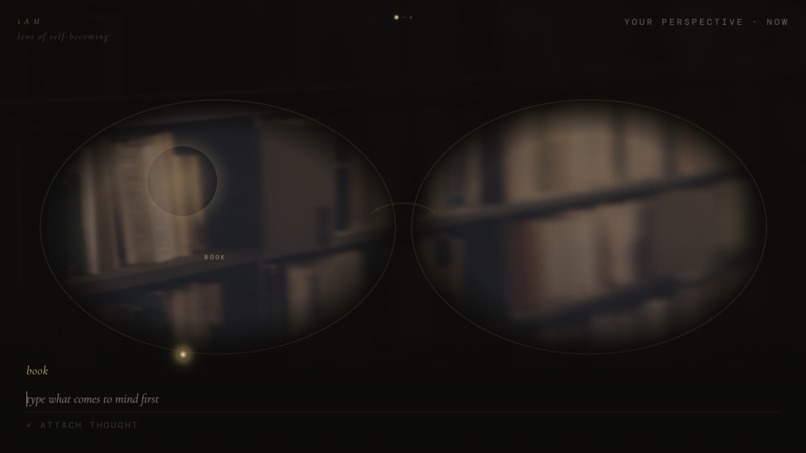
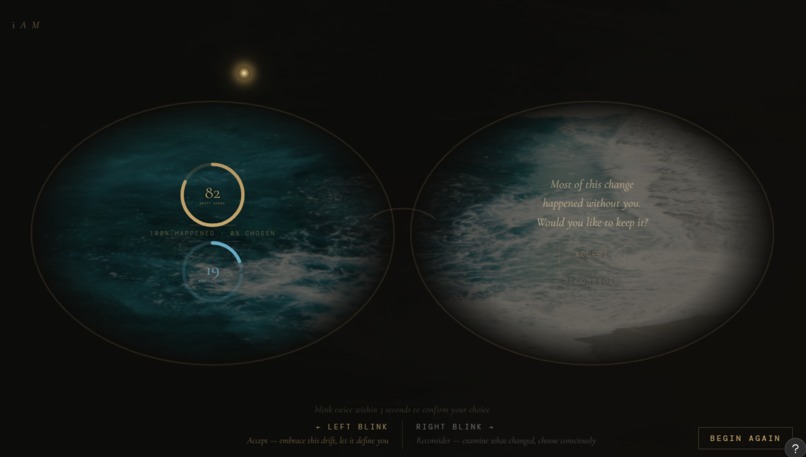
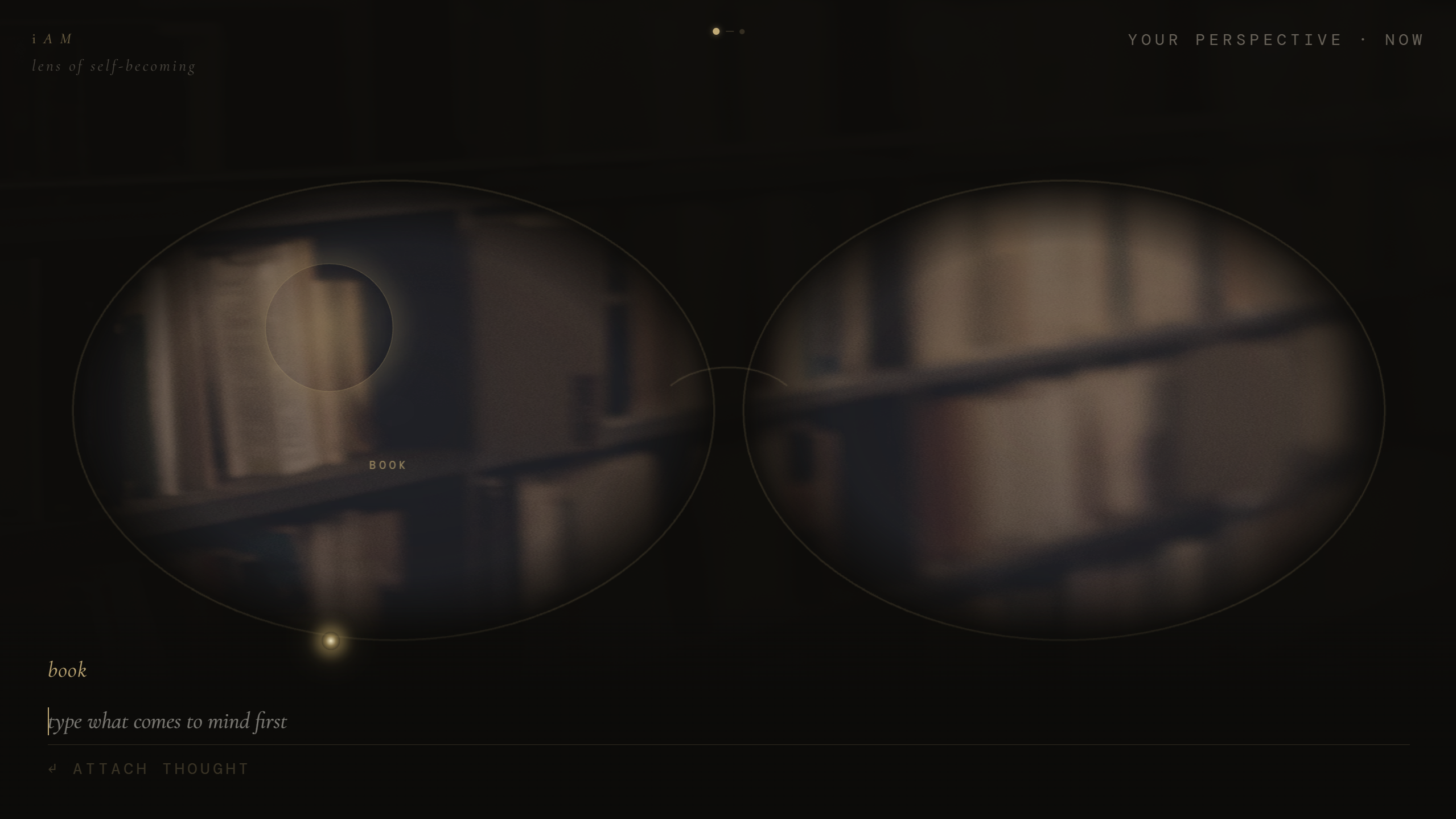
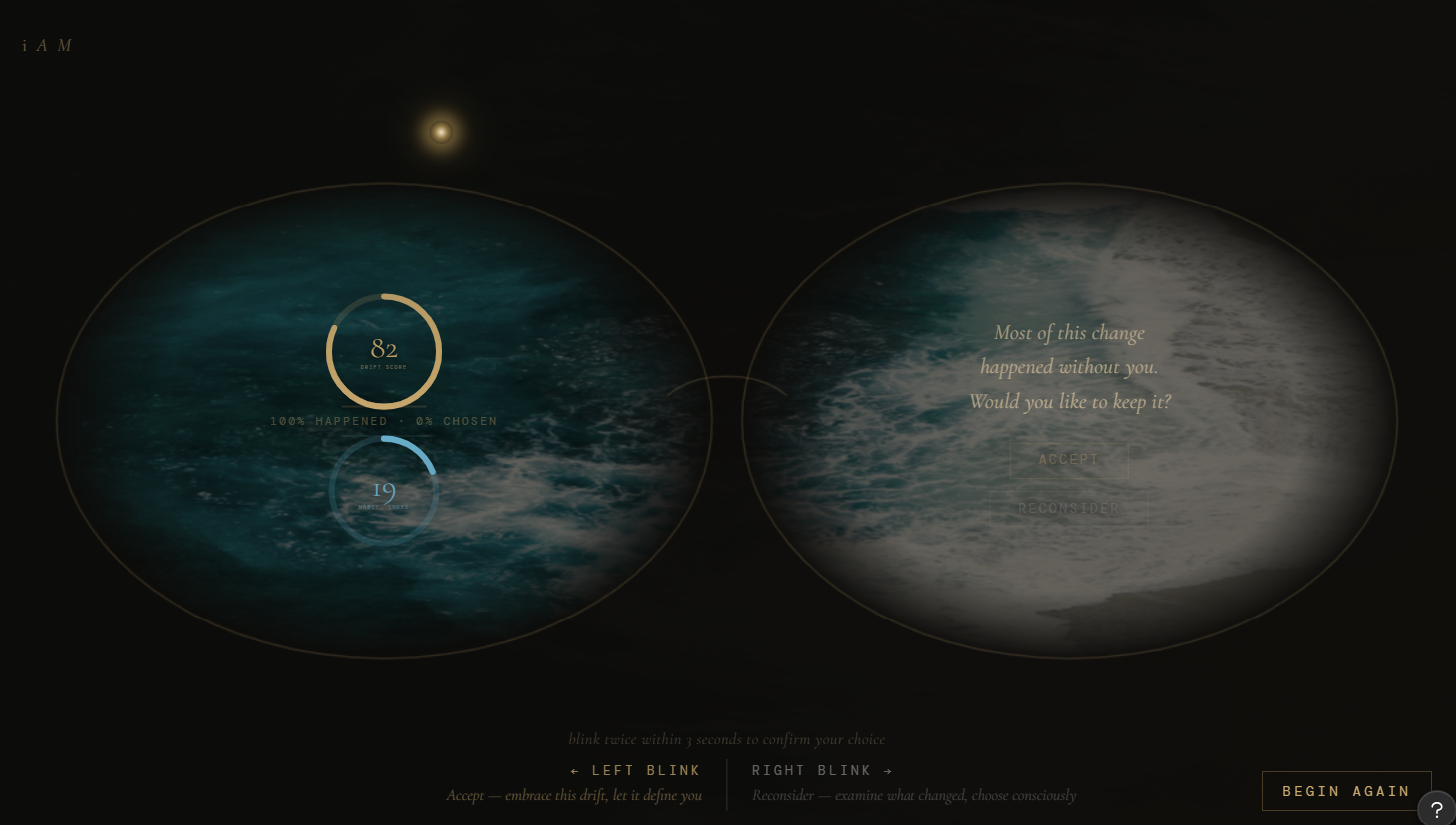
iAM Lens made your associative thoughts surface as word labels on real world entities you see every day. You assign emotional weight and flag agency: chosen or happened to you. The dashboard surfaces two metrics: your Drift Score (how far your identity has moved) and a Habituation Index (how much perception overlap you still share with your past self). Agency split — 62% chosen, 38% happened — is the number that actually changes behavior.
How we built it
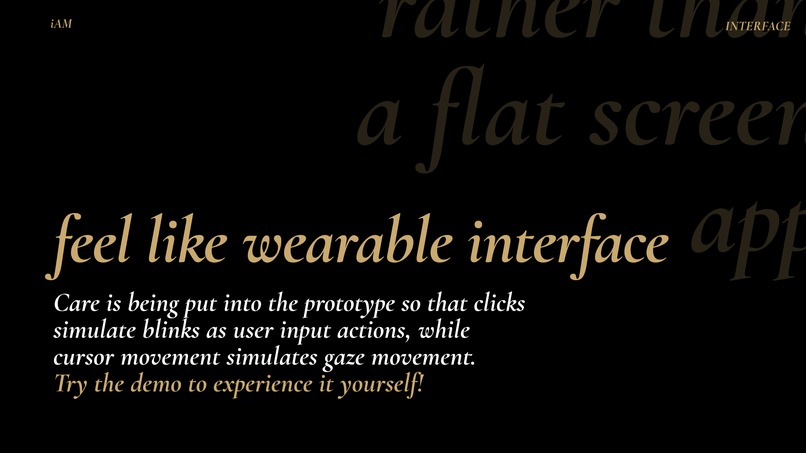
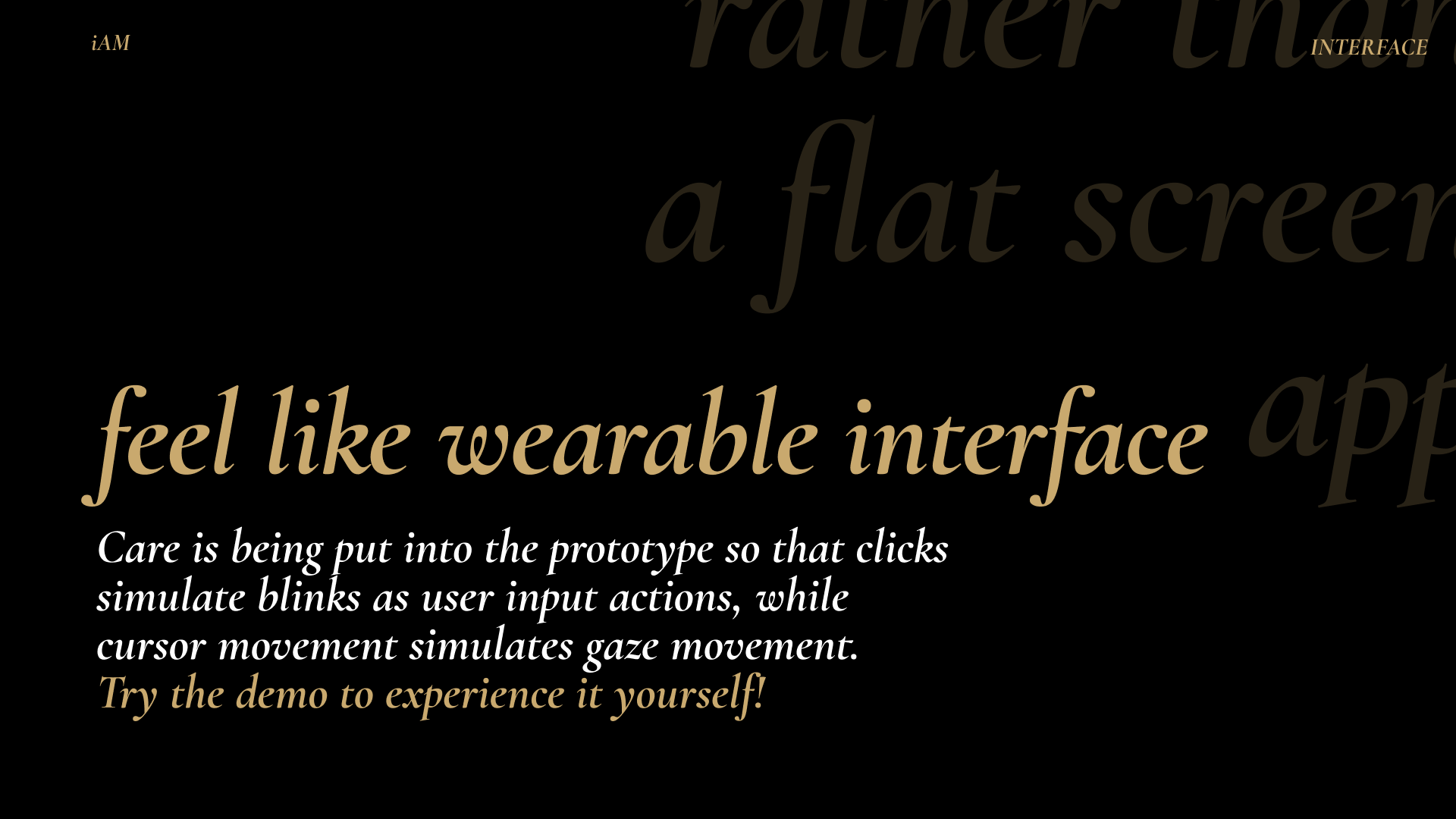
The prototype is built in Figma with a fully interactive flow simulating the lens experience — object detection, word labeling, comparison across time, and the Signature visualization. The typing animations, eye-close transitions, and HUD overlays are all prototyped to feel like a real wearable interface rather than a flat screen app.
The conceptual layer draws on word embedding theory — each label would map to a coordinate in high-dimensional semantic space, with cosine distance between Time A and Time B vectors producing the Drift Score:
$$\text{similarity} = \cos(\theta) = \frac{\mathbf{A} \cdot \mathbf{B}}{|\mathbf{A}| |\mathbf{B}|}$$
The Habituation Index would compare label similarity across repeated sessions on the same object. In the prototype, these are simulated with curated data to demonstrate the concept end-to-end.
Challenges we ran into
- Designing for absence. A smart glasses interface lives or dies by restraint. Every instinct in UI design pushes toward showing more, and we had to fight that constantly. The rule we kept coming back to: if you'd notice the interface more than the insight, it's too much.
- The agency toggle. The single most contested design decision was the Chosen vs. Happened to You binary. It felt reductive. We kept it because the friction is the point being forced to answer that question is the intervention.
What we learned
That the most powerful design interventions are not features — they are questions forced at the right moment. The entire iAM system exists to create one interaction: a person looking at their own word clouds across time and deciding, consciously, whether they want to keep what they've become.
We also learned that Habituation Theory is an underused lens in wellness design. Most tools treat the self as static and measure deviations from it. iAM treats the self as a moving target and asks who's steering.
What's next for iAM
- Real word embedding pipeline. Connect actual NLP models so Drift Score and Habituation Index are computed from genuine semantic vectors, not simulated data.
- Parental empathy mode. A shared-session feature where a parent's archived childhood data is overlaid against their child's current labels on the same object, making generational projection visible and breakable.
Built With
- figma
- react


Log in or sign up for Devpost to join the conversation.