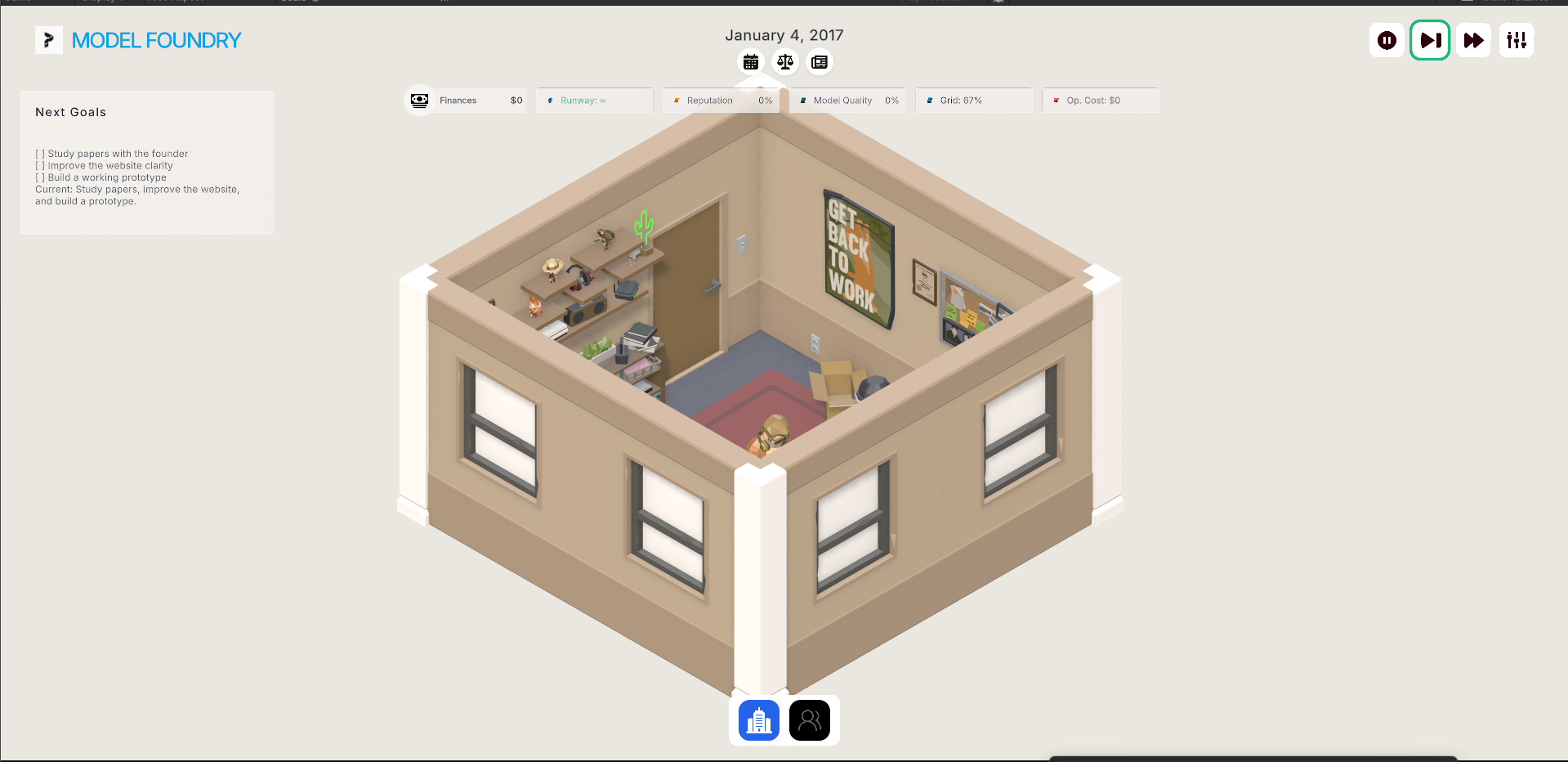
The game is still in development, but I work on it whenever possible.
The entire storyline, progression system, and the way the AI market works in the real world were developed with the help of GPT. It generated the .md documentation files for me and has been one of the main tools helping me build this project.
Inspiration
I have always been a fan of Tycoon games and have spent a lot of time playing games in this genre. I believe this project could offer a unique and entertaining experience: building your own AI company, similar to OpenAI, while facing challenges involving personal learning, individual and team development, technology, strategic decision-making, and, of course, resource management.
The ultimate goal is to compete against real-world-inspired AI companies and, eventually, other players. Players may collaborate by sharing trained models and helping one another, or compete through intense rivalry.
Throughout the game, you experience the AI industry evolving in real time: garages turn into advanced research laboratories, model launches go viral on social media, GPU shortages affect the market, investment rounds reshape your company, and boards of directors put increasing pressure on founders.
You train models, choose your data sources, spend large amounts of money on compute infrastructure, and watch your success—or failure—depend heavily on your company’s reputation and strategic decisions.
What It Does
AI Tycoon is a 3D management simulation game where you found an AI startup in a garage around 2017 and attempt to scale it into a world-class AI laboratory.
You can train different types of models, including Vision, NLP, and Agentic AI; decide whether to scrape data or pay for licensed datasets; hire specialists; upgrade your GPUs; expand your office; and watch employees move around and work at desks that physically exist within the game world.
Outside the office, the world continues to evolve:
- TechPulse, a social media platform inspired by X, reacts to your model launches, periods of inactivity, company decisions, and rival drama.
- Commercial contracts come with deadlines, quality requirements, rewards, and penalties.
- Global events, such as GPU shortages, new regulations, and AI hype waves, affect the entire industry.
- Later in the game, you must manage Series A, B, and C funding rounds, IPO pressure, board objectives, and even opportunities to acquire smaller competitors.
Cash, burn rate, runway, reputation, model quality, followers, and board trust constantly pull the company in different directions.
Release a weak model, and the public may criticize you. Hire too aggressively, and your runway may collapse. Ignore the board for too long, and you may be removed from your own company.
How We Built It
The game is being developed in Unity 6 using C# and URP, with Windows as the initial target platform.
Core systems include:
GameManagerandTimeControllersystems for managing company data and day, week, and month progression.- Simulation systems for projects, employees, office tiers, energy and heat management through the NOC, contracts, research, and investments.
- A TechPulse social feed featuring competitor posts, organic mentions, industry discussions, and reactions to model launches.
- A uGUI-based HUD with resource bars, glass-style interface panels, analytics charts, and a local JSON save/load system.
- A low-poly isometric office diorama that physically expands as the player unlocks the Corporate Suite, R&D Lab, Datacenter, and Board Room.
Challenges We Ran Into
The biggest challenge affecting development right now is time, of course—haha.
I also feel that AI is not yet very effective at fully understanding animation systems and complex spatial behavior. I use MCP inside Unity, which gives ChatGPT access to the project, but I still notice difficulties when implementing animations and more detailed gameplay logic.
For example, a request such as:
“Create a collision and pathfinding system where the character understands that it cannot climb over furniture and must navigate around obstacle X to reach destination Y.”
can still be difficult for the AI to implement correctly without significant guidance, testing, and iteration.
The project is also very large in scope, with many interconnected systems and a huge number of details that still need to be developed and refined.
I started working on it less than a month ago.
Accomplishments That We’re Proud Of
More than anything, I am incredibly grateful to OpenAI and other AI providers for giving people access to tools that allow us to create software, games, and many other projects that we may once have believed were impossible.
For example, I had always wanted to create a game, but I was never able to make it happen before. These tools finally gave me the opportunity to turn that idea into something real.
I am also working on another personal project that is still secret. I work on it every day and have already made enormous progress. For that project, I use Codex almost exclusively. It has consistently helped me throughout development, and I trust it completely.
I used GPT-5.3-Codex extensively, and GPT has essentially become my daily development partner across these projects. I have never seen my GitHub contribution graph so green.
Even more importantly, my other project is already helping other people—and all of this became possible because of the tools created by OpenAI.
Once again, thank you for building such a powerful product and for genuinely listening to your users.

Log in or sign up for Devpost to join the conversation.