-
-
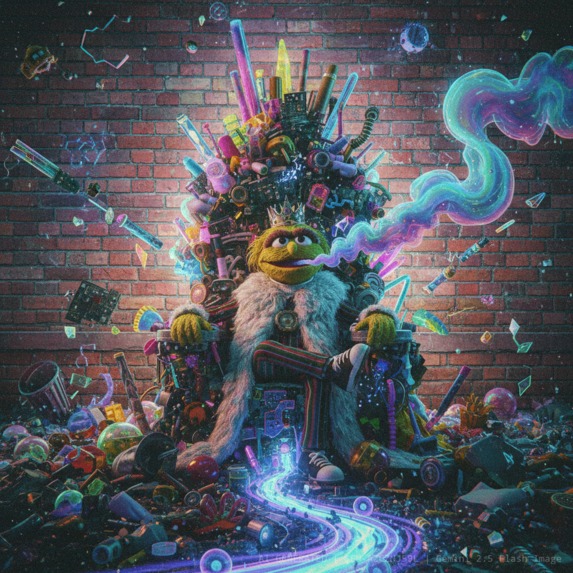
[Generate] creacion neural desde prompt
-

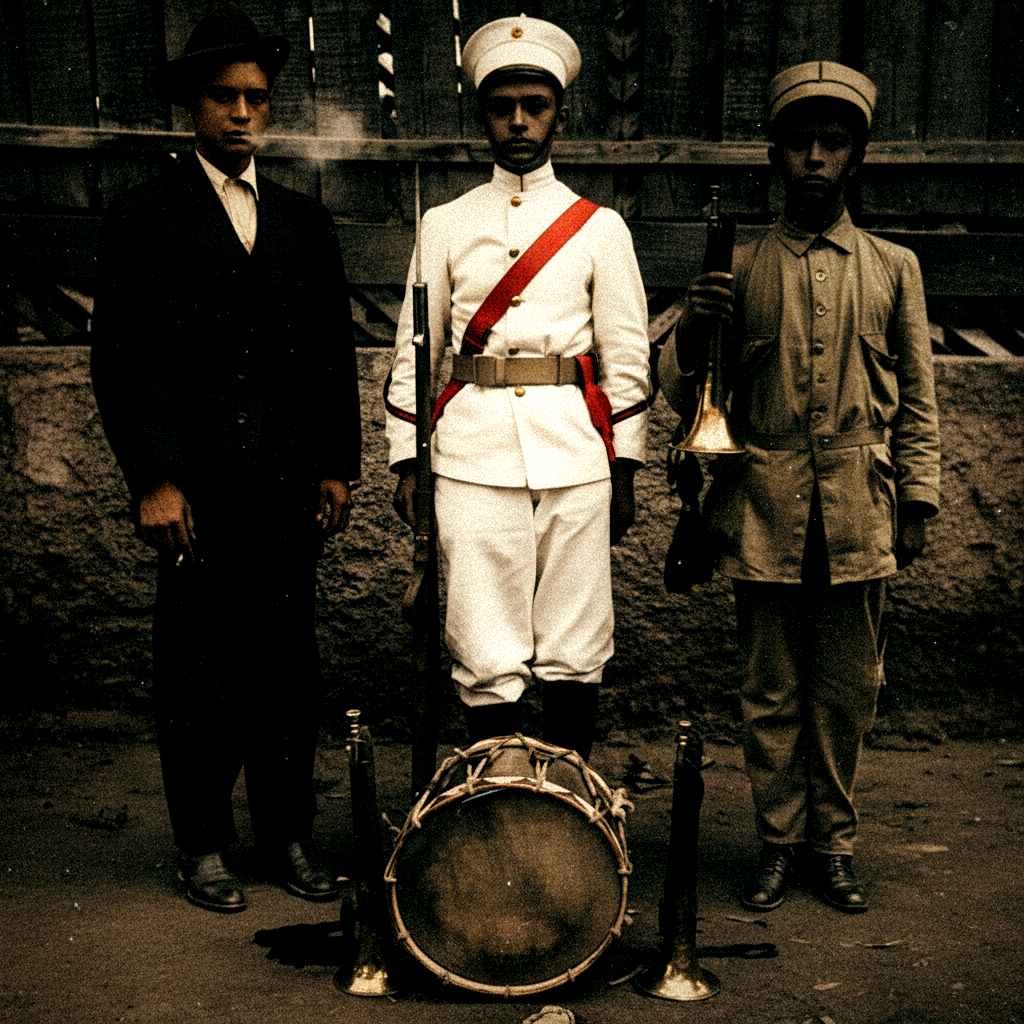
fotografia capturada con la cámara frontal de 5 Megapíxeles de un dispositivo móvil Motorola Moto G5, sistema operativo Android 8.1 (
-

[evolution Mode]este la generación actual del ciclo, aplicando una nueva ronda de micro-mutaciones sobre la nueva base
-

[evolution Mode]este bucle iterativo continúa hasta el resultado final de ultra-alta fidelidad.
-

[Generate] creacion neural desde prompt
-
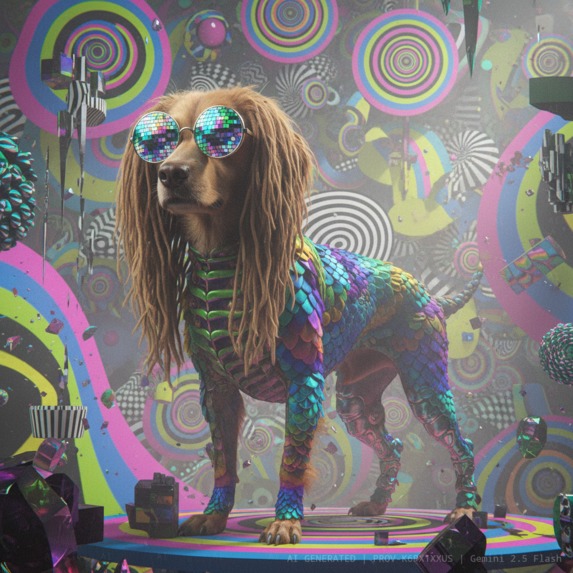
[Generate] creacion neural
-

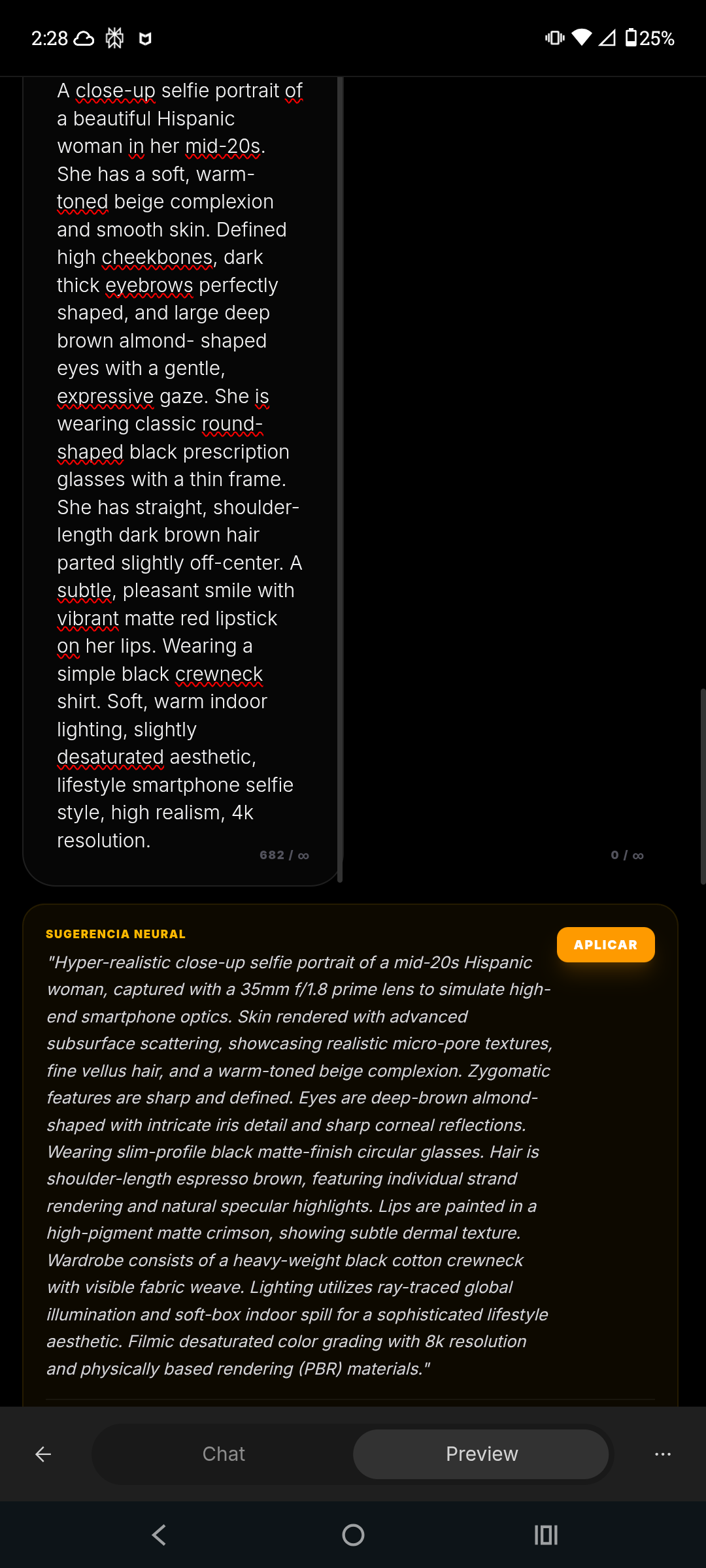
prompt original y de sugerencia neural mode
-

imagen generada con el prompt de sugerencia neural mode
-

[evolution Mode]
-

[evolution Mode]
-

[Generate] creacion neural
-

[Generate] creacion neural
-

[Generate]
-

-

Después Restauración de fotografía





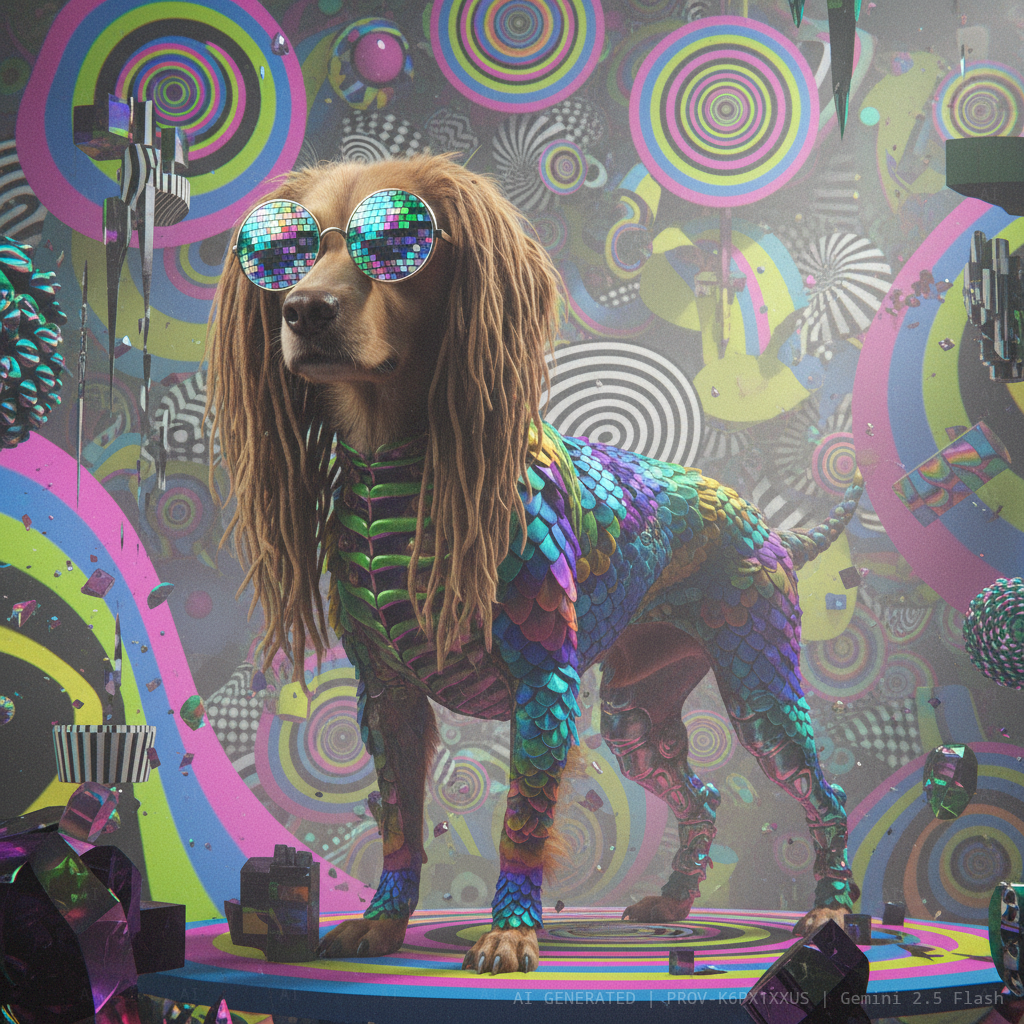







Syntergic Master Control: IA Studio A+B
Inspiration
The inspiration behind Syntergic Master Control: IA Studio A+B is born from the intersection of cinematic photography direction for high-level fashion campaigns (such as Vogue or Dazed) and the retro-futuristic aesthetic of tactical command centers.
We sought to transcend traditional image generators that usually offer flat or predictable results. We wanted to create a true "visual intelligence cockpit" for creative directors: a platform that not only generated images, but iteratively refined them through a multi-judge evaluation pipeline, policy learning and prompt evolution — emulating the way a real director of photography reviews, critiques and reframes until obtaining the perfect frame.
What It Does
Syntergic Master Control acts as an artificial intelligence visual synthesizer with a multi-stage autonomous refinement pipeline. Its main functions include:
Pulse Generator & Optimizer
Unified synthesis interface that fires a complete cycle of generation, evaluation and prompt evolution. Each "pulse" is not a single API call — it is an iterative pipeline that generates variants, evaluates them in parallel and selects the best one before returning the result.
Pre-Execution Intuition Engine
Before spending a single token, the system consults its memory of previous executions to estimate the expected quality and cost of the operation. If the predicted ROI is too low, the system recommends refining the prompt instead of executing. This avoids quota waste and guides the user toward more effective prompts.
C-ROI Evaluation Protocol — 4 Parallel Judges
The heart of the system is a multimodal evaluator that launches four simultaneous judges on each generated result:
$$\lambda = 0.35 \cdot r_{\text{relevance}} + 0.25 \cdot c_{\text{coherence}} + 0.25 \cdot q_{\text{quality}} + 0.15 \cdot s_{\text{strict}}$$
Each judge is an independent call to Gemini with specific criteria. The resulting $\lambda$ score guides the decision to continue iterating or accept the result.
Prompt Evolution Pipeline
When the $\lambda$ score does not reach the acceptable threshold, the system does not repeat the same prompt — it evolves it. It applies logic inspired by genetic algorithms: it preserves the best candidate, generates mutated variants and combines fragments from the most successful prompts through crossover, producing a new generation of more refined inputs.
Cross-Session Policy Learning
The PolicyLearner records which strategies (number of variants, number of judges, execution mode) produce better rewards over time:
$$\text{Reward} = \lambda - 0.05 \cdot \text{API_cost}$$
With sufficient history, the system automatically adapts its execution strategy to the user's patterns.
Real-Time Diagnostic Console
A reactive terminal that exposes each stage of the pipeline: pre-execution predictions, per-judge scores, active decision mode (fast, focused, conserve) and current generation of the evolutionary cycle.
How We Built It
Technology Stack
| Layer | Technology |
|---|---|
| Frontend | React 18 + TypeScript (modular) |
| Build | Vite |
| Styles | Tailwind CSS |
| Animations | Framer Motion |
| Backend | Node.js + Express |
| Real-Time | WebSockets (ws) |
| AI Core | Google Gemini SDK (official) |
Immersive User Interface
Developed with React 18 and Vite. Styled with Tailwind CSS to create a high visual-density panel with amber and chrome accents. Framer Motion gives the panel fluid micro-interactions and a pulsing animation loop during the processing phase.
Full-Stack Architecture with WebSockets
The Node.js + Express backend orchestrates all heavy operations: Gemini calls, parallel evaluation pipeline and collaborative state management. Real-time communication between client and server occurs via WebSockets, which allows the frontend to receive progressive updates from each pipeline stage without blocking the UI.
Real-Time Multi-User Collaboration
The server manages rooms with shared state: up to 50 simultaneous users per room, cursor synchronization, comments anchored on the image and automatic cleanup of inactive rooms. The entire room state — filters, grading, active prompt, result image — is synchronized in real time between all participants.
Robustness & Quota Management
The retryManager implements exponential backoff with jitter to handle 429 API errors without saturating the queues:
$$t_{\text{retry}}(n) = t_0 \cdot 2^n + \mathcal{U}(0,\, 500\text{ms})$$
Idempotency is guaranteed with AbortController: if the same user fires a second operation before the first one finishes, the previous one is cancelled cleanly.
Challenges We Ran Into
Parallel Evaluation Without Saturating Quotas
Launching four judges in parallel for each generation multiplies API consumption. We designed the MetaDecisionEngine to dynamically choose between three modes — fast (single agent), focused (standard configuration) and conserve (early stopping if $\lambda > 0.8$) — balancing quality and cost adaptively.
Iterative Pipeline Coherence
Getting the prompt evolution between generations to maintain the user's original intention — without drifting toward generic outputs — required carefully calibrating when to mutate, when to do crossover and when to preserve the elite prompt without modifications.
Real-Time Base64 Image Transmission
Handling base64-encoded images through WebSockets without saturating Node.js buffers or blocking the main thread demanded careful management of data flow and React state rendering.
Accomplishments We're Proud Of
Real Autonomous Refinement Pipeline: The system is not a decorative wrapper over an image API. It is a closed loop of generation → multi-judge evaluation → prompt evolution → policy relearning that operates autonomously until reaching a quality threshold.
Functional Multi-User Collaboration: Multiple creatives can share the same session, see their teammates' cursors in real time and comment directly on the generated image — all synchronized via WebSocket from day one.
Production-Ready Resilient Architecture: Clean compilation with strict TypeScript, layered error handling, differentiated timeouts and automatic resource cleanup.
What We Learned
Iterative refinement outperforms single-shot generation. A prompt evolved three generations with feedback from specialized judges consistently produces better results than the best initial prompt, even when that initial prompt is already technical and detailed.
Pre-execution prediction changes user behavior. When the system warns that a prompt has low expected ROI before executing, users tend to reformulate it instead of firing and waiting — which improves the average quality of results and reduces quota waste.
Defensive asynchronicity is indispensable. Long pipelines with multiple parallel calls to external APIs require redundant layers of error handling, per-operation timeouts and progressive state communication — not as an improvement, but as a minimum usability requirement.
What's Next for IA Studio A+B Master Control
Specialized Cinematic Optics Evaluators
Incorporating judges trained on specific photography criteria — rule-of-thirds composition, bokeh quality, lighting direction coherence — so that the $\lambda$ score reflects real professional aesthetic criteria, not just general semantic coherence.
PolicyLearner Persistence Across Sessions
Currently the policy learning is lost when closing the server. Persisting the policy history per user would allow the system to progressively adapt to each creative director's working style over time.
Cinematic Video Generation Pipeline
Expanding the A+B core to apply the same iterative refinement cycle not only to still images, but to sequences with temporal consistency — interpolating motion vectors between frames with visual coherence guaranteed by the specialized judges.
Vintage Lens & Optics Customization
Allowing the user to select real lens profiles — anamorphic Kowa Prominar, Lomo, Cooke S4 — and inject their optical characteristics (chromatic aberration, barrel distortion, bokeh rendering) as concrete parameters into the pipeline's master prompts.


Log in or sign up for Devpost to join the conversation.